
Table of Contents
Table of Contents
- If Your Business Needs Superheroes, It's Not Innovative
- The Real Scaling Risk at $10M+: Tribal Knowledge + Turnover + Uneven Leadership
- Tribal knowledge
- Turnover
- Uneven leadership
- The compounding effect
- Warning signs you're operating on heroics, not systems:
- What System-Driven Operations Actually Look Like
- Standard workflows and definitions (the baseline)
- Role-based accountability (who owns what)
- Training embedded in the process (not tribal memory)
- Exception management instead of constant firefighting
- Why Software Is the Mechanism, Not "A Tool People Ignore"
- A Day in the Life: Dispatcher/PM Before vs After Systemization
- Aspire Turns Standards Into Daily Execution
- The Takeaway: Map Your Heroics Into Systems
Your best dispatcher calls in sick. Suddenly, the day falls apart. Jobs get misrouted. Crews wait for direction. Client updates don't happen. By noon, you're in firefighting mode.
If your business needs superheroes to function, you have a fragile operation.
At $10M+, your biggest operational threat isn't competition. It's dependence. When a few people's heads hold critical knowledge, every vacation becomes a risk. Every departure threatens continuity.
The most innovative operators don't rely on high performers to save the day. They build systems that make consistency the default. With scalable systems, operations hold steady through turnover, growth, and leadership changes.
If Your Business Needs Superheroes, It's Not Innovative
The "hero culture" feels like strength until it becomes a bottleneck.
You know the dynamic: a handful of high performers who make everything work. The dispatcher who routes by memory. The branch manager who knows every client's quirks. The supervisor who can solve any problem in the field. They're invaluable until they're unavailable.
The hidden cost of heroics:
Burnout: Your best people carry unsustainable loads
Inconsistency: Service quality depends on who's working that day
Slow onboarding: New hires can't learn what someone else's head locks away
Fragile client experience: When the hero is out, standards slip
Innovation isn't the new tool you bought—it's whether the business runs when the hero is out sick.
At $10M+, innovation means resilience: the operation holds steady through turnover, growth, and leadership changes. If it doesn't, you're not scaling—you're just getting bigger and more fragile. System-driven innovation provides a lasting advantage over businesses that rely on heroics, ensuring your company can outperform competitors and maintain consistent operations.
The Real Scaling Risk at $10M+: Tribal Knowledge + Turnover + Uneven Leadership
The true enemy of enterprise growth isn't competition—it's fragility—and fragility compounds in three predictable ways.
Tribal knowledge
"Only Sam knows how to route this client." "Only Maria can fix that invoicing issue." "Call Dave—he's the only one who understands how we price construction."
When individual people's heads hold critical operational knowledge, you don't have a process. You have a dependency. This limits your organization's capacity to grow and respond to change, making it harder to scale and adapt to new challenges.
Turnover
Frontline churn resets standards and slows execution. When employees leave, it disrupts innovation and continuity, as valuable knowledge and creative problem-solving often depart with them.
A crew lead leaves, taking their understanding of "done" with them. A new hire starts, but there's no clear playbook—just "shadow someone for a few weeks and figure it out."
Uneven leadership
Branch-to-branch variance becomes brand risk and margin variance. Phoenix runs tight. Denver drifts. Dallas is somewhere in between. Your clients notice. Your CFO definitely notices. Uneven leadership creates organizational consequences, such as inconsistent processes and reduced ability to drive innovation across the company.
The compounding effect
Every new crew, every new site, every new branch adds more complexity—and more opportunities for drift. What worked at $10M breaks at $20M. What worked with two branches collapses at five.
Warning signs you're operating on heroics, not systems:
Work quality depends on which supervisor is on duty
New hires take months to become productive
Dispatching is held together with sticky notes, texts, and memory
Teams discover problems late (after hours, after month-end, after renewal complaints)
Failing to address these warning signs can jeopardize your company's growth objectives by allowing unmanaged complexity to hinder scalable and sustainable expansion.
What System-Driven Operations Actually Look Like
System-driven operations don't remove people; they remove the need for the right people to be present. This shift increases the effectiveness of the entire operation by ensuring consistent processes and outcomes, regardless of individual availability.
In practice, systems just look like best practices that you already know, but haven’t gotten around to implementing (and enforcing).
Standard workflows and definitions (the baseline)
Standardize the work language:
Service items, job codes, cost buckets, and "done" definitions that mean the same thing across every branch
Use standardized forms, templates, and checklists to ensure consistency in processes and documentation
Eliminate the guesswork: crews know what's expected, PMs know how to schedule, and finance knows how to code
Standardize the flow:
Request → schedule → execute → verify → report → bill
The same sequence every time, regardless of crew, branch, or client
Why it matters: Consistency across branches, easier onboarding, and less rework. New hires inherit a playbook, not chaos.
Role-based accountability (who owns what)
Clarity by role:
Dispatch/PM/supervisor/crew lead/account manager—everyone knows their lane
Teams define hand-offs, not leave them informal
Dashboards and KPIs map to ownership
When you clarify accountability, problems don't fall through the cracks. When you don't, everything becomes everyone's problem—which means it's no one's problem. Clear roles also enable the team to collaborate more effectively, ensuring strategic alignment and smoother execution of initiatives.
Training embedded in the process (not tribal memory)
The best systems teach people while they work:
Required fields ensure teams capture critical data
Step sequences guide execution
Templates standardize estimating, scope definition, and reporting
Standardizing tasks within workflows supports ongoing training and reduces errors
Training isn't a one-time event—the workflow reinforces it: faster ramp, fewer "guessing" moments, less dependence on who trained them.
Exception management instead of constant firefighting
Innovative operations don't chase every problem—they surface the right ones early.
Define what qualifies as an exception:
Missed time entry
Scope change without approval
QC failure
Overdue corrective action
Schedule slip
Create a weekly rhythm: Exceptions → owners → resolution → trends
Firefighting feels productive. Exception management is what actually scales. This approach gives organizations greater control over operational risks and outcomes.
Why Software Is the Mechanism, Not "A Tool People Ignore"
At enterprise scale, workflows run the business. Automation and technology are essential for scaling innovation, enabling organizations to streamline operations, drive efficiency, and adapt quickly to changing demands.
You can write all the standard operating procedures you want. You can hold training sessions and send memos. But if the software doesn't reinforce the standards, people will revert to what's easiest: memory, shortcuts, and workarounds.
Software operationalizes standards by:
Guiding work steps: The system walks users through the correct sequence—estimating, scheduling, execution, verification
Enforcing consistent data capture: Required fields ensure teams capture the data you need to manage
Making accountability visible: Dashboards show who owns what, what's overdue, and where exceptions pile up
Creating feedback loops: Quality trends, job cost variance, and client experience metrics surface in real time—not at month-end
Enabling automation and data processing: Software services automate workflows by processing input data, orchestrating tasks, and integrating with APIs and cloud resources to deliver more efficient and innovative solutions.
The key distinction: Tools store information. Systems shape behavior.
The real question: does your software reinforce the way you want teams to operate, or does it sit on the side while spreadsheets run the show?
A Day in the Life: Dispatcher/PM Before vs After Systemization
Before: Heroics-based operations
Dispatch relies on memory and "who's good at what."
Teams schedule jobs without consistent scope clarity
Field updates are incomplete; office chases data
Issues emerge late; PM scrambles; client comms are reactive
Leadership sees results after the fact (week/month end)
The day is spent reconstructing reality. Texting crews for updates. Hunting down time entries. Asking "Did anyone document that?" The PM becomes a human search engine, piecing together what happened so leadership can understand it—days or weeks later.
After: System-driven operations
Standard work orders and scope expectations reduce ambiguity
Required data capture happens in-process (less chasing)
Exceptions surface quickly (missed steps, time gaps, QA failures)
PM focuses on decision-making, not scavenger hunts
Reporting becomes routine and renewal-ready
Teams complete tasks efficiently, and processes produce consistent, innovative results.
The day is spent managing, not reconstructing. The PM sees what needs attention, assigns owners, tracks resolution, and moves on. Leadership has visibility in real time.
Less time spent "figuring out what happened." More time spent "improving what happens next."
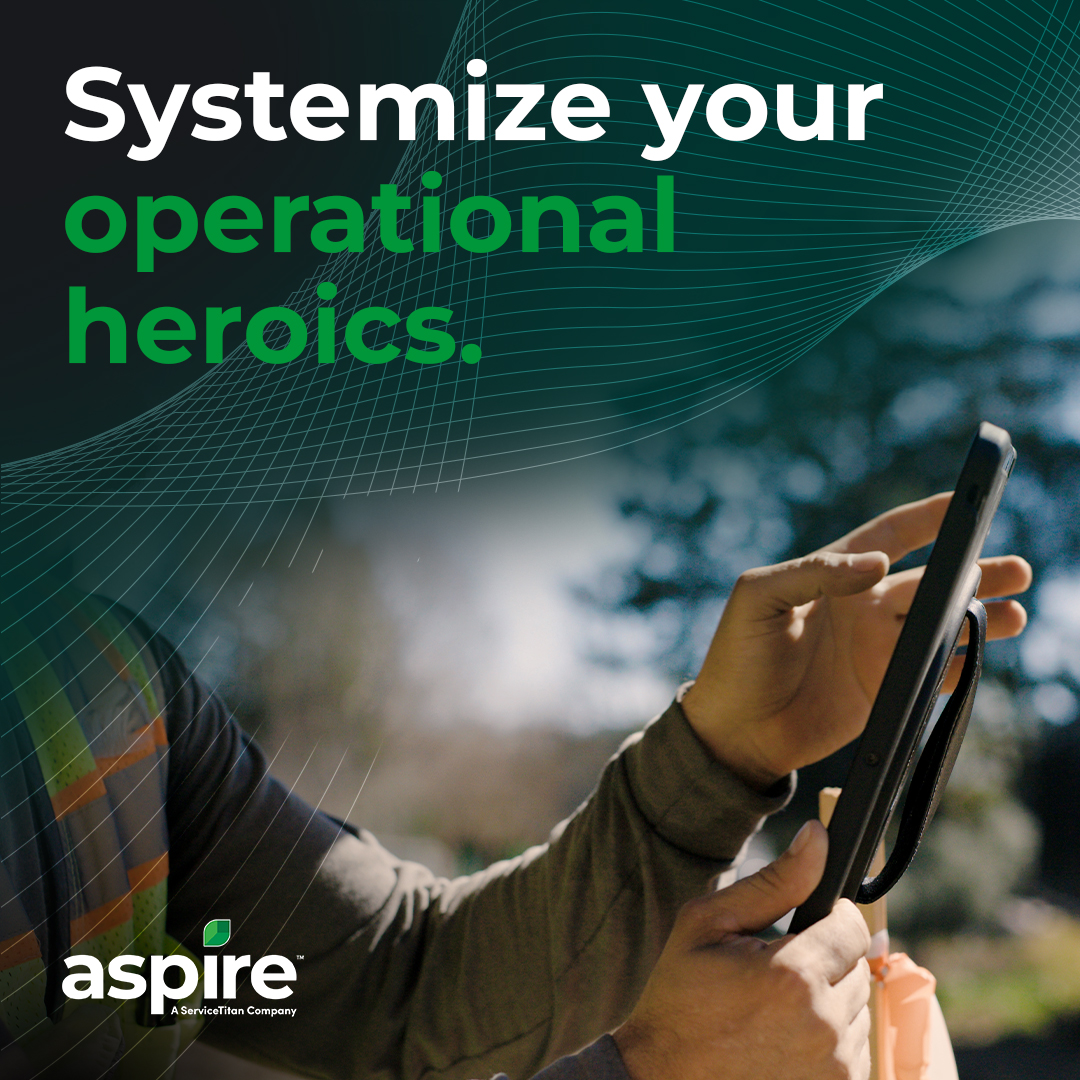
Aspire Turns Standards Into Daily Execution
The daily execution of system-driven operations is shaped by how the platform structures work. By implementing these systems at the organizational level, companies benefit from improved risk management, streamlined processes, and the maintenance of high standards across all teams.
How this shows up in practice:
Standardized workflows that make the "right way" the default way; crews follow defined processes, not individual interpretations
Required data capture to prevent missing time, materials, and progress details. The system enforces completeness, so nothing falls through the cracks.
Role-based dashboards so each leader sees what they own (and what needs attention); dispatchers, PMs, supervisors, and account managers have clarity on their priorities.
Process enforcement that reduces variance across crews and branches; Phoenix runs the same way as Denver, with the same standards and accountability.
Operational visibility that supports exception management, not month-end surprises. Problems surface early, when there's still time to course-correct.
Implementing these workflows enables more effective resource allocation and helps maintain operational consistency as the business scales.
This is what innovation looks like when you build it for operators who need resilience at scale—not tools that sit unused while spreadsheets run the business.
The Takeaway: Map Your Heroics Into Systems
If your best people are the system, you don't have a system. You have a dependency that's costing you margin, slowing your growth, and putting client relationships at risk whenever someone leaves or goes on vacation.
Resilient operations protect margins and client experience during growth and turnover. They make consistency the default, not the exception. They allow you to scale without breaking.
Innovation isn't the newest feature or the latest buzzword. It's building an operation that runs consistently without heroic effort.
Ready to map your heroics into systems?
Request a demo to explore how Aspire helps enterprise landscapers build operations that survive—and thrive through—turnover and growth.
Other blogs in this series:
Quality at Scale: The innovative QC systems that don't break at $10M+
Client Experience Is an Ops System: Proof, Proactive Comms, and Renewal Defense
The Standardization Playbook: Where to standardize—and where to stay flexible








 866-727-7473
 Schedule Demo
 390 S Woods Mill Rd #300 Chesterfield, MO 63017


