
Table of Contents
Table of Contents
- QC = the operating system for brand consistency and retention
- The shift:
- Why this matters now:
- Why QC collapses at scale (the failure modes)
- A) Inconsistent standards
- B) No closed loop
- C) Manual audits don't scale
- D) Quality is measured by complaints
- From "inspect occasionally" to continuous, measurable quality
- What "continuous QC" actually means:
- What enterprise-grade QC does require:
- The enterprise-grade QC system (core framework)
- Component 1: Standard inspections by property type/service line
- Component 2: Defect logging + root cause (not blame)
- Component 3: Corrective action workflow
- Component 4: Trend analysis + proactive coaching
- Innovation You Can Measure: The QC Link to Repeatable Outcomes
- Before/After: What the shift looks like in practice
- Before: Clipboard QC
- After: Digital, closed-loop QC
- What this looks like in Aspire
- Quality systems built for scale
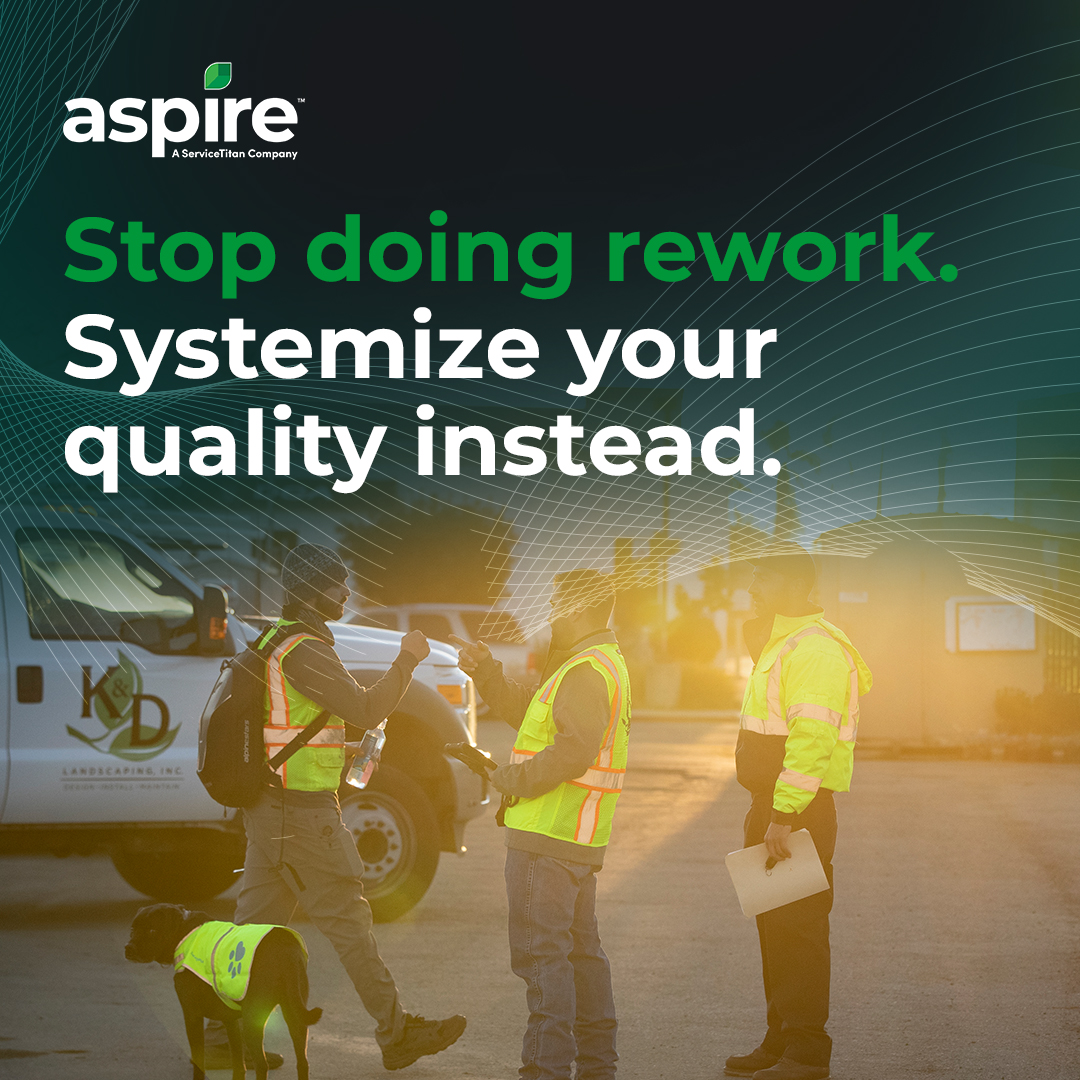
You get the call mid-week: a multi-site client is escalating.
One property looks pristine, another seems neglected. Your best supervisor is out, and suddenly, standards are drifting across the portfolio.
This isn't a crew problem. It's a system problem.
When you’re operating at $10M+, quality inconsistencies aren’t because some teams care and others don't. It’s usually because quality control is challenging to operationalize at that scale.
Companies scaling profitably aren't relying on hero supervisors or periodic inspections. They've built quality systems that deliver consistent outcomes across every crew, every site, every week.
If your QC is still a checklist, it’s time to innovate it into an operating system.
QC = the operating system for brand consistency and retention
The way most landscaping companies think about quality control hasn't kept pace with their growth.
The shift:
Traditional view: QC = periodic inspections to catch problems. A supervisor walks properties when they have time, flags issues, and hopes crews fix them.
Enterprise view: QC = continuous quality management that prevents problems, proves performance, and standardizes delivery. Workflows build quality in; systems track it systematically; operators measure it like any other operational metric; and processes standardize and integrate it into daily operations.
Why this matters now:
Clients demand proof and consistency across every site. Multi-site accounts expect the same standards in Phoenix and Dallas—not variations based on who's assigned.
Multi-branch growth increases variance. What worked with 20 employees and one branch breaks at 100 employees across four branches.
Labor churn makes tribal knowledge brittle. When your best supervisor leaves, their quality standards shouldn't go with them.
Margin pressure makes rework unacceptable. Every callback, every redo, every "go fix that" costs you margin you can't afford to lose.
If you’ve been measuring quality by what your best crew delivers, it’s time to reframe it into what every crew can provide, every week.
Why QC collapses at scale (the failure modes)
Failures in quality aren’t usually because people stop caring, but because the system can't scale alongside growth. Here are the four failure modes that show up when landscaping companies scale past $10M:
A) Inconsistent standards
Each supervisor or branch defines "good" differently
New hires inherit habits, not standards
Property types and services require different expectations, but QC stays generic.
One branch's "acceptable" is another branch's "redo."
B) No closed loop
Teams find issues, but don't track them through resolution
Operators apply corrective action inconsistently or leave it undocumented
The same issues recur because nobody learns at the system level
Problems disappear into text messages and verbal follow-ups
C) Manual audits don't scale
Clipboard inspections, photos living on phones, notes in texts and emails
Data stays unstructured; trends remain invisible
QC becomes sporadic when leaders get busy
You can't analyze what you can't aggregate
D) Quality is measured by complaints
Reactive operations: only fix what the client notices
The "silent churn" problem: clients don't complain until renewal—or they just switch providers
You're managing perception, not performance
From "inspect occasionally" to continuous, measurable quality
The alternative to broken QC isn't more inspections—it's a better system.
What "continuous QC" actually means:
Workflows integrate QC as part of how teams execute work, not as an extra activity
Every inspection produces structured data
Issues flow into a corrective action process
Leadership reviews trends routinely (weekly/monthly)
This doesn't mean inspecting everything every day. That's not realistic, and it's not necessary. Instead, choose the proper method for continuous QC—whether that's scheduled audits, digital checklists, or targeted spot checks—to ensure you consistently monitor and improve quality.
What enterprise-grade QC does require:
You need a system that ensures:
The right sites get inspected at the right cadence. High-visibility properties, high-risk contracts, or sites with recurring issues get more frequent checks. Stable sites get routine audits.
Teams consistently capture issues—same categories, same criteria, same documentation standards—regardless of who's doing the inspection.
Systems track resolution. Problems don't disappear into "I'll handle it." Teams assign them, follow up on them, and verify them.
Trends inform coaching, staffing, and process improvements. You're not just fixing individual problems—you're identifying patterns that point to training gaps, capacity constraints, or workflow issues.
When QC is continuous and measurable, quality becomes manageable—not aspirational.
The enterprise-grade QC system (core framework)
Here's what a scalable QC system actually looks like. Nothing complicated, just a scalable structure.
Component 1: Standard inspections by property type/service line
“One checklist” doesn’t work. An office park isn’t a retail center, isn’t an HOA, and isn’t a healthcare campus.
What this means:
Create inspection templates tied to scope and risk
Define pass/fail criteria with clear definitions (reduce subjectivity)
Tailor expectations to property type and service line
Standards become transferable across branches and new hires. A crew leader in Dallas knows exactly what "acceptable" means—and it matches what a crew leader in Phoenix would expect.
Component 2: Defect logging + root cause (not blame)
Shift the conversation from “who messed up” to “what broke in the process.”
What this means:
Log issues with consistent categories (e.g., turf, beds, litter, irrigation, hardscape, safety)
Capture context: site, service line, crew, date/time, notes/photos if needed
Ask “Why did this happen?” Root cause examples: Use defect and error analysis to drive better system improvements.
Training gap
Unclear scope
Scheduling mismatch
Equipment constraints
Handoff failure
Fewer repeat issues, faster coaching, better predictability. You’re fixing the system, not just the symptom.
Component 3: Corrective action workflow
Problems need to move through a defined process:
Assignment: Who owns the fix?
Due date: When does the resolution need to be completed?
Verification: Did the fix work?
Follow-up: Does the crew need retraining, or does the process need adjustment?
Without this workflow, problems get "handled" but never truly resolved. Crews fix individual instances without addressing root causes. The same issues recur because the system never learned.
Component 4: Trend analysis + proactive coaching
This is where QC shifts from reactive to strategic.
What leaders should see:
Defect rates by crew, branch, and property type
Time-to-resolution metrics
Recurring issue patterns
Performance trends over time
This data informs staffing decisions, training priorities, and process improvements. No more reacting to complaints after the fact. Instead, you're managing quality proactively based on operational patterns.
Innovation You Can Measure: The QC Link to Repeatable Outcomes
Here's the connection most operators miss: innovation is more than a buzzword or a new feature. For enterprise-level landscaping businesses, innovation is repeatable outcomes and proof at scale.
A mature QC system signals innovation by demonstrating you've operationalized consistency. You're not promising quality—you're documenting it. You're not relying on your best people to save the day—you're building systems that make quality the default.
When you can measure quality, you can improve it. When you can prove quality, you can defend renewals and expand accounts.
Before/After: What the shift looks like in practice
Before: Clipboard QC
Inspections happen inconsistently
Notes are subjective; photos are scattered across phones
Issues are communicated in texts
Rework happens, but nobody can quantify it
Clients complain; leadership reacts
After: Digital, closed-loop QC
Inspections standardized by property type and service line
Defects logged consistently; corrective actions assigned and tracked
SLA-based follow-ups and verification
Dashboards show trends by branch, crew, and property
Leaders coach proactively; quality improves and stays consistent
Speed of inspections and reporting increases dramatically with digital QC systems
The difference between before and after is not just improving efficiency; it’s also creating predictability. One system depends on heroics. The other scales.
What this looks like in Aspire
Modern QC systems don’t add work—they structure it. Here’s how enterprise-grade quality management shows up in practice:
Standardized inspection templates by property/service line enable consistent expectations across crews and branches
Mobile QA workflows are optimized for mobile devices, making inspections fast and consistent, capturing data where the work happens.
Defect logging with categories, notes, and photos creates structured visibility into what’s breaking and why
Corrective actions with ownership, due dates, and verification close the loop on issues without relying on memory or follow-up texts.
Trend dashboards by branch, crew, and property surface patterns that inform coaching, capacity adjustments, and process improvements
Exportable reporting supports client conversations and renewal defense with proof, not promises.
Real-time QC data enables leaders to manage quality proactively rather than reactively.
Scalable standards transfer across regions and new hires, making growth repeatable.
This is what innovation looks like when it’s built for operators who need quality systems that scale—not checklists that break.
Quality systems built for scale
In the ServiceTitan ecosystem, the most modern operators don't rely on "good crews" to protect their brand—they build quality systems that scale. Aspire applies that same platform-first approach to QC in commercial landscaping, bringing proven innovation from across the trades to an industry that's outgrown clipboards and heroics.
QC is the system that protects brand consistency at scale. The most innovative landscapers go beyond delivering quality to integrating it into their growth by operationalizing, measuring, and proving it.
If your QC depends on heroics, it will break as you grow. When you build a system that can deliver quality consistently across every crew, every site, every week, it’s guaranteed on every job site.
Ready to see how enterprise-grade QC systems work in practice?
Request a demo to explore how Aspire helps multi-site operators standardize quality, scale profitably, and access ongoing training and support.
Coming up in this series:
Client Experience Is an Ops System: Proof, proactive comms, and renewal defense
From Heroics to Systems: The innovation that survives turnover and growth
The Standardization Playbook: Where to standardize—and where to stay flexible







 866-727-7473
 Schedule Demo
 390 S Woods Mill Rd #300 Chesterfield, MO 63017


