Table of Contents
Table of Contents
- Understanding landscaping business interstate regulations
- Key interstate regulations for landscaping businesses
- Vehicle and DOT regulations
- USDOT numbers
- Insurance requirements
- Environmental regulations
- Pesticide application
- Waste management
- Interstate business licensing
- State-level licensing
- Cross-state business regulations
- Key considerations for landscaping businesses expanding interstate
- Understanding and managing compliance costs
- Training and certification for employees
- How Aspire helps landscaping businesses manage interstate regulations
- Fleet management and USDOT compliance
- Crew coordination and documentation
- Financial visibility across state lines
- Over to you!
- Frequently Asked Questions (FAQs)
- Do I need different landscaping licenses to operate in multiple states?
- What happens if I fail to comply with state regulations?
- How do I handle employee certification for pesticide application across state lines?
- Are there specific federal regulations for transporting landscaping equipment across state lines?
- Can my landscaping business operate in another state without a physical office?
Expanding your landscaping business across state lines opens up many new opportunities. New markets, nationwide commercial clients, and diversified income streams are just a few of the benefits.
But operating across state lines introduces layers of compliance complexity that single-state operations never face. From commercial vehicle regulations to multiple business licenses, navigating new standards can feel overwhelming.
Yet those challenges are manageable with the right preparation.
This guide explains the essential interstate regulations that landscaping businesses must follow, so you can expand with confidence and ensure compliance.
Understanding landscaping business interstate regulations
Growing from a single-state to an interstate business represents a fundamental shift in how your business operates. You’ll need to manage multiple business licenses, navigate different state requirements, and comply with tax obligations across jurisdictions.
In addition, you’ll have to consider:
DOT and vehicle regulations: Commercial vehicle requirements, preparing for vehicle inspections, and insurance coverage.
Environmental compliance: Pesticide licensing, application restrictions, and disposal requirements.
Employment and labor laws: Worker certifications, wage laws, and workers’ compensation.
Key interstate regulations for landscaping businesses
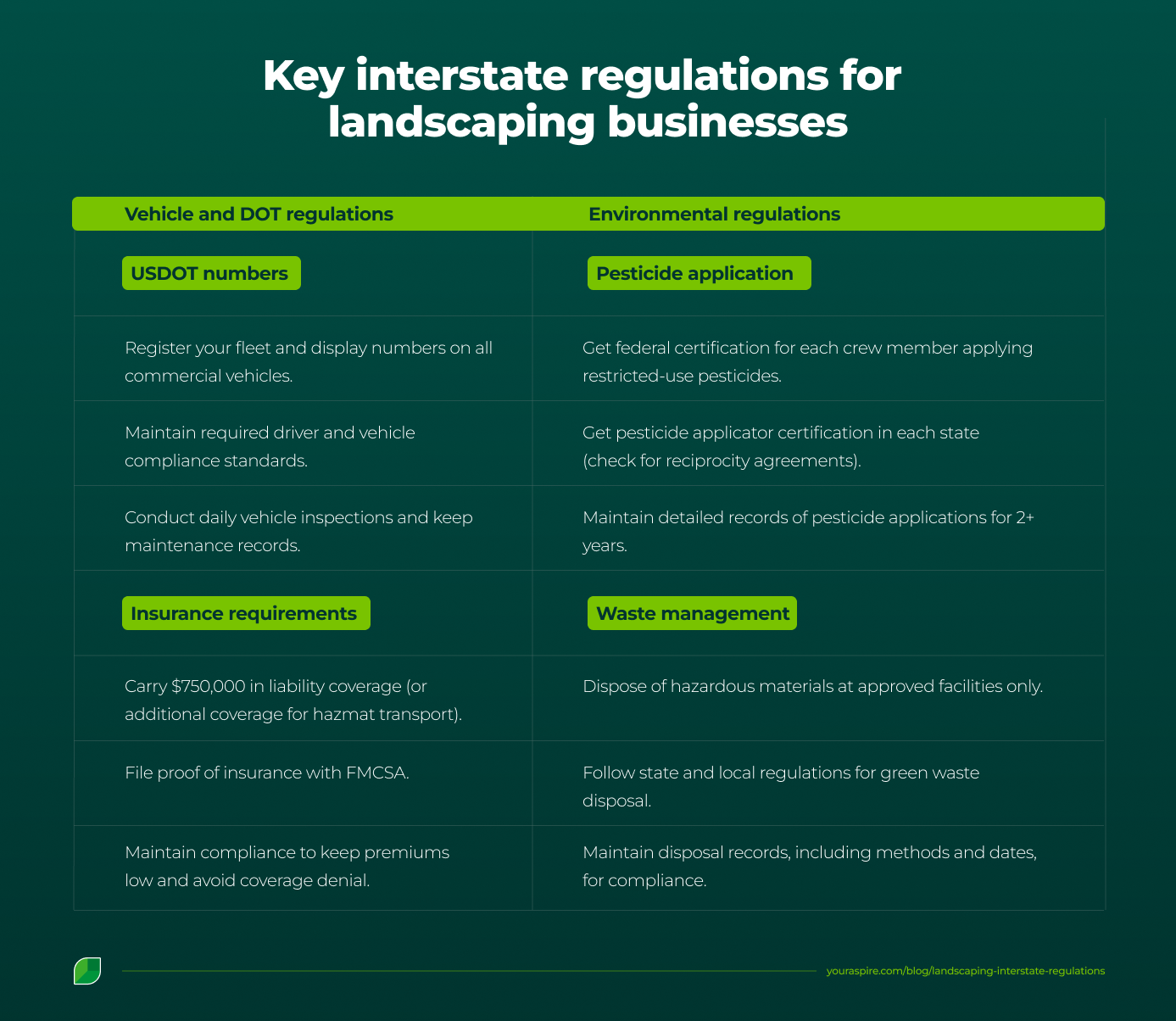
Operating across state lines will require you to register your vehicles with the U.S. Department of Transportation (USDOT) and comply with federal environmental regulations as well as state ones.
Vehicle and DOT regulations
If your vehicles cross state lines, they’ll probably need to comply with FMCSA (Federal Motor Carrier Safety Administration) regulations. You’ll need a USDOT number if your vehicle meets certain regulatory thresholds.
For landscapers, the relevant triggers are:
Weight threshold: Any vehicle (or vehicle and trailer combination) with a Gross Vehicle Weight Rating (GVWR) of 10,001 pounds or more – even if it isn’t loaded to capacity.
Hazmat threshold: Any vehicle transporting hazardous materials like pesticides in certain quantities (different hazard classes have different thresholds).
Most landscaping businesses hit the weight threshold before the hazmat threshold.
Once you register, the same USDOT number covers all vehicles in your fleet, which could be inspected at any time. You’ll need to comply with specific safety and insurance requirements to avoid penalties and fines.
USDOT numbers
Landscaping businesses with vehicles that meet regulatory thresholds need to register for a USDOT number through the FMCSA online portal. This number will track your company’s safety record and compliance history.
You’ll need to display both the USDOT number and fleet number on both sides of each commercial vehicle, and be prepared for roadside inspections.
Drivers will need:
A Medical Examiner’s Certificate, renewed every 1-2 years
A Commercial Driver’s License for vehicles over 26,001 pounds
Pre-employment drug testing, with random testing programs
Hours of service compliance (can’t exceed maximum driving hours)
Driver qualification files, including driving record checks
Vehicles will need:
Daily vehicle inspections, with documentation of any defects
A fire extinguisher, reflective triangles, and a first aid kit
Properly secured loads to prevent shifting or falling
Vehicle maintenance records with documentation of repairs
Annual inspections performed by a qualified inspector
Safety violations can result in out-of-service orders, meaning your vehicle can’t move until the violation is corrected. Fines can vary by violation type, but serious violations can cost you over $5,000 each time.
Insurance requirements
Most landscaping operations are required to carry at least $750,000 in liability coverage under federal regulations. Businesses transporting large quantities of pesticides or hazardous materials might need $1 million or more in insurance.
Once you get coverage, you’ll need to file proof of insurance with the FMCSA to stay compliant.
This liability coverage protects you against accidents, injuries, property damage, and equipment loss when you’re operating across state lines. Getting insurance beyond these federal minimums can protect your fleet from accidents, weather damage, theft, cargo loss, and more.
Maintaining compliance with USDOT regulations will keep your premiums low, while violations and out-of-service orders can increase costs or even result in coverage denial.
Environmental regulations
The Environmental Protection Agency (EPA) oversees chemical use nationwide, which means you’ll need federal certification before you apply restricted-use pesticides. Remember, “the label is the law,” so the most important thing to remember is to follow all label instructions precisely.
Federal EPA regulations require you to:
Use only EPA-registered pesticides and apply according to the label.
Store pesticides in original containers, in locked facilities.
Use appropriate personal protective equipment (PPE).
Triple-rinse containers and dispose of them according to the label.
Many states have additional certification requirements on top of federal minimums, requiring licensing for all commercial pesticide applications – not just restricted-use products.
Pesticide application
Any crew member who applies restricted-use pesticides or supervises the process will need federal certification. This will require them to:
Pass a core exam covering pesticide use
Pass an exam for ornamental and turf applications
Renew their certification every 3-5 years
When operating across state lines, any crew member who applies pesticides will need state certification as well.
Some states (such as Alaska, Delaware, and Florida) require certification for all commercial pesticide applications, not just for restricted-use products. A few states even allow municipalities to regulate pesticide use, which is a growing regulatory trend.
You’ll also need to maintain detailed records for at least two years. This includes which products you applied, where and when, the quantities used, and weather conditions for certain restricted-use products.
Unintentional violations can result in penalties of up to $5,000 per offense for commercial applicators, while intentional violations can result in criminal penalties and fines of up to $25,000.
Waste management
Proper waste management is regulated at both the federal and state levels. That includes not only pesticides and leftover chemicals, but also things like used motor oil, batteries, and green waste such as branches.
Triple-rinse empty pesticide containers before you throw them away, and apply rinsate according to label directions.
Dispose of leftover pesticides, used motor oil, and batteries at hazardous waste facilities – never down drains or onto the ground.
Check state and local regulations before disposing of green waste. You might be required to compost it or dispose of it at approved facilities.
Just like with pesticide application, keep detailed records of disposal methods and dates for compliance.
Violations can result in civil fines of over $80,000 per violation per day under federal regulations – and even illegal dumping of yard waste can result in criminal charges.
Interstate business licensing
Each state has its own licensing and registration requirements for landscaping businesses.
While only about 15 states require landscaping contractor licenses, all states mandate general business licenses, which may have unique requirements, fees, and renewal schedules.
Some states also have specific credentials for pesticide application, irrigation, or tree removal.
If you’re thinking of expanding your business into a new state, research requirements early so you or your employees have time to study for licensing exams, gather the appropriate paperwork, and apply for all the licenses you need.
State-level licensing
Business license requirements vary dramatically by state. For example:
California requires a C-27 Landscaping Contractor license, which involves an exam, four years of proven experience, and a $25,000 bond.
Arkansas uses tiered licensing based on service area size.
Alaska requires a specialty contractor license, a $10,000 surety bond, and proof of insurance.
Meanwhile, states like Colorado and Kentucky have no state-level landscaping licenses but require separate licenses for specific services, such as pesticide application and plant sales.
When you research the licensing requirements in a new state, start by identifying what agency oversees landscaping businesses – whether it’s the Department of Agriculture, state contractors board, or another agency. Visit each state’s licensing website to download applications, review requirements, and understand fees.
Many states also require local licenses from counties or municipalities, so check local requirements as well.
Cross-state business regulations
Beyond basic licensing, each state has its own tax obligations, labor laws, and local ordinances. For example, minimum wage, overtime calculations, and income tax rates vary by state.
Some states have noise ordinances that affect equipment use, and others may have specific tree removal laws.
To stay on top of cross-state regulations, keep compliance calendars that track license renewals, tax filing deadlines, insurance policy updates, and other deadlines.
Consider working with a multi-state payroll provider and consult with accountants who understand interstate business operations to ensure you’re meeting all your obligations.
Key considerations for landscaping businesses expanding interstate
Navigating different tax systems, labor laws, licensing requirements, and vehicle laws can get complicated quickly. Beyond the paperwork, it can also make compliance costs add up – and create new challenges when it comes to training employees.
Successful landscaping businesses expand thoughtfully and invest in systems to track compliance.
Below are a few tips for managing compliance costs and adjusting employee training to ensure your crew understands the new requirements.
Understanding and managing compliance costs
Operating across state lines can significantly increase your startup costs in each state. When you expand into new states, you can expect:
Fees for multiple business licenses and registrations
Costs for USDOT compliance measures
State-specific insurance policies
Additional legal, accounting, and administrative fees
Many landscaping business owners manage compliance costs by factoring them into pricing and budgeting.
Also consider the pros and cons of your business structure. While most landscaping businesses operate as LLCs, you’ll need to register as a foreign LLC in each state where you do business, which adds to your registration fees.
Work with accountants familiar with multi-state operations to explore whether business aggregation would reduce your tax burden.
Training and certification for employees
It’s important to invest in training, exam fees, licensing, and ongoing learning, particularly for employees who handle pesticides or operate machinery.
Some states have reciprocity agreements that allow employees to get certified for pesticide application without retaking tests, but they’ll still need a separate certification in each state.
USDOT compliance requires driver training on vehicle inspections and safety best practices. Drivers will need to understand how maintaining a safe driving record will help their business stay away from fines.
Local laws may require additional training, so research which certifications your employees need for operating equipment or using pesticides in each location before they start work.
How Aspire helps landscaping businesses manage interstate regulations
Staying compliant is much easier with tools that let you track operations in one central location.
Aspire’s landscaping business software gives you powerful tools for reporting, fleet management, crew coordination, and more – with full financial visibility into every location.
Fleet management and USDOT compliance
Aspire integrates with Azuga and FleetSharp for real-time vehicle tracking, driving scores, and safety alerts. Better driver performance helps avoid USDOT violations and roadside inspections.
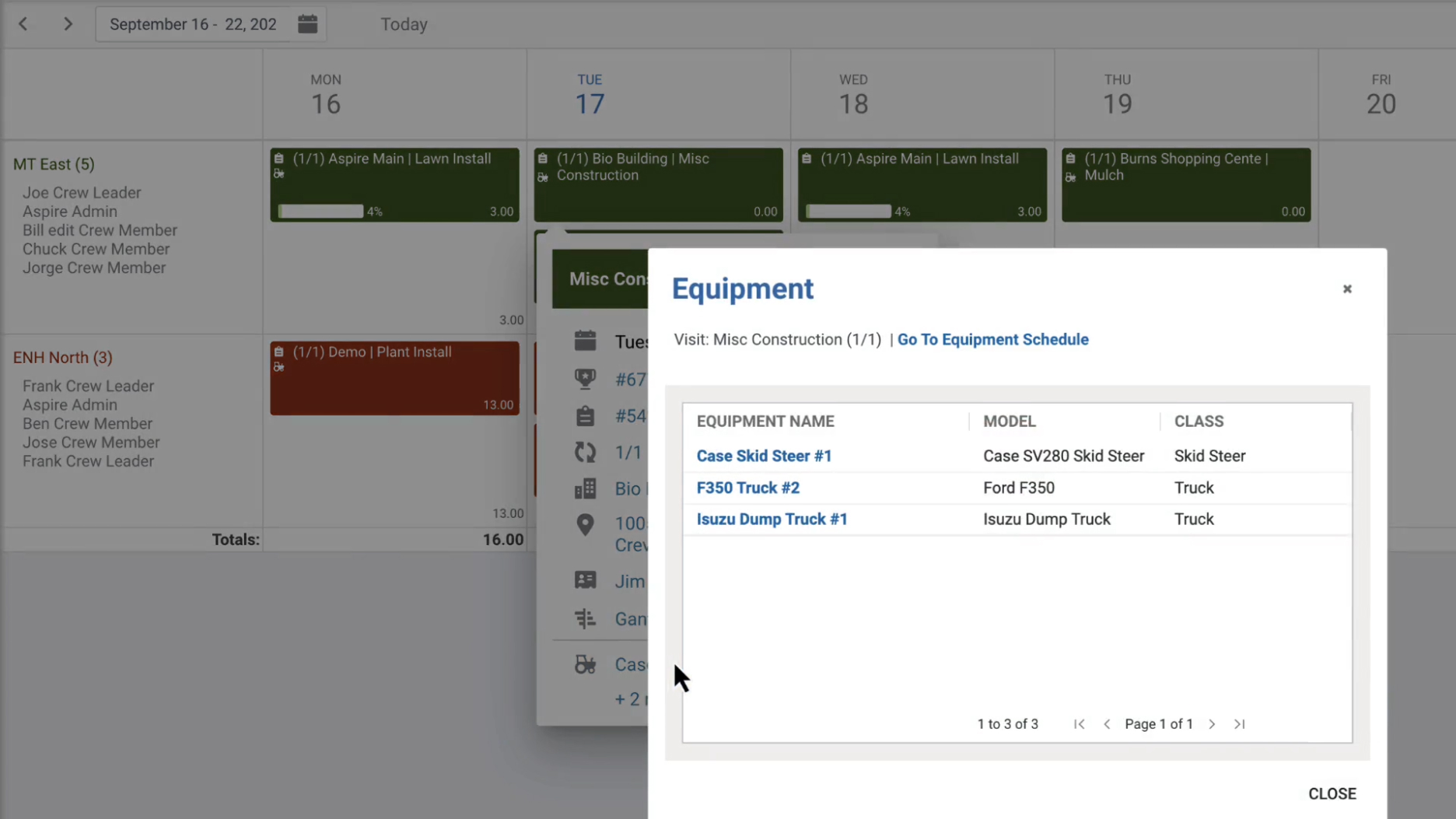
Equipment management tools include asset inventory management to track maintenance schedules, helping ensure your fleet meets federal safety standards across all locations.
Crew coordination and documentation
Aspire’s mobile app keeps teams connected with real-time schedule updates, ensuring crews with proper state certifications work in the right locations.
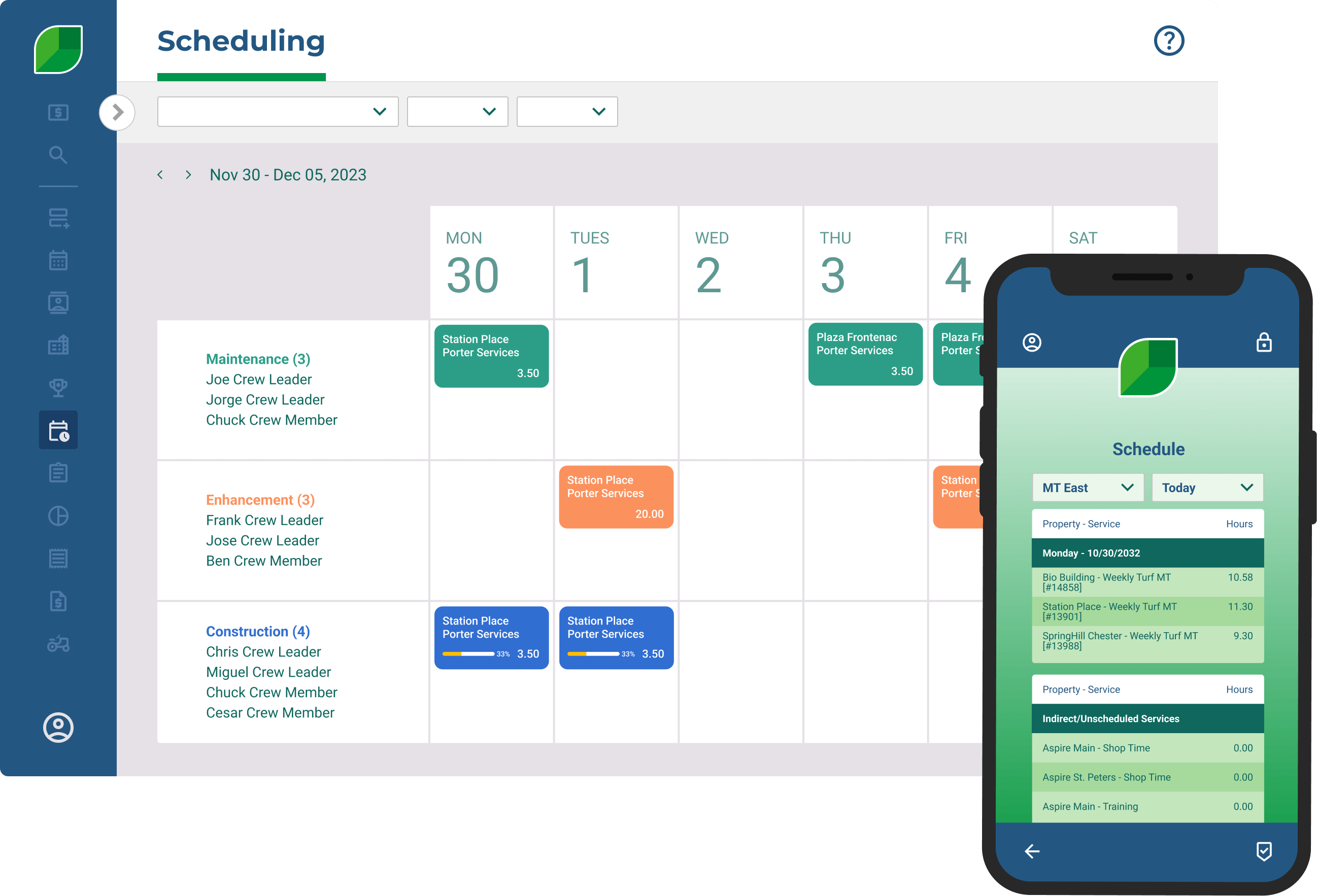
Teams can also document work with photos and videos – capturing completed tasks, site conditions, and proper waste disposal for compliance records that protect your business.
Financial visibility across state lines
Aspire’s reporting tools include real-time job costing to show profitability by location, helping you determine whether expanding into new states justifies the compliance costs.
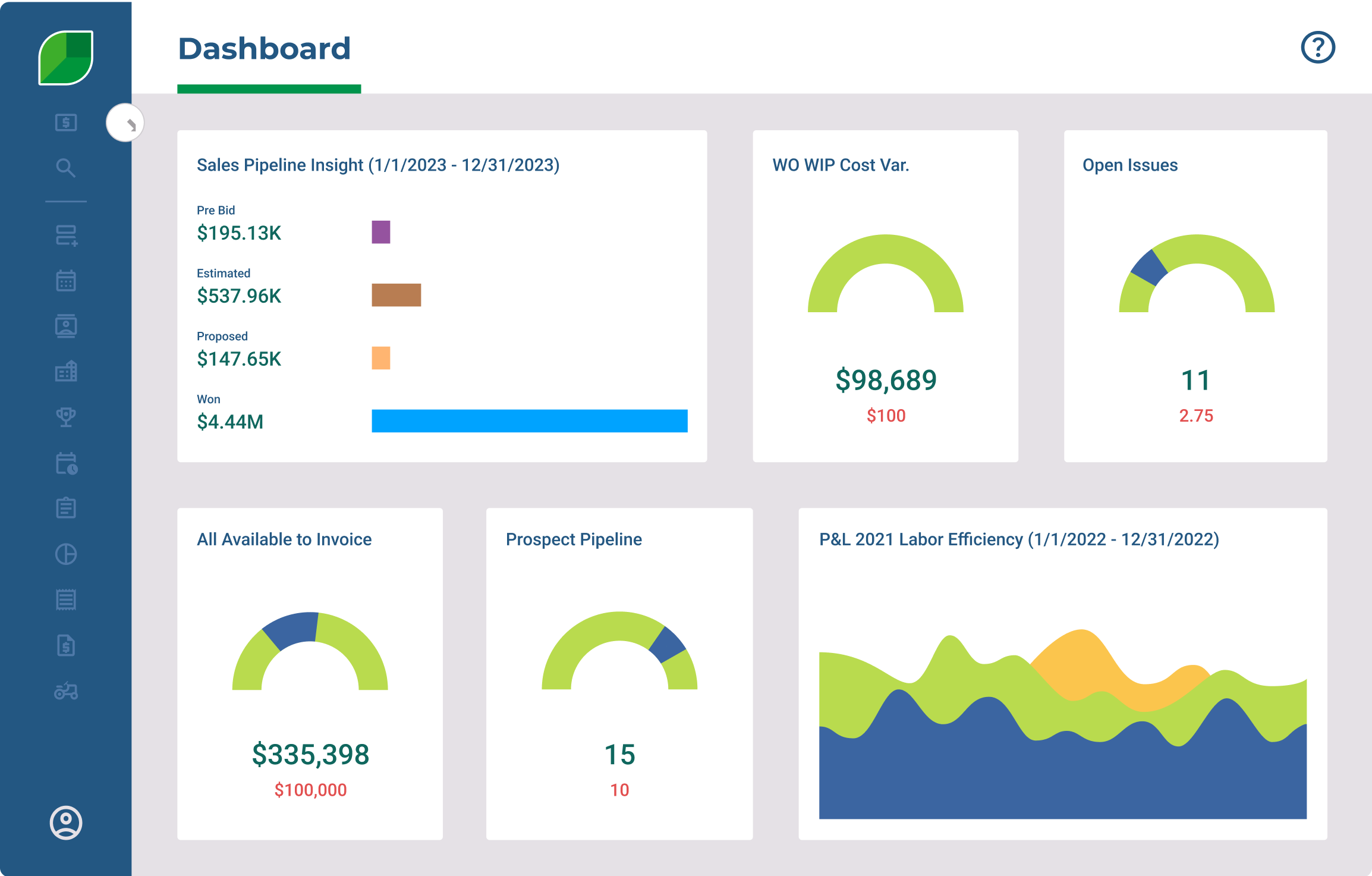
Centralized reporting across all business locations gives you clear visibility into which markets drive growth.
The QuickBooks integration simplifies multi-state tax compliance and maintains audit-ready documentation across all jurisdictions.
Over to you!
Staying informed and meeting federal and state requirements will help you ensure smooth operations and avoid fines that hurt your profitability.
Whether you’re starting a new landscaping business or are ready to expand across state lines, Aspire gives you the tools you need to grow your business without compliance headaches slowing you down.
Ready to see Aspire in action? Book a demo to discover how your business can benefit from tools that make quality, safety, and compliance a breeze.
Frequently Asked Questions (FAQs)
Do I need different landscaping licenses to operate in multiple states?
Yes. Each state has its own licensing requirements – and while many states don’t need specific contractor licenses, all states require general business licenses.
You’ll also need pesticide applicator certifications and other service-specific credentials for each state you operate in.
What happens if I fail to comply with state regulations?
Non-compliance can result in substantial fines, suspension of the business license, and even criminal charges for serious violations.
USDOT violations can cost over $5,000 per offense, while hazardous waste violations can reach $80,000 per day.
Beyond financial penalties, compliance failures can damage your business reputation, and you can lose the ability to operate in some states.
How do I handle employee certification for pesticide application across state lines?
Crew members will need separate pesticide applicator certifications in each state where they apply pesticides. Federal certification alone isn’t enough, since each state administers its own certification program.
When assigning workers to jobs that require pesticide application, always make sure they’re registered in that state.
Are there specific federal regulations for transporting landscaping equipment across state lines?
Yes. If your vehicle (or vehicle and trailer) exceeds 10,001 pounds GVWR, you need USDOT registration to transport landscaping equipment. This includes staying compliant by displaying USDOT numbers on all vehicles, conducting daily inspections, and meeting many other requirements.
Can my landscaping business operate in another state without a physical office?
Yes, but you’ll still need to register your business and obtain all required licenses in any state where you work. You also need a registered agent in each state who is authorized to receive legal documents on your company’s behalf.




 866-727-7473
 Schedule Demo
 390 S Woods Mill Rd #300 Chesterfield, MO 63017


