Reaching new snow clients during the off-season, standing out in a crowded market, and growing your business have always been challenging.
While you might have had promising leads in the past, converting them into paying customers hasn’t been easy.
So, how do you change that?
This post will guide you on what to do.
Here, you’ll discover practical marketing strategies to help you attract more customers, gain their trust, boost brand recognition, and ultimately increase revenue.
The power of marketing for snow removal businesses
Marketing your snow removal business involves staying visible and familiar with potential clients. It builds trust by showing prospects who you are, what you can do, and why you’re reliable. But it needs to start before winter arrives.
Think about those injury lawyer ads you see everywhere. You may not need such services immediately, but the constant visibility keeps that particular lawyer top of mind. Their name sticks because the ads are everywhere.
Should you or an acquaintance need an injury lawyer in the near future, that one will instantly spring to mind because they’re familiar and visible. You’re already halfway to hiring them.
The same principle applies to marketing your snow removal business. You differentiate your business in a crowded market where many contractors offer similar services.
Your business no longer seems distant to clients and, as a result, choosing your snow-clearing services becomes an easy decision.
So, how do you increase your snow removal business’s visibility and build trust and familiarity?
The strategies below are a good start.
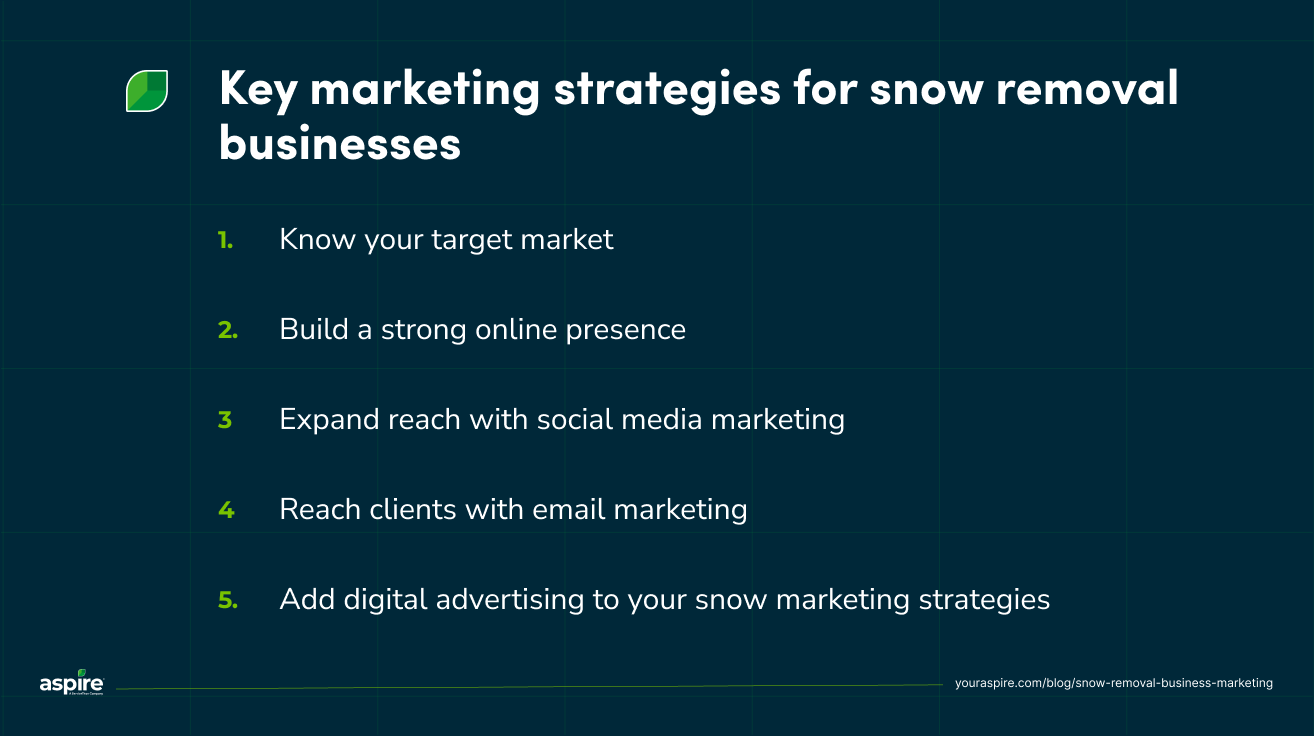
Key marketing strategies for snow removal businesses
Here’s how to position your snow-clearing business for visibility:
1. Know your target market
The first step is to define your ideal audience. What kind of customer would you like to serve?
This will help you craft the right marketing message to attract them, position your business correctly, and grow sustainably.
To know who your ideal target audience is, assess your existing customers by answering these questions:
Are they residential customers, small business owners with a storefront, or commercial clients with multiple properties?
Where are they located? Name specific neighborhoods or towns, as that’s where you’ll focus your marketing efforts.
What services do they need the most? Do you clear snow from their driveway, roof, sidewalk, or parking lot? Do they contact you for ice management?
What’s their typical property size or square footage?
What’s the income level of your typical customer? Knowing this ensures you market to customers who can afford your services.
Based on these answers, create a customer persona to help you target individuals similar to your current audience.
2. Build a strong online presence
To nail marketing for your snow removal business, you need a strong online presence. Why? Because when people need help, the first place they usually look is the internet.
Here’s what you can do to build a solid presence online:
Create a professional, easy-to-understand website
Think of a website as your business’s little corner of the internet where prospects can learn more about you.
Here’s an example from PlowGuys:
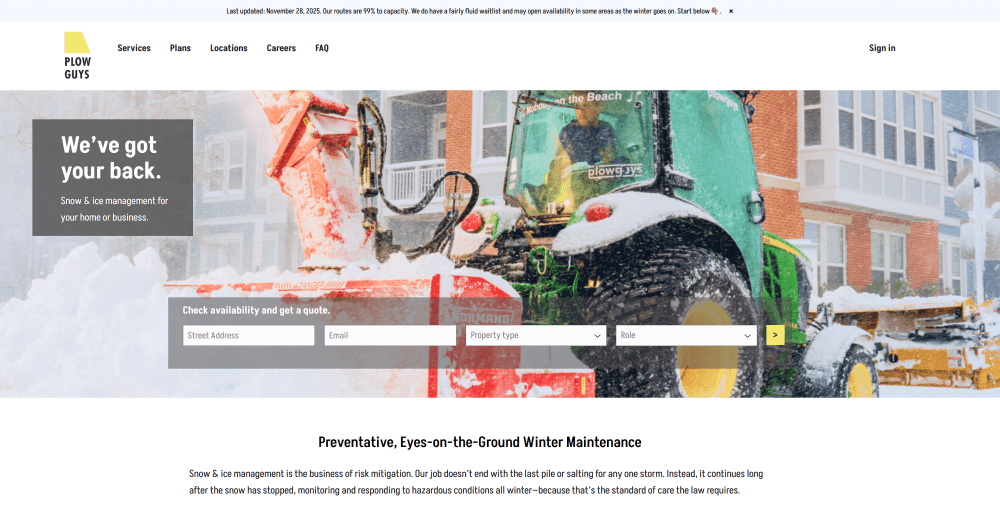
To build a site like this, collaborate with a web developer or use a website builder to create the site yourself, using templates.
Outline your service area, services offered, and contact information on the site. The website should have your logo, colors, font, and slogan to reflect your brand identity. Use local keywords around snow removal or snow clearing in your city to improve the site’s visibility on Google.
You also need to ensure it’s optimized for mobile since most people search on their smartphones.
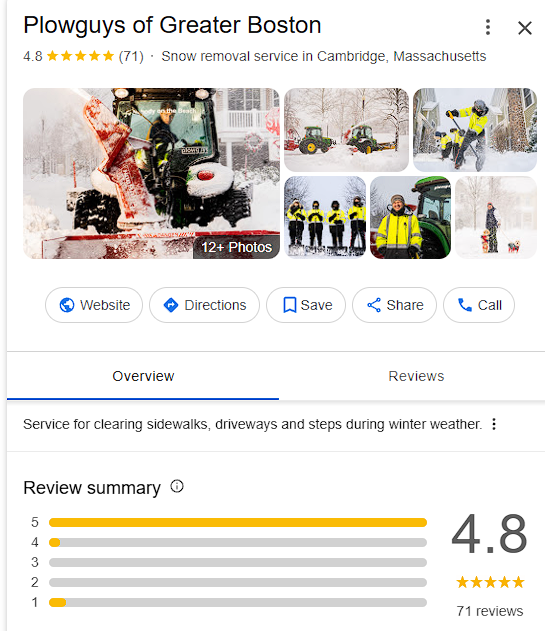
Claim or open a Google Business Profile
This will help manage how your business appears in Google search results. A business profile with client reviews, project photos, contact information, and your website link makes it easier for clients to find and contact you online. Plus, you get to stand out in local searches.
Open social media accounts
Almost everyone is using social media these days. So, whether you’re targeting residential or commercial clients, chances are your clients are most likely hanging out on a social media platform.
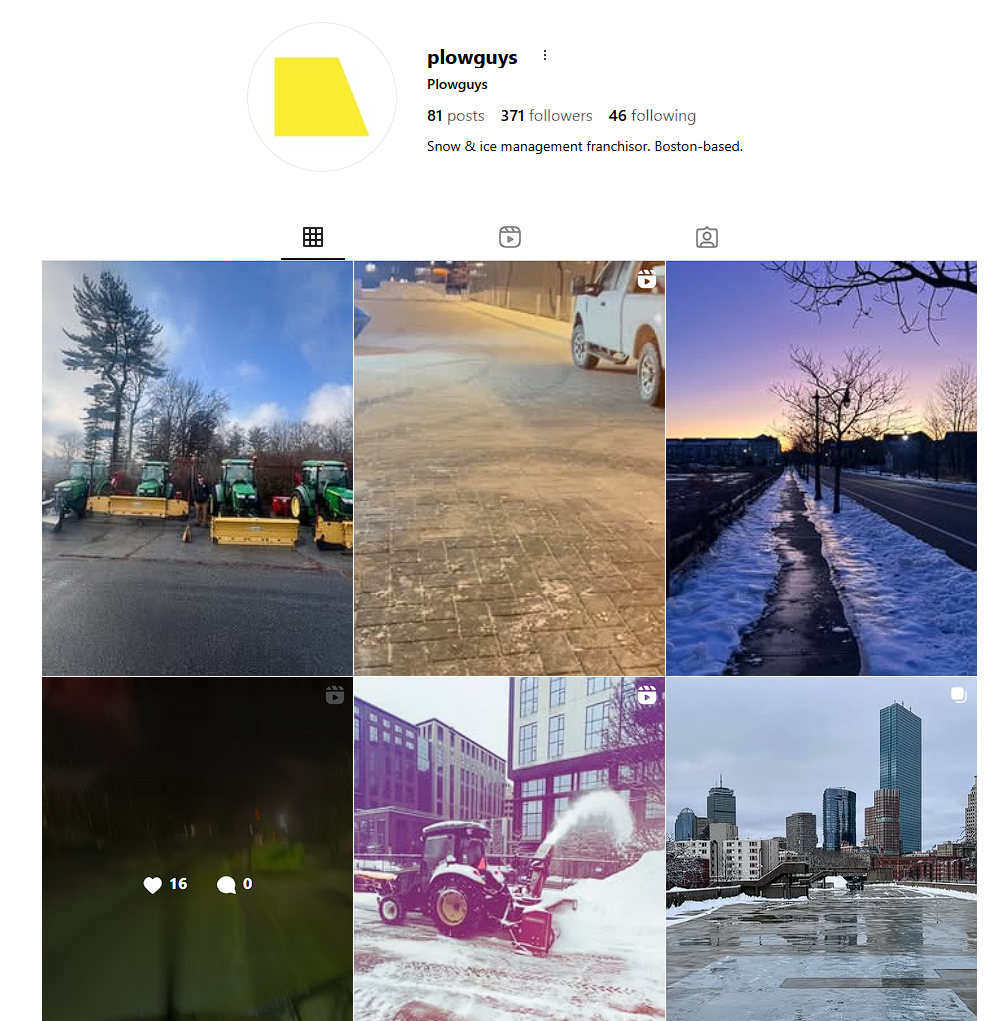
By creating an account with any of them, say LinkedIn, Instagram, or Facebook, you make it easier for prospects and clients to find and connect with you.
As for what to post on your social media page, you can share:
Before-and-after photos or videos showing the transformation of a snowed-in driveway to a clean lot.
Service announcements to keep clients informed during the winter months. For instance, ‘Expect eight inches of snow tonight’ or a post on how to prepare for it.
Behind-the-scenes content showing your crew getting ready for a project.
Safety reminders on what people can do. This builds trust and shows you care about the community.
3. Expand reach with social media marketing
Aside from helping you connect with the audience, social media enables you to target your ideal customers.
You can run full advertising campaigns on these platforms to reach a larger audience. Here’s what a social media ad on Facebook looks like:
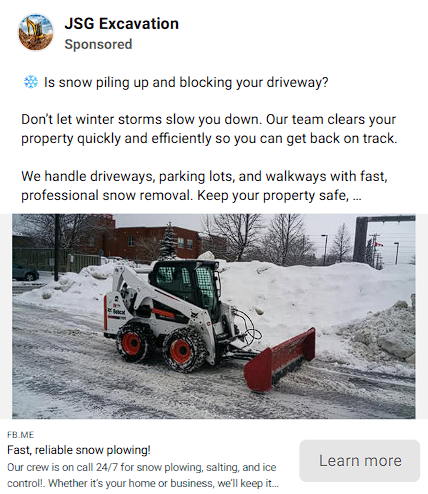
Social media ads like this one mean you’re paying to put your message in front of people in your service area. This way, they see your services at a time they might need them.
Compared to posting regularly, which helps you connect with people and allows prospects to find the business, ads enable you to target customers in specific demographics and ensure you’re visible before and during storms. Plus, you can promote special offers for new clients.
To run social media ads, you can work with a marketing professional or do it yourself by boosting a social media post or building a campaign from the beginning.
If you want to do it on your own, the typical process is to choose the platform where your audience spends the most time. Then, set a clear goal, e.g., traffic, leads, or sales, define your audience, and craft a compelling message with captivating visuals.
From there, set a budget, choose when you want the ads to appear, and launch the campaign.
4. Reach clients with email marketing
You know how Amazon occasionally sends you emails about offers or new products? That’s another way to advertise your snow removal company.
This strategy helps you stay in touch and top-of-mind with clients before, during, and after snowstorms.
Start by building an email list from past clients, website signups, or inquiry forms.
Once you have a comprehensive list, import it into an email marketing software tool like Aspire’s Marketing Pro, so you can send automated emails before the season begins. These can be early-bird sign-up promos or first snowfall alerts to encourage prospects to book ahead.
During the season, send emails regarding storm updates, safety tips, or service schedules to position your company as reliable and proactive. The idea is to nurture existing customers and win back former or inactive ones by sharing timely messages for upsell, cross-sell, and renewal opportunities.
5. Add digital advertising to your marketing strategies
You can also run different types of digital ads, such as display ads or search ads, to put your snow removal business in front of customers when they’re actively searching for help.
Similar to social media ads, options like Google Ads let you target people searching terms like ‘snow clearing services near me.’ And then there’s programmatic advertising that helps widen your search by placing display ads across websites for weather updates, home improvement, or local news.
Here’s an overview of different digital ad options you can leverage:
SEO (Search Engine Optimization)
This first option helps you drive traffic to your website with keywords. It involves using terms that prospects will likely search for on Google across your website, so it shows up higher in search results.
To get the best results, you may want to work with SEO experts.
But with the right tools like Ahrefs, you can DIY by researching key terms around snow removal, optimizing meta titles and descriptions, and creating blog posts around keywords such as ‘winter safety’ or ‘snow removal tips.’
Some other actions you can take include:
Ensuring your website is mobile-friendly, since most users search from their phones.
Keeping your business name, address, and phone number (NAP) consistent across all online directories.
Encouraging clients to leave reviews on your website and Google Business Profile.
AEO (Answer Engine Optimization)
This approach lets your snow removal business website show up in direct answers delivered through featured snippets on Google, voice assistants, and AI-driven search results.
Here’s an AEO example from the Centers for Disease Control and Prevention:
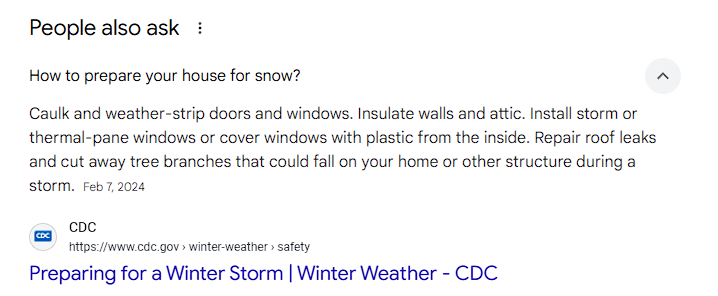
To optimize your website for AEO, you should:
Create clear and straightforward answers to common client questions like the one in the example above, or others such as ‘How much does snow removal cost?’ or ‘Do you offer emergency service?’
Add an FAQ section to your blogs and website, where you can answer questions in a conversational tone.
Optimizing for AEO boosts credibility and can generate highly qualified leads who need fast, reliable snow removal information.
Programmatic advertising
With this option, you leverage automation and real-time bidding to run ads across different websites where prospects spend their time. It offers broader visibility, simplified ad display, and qualified leads.
If you want to use this method, you need a demand-side platform like Google Display or Video 360 to analyze user behavior and location. Then, based on the analysis, it delivers targeted ads to prospects without manual placement.
Programmatic advertising is typically automated, but here’s an overview of how it works:
Pick a demand-side platform where you can buy display ads.
Select your target audience, e.g., homeowners' associations, small business owners, or property managers, and target them by location, interests, or weather-triggered events.
Create and upload your ad creative to the platform.
Set your budget and bidding strategy to compete for available ad placements on websites.
Launch the campaign and let the system automatically place your ad across relevant sites.
How Aspire helps manage your marketing strategies
Launching an effective marketing campaign is a breeze when you have the right data at your fingertips.
For instance, if you’ve got a detailed client list and know their project history, imagine how simple it will be to spot your best clients so you can go after similar prospects.
A tool like Aspire can give you such data, making it easier to promote your services more effectively.
Here’s how Aspire helps with marketing:
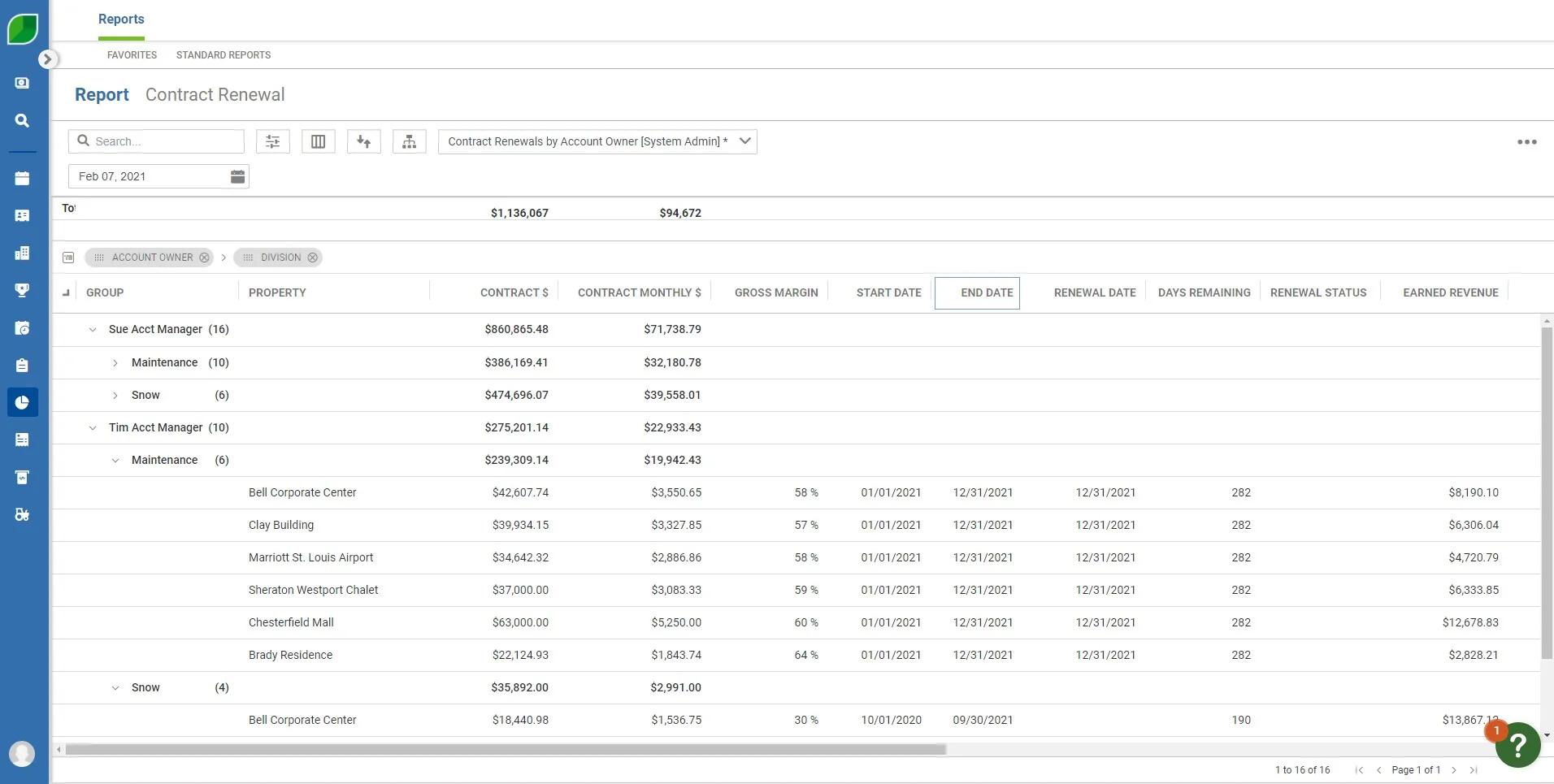
Reveals your most profitable clients: With Aspire’s job costing and financial reporting features, you can identify high-value accounts.
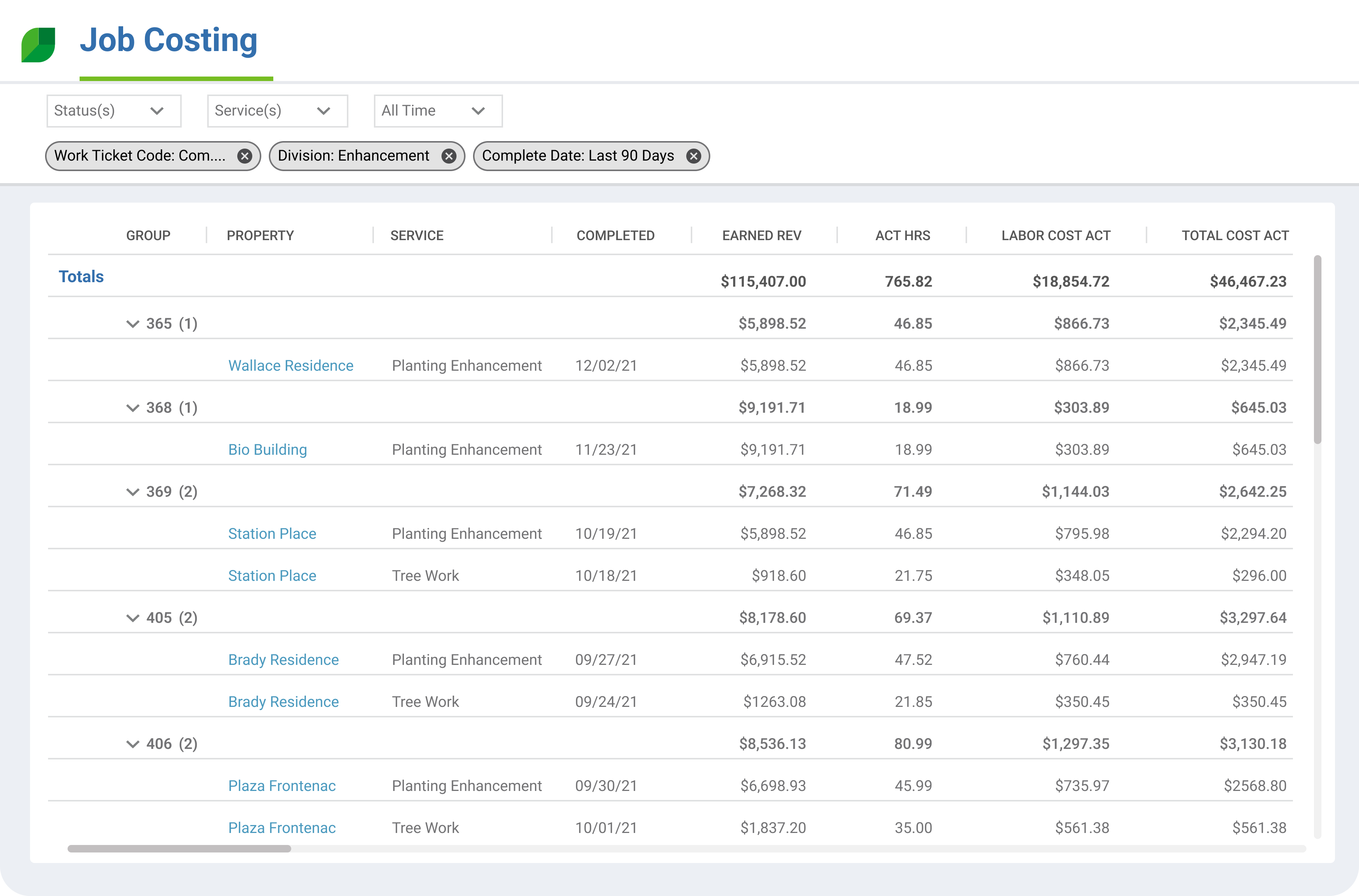
You can use that information to build an ideal customer persona to target similar prospects in your marketing campaign.
Centralizes client and lead information: Aspire’s CRM keeps all your client details, service history, and sales interactions in a centralized location. It helps segment your customer list to create a hyper-targeted audience in minutes so you can personalize marketing campaigns.
The built-in CRM tool also lets you track new leads, schedule follow-up messages, and ensure no prospects fall through the cracks.
Supports consistent communication: As marketing involves constant customer communication, Aspire provides email templates to help you deliver clear, professional messages. You can reach clients wherever they are most likely to respond—email, direct mail, or SMS—right from the Aspire platform.
Provides data to refine marketing decisions: With Aspire’s reporting feature, you can discover which services are in top demand, your most profitable routes, and the service that offers your preferred profit margin.
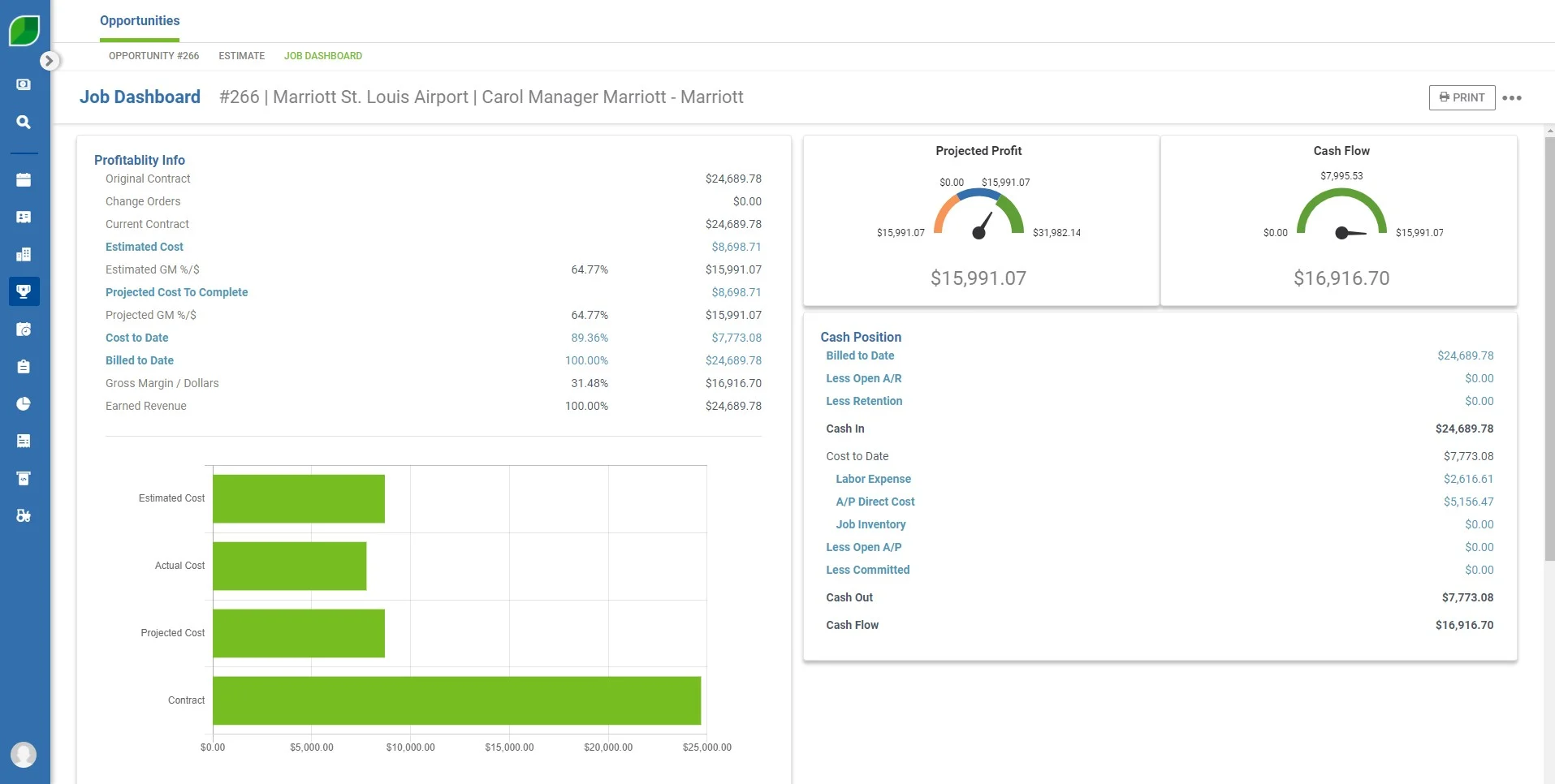
This information helps you focus your marketing efforts on services and client types that can bring the highest returns.
And when you eventually secure new clients, Aspire offers these features:
Estimation: Create project estimates easily so you can bid on jobs without delay.
Scheduling: Schedule jobs the moment they’re won and assign them to dates.
Job costing: Monitor how much is being spent on a project versus the estimated costs, to track profitability.
Invoicing: Generate and send invoices via email or from the customer portal.
Mobile app: Enjoy seamless communication with your field crew and track their performance.
Over to you!
If you’re planning to expand or start your snow removal company, begin by implementing the strategies discussed above.
Think of it as a guide to help grow the business.
First, understand your target audience as mentioned. Secondly, build a strong online presence to ensure visibility.
Thirdly, use a combination of SEO, social media advertising, email marketing, and paid advertising to put your company in front of your audience.
Lastly, leverage Aspire to provide the data and tools needed to promote your services more effectively. It also helps streamline your snow removal operations, so you can save time and focus on growing the business and delivering high-quality service.
Schedule a live demo with Aspire to see how it helps refine your marketing efforts and automate operations.
Frequently Asked Questions (FAQs)
How can I build trust with new clients for my snow removal business?
You can build trust with new clients by delivering helpful content, like snow removal or storm prep tips or weather updates, on social media or your website.
Sharing client reviews or before-and-after photos on social media or Google can also help new clients feel confident about choosing your business.
How do I track the effectiveness of my marketing efforts for snow removal services?
You can track your marketing campaign’s effectiveness by monitoring metrics like website traffic, ad clicks, form submissions, email open rates, and the number of new leads you generate each month.
But what you need to track actively is conversions. This tells you how many of the multitude of traffic or clicks garnered lead to actual sales.
Use tools like Google Analytics, Facebook Ads Manager, or your CRM to see which marketing channels deliver the most inquiries and conversions, so you can focus on what works.
How often should I update my snow removal marketing campaigns?
Endeavor to monitor your campaign performance weekly or biweekly to see if it’s generating the expected results.
If it’s not, adjust the ads. And if it is, publish the ads across other marketing channels to get more visibility, leads, and sales. Update messaging based on weather patterns, client demand, and profitable services.
Adjust your ads or emails whenever engagement drops or when you introduce new offers or service packages.












 866-727-7473
 Schedule Demo
 390 S Woods Mill Rd #300 Chesterfield, MO 63017


