Table of Contents
Table of Contents
- What is the history of landscaping?
- How did landscaping evolve into a business?
- Who is considered the father of landscaping?
- When did landscape design become a profession?
- How did landscaping become popular in the United States?
- How has the landscaping industry changed over time?
- What is the difference between landscaping and landscape architecture?
- What is the modern scope of landscaping services?
- How profitable is the landscaping business today?
- What challenges have landscaping businesses historically faced?
- How does technology impact the landscaping industry?
- What trends are shaping the future of landscaping businesses?
- Over to you
The landscaping industry has come a long way since its inception. What began as a practice for the elites and a pragmatic way to manage household land has grown into a professional industry shaped by design principles, tech, and client interests. From outdoor gardens, classicism, and early land management to the modern landscaping industry, the evolution has been significant.
As a business owner, understanding how it all started provides context to many practices you see today. Knowing the state of the industry and where it’s headed can better position your business and help identify ways to grow and stay competitive.
This post dives into the history of landscaping to help you better understand the current challenges that could impact your business's future.
What is the history of landscaping?
Long before the manicured lawns and decorative gardens everyone knows, early civilizations shaped land to grow food, manage water, and create order in their environments.
The Egyptians were the first recorded civilization to have detailed garden plans. They had outdoor spaces with symmetrical axes, tree-lined avenues, water features, and pavilions.
Then came the Persians with organized gardens within temple courtyards, planting rows and designing spaces for trees and sacred plants. They had paradise gardens symbolizing an earthly paradise.
The Greeks and Romans introduced the classical period, which saw the emergence of peristyle gardens and public shaded groves used for exercise and learning.
Landscaping during this period was primarily about utility, aesthetics, food production, and serving the elite. You see this in other cultures, like the Japanese, with their zen gardens.
This kind of work was handled by conscripted labor or estate staff, definitely not as a commercial service.
How did landscaping evolve into a business?
The commercialization of landscaping began in the 18th century, as the concept spread across the Western Hemisphere, particularly in North America and Europe.
Here’s an overview of the timeline from private, luxurious gardens to full commercial activities:
18th Century: Landscaping became popular with private estates expanding across the West. Nobles began to hire landscape designers for one-off projects, and garden plans were commissioned for a fee. In this period, landscape design became a recognized profession, moving away from work performed by household staff.
19th Century: The Industrial Revolution happened, with urban growth increasing demand for managed green spaces. Public parks needed ongoing maintenance, and middle-class homeownership grew rapidly. Services were offered to multiple clients, and landscaping firms began forming.
20th Century: This period saw a boom in suburban housing, and having the perfect lawn became all the rage. New technologies also made it possible for homeowners to transform their green lawns.
Who is considered the father of landscaping?
Frederick Law Olmsted is considered the father of landscaping in the United States, largely due to his:
Iconic designs for Central Park, Prospect Park, the U.S. Capitol grounds, and the World’s Columbian Exposition in Chicago.
Establishment of landscape architecture as a formal profession.
While Olmsted wasn’t the first to design landscapes, he was the first to approach landscape design as a professional discipline rooted in scientific planning and social impact, earning him the title of father of American landscape architecture.
When did landscape design become a profession?
Landscape design became a recognized profession in the mid-to-late 19th century, as the growing urbanization created demand for planned parks and public spaces.
More specifically, Olmsted officially used the title of landscape architect while working on public projects in 1863, a major milestone in professional recognition.
Then, some 20 years later, in 1899, the profession was formally recognized with the creation of the American Society of Landscape Architects (ASLA), which established professional standards, ethics, and education pathways for landscape architects.
How did landscaping become popular in the United States?
In early America, landscaping outdoor spaces was primarily practical, with yards used for protection and farming. But as agricultural systems in the country became more efficient, families became less dependent on their land for survival and could consider it for aesthetic purposes.
This shift set the stage for the landscaping trends that would eventually shape American homes.
Immigration influence and European inspiration
As people immigrated from around the world, personalized landscaping became a thing in households. This migration phase played a major role in shaping American landscaping tastes.
Around this period, America’s founding fathers and early elites traveled to Europe, where they saw formal gardens and expansive lawns on aristocratic estates. Many incorporated these ideas into their properties back home in places like Washington's Mt. Vernon and Jefferson's Monticello.
This introduced the lawn as a symbol of refinement in the young nation.
Olmsted’s impact
Olmsted’s works became the catalyst for the popularity of landscaping, as his designs for Central Park and early suburbs introduced open lawns and shared green spaces as essential parts of American life.
Suburban expansion
After WWII, victory gardens grew in popularity, and in the 1950s, the first suburban homes were built on Long Island for affordable living. These original American suburbs, built by Abraham Levitt and his family, were among the first to include lawns when homeowners bought the property.
The rise of suburbs in the mid-20th century made landscaping mainstream, as lawns became standard features of new homes, reinforced by social expectations, accessible tools, and professional services.
How has the landscaping industry changed over time?
Landscaping has gone from an extremely labor-intensive yard-maintenance job to a specialized, service-driven profession shaped by technology and changing consumer expectations.
In the past, the practice relied on manual labor and basic tools like hoes, shovels, shears, hand weeders, and wheelbarrows. The invention of the push lawnmower in 1830 gave homeowners a tool to maintain their lawns easily and effectively.
Today, modern equipment, such as power mowers, blowers, trimmers, automated irrigation systems, and design software, has improved productivity and expanded the range of services contractors can offer.
Services have also diversified beyond lawn care, park design, and feature installation to include landscape design, hardscaping, xeriscaping, drainage solutions, and outdoor living spaces. This shift has allowed landscaping companies to move beyond one-time projects to recurring revenue models through maintenance contracts, seasonal services, and bundled offerings.
Business models have become more structured, as reflected in the fact that landscaping has become an $188.8 billion industry. Landscaping companies have more professional branding, pricing systems, and specialized crews replacing informal, labor-only operations.
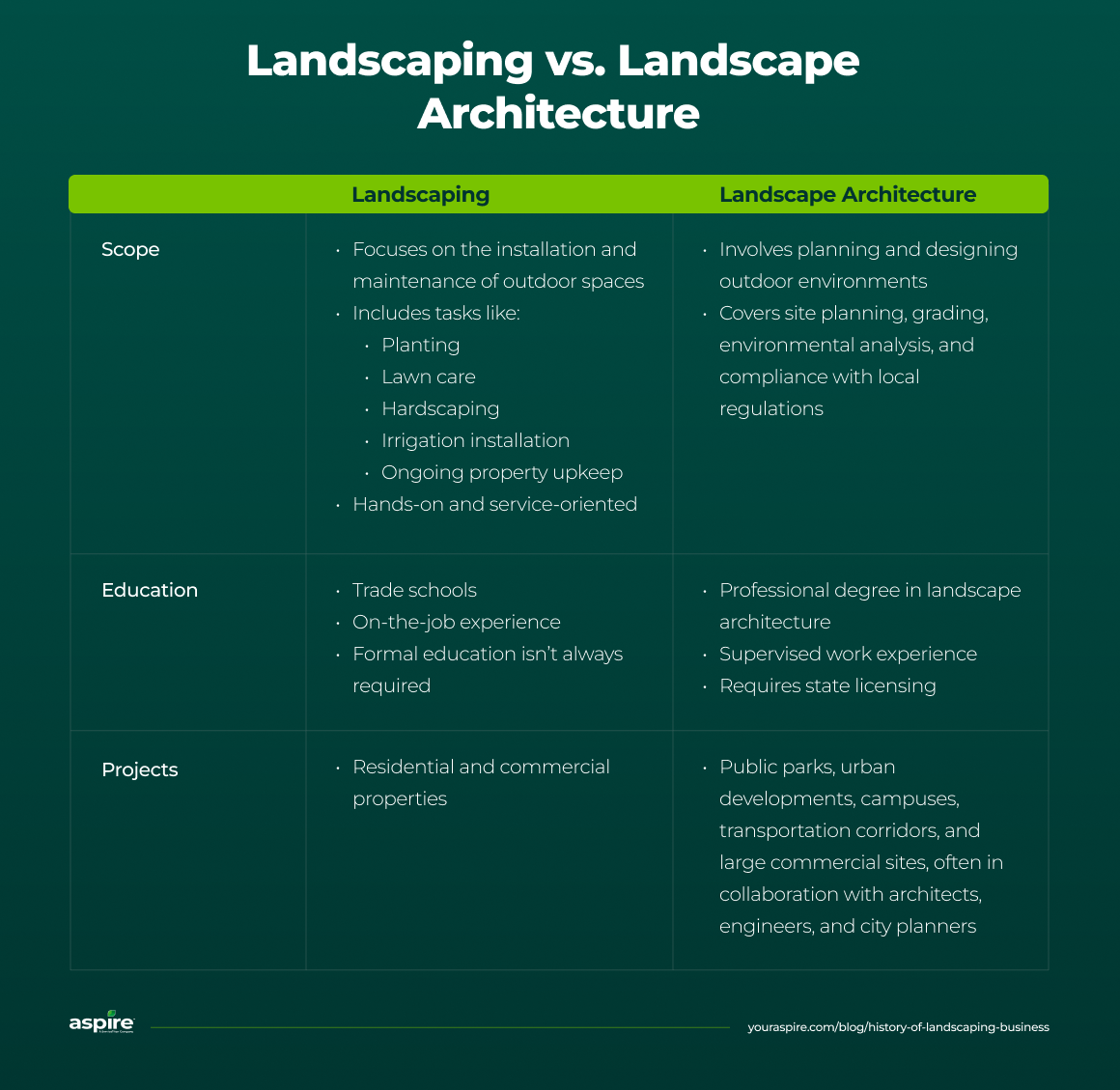
What is the difference between landscaping and landscape architecture?
While the terms are occasionally used interchangeably, landscaping and landscape architecture are two different concepts.
Landscape architecture involves the planning and design of outdoor spaces, including the placement of outdoor structures and the layout of softscape elements.
On the other hand, landscaping is the process of designing and installing various elements of a landscape project, including its maintenance (e.g., trimming, mowing, and weeding). It also covers putting in things like masonry, carpentry, irrigation systems, and plants.
What is the modern scope of landscaping services?
Landscaping companies in the 21st century now provide services beyond yard maintenance, including the design, construction, and upkeep of outdoor spaces.
These services include:
Landscape design and installation: Planning and installing plantings, lawns, garden beds, and outdoor layouts to align with the property’s aesthetic goals.
Lawn care and maintenance: Routine services such as mowing, fertilization, weed control, aeration, irrigation monitoring, and seasonal cleanups.
Hardscaping: Construction of non-plant elements such as patios, walkways, retaining walls, outdoor kitchens, fire pits, and seating areas.
Irrigation and drainage solutions: Installation and maintenance of sprinkler systems, drip irrigation, grading, and drainage to improve water efficiency.
Arborist and tree services: Pruning, trimming, planting, disease management, tree removal, or transplanting.
Sustainable landscaping: Xeriscaping, water-efficient design, and soil health management.
Seasonal services: Snow removal, post-storm cleanup, landscape outdoor lighting, rooftop gardens, and commercial property maintenance.
How profitable is the landscaping business today?
The landscaping industry can be quite profitable, with its 2025 market size estimated at $184.1 billion, according to IBISWorld.
Within this market, most established landscaping companies in the U.S. achieve net profit margins of about 10–20%, with typical averages around 10–14% of revenue, per FieldCamp.
Profitability varies by service type, as businesses that offer premium offerings, such as design/build, hardscaping, and specialized installations, often secure higher margins (25–40%+).
However, routine lawn maintenance yields lower margins but provides steady recurring income.
Overall, how profitable a landscaping business is depends heavily on labor and equipment costs, service offerings, pricing strategy, and scale.
What challenges have landscaping businesses historically faced?
While the landscaping industry has an interesting history, it’s always faced certain challenges, such as:
Seasonality: Demand for landscaping services peaks during the warmer months and declines significantly in winter, affecting cash flow and workforce stability.
Weather dependence: Weather across regions has posed several risks to landscaping businesses. Droughts, heavy rainfall, extreme heat, or early freezes can delay projects, damage landscapes, and reduce revenue.
Labor challenges: Landscaping relies heavily on manual work, and finding people to hire can be difficult. In the past, companies could hire foreign workers, but even that has changed. The government has reduced the issuance of H-2 visas, leading to a decline in the number of foreign landscaping workers.
How does technology impact the landscaping industry?
Compared with the early days when landscaping relied on manual labor, the introduction of mechanized equipment, such as power mowers, trimmers, and blowers, reduced labor intensity. It allowed crews to complete jobs faster and serve more clients.
There was also:
Irrigation technology: Tools such as automated sprinklers and drip systems that improve water management and long-term landscape health.
Digital business software: Platforms such as Aspire help landscapers with scheduling, route optimization, GPS routing, estimation, job management, and invoicing, streamlining operations, reducing downtime, and improving cash flow.
Virtual design tools: Enable estimators and field technicians to create digital models of residential homes and businesses.
Drones: Ensure landscapers get a bird’s-eye view of client properties, allowing them to assess sites in minutes. This helps save time and resources, reducing the need to climb roofs or ladders.
Field service apps: Mobile tools that help field techs track time and materials, report on projects, and stay in constant communication with office staff.
Aspire, for instance, even has a mobile app that gives field techs visibility into previous job information, provides accurate reporting and payroll, and allows them to create quick estimates in the field.
What trends are shaping the future of landscaping businesses?
Like in most industries, changing client expectations are shaping the future of landscaping. It’s the customer’s world, and everyone is living in it.
A report by Aspire showed that 58% of landscaping services installing smart irrigation solutions see their revenue streams increase by 76%.
Another growing trend is sustainable landscaping. While some people are genuinely concerned about the environment, others need to conserve water because of the financial implications.
Regardless of the reason, a study by American Home Shield—a home insurance business—revealed that 1 in 4 homeowners is embracing sustainable landscaping. 52% have done climate-conscious landscaping, and 41% have considered regenerative landscaping for sustainability reasons.
In addition, here are other trends defining the future of landscaping:
Increased field service management usage: 93% of surveyed landscaping businesses already use tools like Aspire to streamline operations such as estimating, invoicing, payroll processing, scheduling, equipment maintenance, and marketing automation.
AI adoption: Respondents in an Aspire survey believe that AI will have the greatest impact across operational areas over the next few years, including field operations (39%), smart routing (33%), and scheduling (30%).
But at the same time, another report finds that over 50% of Americans say they’d adopt AI-powered lawn care tools to reduce costs, with urban homeowners more likely to adopt than rural residents.
Over to you
As a landscaping business owner, you carry forward a long tradition of shaping outdoor spaces—one that evolved from elite estates to public parks designed by visionaries like Frederick Law Olmsted. Your role today is to transform lawns into spaces clients are proud to call their own.
While many foundational landscaping principles still apply, the approach has changed. Success as a modern landscaper depends on understanding client expectations and having the right systems in place to bring their ideas to life.
One way to do that is by using a platform like Aspire, which helps you:
Create accurate estimates.
Stay in constant communication with clients.
Schedule projects for timely responses.
Maintain equipment for smooth project execution.
Report on projects to understand what's going on with them and your business, so you can make informed decisions.
Book a full demo with Aspire to see how it works and how it can help support the growth of your landscaping business.
References used:











 866-727-7473
 Schedule Demo
 390 S Woods Mill Rd #300 Chesterfield, MO 63017


