
Table of Contents
Table of Contents
- What is commercial landscaping job pricing?
- How do you price commercial landscaping jobs?
- How do you price commercial lawn care contracts?
- How do you bid commercial landscaping jobs?
- What factors affect commercial landscaping prices?
- How do you estimate property size accurately?
- How do you avoid underpricing jobs?
- Should you price per hour or per contract?
- When should you raise your prices?
- What tools help price landscaping jobs?
- How does Aspire support commercial job pricing?
- Over to you!
You’ve decided to get into commercial landscaping. Congratulations.
You know this will bring big, consistent, and high-paying jobs. But to get contracts like that, you need to know how to market the landscaping company, bid on contracts, and price jobs profitably.
Wondering how to do that?
This guide shows you how to price commercial landscaping projects, including:
Costs associated with commercial landscaping jobs
How to calculate labor and overhead costs
Ideal profit margins for commercial landscaping projects
Factors that affect pricing
How to avoid underpricing your jobs in a way that erodes profit margins
Read on to learn how to price commercial landscaping jobs and develop accurate estimates that cover labor, materials, overhead, and profit while staying competitive.
What is commercial landscaping job pricing?
Commercial landscaping pricing is the method you use to calculate how much to charge commercial clients for landscaping services under a defined scope.
It’s typically based on factors like property size, service scope, labor hours, equipment costs, materials, liability, and desired profit. Pricing is often structured as a single contract, a monthly contract, or a bundled annual agreement.
How do you price commercial landscaping jobs?
Pricing commercial landscaping jobs is similar to residential projects. The main differences are the size, time, and equipment needed to complete a job and the project’s scale.
Here’s a simple formula to help you price commercial landscaping projects:
Labor costs + material costs + (overhead + equipment costs) + profit margin
To use this formula correctly, you need to calculate labor, overhead, and material costs. These are costs associated with commercial landscaping jobs.
Here’s how to do that step by step:
How to calculate labor costs:
Use this formula to get started:
Number of crew members (hourly wage + hourly burden) time required
For example, a job requires four crew members.
Each is paid $30 per hour, plus a 20% burden to cover insurance and employee taxes, and the project will take 60 hours.
4 ($30 × 1.20) 60= $8,640
How to calculate overhead per hour:
Total operating costsannual billable labor hours
Go through your records from the previous season for office rent, admin salaries, insurance, licenses, software, vehicles (non-job specific), marketing, accounting, utilities, equipment maintenance, and management time, and add all indirect costs to get a single number.
Next, calculate the number of billable hours.
So, say, monthly you spend…
$1,000 on rent
$300 on insurance
$2,500 in admin salary
$500 on office expenses
$700 on software subscriptions, marketing, and licenses
$1,500 on utilities, fuel, and equipment maintenance
$2,000 on an estimator/sales guy/trainer
Total operating costs = $102,000
If your four crew members work 60 hours per week over 35 weeks, annual billable hours = 4 60 35= 8,400
Overhead per hour: 102,000 8400 = $12.14/hr
The overhead for the job will be $2,914.29, based on the project requiring 240 billable labor hours.
How to calculate material costs:
To calculate the material costs for a job, you need to price what will be used and account for waste and the property size.
List the required materials, e.g., mulch, hardscape materials, and fertilizers, and base quantities on measurements (square footage or plant counts). Next, get quotes from suppliers, add 5-15% for wastage or shrinkage, include delivery and handling costs, and apply a 15-35% material markup.
So, say the mulch needed for the project is 40 cubic yards, and the supplier price is $28 per yard.
The base material cost: 40 x $28 = $1,120
Accounting for 10% waste: $1,120 x 1.10 = $1,232
Delivery and handling costs: $100. This brings the new subtotal to $1,332
25% material markup: $1,332 x 25% = $333
Total material cost: $1,332 + $333 = $1,665
How much profit margin should you add?
The average profit margin for commercial clients ranges between 10 and 30%, depending on the project’s scope, risk, and complexity.
Think about it this way:
Consider 10–12% for large but low-risk landscaping contracts with a predictable scope, like lawn maintenance
12–15% for standard commercial projects with moderate complexity, such as installation jobs
15–30% for high-risk projects, tight timelines, or one-off enhancements like hardscaping projects.
Assuming your profit margin is 30%, here’s what the cost of the project will be (using previous examples):
($8,640 + $1,665 + $2,914.29) ÷ (1 - 30%) = $18,884.70
The final price to charge clients is $18,884.70. That should cover costs and make a profit for the job.
How do you price commercial lawn care contracts?
To price commercial landscaping contracts, here’s what you need to do:
Estimate the project scope and time: Visit the property to know how long it will take. Ask clients about their expectations to know what special approach you may need to take. Why?
Their requirements or expectations may impact the project’s time and pricing. For instance, a commercial client who just wants a contractor to mow their lawn biweekly will pay a different price than a client who wants services for edging, trimming, blowing, fertilization, and seasonal cleanups.
Calculate your costs: Your price needs to account for labor (e.g., hours, crew size, hourly rate, payroll burdens, and taxes), equipment costs, materials, overhead, and profit margin.
Remember, you’re handling commercial projects, so you may need more field workers. If you overlook that, it might lead to financial loss or no profit.
Decide whether to charge for equipment: When pricing a commercial contract, it’s crucial to consider equipment costs because they are typically pricier to secure and maintain than residential projects.
You need to factor in the labor required to use the equipment on the job site, so you have enough funds to maintain and secure new tools when needed.
Choose a preferred pricing model: For commercial clients, you can choose per visit, monthly, or seasonal pricing.
For monthly pricing, estimate your annual cost to service the property, calculate a price that includes your desired profit margin, and divide by 12. This would give you a monthly bill, which you can further divide by the number of visits required per month to get the per-visit pricing.
How do you bid commercial landscaping jobs?
Once you understand the cost of executing a commercial landscaping project, you can bid on jobs aligned with your team’s skill set.
Here’s how to do that:
Visit the site or carefully review the RFP document: Before bidding on a project, tour the property to measure turf, beds, and slopes and evaluate its accessibility. You also want to note safety or compliance requirements. The point is to do a walk-through to understand the client’s expectations and prepare to outbid competitors.
Define the scope of work: Next, confirm what will be done and how often. This means you need to outline the landscaping services clients require, including frequency, standards, and exclusions. Are seasonal services included or billed separately? What areas on the property are included? Are there restricted areas landscapers must avoid?
Estimate the project cost: Based on the information gathered from the site visit and the project’s scope:
Determine the crew size and hours needed to complete the job
Calculate the material, fuel, equipment, subcontractor, and overhead costs
Add your profit margin and adjust for contract length and competition
Make allowances for risks and contingencies in your estimates
Present the bid clearly: Create a comprehensive landscaping proposal that covers the services noted in your project visit. Include pricing, exclusions, insurance coverage, contract terms, timelines, warranties, and a policy for cancellations or changes. After creating the proposal, send it to clients for review and wait for approval.
You may also want to send follow-up emails while waiting for the client’s response. However, if your pricing is competitive and the client is satisfied with your understanding of their scope and terms, you are likely to win the bid.
What factors affect commercial landscaping prices?
There are several systems for pricing commercial landscaping contracts, so there’s no single solution that works for everyone.
What’s certain is the different factors that can affect your profitability, regardless of the approach used.
Here are some of them:
Property size and layout: Larger sites take more time to complete, which could increase the total labor cost and the overall landscaping price. The property’s layout equally matters, as tight areas, obstacles, and islands can slow crews down and increase labor hours and, ultimately, costs.
Project scope: Commercial contracts with multiple or bundled services have higher prices than those with a single or a few service requests. If there’s no clarity on what needs to be done, there’s a good chance the labor cost will increase to cover the uncertainty. You need to make allowances in scenarios like that, or you risk losing money.
Location and drive time: If it takes a long time to get to a job site because it’s far away or the traffic is usually heavy, you might have to increase the landscaping project’s price to cover that extra travel time.
Competition: A commercial landscaping job with bids from multiple contractors may have lower profit margins compared to projects with less competition.
Labor and material requirements: Crew size, skill level, time per visit, and material needed for a project drive labor and material costs. Commercial contracts typically require crews with experience to meet appearance and safety requirements.
Contract length: Locking in long-term contracts gives your landscaping company predictable income, so you might be able to offer a slightly lower price on the project. Shorter contracts bring more risk and less predictability, which means higher rates.
How do you estimate property size accurately?
Measuring the size of a client’s property is crucial to the job’s pricing. It’s how you know the quantity of materials and the number of workers needed to complete the job.
Here are different options to consider:
Use a digital measuring tool: Software like PropertyIntel, GoMeasure, or Measure My Lawn lets you collect accurate property measurements with precision measuring tools designed to easily create takeoffs for landscaping work.
PropertyIntel allows you to measure the size of a property using digital maps. If there’s an existing blueprint, you can digitize it and use PropertyIntel to extract the measurements.
Leverage Google Maps or Google Earth: While these aren’t conventional measuring tools, they help you calculate the distance of a property so you can outline the area. Google Earth even has a polygon tool that gives you the square footage of the property automatically.
Visit the site physically: Walk the property to measure it in person and account for obstacles. Separate maintainable space from what’s non-maintainable so you can price accurately.
How do you avoid underpricing jobs?
You can avoid underpricing landscaping contracts by accounting for everything the project will need before sending your quote.
Here’s what you need to do:
Calculate labor costs: Make sure you include full burdened wages (that’s taxes, insurance, and benefits), the hours you’ll need for the project, all materials and supplies (don’t forget waste, delivery, and a markup), your overhead costs (office, equipment maintenance, admin, subs, utilities, insurance, and taxes), plus a healthy profit margin.
If you take all these factors into account, your company won’t lose money by underpricing the job.
Account for site-specific challenges: You need to visit the commercial property to note obstacles and accessibility issues present. Failing to do that may mean you pay out of pocket for additional labor costs the project incurs.
Be clear about the project’s scope: Understand the project’s requirements before pricing a job. Know what services are included and excluded, and define how new requests are added to prevent scope creep and keep your labor costs on budget.
Review past commercial landscaping projects: Sometimes, it helps to look back at old jobs to figure out where you misjudged the time, materials, or labor costs so you can price future projects profitably. Use job costing or reporting software like Aspire to go over past landscaping projects. Take a peek at labor, material, and equipment costs along with the profit margin. Did you make a profit, or did you end up losing money? What did or didn’t you account for? Reviewing such information can ensure you don’t underprice your services anymore.
Should you price per hour or per contract?
You can price commercial projects by the hour or on a fixed contract, but a fixed project price is ideal in most cases.
The reason?
Per contract offers:
Predictability for clients: They know what to pay each month or season.
Stable revenue for your business: Flat contracts mean consistent cash flow for your company, enabling effective planning and budgeting.
Profit margin protection: Per-hour pricing can expose you to potential delays, site challenges, or slower crew productivity that can eat into your margins.
Encourages efficiency: With contract pricing, crews aren’t rushing to beat time and maximize hourly pay. They follow the defined scope safely and with ease.
Simplifies billing and reporting: It’s easier to track cost records with contract billing and compare estimates versus actual costs across projects.
Here’s how to think about it:
Use per hour when:
The project’s scope is unpredictable or unclear. This way, you don’t pay out of pocket when the client’s demand changes.
There’s scope creep. When you do extra work outside of the original scope, getting paid by the hour helps cover expenses you’ve incurred and still turn a profit.
Use per contract when:
There’s a well-defined scope. Pricing per contract is much easier when clients are clear on their expectations. This lets you accurately estimate the project costs and make a profit.
The client wants a fixed budgetable expense. Compared to hourly pricing, per contract rates help clients plan and avoid potential pricing friction if the job takes longer than expected. That’s why it’s important to include allowances in your budget.
When should you raise your prices?
As a business owner, regularly review old prices against current economic realities. Then, raise your landscaping price to maintain or grow your margins.
For example, if the price of expenses like rent, utilities, labor, fuel, materials, and equipment has gone up, your rates should, too.
So, raise your prices:
When costs increase: If a supplier raises prices or material prices increase, the labor market is shifting, fuel costs spike, or purchasing and maintaining equipment is way too expensive, you should raise your prices.
When there’s an increase in demand for your services: Most landscaping business owners tend to hire more workers to meet rising demand. However, that may lead to burnout and low profit margins. Instead of hiring, increase your rates to match demand and ensure profitability.
When you need to reduce low-margin accounts: If you have difficult commercial customers who have high demands but low budgets or are just far out of your route, increase the rates. This will either push them to leave or get you to finally start making a little money on them.
When the market shifts: You should increase rates if competitors in your region have raised their rates or demand for landscaping services has increased.
When you need to project expertise and create exclusivity: Do you consider yourself an expert or specialist in landscaping services? Your rates should be premium to be perceived as an expert.
When the numbers tell you to: You need to raise prices if your margins have been shrinking year over year or if a job that used to be profitable leaves you with nothing now.
What tools help price landscaping jobs?
Between managing the crews, the clients, and the projects, you need a pricing method for your landscaping jobs that’s not totally manual. That way, you can save some time and get your quotes right.
Here are software tools that can help price landscaping projects:
Job costing tools: This software lets you compare actual job costs with estimated labor and material costs and past projects. It shows you if the estimates are a true representation of what the landscaping job requires. With insights into how much you actually spend on a job, you can price future projects profitably.
Estimating software: These tools let you build scopes of work and automatically calculate labor, material, overhead, and profit. They standardize inputs to reduce manual errors and speed up quoting. Estimating tools ensure every landscaping job is priced using the same cost logic and not assumptions.
Production rate calculators: With this software, you can estimate how long jobs should take based on crew size, equipment, and site conditions. They help translate property size and scope into realistic labor hours, which happens to be one of the biggest drivers of job costs.
CRM systems: Customer relationship management (CRM) software helps you centralize client information so you can review and track past quotes, contract terms, and outcomes to inform pricing decisions. When bidding on a new job or renewing a contract, you can reference what similar properties cost and how profitable they were. Over time, this data shows patterns, such as price points that consistently win work or scopes that tend to be underpriced.
How does Aspire support commercial job pricing?
Aspire is landscaping business software that supports commercial pricing by bringing estimating, job costing, and contract management into one single system, so prices are built on real costs.
You have access to a connected set of tools to help price work accurately. Here’s how they support pricing:
Estimating: Helps you measure properties, define work scope, calculate labor costs, and add them as line items on a quote and factor in your desired profit margins. Aspire’s estimating software has templates you can leverage to build detailed quotes from one system.
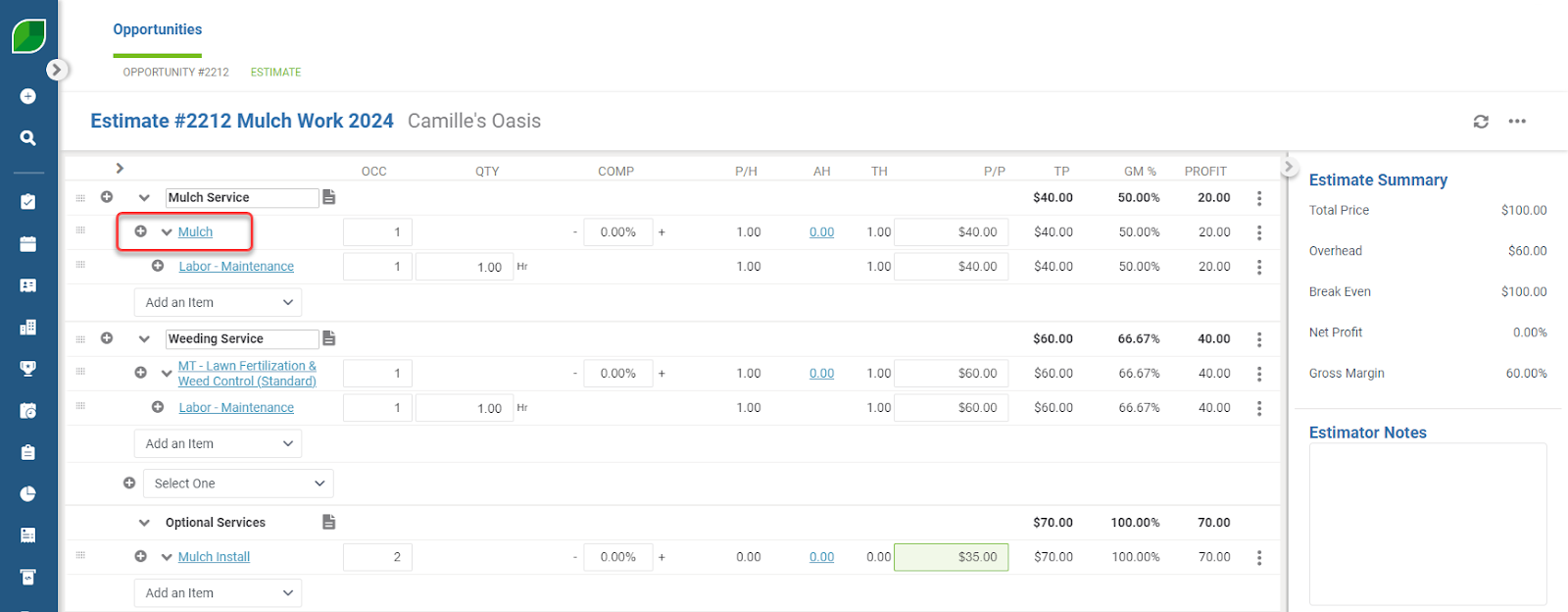
Contract management: For long-term commercial contracts, Aspire supports pricing at the contract level. It lets you roll multiple services into predictable monthly or seasonal rates. This ensures pricing stays aligned with scope changes, service frequency, and operational costs.
Job costing: Aspire has a job costing feature that lets you compare estimated versus actual costs to identify underpriced work, underperforming contracts, low-margin services, and pricing gaps.
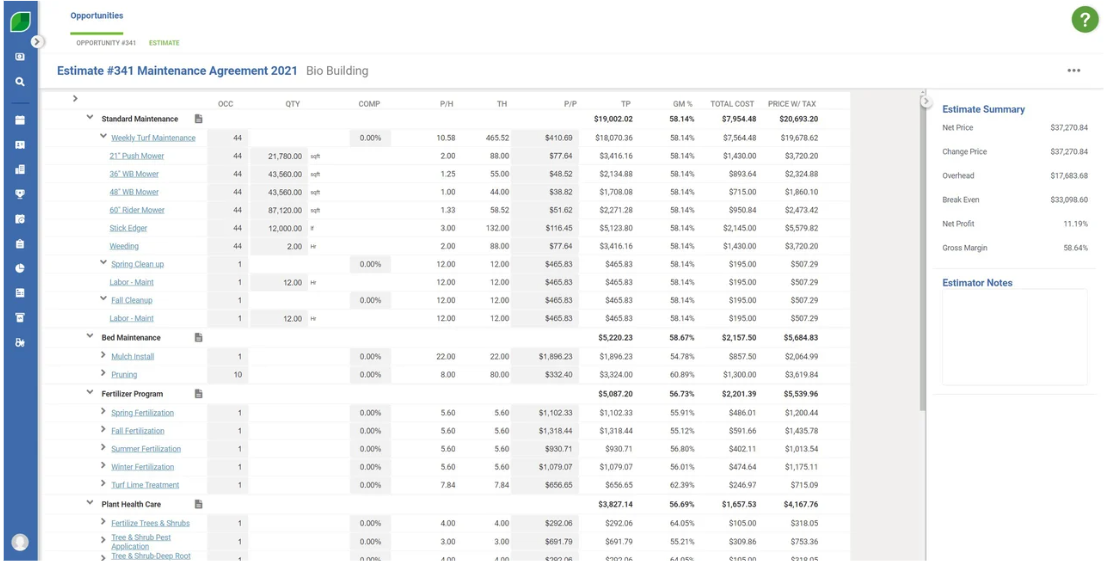
It allows you to see where margins hold or erode, so you can adjust future prices accordingly.
Essentially, Aspire lets you collect real performance data and connect it with estimating, so you can price accurately, protect margins, and scale your business confidently.
Over to you!
Pricing commercial contracts doesn’t have to be difficult. You can use the approach shared in this article as a starting point:
Calculate labor costs + overhead + materials and add a profit margin to get a price that covers all expenses and leaves a good take-home.
But when landscaping service demand increases, you need to consider automation with the help of estimating tools like Aspire.
You can create catalogs where you input labor and material or supply costs and profit margin. This way, instead of starting from scratch, you can quickly and accurately bid large or complex jobs by simply changing the property measurements and material quantities.
Book a demo with Aspire to see how it works.






 866-727-7473
 Schedule Demo
 390 S Woods Mill Rd #300 Chesterfield, MO 63017


