


Sam Rankin, president of ETCH Outdoor Living and Yardline Pest Control, lost six construction leaders in a matter of weeks, right before spring. His construction lead gave notice first. Days later, the project manager left, then four crew leaders, one after another. The last one walked out days before the season started.
Rankin and Nate Schweers, ETCH's business development lead and a partner at Yardline, shared what he did about it at Ignite 2026.
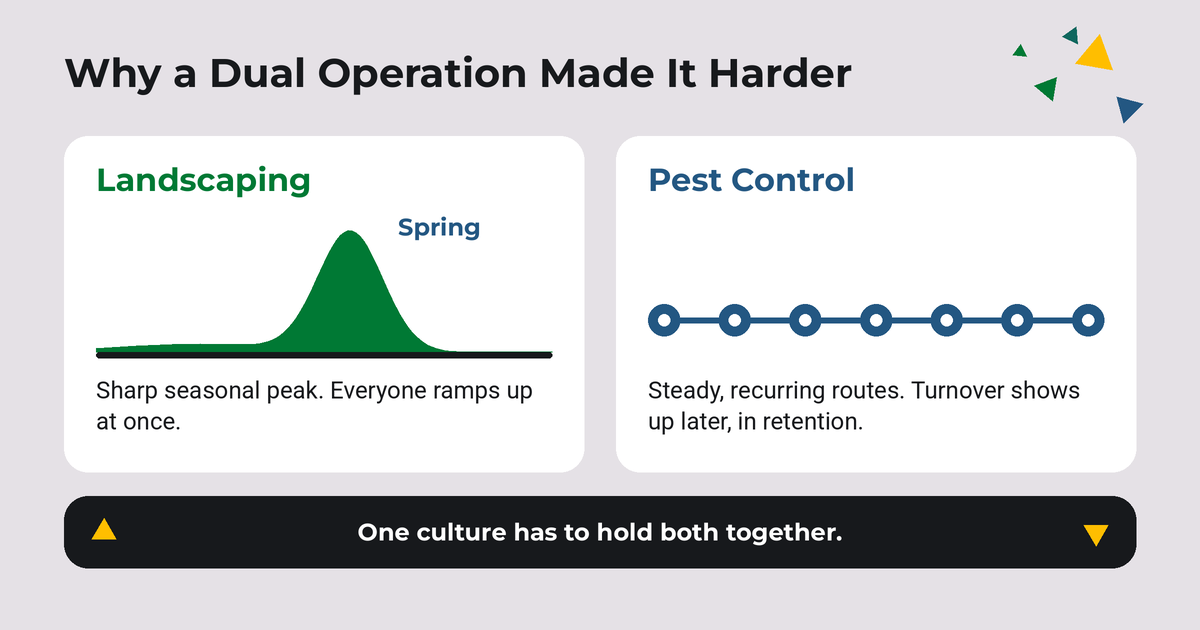
Why a dual operation made it harder
ETCH and Yardline run on different clocks, and one culture has to hold both together.
Landscaping has a sharp seasonal peak. Construction crews, designers, and project leads all ramp up at the same time, so losing a leader right before spring hits hard immediately. There's no slow season to absorb it.
Pest control has a steadier, recurring cadence, but it runs on routes. Customers build trust with the technician who shows up on the same schedule. Turnover on that side shows up later and quietly, in retention.
Rankin and Schweers built their talk around three questions.
How do you protect morale when change is forced on you?
How do you communicate so people stay?
How do you come out stronger on the other side?
Step 1: Stabilize before you strategize
Rankin said the first 48 hours came down to a choice between panic and discipline.
Panic looks like announcing something before you have a plan, making promises you can't keep, and letting the loudest rumor set the story. It also drags every remaining leader into crisis mode at once and burns out the people you need thinking clearly.
Discipline looks like controlling who hears what, and in what order. You say what you know and what you don't know yet. You make one steady decision, then the next, and you protect a few people's time so they can think.
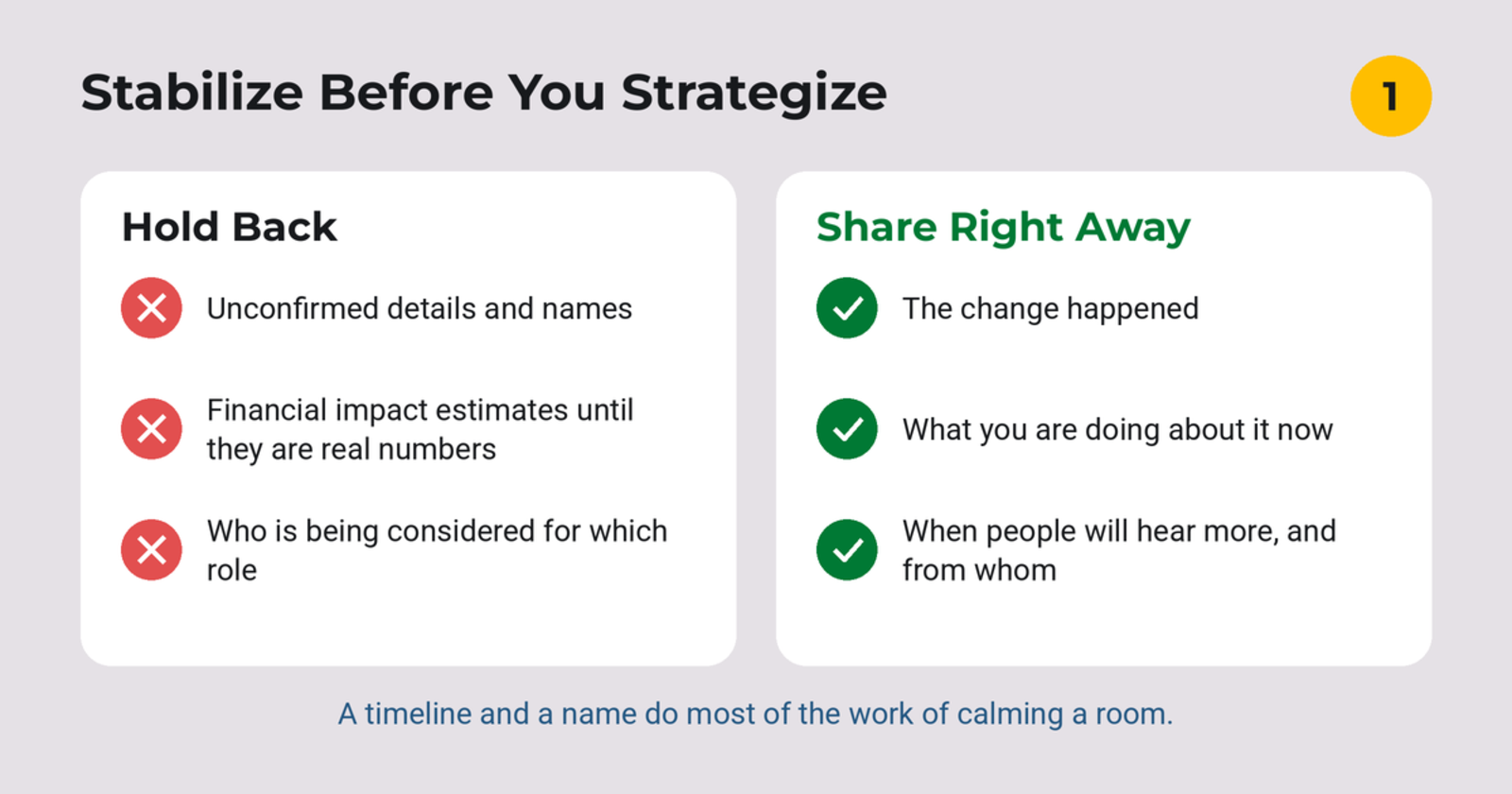
What to hold back and what to share.
Hold back unconfirmed details and names, financial impact estimates until they're real numbers, and who is being considered for which role. Floating names early creates politics and false hope.
Share three things right away:
The change happened
What you're doing about it now
When people will hear more and from whom
A timeline and a name do most of the work of calming a room.
Add oversight and keep leaders from stretching.
The usual instinct is to ask the remaining people to cover more ground. Rankin did the opposite. He added structure, more check-ins, and more presence on job sites while new leaders found their footing. Fewer leaders covering more ground looks efficient on paper, but morale drops as fast as the org chart shrinks. He called this a deliberate, temporary posture, and he scaled it back once the new structure could carry weight.
Replace the output.
When a leader walks out, the instinct is to find a copy of that person. Rankin asked a different question: what outcomes did that role produce, and can we rebuild toward those outcomes even if the new structure looks nothing like the old one?
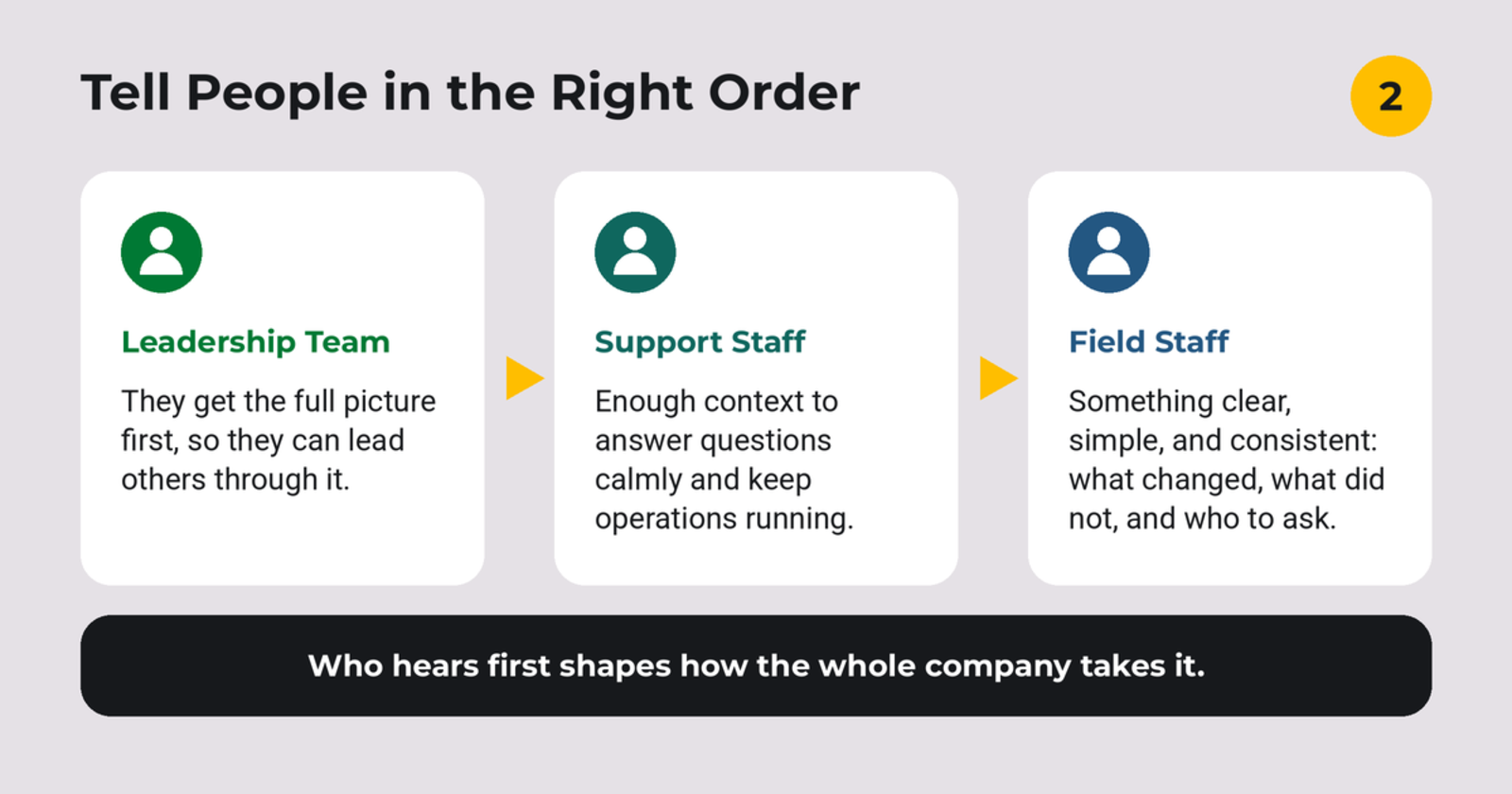
Step 2: Tell people in the right order
Rankin quickly learned that who hears something first shapes how the whole company takes it.
Leadership team. They get the full picture first. They have to lead others through it, and they can't do that if they're reacting alongside the field staff.
Support staff. They get enough context to answer questions calmly and keep operations running.
Field staff. They get something clear, simple, and consistent: what changed, what didn't, and who to ask.
Leaders who understand the why can absorb pressure from the field and hold it there. Reverse the order and your most junior people end up managing everyone else's uncertainty.
Cadence and channel.
Short, frequent check-ins beat one big announcement. When people go a week without hearing from you, they fill the silence with the worst version of the story. Use in-person conversations when something carries weight, group chat for quick updates, and one-on-ones for anyone directly affected.
Say so when you don't know.
Rankin used the same three-part sentence over and over: here's what's true today, here's what we're still working out, here's when you'll hear next. He said it did more to hold the team together than almost anything else he said.
Don't overshare and don't withhold.
Oversharing means passing along raw speculation and your own fear. Withholding means vague reassurance or false certainty, which falls apart when it turns out to be wrong. His rule for every conversation: say what's true, say what you don't know yet, and never say something you might have to walk back later.
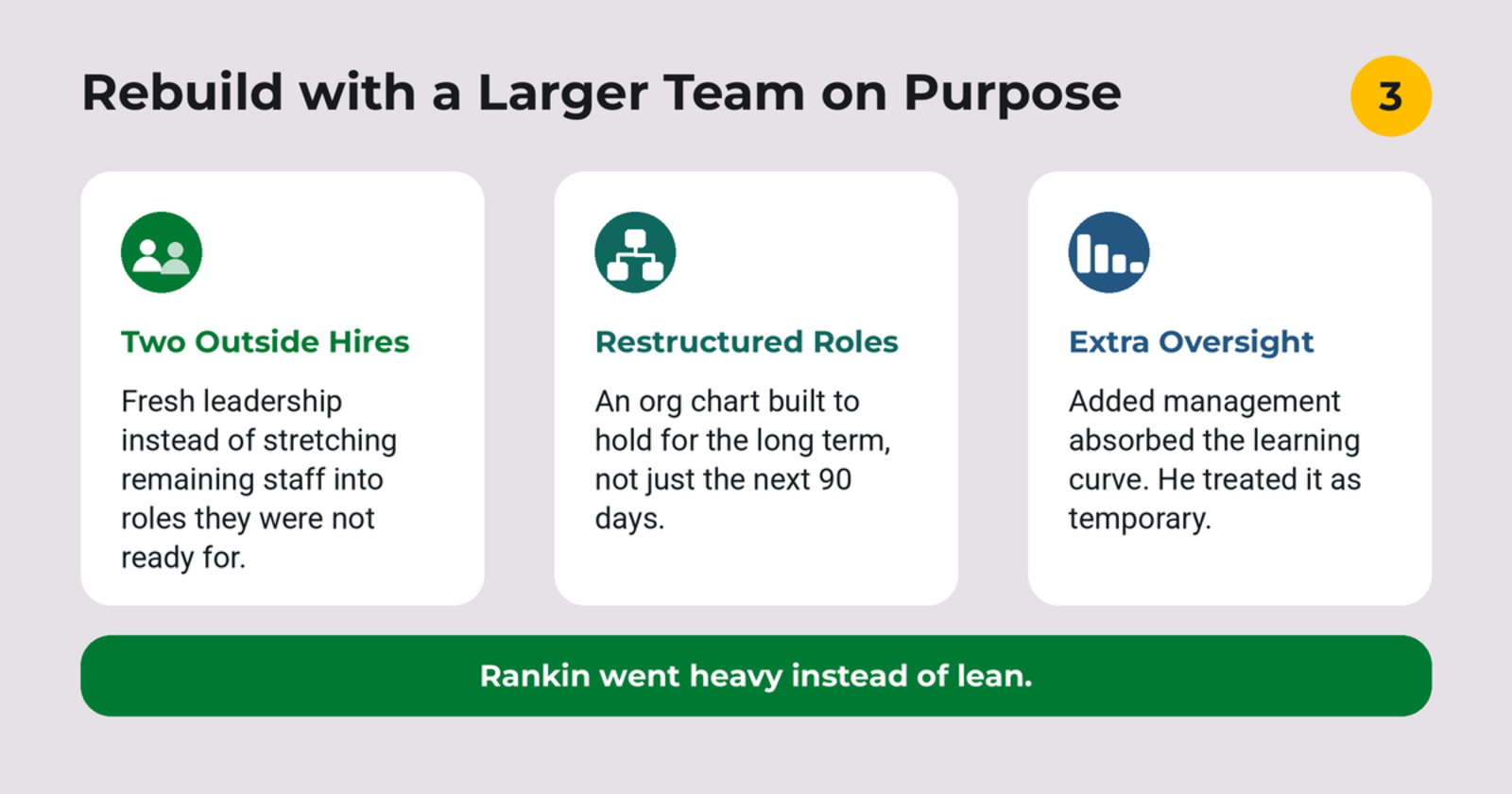
Step 3: Rebuild with a larger team on purpose
The rebuild started days before spring. The obvious move was to go lean, fill seats fast, and survive the season. Rankin went heavy instead.
Two outside hires. He brought in fresh leadership instead of stretching remaining staff into roles they weren't ready for. Promoting from within sounds good, and it can quietly set people up to fail.
Restructured roles. He rebuilt the org chart to hold for the long term, and the goal went beyond getting through the next 90 days.
Extra oversight to start. The added management absorbed the learning curve during the year's highest-stakes stretch, and he treated it as temporary.
What changed underneath
Before the departures, one person held institutional knowledge. Key roles had no documented backup, and trust ran through tenure and relationships. The answer to a question was "ask him, he'll know."
Now roles have built-in redundancy and processes are documented. Trust runs through communication systems and how long someone has been on the team. Rankin described the goal this way: no single departure, whoever it is, can do this kind of damage again.
Losing that many leaders also forced a hard look at what had been happening day to day. Work he had assumed was handled wasn't getting done, and the culture had drifted from what he thought he was reinforcing. The rebuild became a chance to realign expectations, build the team he wanted, and replace the one he lost.
Rankin says the company is stronger and more stable than before the crisis. He credits his response, not the disruption itself.
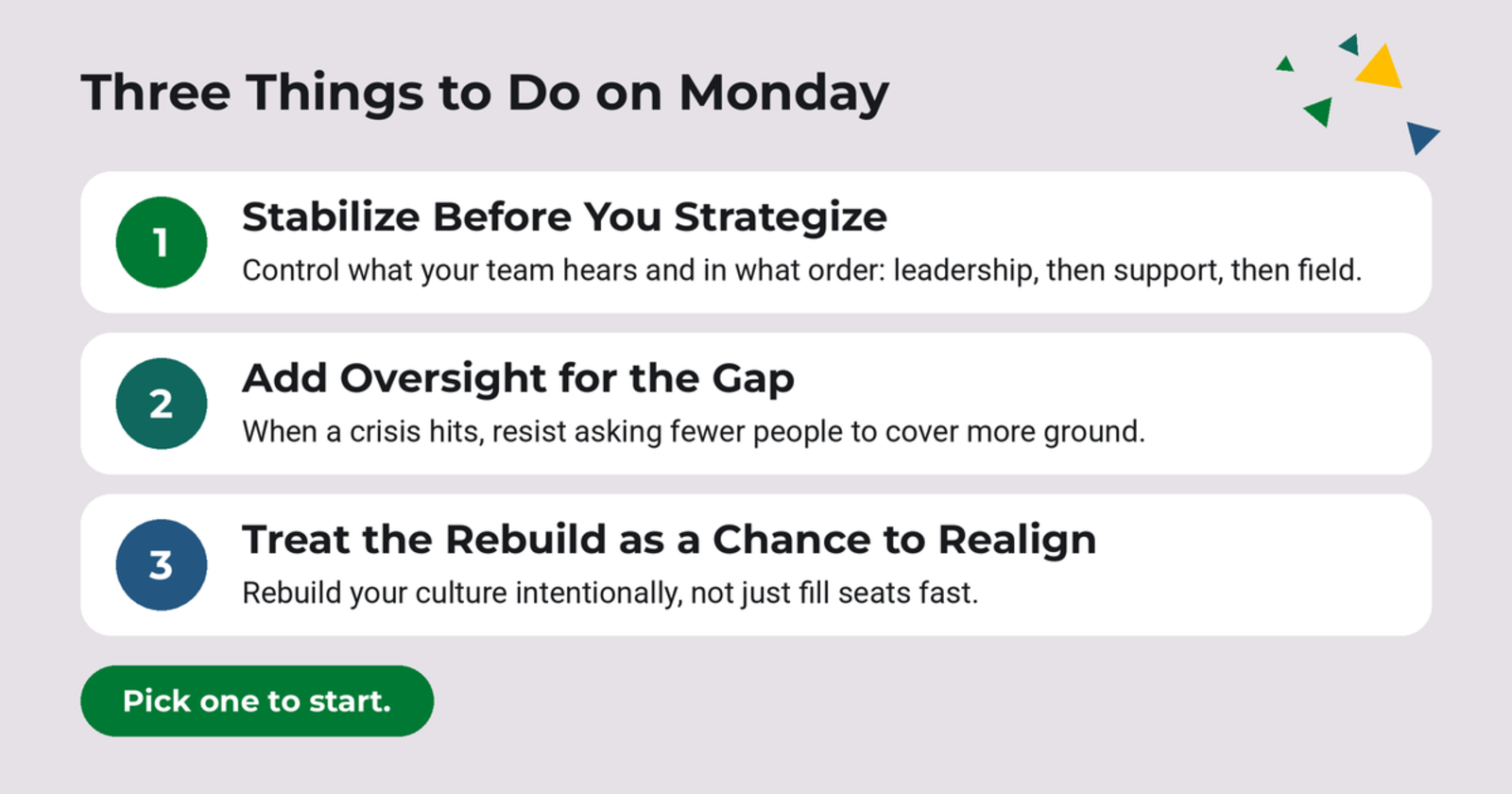
Three things to do on Monday
Schweers closed with a short list and suggested picking one to start.
Stabilize before you strategize. Control what your team hears and in what order before you work on the long-term fix. The order is leadership, then support, then field.
Add oversight for the gap. When a crisis hits, resist asking fewer people to cover more ground.
Treat the rebuild as a chance to realign. Use it to rebuild your culture intentionally, rather than filling seats as fast as you can.








 866-727-7473
 Schedule Demo
 390 S Woods Mill Rd #300 Chesterfield, MO 63017


