Table of Contents
Table of Contents
- Why do landscapers need a sales script?
- How a landscaping sales script helps you win clients
- How to write a compelling landscaping sales script
- What is a good landscaping sales script example?
- How do you qualify landscaping leads?
- How do you handle landscaping sales objections?
- Residential versus commercial landscaping scripts
- How to automate your sales follow-up and win more contracts with Aspire Marketing Pro
- Frequently Asked Questions (FAQs)
Ever been on a sales call where landscaping prospects get distracted, raise objections, or talk over you? While you’re trying to explain your vision for their landscape transformation, they keep interrupting with questions or say, “I’m busy” or “I’ll call you right back,” but you never actually hear from them again.
Other times, the conversation goes smoothly, but one client objection rattles you, and the opportunity to convert them fades.
If you struggle with inconsistent sales results, unstructured sales calls, and converting inquiries/leads into clients, a sales script can turn things around for you.
It’ll provide a framework for how you communicate, ensuring every conversation has the desired impact and drives conversions.
In this guide, you’ll learn how to create scripts that can close landscaping contracts based on what successful landscapers use.
You’ll also get a clear, actionable script example to guide sales calls and boost conversions.
Why do landscapers need a sales script?
Sales scripts give you an outline to follow when speaking with prospects and customers. They guide how you respond, handle objections, and carry the conversation.
Think of it like flashcards. But instead of helping you study for an exam, it structures the sales team’s interaction with clients.
Using a sales script:
Builds confidence: It ensures you or the sales team know what to say, reducing anxiety and improving delivery during sales calls.
Improves close rates: With a script, you touch on key client pain points, position your landscaping business as the solution, and invite clients to take specific actions.
Supports training and accountability: Scripts make it easy to train your landscaping sales staff and audit performance.
Ensures consistency: Scripts keep everyone aligned on the same page, regardless of who’s communicating with the client.
The main question, though, is: can it help you win clients? If yes, then how?
How a landscaping sales script helps you win clients
Without a sales script, every estimate or potential contract is a gamble.
Some days, you’re sharp, asking the right questions, handling objections smoothly, and closing the sale.
Other days, you leave the sales call wondering why you didn’t handle the conversation better.
That inconsistency impacts your close rate and can lead to unpredictable revenue.
A script changes that by providing a system that ensures clients get your best and helps you secure contracts. Here’s how it does that:
Positions you as a landscaping expert: Whether it’s you or the sales team that’s on a call, a script positions you as an expert. It guides you to ask discovery questions before suggesting solutions.
This gets clients to see the landscaping team as knowledgeable and experienced. Instead of answering how much you charge, ask what they need to get done, their timeline, or if they’ve worked with other landscape contractors.
The script helps you ask thoughtful questions so clients see you as a consultant who understands their needs, not just another contractor chasing a paycheck.
Handles objections before they derail the conversation: A good script prepares you to answer common objections typical landscaping clients have, so you don’t freeze up on a call.
For instance, if they say, “Let me think about it,” after what you consider a good conversation, you can respond with, “That’s fine; we can actually visit your property so we can move fast when you’re ready.”
This way, instead of stumbling or getting defensive, you can smoothly respond to the objections and steer the conversation in a way that you want. Even if they don’t become clients immediately, they can become a part of your email list.
Increases confidence so you can close more deals: When you know what to say at every turn, you show up with confidence. And clients can sense that.
You’ll sound like you’ve handled the landscaping project they need 100+ times, aren’t desperate for the sale, and are confident in the value your team brings and the pricing you charge.
When you’re certain, it shows, and clients feel more confident about working with you.
Creates urgency and direction without being pushy: Scripts provide natural transitions to help you close a sale. They keep you in control of the conversation without making prospects feel pressured.
For instance, you could say, “Based on what you’ve shared, it sounds like getting this done before summer is important. Our schedule fills up about 6 to 8 weeks out. If we get your deposit this week, I can lock you in for early May or July. Does that timeline work?”
You’re creating urgency based on their needs, encouraging them to make a decision fast.
Let’s now discuss how you can create an effective sales script for your landscaping business.
How to write a compelling landscaping sales script
A sales script can help you close deals, but only if you focus on your prospects and clients, not your landscaping business.
The script should feel like a natural conversation that guides prospects toward realizing you’re the right choice.
So, think like a prospect and structure the script around what questions they might have. What concerns are holding them back? What outcomes do they actually care about?
Here’s how to structure your script:
Step 1: Start with a warm introduction
When you start a conversation with clients, focus on building a personal connection. Introduce yourself and the company, then ask how they’re doing or how their day is going.
Try to find a shared experience or common ground. Ask if someone referred them and where their property is located so you can find something to connect over.
The shared experience can make them feel relaxed and trust you from the get-go, bringing you a step closer to securing a contract with them.
Even if you don’t have something to bond over, ask how they found out about you to build rapport.
Example: Hi [Name], I’m [Your Name] from [Company Name]. Thanks so much for hearing me out today — I appreciate you taking the time. How’s your day going so far? Before we talk about the property, I’m curious about how you heard about us. Was it through a referral, or did you find us online?
[If referral]: "Oh, [Referrer’s Name]! They’re great. We did their backyard last spring — the patio project, right? How do you know them?
[If location-based connection]: "And you’re in [neighborhood/town], correct? We’ve done quite a bit of work in that area. Are you familiar with [local landmarks or streets]?
Step 2: Find out what they need
Remember, the conversation is about helping your clients, so focus on discovering what they need.
Steve Corcoran, CEO of Lawn Love, says, “People don’t often know where to start with the landscaping or lawn projects, so what we want to do is help people out.” If you can nail that, you’re halfway there to winning a contract.
Here are some questions you can ask to uncover what they need:
What are your top three landscape concerns?
What are your top three things you want to see change?
What is the reason for the change, and when?
Do you/they have a budget? We have a minimum of $1,000 per month.
Do you have any questions or concerns about working with us?
What’s the condition of your lawn? What types of issues have you experienced with it in the past?
Have you serviced the lawn yourself or always hired a professional?
The idea is to understand the customer, their budget, and the job to help you define the next step.
Step 3: Position your landscaping service as their solution
Now that you’re clear on the customer’s needs, it’s time to introduce your landscaping service as the ideal solution to their challenge.
Give them a breakdown of how your service fits them and why you’re ideal for the project.
Your response could be along the lines of:
“So, from what I gather, it seems you’ll benefit from our starter lawn care service. We’re probably different from other services you’ve used because we do [XYZ tasks] on the property to ensure you get a beautiful, thick, weed-free lawn from spring through fall.
We also eliminate crabgrass, spurge, and other weeds at no extra cost. Plus, if you notice anything within [X amount of time], we’ll come back out at no charge. Does this sound like what you’re looking for?”
This phase is about setting your landscaping business up and building credibility and trust.
Step 4: Handle potential concerns clients may have
Prepare to address possible objections your prospects may have by being familiar with questions within the landscaping industry, budget, timelines, and value.
In landscaping, clients typically have objections around cost, a contractor’s expertise, DIY experience, service quality, working with the competition, fear of change, timeline, and personal preferences.
So, you need to have prewritten responses for any concern.
For instance, if the budget is a concern, consider offering discounts or open promotions that they can leverage.
“Based on the size of your lawn, and because you’re a new customer, I’m happy to offer you our 30% discount on services. This would bring your total cost to…[insert price].”
While this step may not always be part of your sales call, it’s ideal to have answers in anticipation.
Read more about how to respond to objections during a call.
Step 5: Close the deal
After responding to the objections, guide the clients to act. This can be scheduling a site visit for inspection and estimation or adding them to your email list.
Before you make your final move, always remember that clients think about themselves first. So, you need to leverage that.
Kevin Kehoe, the late co-founder of Aspire, describes how you can do that with an example:
“Our clients work with us because we help them manage their landscape dollars better. You’ll spend money in three ways with any contractor:
1. monthly services;
2. fixing, repairing, and replacing things as they age like your irrigation system;
3. enhancement and property improvements.
If you don’t spend enough on the first, you end up spending way more on the second, which leaves very little for the third. In your current situation, where would you rather be spending your money?”
He says that should get them talking and interested. Then you can ask if they are ready to sign up for your program.
What is a good landscaping sales script example?
Based on the structure provided above, here’s a sales script example you can customize to improve sales calls and close more contracts:
Hi [prospect name], this is [your name] from [your landscaping company]. Thanks so much for reaching out! How's your day going?
I see you contacted us about [lawn care/landscaping project]. I'm curious: how did you hear about us?
Use their answer to build a connection and form a rapport.
[If referral]: Oh, [Referrer's Name]! They're great. We did their backyard last spring. The patio project, right? How do you know them?
[If location-based connection]: And you're in [neighborhood/town], correct? We've done quite a bit of work in that area. Are you familiar with [local landmarks or streets]?
[If online]: Oooh! Was it our ad on [x] that project you saw?
Next, ask questions about their challenges, property, budget, and timeline:
What are the top three things you want to see change?
What's prompting this project now? Is there a specific reason or timeline?
What's the current condition of your lawn? What issues have you experienced in the past?
Have you maintained it yourself, or do you typically hire professionals?
Do you have a budget range in mind? Just so you know, our minimum project starts at [$ amount] per month for ongoing services.
Do you have any concerns about working with a landscaping company?
Take time to get specifics and define what a successful outcome would look like.
Then, proceed to describe how you’ll handle their project. Avoid being too technical. Focus on the benefits clients will get and keep it short.
From what I'm hearing, you'd benefit from our [starter lawn care program/full landscape renovation/hardscape installation].
Compared to other services you've used before, we [mention specific approach: scheduled treatments, guaranteed weed control, custom design process].
Here's what you'll get: a beautiful, thick, weed-free lawn from spring through fall with consistent treatments on a set schedule. You will also get an account manager assigned to you. They'll be your primary point of contact at all times. This means you won't be left waiting for a response. More importantly, you'll get a plan showing you ways to manage your budget better and improve your property.
And if you notice any problem areas within [X timeframe], we'll come back out at no charge.
Give them time to ask questions or share their concerns and respond confidently to show experience, skill, trust, and empathy. Then, lead them to act.
Great! So would you like to get started with [specific service program], or would you prefer I schedule a site visit to give you a detailed quote first?
If they're ready: Perfect! I can get you locked into our schedule for [date/timeframe]. I'll send over the agreement, and we'll get this moving for you.
If they need to think: No problem at all. When would be a good time for me to follow up? Does [specific day/time] work to reconnect?
How do you qualify landscaping leads?
Not every sales call translates to a contract. So, part of your script should include questions to help you qualify leads to determine if they’re a good fit.
Chad Diller, vice president of Landscape Leadership, a sales and marketing agency for lawn and landscape companies, suggests qualifying questions around five areas:
Needs: What specific problems are they trying to solve? While a patio can be considered a need, dive into how it impacts their daily lives and overall goals.
Budget: Do they have a realistic budget for the project? It doesn’t have to be specific; a range can help assess where they’re at.
Timeline: When do they need the project done, and does it align with your company’s schedule?
Authority: Are they the decision makers, or do they have to defer to someone else?
Positioning: Do they consider the landscaping project an important job or a quick fix? This helps you assess if they align with your ideal customer persona.
The key when asking qualifying questions is framing the process as mutually beneficial. “If you say, ‘I want to save you (the client) time and make sure this is good for both of us,’ it disarms the conversation,” Diller says. This positions you as an expert determining fit (a premium experience), not a salesperson chasing any deal.
How do you handle landscaping sales objections?
Constant objections from clients during a sales call can be frustrating. But they can be an opportunity rather than a roadblock.
Kenneth Deemer, co-founder of Local Roots Landscaping, says that sales objections are an opportunity to uncover the client’s true priorities and adjust your solution to meet their needs.
Here’s how to navigate objections:
Understand the client’s worries: Listen to what they’re saying and ask questions about what’s most important to them. Get to the root of their objections. Why is a patio, for instance, important to them?
Affirm your commitment to excellent work: If the client’s bad experiences with landscaping contractors are why they’re objecting, acknowledge their concern and commit to doing a better job. This might be a good time to throw in an offer.
Avoid being defensive: When clients object to a design or professional recommendation, don’t get flustered or defensive about it. Instead, patiently explain your approach. If possible, share testimonials of how you’ve helped clients like them to build trust and understanding.
Provide alternatives: Landscaping project cost is a common objection you might face with clients. The best way to handle this is to provide options: installment payments, financing options, and reducing the scope of work.
Residential versus commercial landscaping scripts
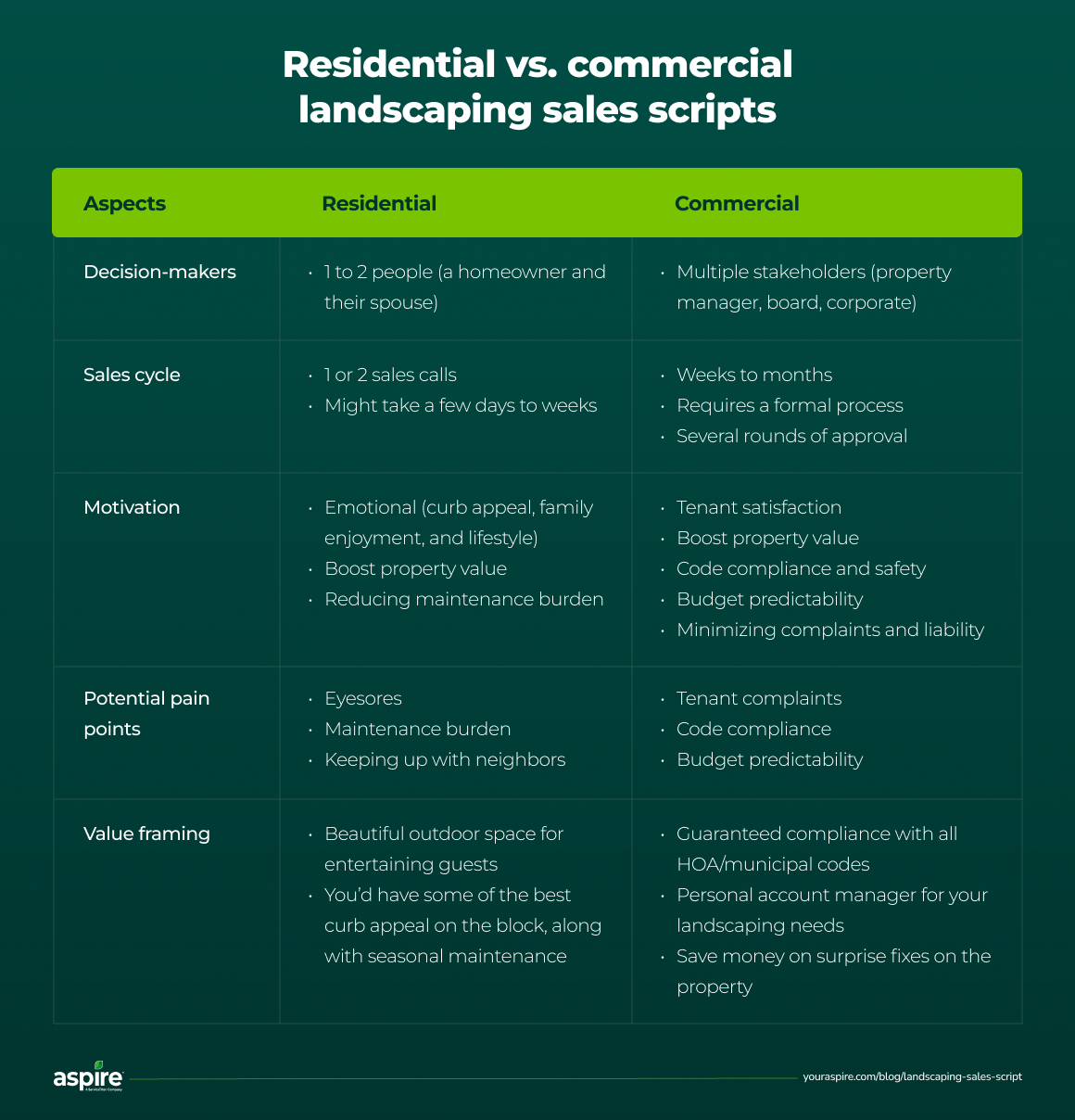
You should keep in mind that the scripts that work for residential clients won’t work for commercial customers. Understanding these differences helps you adapt your approach and close more deals in both markets.
Here’s a breakdown showing how they differ:
How to automate your sales follow-up and win more contracts with Aspire Marketing Pro
After a sales call, you’ll have won a contract or gained a solid lead. Either way, you’ll have all the client details you need to kick off welcome campaigns or follow-ups.
If you use a tool like Aspire, you can leverage such data to keep customers happy and win back leads who canceled or have gone cold. Its Marketing Pro tool lets you add client information and create a welcome campaign for new customers. You get to appreciate them and provide scheduling information.
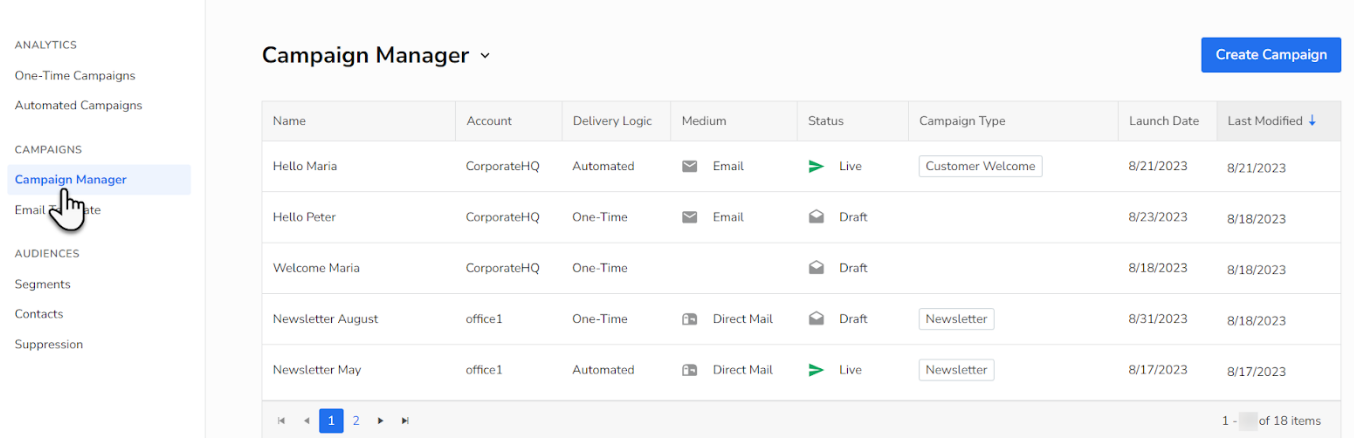
It’s a good opportunity to increase awareness, build trust, and maintain cordial relationships with the clients.
With Aspire’s Marketing Pro, you get to send personalized emails, SMS, and postcards to the right customers at the right time.
You can set up drip campaigns for welcome sequences, renewal reminders, upsells, and win-back campaigns.
For leads that didn’t become customers, you could create an email campaign in the app, sharing a specific offer or discount to convert them.
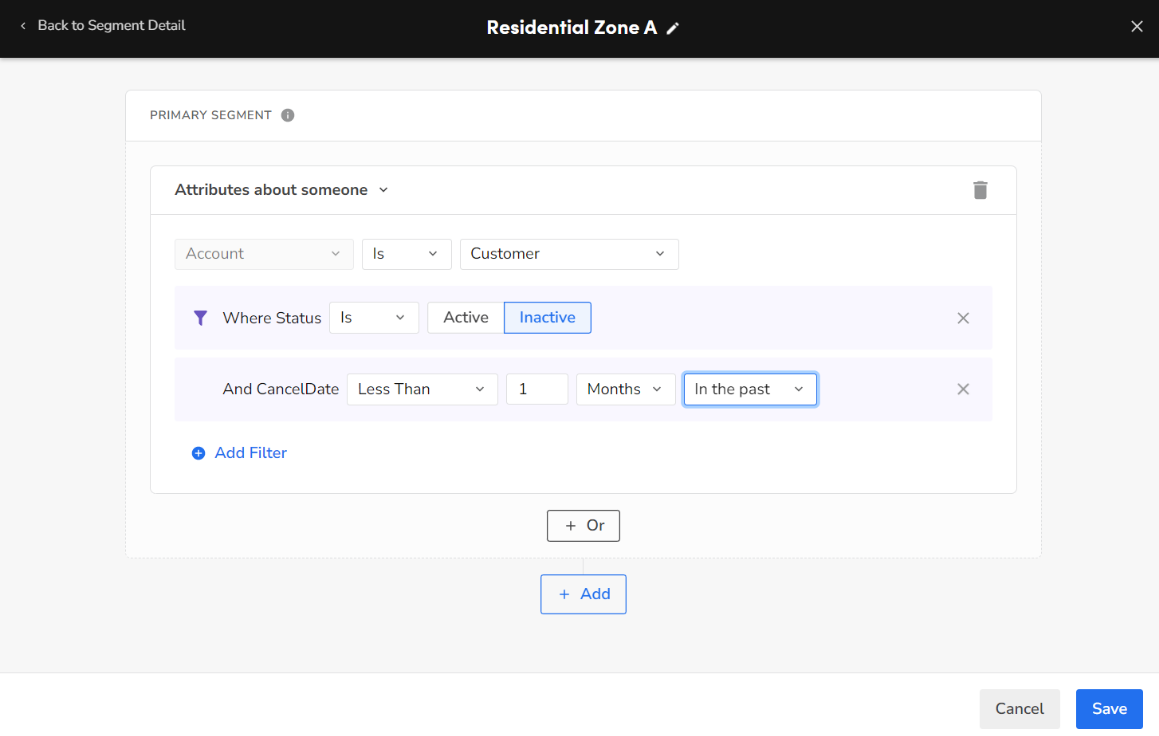
The good thing about Aspire’s marketing system is that you don’t have to build the campaigns from scratch; there are templates to help you launch quickly.
Plus, you can combine email, text, and direct mail to reinforce messaging and build customer relationships.
Want to see how it works in real time?
Schedule a free demo with Aspire.
Frequently Asked Questions (FAQs)
What is a landscaping sales script?
A landscaping sales script is a framework that guides sales conversations from start to finish. It’s a roadmap that ensures you ask the right discovery questions, position your service as a solution, respond to objections confidently, and close the deal.
It is not a script you memorize word-for-word and read. A sales script should always be a guide.
How long should a landscaping sales call be?
Sales calls should last between 15 and 30 minutes for phone conversations. In-person communication might take a bit longer.
The idea isn’t to rush the discussion, but to take control, provide value, and uncover real needs. If you go beyond 45 min on a sales call, there’s a chance you’re overexplaining or dealing with an indecisive client. Avoid that and steer the conversation with open-ended questions.
When should landscapers update sales scripts?
It’s time to update your sales scripts when:
Conversion rates are declining
Clients keep objecting during calls
A new service has been launched
There are ongoing promotions
Project pricing changes
Client pain points in your region keep shifting
A good rule of thumb is to review the scripts’ impact quarterly using feedback from the sales team.
Can landscaping sales scripts sound natural?
Yes, a landscaping sales script can sound like an actual conversation, not a robotic sales pitch. The key is to avoid memorizing it verbatim and use it as a guide.
Practice the framework with natural conversational phrases, such as ‘I’m curious’ instead of ‘let me ask you.’
How can technology support landscaping sales scripts?
Technology can automate follow-up and client communication, helping you to send reminders when they drop off in your sales process.
Systems like Aspire’s CRM can store client information so you can personalize scripts based on their position in the sales funnel, past interactions, existing projects, and preferences.
With its Marketing Pro tool, you can send scripted email sequences after calls, reinforce your pitch with direct mail, and nurture leads who aren’t ready to buy yet.
There are many tools, such as SalesLoft or Gong, that record calls to help refine scripts using information from real client conversations.









 866-727-7473
 Schedule Demo
 390 S Woods Mill Rd #300 Chesterfield, MO 63017


