Table of Contents
Table of Contents
- What are landscaping business skills?
- Why are business skills important for landscapers?
- What leadership skills do landscaping owners need?
- What financial management skills are required?
- What estimating skills must landscapers develop?
- What sales skills help landscaping businesses grow?
- What marketing skills do landscapers need?
- How important are customer service skills in landscaping?
- What project management skills are essential?
- What hiring and team management skills are required?
- What technology skills benefit landscaping businesses?
- How can landscapers learn business skills?
- How does Aspire help landscapers run better businesses?
- Frequently Asked Questions (FAQs)
You know how to:
Plant and care for trees and flowers
Install, maintain, and troubleshoot sprinkler and drip irrigation systems
Construct non-plant features, such as patios, walkways, retaining walls, fences, decks, and water features
Create and implement outdoor designs
You’ve done these for several years and have even launched a landscaping company.
But do you have the skills required to grow and run a successful business?
Beyond being an experienced landscaper, running a lawn care company requires business skills, such as client relationship building, time management, financial management, and team leadership.
These skills can give you an edge over competitors when bidding on projects.
Wondering what they are?
Read on to explore the skills you need to cultivate and improve your landscaping business.
What are landscaping business skills?
Landscaping business skills are a mix of leadership, financial, operational, and business management abilities that help landscaping business owners run their companies efficiently, deliver high-quality work, and stay profitable.
They go beyond mowing or landscape planning and focus on the business side of things. Here, you’re asking:
How do we get clients to trust us?
How do we get more clients?
How can our landscaping company stand out?
How do we save more?
Do we have the right structure to take on more clients?
How do we handle contracts, proposals, and renewals better?
How do we leverage marketing channels to generate leads?
How do we upsell services?
How do we manage projects better and save money?
Why are business skills important for landscapers?
Landscapers need business skills to operate efficiently, better satisfy client needs, and scale the company. They help turn good workmanship into profitability.
Without these learned abilities, you may struggle with cash flow, take on unprofitable clients, lose track of costs, and underprice jobs.
More specifically, business skills are important because they help with:
Growth management: As your landscaping business takes on more clients, you can’t keep running it alone anymore. You need business skills like hiring, crew management, and scheduling to scale without your operations descending into chaos.
Client acquisition and retention: Marketing, strong communication, contract management, and client service are skills you need to secure and retain clients. This aspect is especially important because clients are the lifeblood of a landscaping company. And without them, there’s no business.
Seasonality management: In most climates, landscaping is seasonal. You need financial and operational planning skills to manage slow periods, retain employees, and avoid cash-flow dips.
Competitive advantage: Beyond securing clients, you need to prove your business is better than the competition. You do that not by saying you are better, but by showing clients through marketing, branding, and sales skills. That’s how to stand out.
Legal and compliance risk: Without business knowledge, you may operate outside the confines of the law by skipping a license and operating without adequate insurance. That can put the business at huge risk and expose it to serious liability.
What leadership skills do landscaping owners need?
Every high-performing landscaping business needs effective leadership to provide clear direction and keep the team aligned.
You need the skills below to ensure your crew doesn’t struggle to be productive.
Problem-solving
Team management
Conflict resolution
Decision-making
Motivation
Delegation
1. Problem-solving
Landscaping business owners need to know how to identify problems, brainstorm solutions, evaluate them, and implement them.
Say one of your mowing contracts is taking longer than estimated, increasing labor costs. That’s a problem that can affect your profitability. As the owner and leader, it’s up to you to critically think about solutions.
Ask field crews for their perspective. If you find obstacles on the property are slowing the crew down, you can adjust their workflow by assigning one worker to trim obstacles while others focus solely on mowing. Or you can switch to using smaller equipment for tight spaces.
As a strong leader, it’s up to you to step in to define issues, adjust plans, and keep crews working.
2. Team management
Landscaping jobs can be unpredictable.
Sometimes they go exactly as planned; other times, they don’t. You must learn how to organize crews, assign responsibilities, and communicate the scope of work effectively.
If a difficult client has just made a job challenging for your crew, you must be emotionally mature to boost their morale and empathetic enough to understand their experience.
Being the leader means thinking like a coach who can reduce confusion in the field, improve productivity, be firm and understanding, make hard decisions, and keep projects on schedule.
3. Conflict resolution
When disagreements arise between landscaping crews and clients, a good leader should address conflicts calmly. Listen to both sides and resolve issues in a way that maintains professionalism and team morale.
You should be objective and not pick sides. Try to address matters in a way that improves relationships and promotes a productive environment.
4. Decision-making
Landscape business owners often need to make quick decisions about scheduling, equipment, staffing, pricing, and client requests.
As such, you should be skilled at analyzing situations, evaluating options, and making the right decisions through clear thinking, data analysis, and emotional control.
When you make the right decisions, projects stay on track and operations continue without unnecessary delays.
5. Motivation
Landscaping work can be physically demanding. Customers keep calling, and your schedule is tight. To keep operations running smoothly, you need to maintain motivation and encourage employees.
You can do this by recognizing and appreciating good performance, supporting crews that are having a hard time, or sharing the impact their work has had on clients.
6. Delegation
Another important leadership skill to have is knowing how to delegate responsibilities. As the business grows, you can’t handle every task, and assigning work to the wrong person can disrupt workflow, productivity, and profit.
You must know how to identify good talent and delegate work to them. One way to do this is to give responsibilities to people who’ve been with you a long time.
What financial management skills are required?
To run a profitable landscaping business, you need financial literacy. You need to know how to track expenses, revenue, and cash flow to know if your business is actually making or losing money.
The most important financial skills for landscapers include:
Budgeting
Pricing strategy
Cash flow management
Expense control
1. Budgeting
Your landscaping business needs a monthly and seasonal budget for labor, materials, equipment, and overhead. That’s how you can plan and set profitable prices for your services.
Learn how to create a budget that meets your landscaping business needs. A clear budget ensures you can cover expenses in and out of season.
Plus, you can handle billing without worrying about where money will come from.
2. Pricing strategy
Leading a landscaping team means knowing how to estimate projects for profit and support business growth.
You should know how to calculate labor, overhead, and material costs so you can set competitive prices and adjust rates when expenses increase.
It’s also important to learn how to:
Research competitor pricing and client income to guide your landscaping prices
Offer multiple pricing options based on a client’s budget
Merge services for bundle pricing
3. Cash flow management
You must be familiar with tracking labor, material, fuel, equipment, and overhead costs for each job. This helps you estimate revenue, expenses, and business profit. You can also assess project profitability and avoid underpricing in the future.
By monitoring payments, scheduling expenses, and maintaining reserves, you can keep the landscaping business operating during slower months when revenue is low.
4. Expense control
You need to know how to ensure the business spends less than it earns to enable growth. This means tracking revenue and expenses, reducing unnecessary spending, and improving operational efficiency without affecting service quality.
Another part of expense control is preventing waste. For instance, you can schedule jobs and crews to reduce overtime, maintain equipment promptly to prevent expensive breakdowns, or buy the right amount of materials to avoid unnecessary purchases.
What estimating skills must landscapers develop?
Estimating skills help you avoid underpricing or overpricing jobs, protect profit, and keep the business going.
Here are some important estimating skills to learn:
Accurate property measurements
Material takeoffs
Labor and overhead costing
Digital estimating
1. Accurate property measurements
You need to know how to measure the square footage of client sites, accounting for slopes and access.
This is crucial because it tells you how many workers the project needs and helps you estimate labor costs accurately.
You should also learn how to interpret blueprints and site plans. Without that skill, it's difficult to offer design services or bring your landscaping plans to life accurately.
2. Material takeoffs
Calculating the exact quantities of materials needed for a project is an important skill to have.
How much mulch, seed, sod, plants, gravel, or pavers do you need, including waste allowances and overordering buffers? That’s how you can calculate the material costs when pricing a landscaping job.
Find out how to source accurate and current material costs from suppliers so you can give accurate estimates to clients.
3. Labor and overhead costing
Part of your estimating skills should include calculating labor and overhead costs. How many realistic hours per task would the project need based on your crew size and conditions?
You should know the cost of paying employees per hour, including wages, taxes, benefits, and insurance. Account for travel time, setup, and cleanup.
Understand overhead (fixed costs for equipment, insurance, vehicle, rent, utilities, and admin), then spread it across jobs. Make sure every estimate contributes to your overhead.
Plus, you must know how to apply profit margins to projects instead of guessing and adjusting pricing based on complexity.
4. Digital estimating
To keep operations running smoothly, automate processes, and save time and costs, explore estimating software like Aspire to standardize the process.
Using estimation software speeds up your workflow so you can focus on managing teams and clients and delivering quality landscaping services.
Estimating software can also help track actual versus estimated job costs to improve your pricing accuracy.
What sales skills help landscaping businesses grow?
You need sales skills to convert prospects to clients and convince one-time customers to become long-term accounts.
But what abilities in particular?
Relationship management
Closing techniques
Consultative selling
Upselling and cross-selling
First impressions and professionalism
1. Relationship management
First, you need to record client information in real time to personalize communication. Learn how to stay in touch with past clients through seasonal check-ins or a newsletter.
You want to build loyalty that makes clients resistant to competitor offers.
2. Closing techniques
Closing is about making things easy for the customers to say yes to your proposal or request and removing friction from the process.
Do that by creating urgency around seasonal availability and scheduling. Provide simple contracts with clear, straightforward steps. Instead of waiting for approval, ask for their business straight up.
3. Consultative selling
One skill to learn as a landscaping business owner is not to sell too much but to listen to what the client needs, including their budget and timeline.
Ask questions about what they want and position yourself as a trusted advisor, not a vendor. Then, tailor each proposal to their specific needs.
4. Upselling and cross-selling
Existing clients are your easiest sales. They already trust you, so introducing new services to them increases your average job value without the cost of acquiring new customers.
You need to learn how to identify services that clients can benefit from. Offer maintenance agreements and seasonal packages, and introduce them naturally during in-person conversations.
5. First impressions and professionalism
Clients begin evaluating your landscaping service from the moment they interact with you.
As such, you need to brand your landscaping company through appearance, punctuality, skill, knowledge, and customer service.
Show up on time, present proposals instead of scribbles or word-of-mouth descriptions, be patient, and follow up promptly.
What marketing skills do landscapers need?
Knowing plant names or being a skilled landscaper helps, but it won’t send clients your way.
You need marketing skills that attract a steady stream of clients, build brand recognition, and reduce reliance on word of mouth alone.
Here are some top marketing skills you need:
Branding and positioning
Local SEO
Digital marketing
Direct and community marketing
1. Branding and positioning
Present your landscaping business professionally with a clear brand, including a logo, color scheme, tone of voice, website, and consistent messaging.
This also includes professional vehicle wraps, uniforms, and yard signs.
Strong branding helps clients recognize your landscaping company and builds trust.
2. Local SEO
Optimize your landscaping service for local search so people can find your brand when they need it.
You can do that by learning how to:
Optimize a Google Business Profile with photos, services, reviews, address, and hours
Get listed in local directories
Use location-based keywords on a website to rank in local searches
Part of local SEO is also requesting and sharing client testimonials on Google and local directories. Those are forms of social proof that can attract prospects and convince them to become clients.
3. Digital marketing
In addition to local SEO, use social media marketing, email marketing, content marketing, and paid advertising to increase reach and generate leads.
Customers use most of these channels frequently. Knowing how to market your landscaping services through them can increase visibility and generate leads.
So, you might want to learn how to:
Manage social media accounts for your business. Post consistently, sharing high-quality visuals and engaging your audience.
Run content marketing strategies. Publish SEO- and AIO-optimized blog posts. Create and post informative videos on YouTube and social media. Use content to position your brand as an expert, not just a vendor.
Launch email campaigns. Build a client list to send emails for promotions, reminders, contract approvals or renewals, or announcements.
4. Direct and community marketing
Landscaping business owners must learn how to speak to people about their services in person. Practice selling offers to clients, sharing postcards, and placing door hangers in targeted neighborhoods.
Consider sponsoring local events for visibility or partnering with complementary businesses like real estate or property management companies.
How important are customer service skills in landscaping?
Nurturing client relationships can be the difference between landscapers who get one-time jobs and those who keep repeat, long-term customers.
You need these strong customer service skills to build trust and maintain relationships:
Communication
Expectation management
Problem resolution
Active listening
1. Communication
Clear communication ensures clients understand the project scope, pricing, and schedule for the service you’re offering. You must learn how to explain services, answer questions, inform clients about delays, provide updates, and set expectations to avoid misunderstandings.
A key skill is proactively updating customers before they ask, showing your commitment to them.
2. Expectation management
Clients should know what to expect when they hire you for a service. Even if you’re working with what they want, you must explain what that means to avoid ambiguity.
Set realistic timelines, document the scope to avoid or reduce disputes, and outline maintenance schedules.
3. Problem resolution
When incidents happen with clients, it’s up to you to address them quickly and professionally. Stay calm, find out why they’re unhappy, own mistakes without getting defensive, and know when to offer remedies.
Being helpful, responsive, and patient can help maintain customer trust and protect your company’s reputation.
4. Active listening
Understanding what clients want before offering a solution is an important skill. Listening helps tailor your services to meet their needs, avoid misunderstandings, and deliver results that exceed expectations.
You can pick up on excitement, hesitation, or concerns, which helps you tailor landscaping solutions to each client’s needs.
What project management skills are essential?
Landscaping businesses need project management skills to complete jobs on time, stay within budget, and keep projects running smoothly.
Skills like these help clients trust you, reduce labor costs, and encourage repeat business.
Scheduling and time management
Scope definition
Resource allocation
Documentation and tracking
1. Scheduling and time management
Landscaping jobs typically depend on factors like weather, material arrival times, and crew availability. And all of that shifts constantly.
Strong scheduling keeps multiple jobs going without things falling through the cracks. It reduces downtime, improves productivity, and ensures jobs are completed efficiently.
You need to learn how to build:
Realistic timelines that account for delays and dependencies
Workflows that sequence tasks in the right order
Efficient schedules that meet deadlines
Flexible plans to adjust timelines proactively, not reactively
You need to balance workloads, avoid scheduling conflicts, and ensure crews finish within a timeframe.
2. Scope definition
Part of project management involves defining what you need to do to protect both clients and the business. Without it, scope creep slowly eats into your profit on each project.
So, you want to document deliverables, materials, and boundaries in writing. Get clients to sign off before mobilizing crews, note scope changes, and price them accordingly.
3. Resource allocation
You need to deploy the right crew, equipment, and materials for each project at the right time. That’s what separates efficient operations from chaotic ones.
Discover how to:
Match crew size and skill level to a project
Avoid equipment bottlenecks across simultaneous jobs
Order materials early enough to prevent expensive delays
4. Documentation and tracking
Good project management also includes recording every part of your operations. Track job progress, labor hours, and material usage to generate data that can improve estimating and pricing for future jobs.
Keep a record of contracts and change orders. Photograph job progress at key milestones, and conduct site checks during and after each work phase.
You also need to monitor completed work and material costs against estimates to catch overages before they compound.
What hiring and team management skills are required?
These skills help you build a reliable, productive landscaping crew. Since much of landscaping involves field work, hiring the right people and managing them well is key to providing top service quality.
Here are the hiring and team management skills you need:
Recruitment and hiring
Training and onboarding
Performance management
Delegation and supervision
1. Recruitment and hiring
Learn what makes a good landscaper or admin staff member for your business. What makes them qualified? What skills and work ethic do they need to ensure jobs are completed?
Knowing that helps you identify the right workers when recruiting and use that knowledge as a checklist during interviews.
2. Training and onboarding
New employees need to understand your landscaping company’s processes for handling workflows, equipment, client interaction, and safety procedures.
As such, you should teach them the business’s values and systems through training and onboarding.
Learn how to create slides, SOPs, and Loom videos so workers can prepare to execute tasks correctly and meet service standards.
3. Performance management
Part of team management is being able to monitor employee performance, provide feedback, and address issues early. Use the skills you expect them to have as a benchmark and review their performance against it to identify gaps or excellence.
Recognizing and rewarding strong performance, while correcting problems where needed, helps maintain productivity and accountability.
4. Delegation and supervision
As an effective manager and leader, you should learn to assign tasks based on workers' skills, experience, and commitment. No matter how hard you try, you can’t handle everything yourself, especially if you want to scale the landscaping company.
Delegate responsibilities and oversee execution to ensure your team completes jobs on time and maintains quality standards.
What technology skills benefit landscaping businesses?
If you’re a solo landscaper collaborating with subcontractors, manually handling tasks like estimating, scheduling, or client management might make sense.
As your client pipeline grows and you want to scale the business, digital solutions can help you work faster, stay organized, and manage operations more efficiently.
Here are the different skills that would help your landscaping business:
Estimating and job costing: Using software to build estimates speeds up your sales process and prevents overpricing or underpricing your services. It helps you create accurate quotes and ensures clients who receive your proposal expect a consistent experience.
You can also calculate job costs by tracking estimated labor, material, and equipment costs against actual expenses, so you can keep pricing profitable.
Scheduling and crew management: Digital tools let you organize routes, assign jobs, and manage daily schedules. Digital scheduling platforms reduce confusion, improve crew coordination, and ensure teams complete jobs on time.
Customer relationship management (CRM): CRM systems help you store client information, track leads, and manage communication. They simplify follow-up, contract management, and long-term client relationships. CRM tools help you track who called, what they wanted, and when to follow up.
Mobile apps for field operations: Mobile-first tools keep your team connected, accountable, and informed without multiple phone calls.
They have GPS tracking to monitor crew locations and job progress. Mobile apps also capture time logs, photos, and job notes from the field. Plus, they simplify sharing job details, keeping everything digital for easier compliance instead of verbal handoffs.
Financial and reporting tools: You should also learn how to use digital tools to monitor revenue, expenses, and profitability.
They connect field operations to your books, eliminate double entry, and give you a clear overview of your business’s health. They help you make informed decisions and identify your most or least profitable landscaping services.
How can landscapers learn business skills?
You can learn these business skills through a mix of hands-on experience, education, and industry resources.
Here are learning options to consider:
Mentorship: Find and learn from landscaping business owners with years of industry experience. They can provide practical advice about pricing, team management, and operations. Their experience provides insights that you won’t find in books.
Hands-on experience: Sometimes, the best way to learn is through practice and mistakes. You can learn the skills your landscaping business needs by handling estimates, client communication, or project coordination yourself. This can help you develop real-world management abilities.
Industry associations: Organizations like the National Association of Landscape Professionals offer webinars, certifications, and training programs in business management and workforce development that you can use. They teach business management and operational best practices to help you grow your business.
Business or management courses: Online platforms, community colleges, and trade schools have courses on accounting, marketing, leadership, and project management. These are programs to help you run and scale your landscaping business.
Use business management software: Landscaping software like Aspire not only helps you manage and run the business; it also teaches you to use its estimating, job costing, scheduling, and financial tracking tools to build stronger operational and financial management skills.
How does Aspire help landscapers run better businesses?
As mentioned, landscaping software helps you leverage its features to run your business.
Aspire is a landscaping management tool that does just that. Instead of using several tools for estimating, scheduling, project monitoring, and invoicing, it lets you manage everything in a centralized system designed for you.
Here are key tools it provides to streamline your operations:
Estimating and bid creation: Aspire lets you bid on projects by building estimates with templates, production kits, and built-in labor and material costs. This helps you create consistent quotes and maintain approved profit margins across projects.
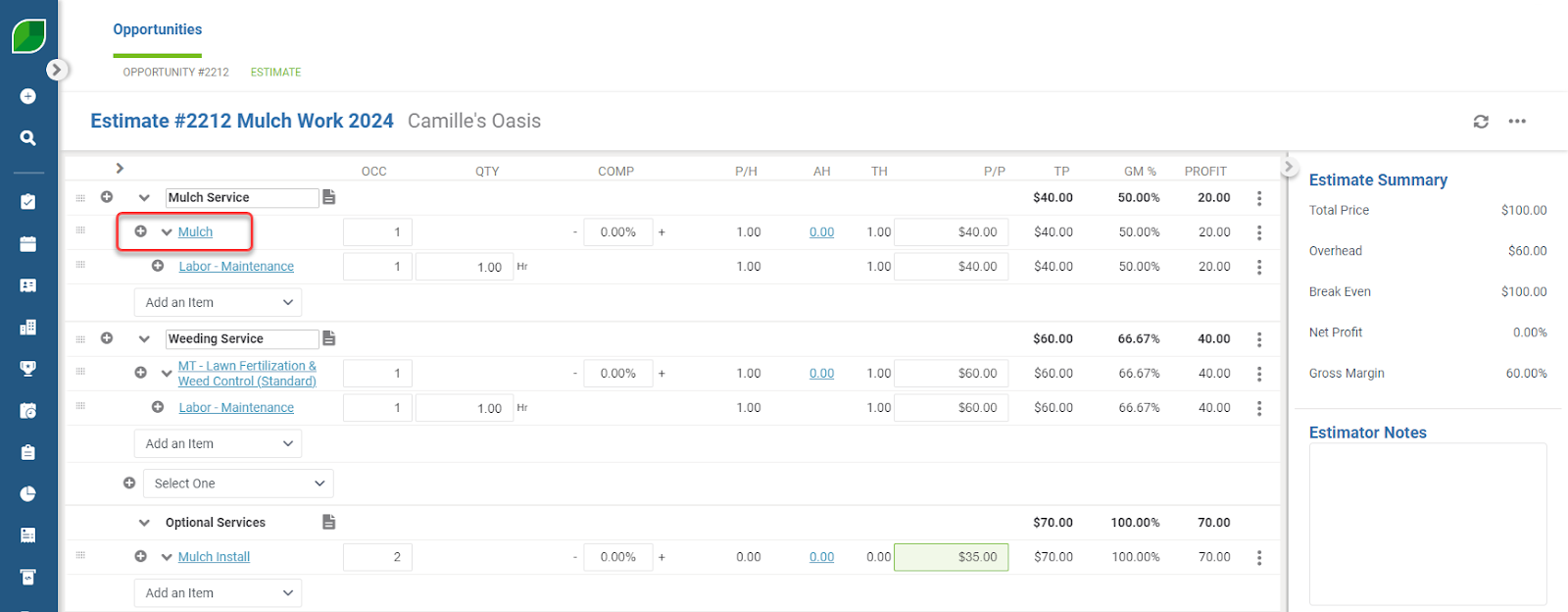
Job costing and margin tracking: With Aspire, you can track expenses in real time to see if a project is within budget. This insight helps you adjust schedules and resources to protect your profits.
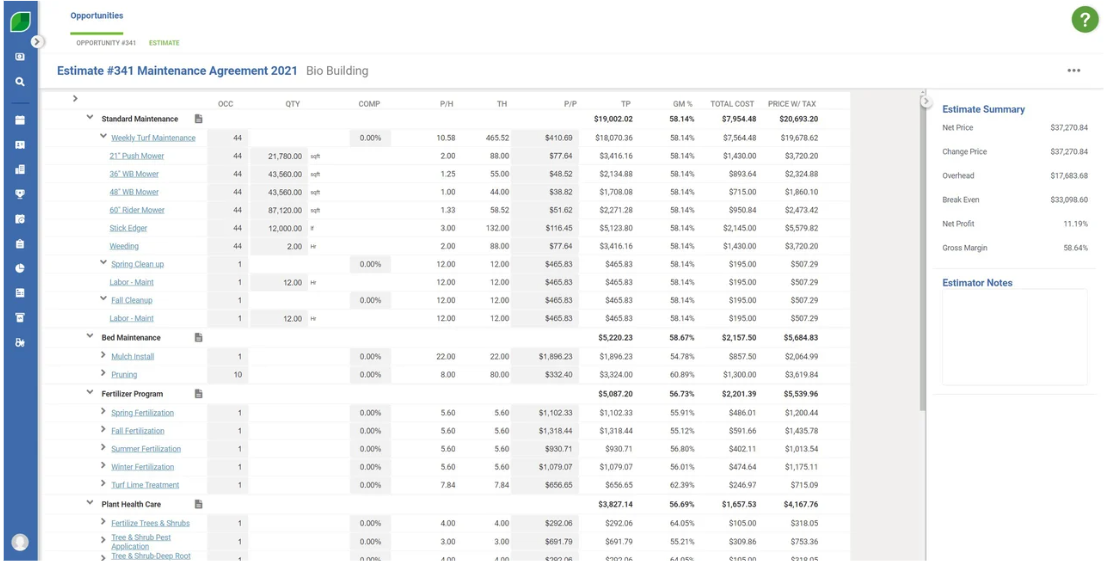
CRM management: Aspire features a CRM tool where you can store and manage client and property data. You can also track proposals, manage renewals, and monitor the sales pipeline. This helps you maintain client relationships, spot upsell opportunities, and keep them informed.
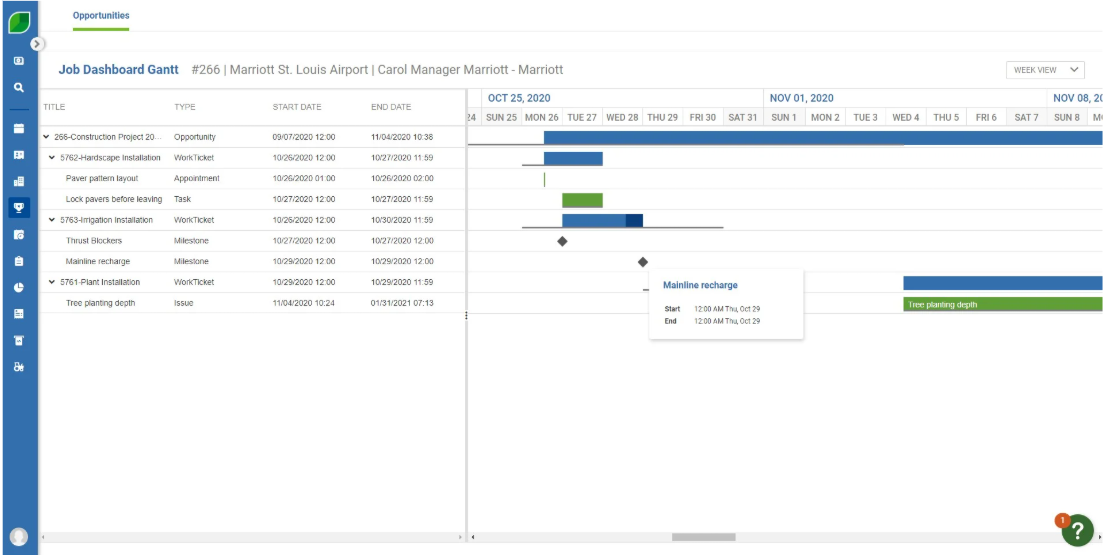
Scheduling and crew management: Use Aspire’s scheduling feature to plan jobs by day, assign projects to crews with drag-and-drop tools, optimize routes, and track labor hours in the field.
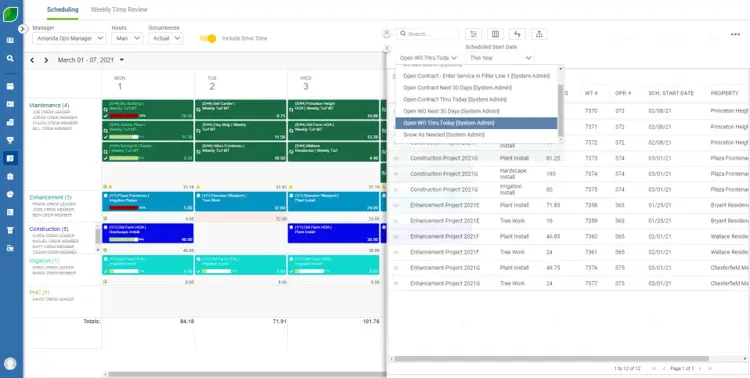
It ensures that both office and field crews align on expectations and communicate asynchronously.
Invoicing and financial reporting: Generate invoices, track payments, and get real-time reports on revenue, job performance, and profitability. The system generates invoices and shows what’s outstanding across your entire portfolio.
Book a demo to see how Aspire helps you run your landscaping business better.
Frequently Asked Questions (FAQs)
How do landscapers price services correctly?
To price your landscaping services, calculate the true costs of labor, materials, and overhead. Then add a profit margin on top.
Track actual job costs against estimates regularly to refine your pricing over time. Bottom line? Understand your numbers before giving clients a price.
How do landscapers improve operational efficiency?
One way to improve operational efficiency is to standardize your landscaping process, from estimating and crew briefings to scheduling and invoicing.
Use landscaping management software to reduce admin time, keep communication lines open, and keep projects moving without constant supervision.
What mistakes do landscaping businesses commonly make?
Common mistakes landscaping businesses make include:
Underpricing jobs
Poor scheduling
Weak marketing
Ineffective crew management
Forgetting to track actual job costs regularly
Delaying investment in systems to automate landscaping workflows








 866-727-7473
 Schedule Demo
 390 S Woods Mill Rd #300 Chesterfield, MO 63017


