Table of Contents
Table of Contents
- What is the average hourly rate for landscaping and lawn maintenance?
- How do landscapers calculate their hourly rates?
- What factors affect landscaping and lawn maintenance hourly charges?
- How do machine hours differ from man-hours in landscaping?
- How do I price a specific lawn maintenance job?
- What are common mistakes when pricing landscaping or lawn mowing work?
- When should I adjust my landscaping or lawn care hourly rate?
- Over to you!
Does this sound like your landscaping business?
You have experienced crew members who understand how to deliver quality landscaping services.
They understand plants, soil conditions, proper maintenance, and how to transform outdoor spaces. And when it comes to structure, speed, and organization, your team has it covered.
But figuring out what to charge clients remains a challenge, especially given fluctuating overhead costs, job complexity, difficulty tracking labor hours, and scope changes.
So, how do you determine your team’s worth without second-guessing your decision?
This guide breaks down how to calculate a competitive rate you can confidently justify to clients.
What is the average hourly rate for landscaping and lawn maintenance?
The average hourly rate for landscaping services depends heavily on the business’s location, equipment used, crew size, project complexity, and the company’s experience.
Most landscaping business owners charge $50–$100+ per hour for lawn maintenance and landscaping jobs.
In GreenPal’s survey of 10,000 landscapers, 12% charged $50/hour and 78% charged $60/hour for lawn care projects.
According to Thumbtack, a home services marketplace app, the national average cost of landscaping per hour is $50–$65.
On the higher end, landscaping influencer Keith Kalfas recommends $78–$100 per hour, depending on the job, location, and team expertise. It’s an opinion that’s also echoed across landscaping-focused forums on Reddit and Facebook.
But ultimately, while industry benchmarks provide a helpful reference point, your actual hourly rate depends on your location, cost structure, and ability to price and close work profitably.
How do landscapers calculate their hourly rates?
To calculate hourly rates, landscapers must understand the business’s operational costs, which include overhead, labor expenses, materials, and profit margins.
Here’s a step-by-step guide on how it’s typically done with this formula:
Hourly Rate = Labor Cost + Overhead + Desired Profit
Calculate overhead costs
Consider the costs involved in operating the business, including insurance, utilities, rent, marketing, service management tool subscriptions, office supplies, miscellaneous expenses, and administrative staff salaries.
Let’s assume $2,000 covers all that per week.
Next, determine the number of labor hours worked weekly, say 90 hours.
Divide the total overhead cost by the weekly hours worked, i.e., $2,000/90 = $22.22/hr.
This means that for each labor hour worked, $22 in overhead costs is required.
Determine total labor costs
Total, in this sense, means the regular advertised landscaping crew wages plus add-ons such as payroll taxes, insurance, uniforms, Social Security, and management costs required to employ field workers.
So, assuming base wages = $20/hour
Employer payroll taxes (~7.65%) = $1.53/hour
Workers Comp/L&I (varies by state, could be 5-15%): Let’s say 10% = $2/hour
Unemployment taxes (FUTA/SUTA, ~3-6%): 4% = $0.80/hour
Other benefits/costs (uniforms, training, etc.): $0.75/hour
Management overhead (time spent managing): $1.00/hour
Total labor costs: $20 + $1.53 + $2 + $0.80 + $0.75 + $1.00 = $26.08/hr
Note: For a two-man crew, multiply the labor cost by 2 (i.e., $26 x 2 = $52 per hour).
Define profit margin
Most landscapers target a 15% to 20% profit margin. However, depending on the project, it can go up to 45%.
For this example, let’s use a middle-ground 30% markup on total costs (labor and overhead).
Total costs = $26 (labor) + $22.2 (overhead) = $48.2/hour
30% profit = $48.2 × 0.30 = $14.46/hour
Calculate your hourly rate
Using the formula mentioned above:
Hourly rate = $26 + $22.2 + $14.46 = $62.66/hour
This rate ensures you cover all costs and achieve your target 30% markup.
What factors affect landscaping and lawn maintenance hourly charges?
While industry benchmarks and formulas can estimate your hourly rate for landscaping projects, multiple factors listed below influence the actual charge.
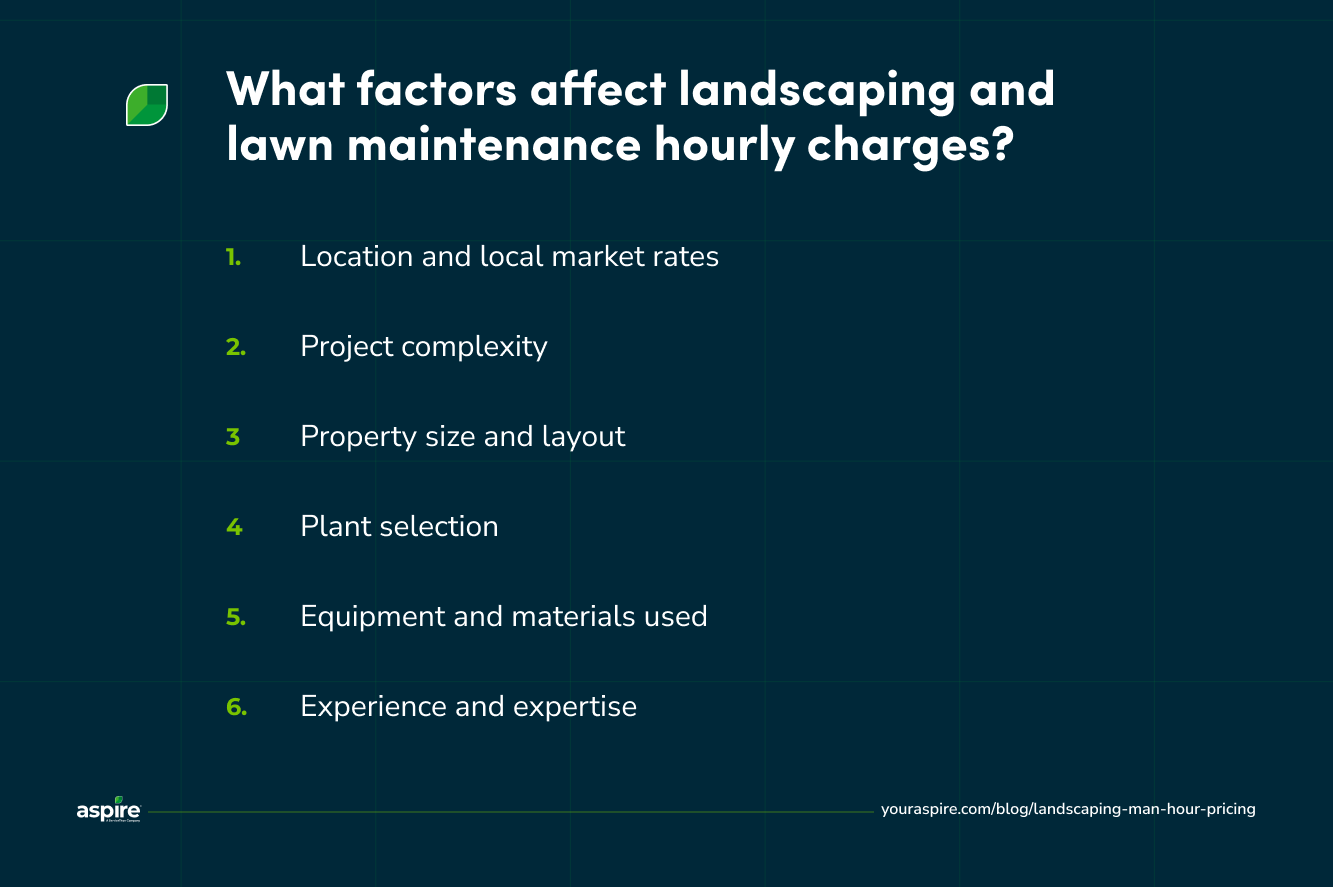
1. Location and local market rates
Regions with a high cost of living typically have higher-than-average landscaping rates. In these areas, labor costs are higher, and expenses such as rent, utilities, fuel, and materials are higher as well.
Climate also plays a role in pricing. Warmer or tropical regions often have higher lawn maintenance rates because longer growing seasons lead to more frequent services, increased labor demand, and greater operational wear throughout the year.
2. Project complexity
Routine lawn maintenance tasks, such as mowing, mulching, edging, and trimming, are generally straightforward and priced lower because they require less time, equipment, and expertise.
More complex landscaping projects, such as xeriscaping or hardscaping, require specialized skills, materials, and planning, which increase labor, risk, and overall cost. As project complexity increases, hourly rates and project pricing typically rise as well.
3. Property size and layout
Larger properties typically require more resources — labor, materials, and equipment — making them pricier to service than smaller sites.
If there are challenging layouts such as sloped terrain, tight access, or heavy debris, labor time increases and may require specialized equipment.
Both the size and layout can influence the price by increasing the time, effort, and resources required to complete the job.
4. Plant selection
The kinds of plants you use increase or decrease the price of a landscaping service.
Native plants are often more affordable because they adapt better to local soil and climate conditions, require less maintenance, and have lower replacement rates.
In contrast, exotic, mature, or specialty plants typically cost more to source, install, and maintain, which raises both labor and material costs.
5. Equipment and materials used
The equipment used on a project can influence how much landscapers charge. Regular lawn care tools that require minimal maintenance may attract regular rates.
However, specialized or high-cost equipment increases operating costs and hourly rates due to the expertise required to operate, install, or maintain it, as well as higher labor and material costs.
6. Experience and expertise
Landscaping companies with experience, efficient workflows, and proven systems typically charge more than new or less experienced operators. Their skilled crews and industry knowledge command trust and credibility, allowing them to increase prices.
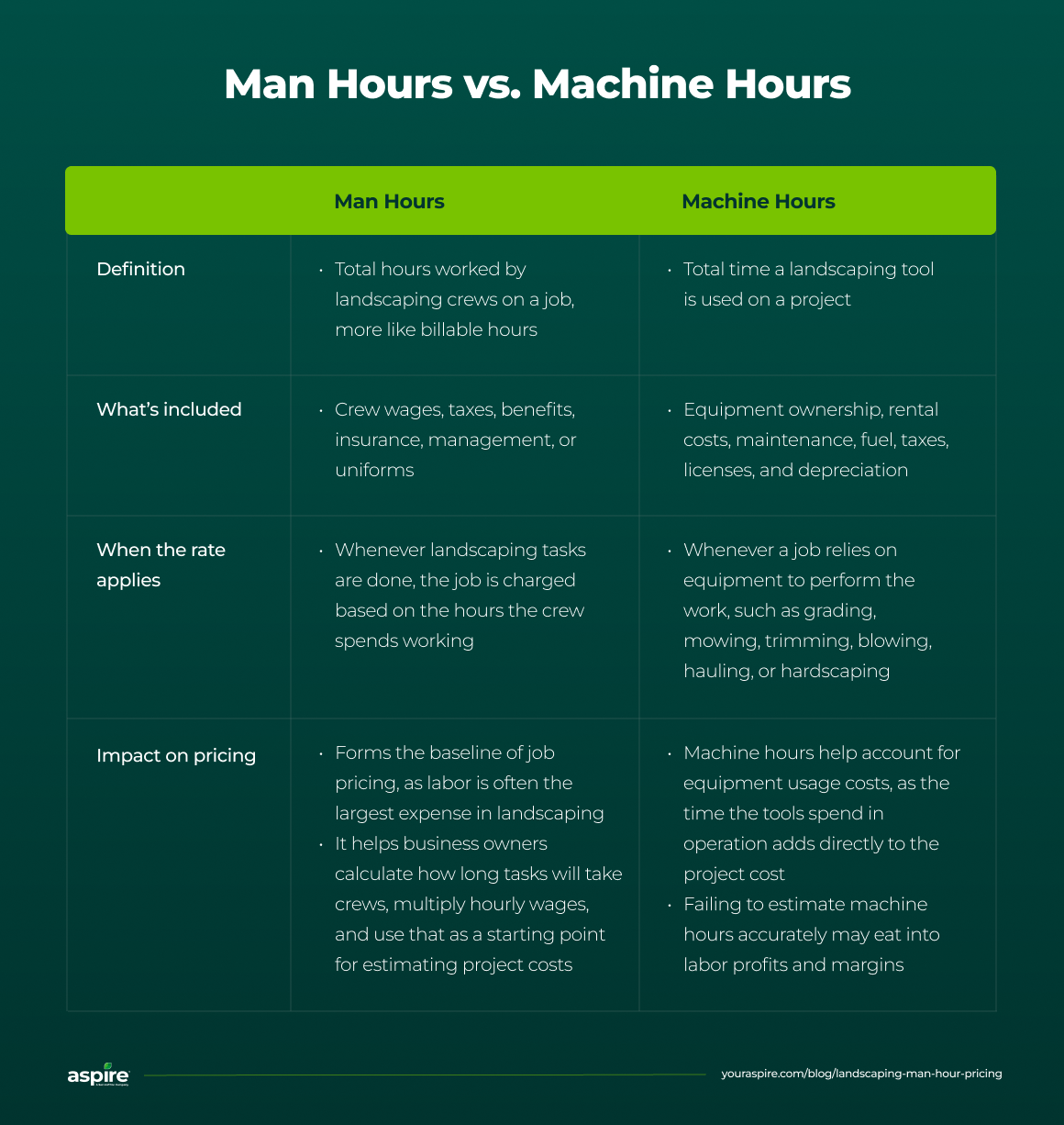
How do machine hours differ from man-hours in landscaping?
Machine hours measure how long landscaping equipment is used on a job and capture costs such as fuel, maintenance, depreciation, and ownership.
On the flip side, man-hours refer to the time crew members spend working on a job. While both are used to estimate the cost of a landscaping project, they are different concepts.
How do I price a specific lawn maintenance job?
To price a lawn maintenance project, you need to know the property’s size, estimated time to complete it, labor cost, and overhead.
If you don’t know how to calculate time and property size, using competitors’ prices as a benchmark is a good place to start. This will teach you how long it takes to complete a half-acre yard and how much material is needed.
Once you figure that out, here’s a formula to use:
Lawn maintenance price = Labor costs + Material costs + (overhead + equipment costs) + profit margin
Let’s break down each component of this formula:
Labor cost
This includes employees’ hourly wages, taxes, workers’ compensation, and any additional employee-related expenses.
To calculate the total costs, multiply the total labor hours you’ll need (for each worker on the job) by the hourly labor cost (all those employees’ hourly wages plus labor expenses).
Let’s assume it’ll take one crew member four hours to complete the lawn care project at a rate of $26/hr.
Cost of labor: $26 x 4 = $104
Material cost
Include the cost of fuel, fertilizers, herbicides, mulch, and any equipment wear and tear or rentals.
To estimate material costs:
Measure the square footage of the property.
Calculate the required product quantities based on the measurements, e.g., mulch: 3 cubic yards, fertilizer: 2 bags, and seed: 10 lbs.
Determine the unit cost using the supplier pricing. For example: mulch $38/yard, fertilizer $45/bag, and seed $6/lb.
Take waste and overage into account by adding 5–15% to material costs to cover spillage, uneven ground, or crew errors.
Add delivery and handling costs, plus a markup (10–30%) to move the materials on-site and cover handling or risk.
Totaling everything up, you get:
Mulch: 3 yards × $38 = $114
Waste (10%): $11
Delivery: $40
Markup (15%): $25
Material costs = $190
Overhead costs
This covers everything that goes into running the business and projects, such as insurance, equipment and maintenance, utilities, rent, marketing, service management tool subscription, and office supplies.
Using the same assumption and calculation from the section above, let’s assume the overhead cost is $22.
Since the job in this example is estimated to take four hours, the overhead is:
$22 x 4 = $88
Profit margins
Profit margins represent how much you intend to take home after covering other expenses. For this example, let’s assume you want 30% of the overall project costs as profit.
Overall project costs = Labor costs + Material costs + Overhead costs
$104 + $190 + $88 = $382
Profit = 30% of $382: $114.60
Lawn maintenance price = Labor costs + Material costs + (overhead + equipment costs) + profit margin
$104 + $190 + $88+ $114.6 = $497.60
What are common mistakes when pricing landscaping or lawn mowing work?
Want to ensure your landscaping business turns a profit and grows sustainably?
Here are pricing errors you must avoid:
Being overly dependent on competitors’ pricing: While using the average rate in your region is a good starting point, it’s not a sustainable way to price landscaping services. Competitors’ pricing helps you understand the actual cost of providing services, so you can align future quotes with your financial goals.
Ignoring labor costs: Many landscapers treat advertised wages as labor costs, forgetting to include labor burdens such as payroll taxes, workers’ compensation, FMLA, and company-provided benefits. Failing to do that may end up eating away at your profits.
To avoid that, ensure you always factor in labor burdens when calculating labor cost.
No contracts or estimates: Relying on handshake deals or vague emails can lead to misunderstandings about scope, expectations, and final project pricing. When there’s no contract, you risk being underpaid for your hard work.
To ensure clients honor your pricing, use Aspire estimation software to create estimates that list the services provided and pricing, which customers can sign off on. This way, everyone’s clear on expectations with your payment intact.
Underestimating equipment, overhead, and material costs: Sometimes, landscapers forget to include the costs of equipment maintenance and replacement, insurance, taxes, administrative time (quotes, invoices, calls), travel time, and material delivery and handling.
Forgetting to consider that can reduce profit and lead to significant loss. It’s important to know these numbers and your actual labor cost before setting prices.
When should I adjust my landscaping or lawn care hourly rate?
If you know your business numbers and realize you’re actually losing money, then it’s definitely time to bump up those hourly rates.
Other times to consider increasing your rates include:
When the business is only breaking even, not profitable.
When you’re marginally profitable and still struggling financially.
When there’s increased demand for your services, and you can’t keep up.
When clients keep accepting your bids, it may be a sign that your prices are too low.
When you need to part ways with a client.
When you’ve become an expert and want to be positioned like that.
When the economy is bad, inflation is high, and the cost of living has gone up.
If you fall into any of these categories, here’s how you can adjust the rates:
Start slowly and inform clients in advance about the changes. For example, let them know rates are going from $50 to $70/hr for new clients. But existing customers are locked in at $50/hr for the next two months.
Provide options so the increase doesn’t feel like an ultimatum. For instance, at the new $70/hr rate, provide add-on services at no cost to the client. Consider bundling existing landscaping services with other services they need.
Over to you!
Accurate pricing is one of the clearest indicators of a profitable landscaping business.
When you understand your true costs and apply a consistent pricing structure, you remove guesswork, protect your margins, and build client trust.
Landscapers who succeed over the long term don’t rely on instinct or one-off estimates. They:
Understand labor, equipment, and overhead costs
Use consistent pricing charts to quote jobs confidently
Adjust pricing based on job complexity and conditions
Track estimates to improve accuracy over time
Aspire’s estimating tool enables you to calculate jobs accurately and consistently, so you stop undercharging, reduce disputes, and make smarter business decisions. It allows you to:
Create proposals and standardized pricing templates
Factor in labor, materials, and overhead automatically
Generate accurate, professional quotes faster
Maintain consistent pricing across all jobs and crews
Schedule a free demo to take control of your pricing and your profitability by starting with the right estimating system.










 866-727-7473
 Schedule Demo
 390 S Woods Mill Rd #300 Chesterfield, MO 63017


