Table of Contents
Table of Contents
- What is snow removal business insurance?
- Who needs snow removal business insurance?
- What risks does snow removal insurance protect against?
- What coverages are included in snow removal business insurance?
- What insurance limits do snow removal businesses typically need?
- How much does snow removal business insurance cost
- How do you choose the best insurance policy for a snow removal business?
- How can snow removal businesses lower insurance costs?
- How Aspire simplifies managing your snow removal business insurance
- Over to you!
- Frequently Asked Questions (FAQs)
As a snow removal contractor, you face unique risks every time you’re out on a snow-clearing project: slip-and-fall, property damage from plowing, or vehicle collisions during storms.
Without an insurance policy, you face liability exposure that could cause the business to lose money or go bankrupt — and you want to avoid that.
This is where policies come in, protecting your snow removal company and showing clients that they’re covered if incidents happen.
But which insurance coverage should you get? Do you even need one?
This guide answers it all. Discover:
Insurance limits snow removal businesses typically need
The average cost of snow removal business insurance
How to choose an insurance policy for your snow removal company
How to lower insurance costs
Disclaimer: This content is provided for informational and educational purposes only and does not constitute legal or professional advice. Readers should consult a licensed insurance professional or qualified advisor to obtain guidance tailored to their specific requirements and jurisdiction before making any coverage decisions.
What is snow removal business insurance?
Snow removal business insurance protects your company from risks associated with winter operations. Generally, it covers plowing, salting, de-icing, sidewalk clearing, roof snow removal, and snow hauling, along with snow removal equipment and vehicles used.
Compared to general landscaping insurance (if you offer landscaping services), snow removal insurance also covers season-specific issues such as icy surfaces, slip-and-fall claims, reduced visibility, and frequent equipment or vehicle operations during snowstorms.
These conditions increase liability exposure, making snow removal insurance important for your winter clearing services.
Who needs snow removal business insurance?
Anyone who intends to clear snow and get paid, whether it’s residential, commercial, or municipal clients, needs snow removal business insurance. It protects your business from claims if or whenever incidents happen.
Brian Fullerton, founder of Brian’s Lawn Maintenance, says that when clearing snow, it’s better to have insurance and not need it than to need it and not have it.
To provide more context, here are the different business types that require snow removal insurance:
Commercial and residential snow removal companies: Businesses contracted to clear snow from driveways, parking lots, roads, roofs, or walkways.
Landscapers: Landscaping businesses offering winter services need insurance, since they’re only insured for landscape-related tasks.
Solo or subcontractors: If you’re using your own trucks and gear for snow removal, you need insurance. Otherwise, any claims or incidents could come straight back to your personal assets.
Property maintenance firms and HOAs: Even if they outsource snow removal contracts, they need insurance to manage risks on shared spaces.
What risks does snow removal insurance protect against?
The appropriate insurance policies protect your landscaping business from risks and incidents associated with snow removal.
Think of liability exposures like:
Slip and fall claim: Injuries caused by icy sidewalks, parking lots, poorly cleared surfaces, or your team’s negligence can result in legal claims and settlements against your business. Snow removal insurance can protect your business by covering legal defense costs and any damages awarded.
Property damage: If you’ve been a snow removal contractor for a while, you’d agree that accidents happen. Insurance covers damages to curbs, landscaping, vehicles, fences, or buildings while plowing.
Vehicle accidents: When collisions with other vehicles occur during winter maintenance, snow removal insurance offsets the cost of repair or part replacement.
Equipment damage or loss: Your snow removal equipment got broken, lost, or misplaced on a job? The insurance can pick up repair or replacement costs.
Worker injuries: Insurance absorbs the cost of on-the-job injuries from operating machinery or working in harsh conditions.
Contractual liability: When liability claims arise after snow clearing projects, insurance premiums can be your defense against them, protecting your business from out-of-pocket legal costs.
What coverages are included in snow removal business insurance?
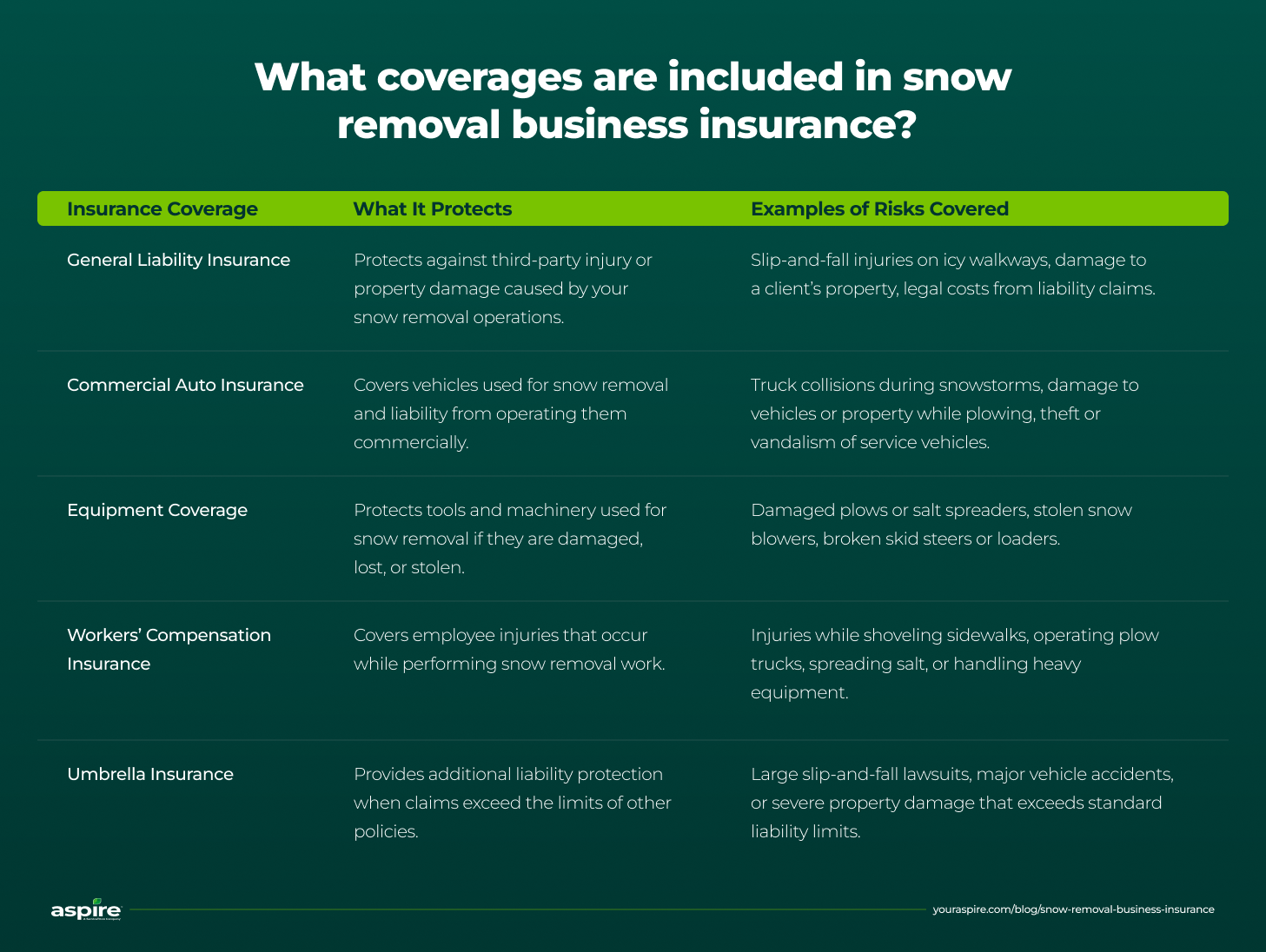
Insuring your snow removal business without understanding what the policy covers can put you at risk. For instance, general liability insurance wouldn’t cover an injured worker on the job. If that’s the only policy you have and you take ‘general’ literally, you may have to deal with several out-of-pocket costs.
Here are the insurance coverages that actually protect a snow removal business:
How general liability insurance protects snow contractors
General liability insurance protects your snow removal business from third-party claims, such as:
Injuries to clients or pedestrians (e.g., slip and fall on an icy walkway)
Property damage caused by your team
Legal costs related to those claims
It also typically includes completed operations coverage that protects you if a claim arises (e.g., someone slips and gets injured) after the job is done.
In many cases, this insurance coverage is required by customers, especially commercial ones, who want to ensure they’re not solely responsible for potential liabilities.
Why is commercial auto insurance critical for plow trucks?
Commercial auto insurance is crucial for your snow removal company because vehicles are usually operated in harsh winter conditions, such as snowstorms, poor visibility, or icy roads.
It’s your business’s defense against:
Third-party injuries or property damage: Offers liability protection if the truck causes injury to another driver or pedestrian, or damages property while on a job.
Vehicle and equipment damage: Helps pay for repairs to your vehicle and plow if you hit another object.
Non-collision losses: Covers theft, vandalism, and similar incidents not caused by collisions.
Many insurers may require snowplow endorsements or policy modifications because attaching plows or salt spreaders increases vehicle risk. Think of them as extra rules added to your insurance policy to cover certain activities.
For example, it allows your trucks to be insured while plowing snow or covers attached equipment like salt spreaders or plow blades.
Without these endorsements, a standard auto insurance policy may exclude damages related to snow removal operations.
How equipment coverage protects plows, spreaders, and snow gear
Equipment coverage protects your snow removal tools and machinery, such as blowers, skid steers, loaders, salt spreaders, or snow plows, if they’re stolen, damaged, or destroyed.
Machinery attached to your vehicle, like the plow or salt spreaders, is typically covered through a commercial auto policy endorsement.
In contrast, portable tools, such as walk-behind spreaders or snow blowers, are covered by inland marine insurance. This policy protects tools transported between job sites.
When workers’ compensation insurance is required
You need workers’ compensation once employees are hired to cover medical expenses, rehabilitation costs, and lost wages if they’re injured while performing job duties.
This insurance policy also covers injuries that happen while shoveling sidewalks, operating plow trucks, or spreading salt/deicing materials.
In fact, many state laws mandate workers’ compensation insurance as soon as a business employs a worker. These laws are designed to help both workers and employers by ensuring injured employees are well compensated while limiting employer liability.
How commercial umbrella insurance increases liability protection
Commercial umbrella insurance gives your snow removal business additional liability protection by increasing the coverage limits of existing policies, such as the general liability and commercial auto insurance.
If there’s a claim that exceeds the limits of those policies, the umbrella insurance covers the outstanding cost. For example, say there was a serious accident involving your truck, exceeding the $500,000 limit of your auto insurance.
The umbrella policy provides extra protection, including legal fees and settlements.
It’s especially important if you’re handling commercial projects, where the financial exposure is higher. The clients will prefer contractors with higher liability limits, and the umbrella insurance makes that possible.
What insurance limits do snow removal businesses typically need?
Your snow removal company needs liability limits that can handle the risks associated with your operations. But while the exact requirements will vary by your contract and insurer, here are common coverage limits:
General liability: Fullerton suggests having a $1 million+ limit for your snow plowing operations to cover third-party injuries and property damages.
Commercial auto: Typically $500,000-$1 million for accidents involving plow trucks or service vehicles.
Workers’ compensation: The limit is usually set by state laws, covering medical expenses and lost wages
Umbrella liability: Many contractors carry $1-$5 million for additional coverage.
How much does snow removal business insurance cost
The cost of snow removal business insurance depends on the company’s size, number of employees, trucks, coverage limits, and the insurance vendor.
However, there are common ranges based on snow removal insurance companies reviewed to help you plan:
General liability: $43-$105 per month, $520-$1,260 per year
Commercial auto: $163-$173 per month, $1,956-$2,076 per year
Workers’ compensation: $246-$254 per month, $2,952-$3,048 per year
Umbrella liability: $81-$83 per month, $972-$996 per year
What factors affect snow removal insurance premiums?
Insurance costs depend on how you run the business and the perceived risk associated with it.
Providers look at the following factors before giving you a premium:
Business size: If you run a small company with few employees, your monthly premiums will be cheaper than those of a business with several trucks and workers. Why? Because more people and equipment mean high injury risks and accidents.
Number of vehicles: The size of your fleet can impact the insurance cost. More vehicles increase exposure, causing you to pay more than a company with fewer vehicles.
Location: Is your business located in regions with heavy snowfall each winter? You’re at a higher risk than companies in milder areas, increasing your monthly premiums. Businesses in urban cities with high populations also command high insurance costs because more people could lead to more incidents.
Claims history: Snow removal companies with prior liability claims can increase your premium. But a clean record could earn you affordable rates.
Type of contracts: Commercial or municipal contracts often involve greater liability than residential projects, increasing your insurance costs.
Payroll: Insurance providers can use the company’s revenue to evaluate your risks. A larger payroll could mean more jobs and room for claims. That can increase the rates.
How seasonal operations affect insurance pricing
Insurance providers typically evaluate snow removal companies that operate during the winter months differently from businesses that combine it with landscaping or commercial cleaning.
If you operate as an extension of a landscaping service, it will be more cost-effective for you to bundle snow removal services with it. Let providers know that you intend to offer winter services, and they will update your existing policies with snow removal endorsements.
This will extend liability and vehicle coverage to winter operations, with potentially reasonable rates.
However, if you purchase snow removal coverage separately, you may be charged more because you’ll be required to get annual policies, despite working three to four months a year.
How do you choose the best insurance policy for a snow removal business?
Choosing the best insurance policy involves matching coverage to the specific risks of winter operations. To choose a policy that protects your business interests:
Assess your existing needs: Before you evaluate insurance options, understand your business operations. Insurers will need that info to figure out your rates.
Here are questions to give you a better understanding of the business:
Do you cater to residential or commercial clients, or both?
How many active contracts do you have?
How about confirmed leads?
How many trucks are in your fleet?
Equipment (owned or rented)?
How many workers do you have?
What scenarios would hurt your business financially?
Understanding these details helps you choose a policy that’s customized to your needs.
Research and compare insurance providers: Find out the different providers in your region that offer snow removal insurance. Some don’t, and others bundle it with construction or landscaping insurance. Request quotes from multiple insurance providers and compare their costs, reputation, experience, and customer service. Beyond pricing, take note of deductibles, coverage limits, and how claims are handled. Sometimes, an expensive premium might be better if the provider has more experience with winter operations than one without.
Work with an experienced agent: Find insurance agents who are familiar with snow removal work, subcontracting, and the liability issues associated with seasonality. These experts can simplify the process of getting snow clearing insurance.
Verify licensing and accreditation: Ensure you pick an insurance provider that’s licensed and accredited. They must follow industry regulations to provide legal protection. Confirm that the provider has the required license by visiting the state insurance department website.
How can snow removal businesses lower insurance costs?
Want to reduce how much you pay for insurance premiums?
Here are strategies to implement:
Safety training: Train workers on proper snow plowing, salting, and equipment handling to reduce accidents.
Vehicle and equipment maintenance: Regularly inspect and maintain your tools and trucks to reduce the chance of accidents or breakdowns.
Document services: Keep a service log of when snow was cleared or salt was applied to defend liability claims against the business.
Bundle policies: Buying multiple policies from the same insurance provider can qualify you for a discount.
Increase deductibles: Selecting a higher deductible (the amount of money you must pay out of pocket before your insurance starts paying for a claim) can lower your monthly or annual premiums.
How Aspire simplifies managing your snow removal business insurance
While Aspire doesn’t manage insurance policies directly, it provides features that reduce the operational risks that drive insurance claims and help you stay organized around insurance requirements.
Here’s how Aspire helps with insurance management:
Documentation and liability protection: Maintaining detailed service logs defends you against liability claims and improves your credibility with the insurance provider.
Aspire allows you to track work tickets, crew hours, and materials used during snow events to document when services were performed. It helps you collate a timestamped trail for every job, which can be useful when claims arise.
Incident reporting: Aspire has a mobile app that supports three-way communication between clients, field, and office teams.
If incidents happen, field crews or clients can report issues with photos or videos, creating visual proof of service completion that can be your defense against disputed claims.
Your snow crew can also share job updates with the office team in real-time.
Real-time job costing: Accurate job costing lets you understand the true cost of a snow removal job against estimated costs. And Aspire does that with ease.
More importantly, it helps you know the cost of insurance premiums relative to each job, so you can price future projects accounting for risk exposure.
Tracking equipment and vehicles: Aspire has GPS-based tracking and equipment management tools to monitor usage and maintenance.
When insurance providers want to know how often you service tools and trucks, you can rely on Aspire for detailed reporting on how often they’re used before being serviced and any other necessary info they might need.
Insightful business analytics for risk assessment: You have insights into your business operations with Aspire’s reporting feature.
It shows you aspects of the business that are costing money and putting you at risk, helping you strategize so providers can confidently offer you coverage.
You have access to the right data to make informed decisions and know when to renew or adjust coverage.
Over to you!
Mistakes happen in the snow removal business: someone trips, a vehicle gets in an accident, or equipment damages the client’s property.
Whatever the case, insurance protects you from claims and damages when they happen. It can even be what convinces customers to hire your snow removal company.
The insurance types provided in this article are meant to account for the added risks of winter conditions. But ensure you do ample research and speak with an agent about your business needs before making a decision.
And if you want an organized and well-documented snow plowing operation that keeps you on top of claims, Aspire helps you create that.
Schedule a demo to experience how Aspire lets you take control of your business.
Frequently Asked Questions (FAQs)
What documents are required to apply for snow removal insurance?
To apply for snow removal insurance, you need:
Business details: Legal name, address, years in operation, and services offered.
Vehicle data: Make, model, and use of plow trucks or service vehicles.
Equipment inventory: List and value of all your snow removal equipment.
Revenue estimates: Expected annual income from snow removal projects.
Claims history and employees: Past insurance claims and number of workers you employ.
How do slip-and-fall claims affect snow removal businesses?
Slip-and-fall claims can affect snow removal businesses because they can lead to legal costs, insurance payouts, and higher premiums.
These claims happen when someone is injured on a poorly cleared icy surface. A snow service business might be held liable for not clearing according to the contract.
To defend against such disputes, keep a detailed service log with photos and timestamps of the completed work.
Is snow plowing covered under standard commercial auto insurance?
No, snow plowing is not covered by standard commercial auto insurance. Most policies exclude damage or liability that happens while the vehicle is performing snow removal services.
To ensure the truck is covered, a snowplow endorsement is required to extend protection to plowing operations and attached equipment. Operating without one means that claims related to snow removal services will likely be denied.
Do small snow removal businesses need insurance?
Yes, snow removal businesses need insurance because they also face liability risks (slip-and-fall injuries, property damage from plowing, or vehicle collisions) during winter operations.
Getting insurance protects the business from financial loss and may be a requirement when targeting commercial contracts.
Does landscaping insurance cover snow removal?
Not all the time. Landscaping insurance often excludes snow removal operations because it involves different risks. If you want the landscaping policy to include winter services, a snow removal endorsement or a separate policy extension is required.










 866-727-7473
 Schedule Demo
 390 S Woods Mill Rd #300 Chesterfield, MO 63017


