
Table of Contents
Table of Contents
- What is a snow removal contract?
- Why snow removal businesses should use snow removal contracts
- Types of snow removal contracts
- Commercial vs. residential snow removal contracts
- How to write a winning snow removal contract that secures clients
- Best practices for snow removal contract acquisition
- How to price your snow removal contract to ensure profitability
- Scaling your snow removal business through long-term contracts
- How your business can benefit from snow removal contract management software
- Wrapping up
- Frequently Asked Questions (FAQs)
Want to scale your snow removal business?
Securing long-term contracts is one of the most reliable ways to do so.
It guarantees steady demand for your snow-clearing services and provides predictable revenue, helping you plan confidently and ensuring you’re not struggling to find customers before the first snowfall.
But this only happens if you know how to craft a winning contract, one that positions your business as a trustworthy option and makes clients feel their property is always accessible and in safe hands during winter.
This post walks you through building contracts that win more jobs and keep clients coming back season after season.
What is a snow removal contract?
A snow removal contract is a binding agreement made between you and a client, whether residential or commercial, usually established on an ongoing or seasonal basis.
It comes after the client has accepted your bid and formalizes expectations between both parties to ensure reliable service, predictable billing, and legal protection.
Furthermore, a snow removal contract outlines the terms and conditions for snow and ice management services. Its primary purpose is to ensure safety, maintain accessibility, manage liability, and provide budget predictability for the client.
Why snow removal businesses should use snow removal contracts
Contracts make your snow removal business look professional.
Instead of relying on verbal agreements, everything is documented to clearly outline the services you’ll provide and when your team will show up, helping prevent disputes.
In addition, a snow removal contract is crucial for contractors because it provides:
Clarity: It ensures both clients and the business owner are clear on their responsibilities.
Predictability: As a business, contracts mean locked-in revenue for the season, so you’re not left hoping the phones ring during a storm. For clients, it guarantees snow-clearing services after each fall.
Protection: Snow clearing sometimes involves safety risks. A contract outlines who’s responsible for what, includes insurance details, and protects your company from claims. For customers, it protects their property from snow and the headaches of inaccessibility, potential damage, business disruption, and loss of profit.
Scalability: Contracts provide recurring revenue, enabling you to grow the business, purchase more equipment, run marketing campaigns, and hire more staff.
Resource planning: Contracts help you make proper plans regarding projects. You get to know how many properties you’re servicing, along with the number of crews you need and the equipment required. With this information, you can plan routes, manage supplies, and schedule equipment maintenance to consistently provide quality service.
Types of snow removal contracts
Snow removal contracts can be designed to suit the customer’s pricing preference. This ensures there’s an agreement in place for every client, not just those on seasonal contracts.
Here are the types of snow removal contracts designed for different client needs and risk levels:
Per-push contracts: The agreement here is that you get paid each time snow is cleared. It’s great for customers who want one-off or occasional services.
Per event: You charge a fee for snow removal after each snowfall.
Seasonal: The customer pays a fixed rate for the entire winter season, regardless of how often it snows. This contract type is ideal for predictable revenue and long-term relationships.
Multi-seasonal contract: Instead of committing to a single season, clients agree to multiple seasons, ensuring guaranteed snow-clearing services year in and year out.
Full-service: This contract covers all snow removal and ice management services. It’s like a premium version of the seasonal contract, in which clients pay upfront for services. This option is ideal for clients who take safety and accessibility seriously, such as hospitals, office/corporate campuses, or retail malls.
Commercial vs. residential snow removal contracts
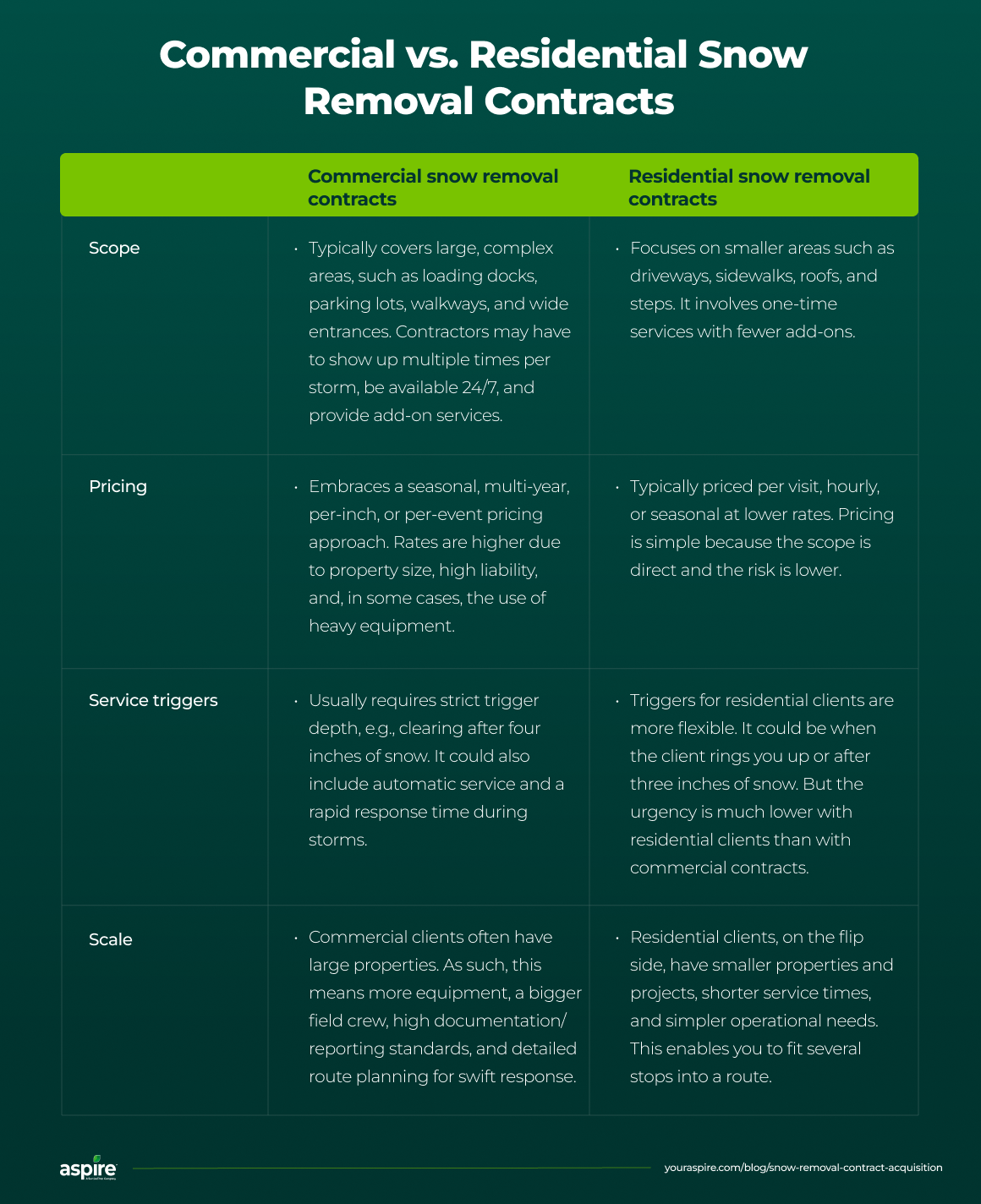
In the snow removal industry, you’ll typically serve commercial and residential clients. While both parties just need their properties cleared of snow, the risk level and service expectations vary.
For instance, commercial properties are usually bigger and come with higher liability, so the workflow, response times, and documentation are different from a residential driveway clearing project.
As a result, the type of contract a commercial client needs differs from that of a residential customer.
Here’s a quick overview of the key differences:
How to write a winning snow removal contract that secures clients
One of the benefits of snow removal contracts is that they typically follow a consistent process. You just need to tweak the agreement depending on what the residential or commercial client prefers: a flat rate for the season, hourly billing, per-event charges, pay-per-inch, or a multi-seasonal deal.
When you’ve got that figured out, here’s how to write a contract from scratch:
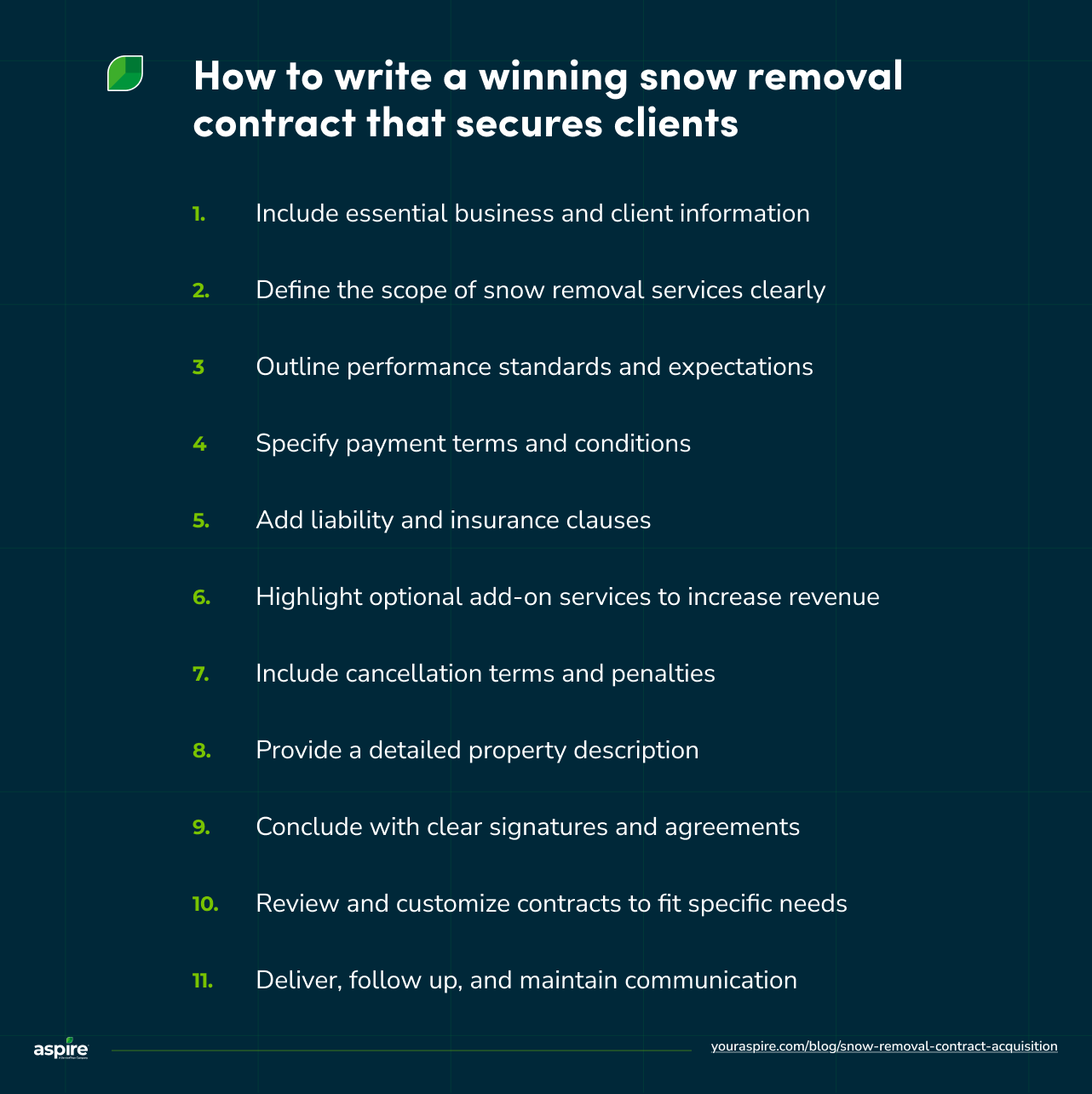
1. Include essential business and client information
The contract should open with your business information—name, address, logo, and contact details—clearly displayed at the top of the document.
It’s a brand piece and needs to be treated as mini marketing material. You want clients to spot it in their email inbox and instantly know it’s from your company.
Don’t forget to include the customer’s details, too. When writing a contract, assume they’ve accepted your project bid and are ready to proceed.
Including their details makes it personal and helps avoid misunderstandings down the line. Otherwise, they might think you’re just sending a generic document, which is unprofessional and doesn’t bode well for your company.
2. Define the scope of snow removal services clearly
In your contract, outline specific services the customer needs, such as ice management, snow plowing, hauling, removal, or sidewalk clearing.
You also need to include:
Service times and the areas covered, like parking lots, roofs, or walkways.
Where snow will be piled after removal. On-site or hauled away?
The amount of snow accumulation and specific weather conditions that will trigger the removal service: 3, 4, or 6 inches?
Expected response times after a snow event. Are you available 24/7 or between specific hours?
Use simple terminology when writing the scope to ensure the customer understands. Instead of terms like ice management, which contractors are familiar with, use terms like salting, sanding, or snow-removal chemicals. Those are words people can easily understand.
3. Outline performance standards and expectations
To show your snow removal company’s professionalism and high-quality standards, describe how long it will take the team to typically clear snow after an event.
You can also decide to:
List the types of equipment you’d ideally use for areas with obstacles, tight spaces, or huge parking lots. Aside from professionalism, this helps clients prepare their property by marking everything, removing obstacles, and reparking their vehicles.
Explain how you intend to communicate with the client regarding the service. Is it via email, text, or an app? If you use a tool like Aspire, you can use all methods to keep customers updated.
4. Specify payment terms and conditions
Next, state what type of contract this is: seasonal, per-event, multi-season, or hourly?
Specify the payment amount and method, including any relevant terms and deadlines.
You should also provide rates for extra services or additional snow depth beyond the trigger amount. Include information about late fees and deposits, so you and the client are on the same page.
5. Add liability and insurance clauses to protect both parties
Create a section on protection in the contract that outlines each party’s responsibilities. This helps you manage risk and protect clients, crews, and your business.
In this section, include:
The kind of insurance your business has (general liability, equipment, or workers’ compensation insurance), along with what each covers and doesn’t.
The company’s process when there’s property damage, injury, or equipment failure.
An emergency contact when there’s an incident.
6. Highlight add-on services to increase revenue
If there are add-on services you intend to provide, outline them in another section of the snow removal contract.
Make sure you list them with the corresponding service area. For instance, de-icing the walkway, removing roof snow, or salting the driveway.
You should also include their costs to ensure clients are on the same page.
7. Include cancellation terms and penalties
An effective contract needs to cover how and when either party can cancel the agreement. This flexibility ensures fairness and prevents both from being stuck in an unfavorable agreement.
Figure out the best ways for both you and the client to send out cancellation notices, perhaps via written or email communication.
You also need to define penalties or fees for early termination.
Including a section that covers this ensures customers understand their obligations and protects you from sudden losses.
8. Provide a detailed property description for accurate service
To avoid potential disputes where clients claim that the wrong area was cleared, include a thorough description of the property and areas that require snow removal.
If there are unique conditions, like steep slopes, tight spaces, or obstacles, note them in this section.
This clarity not only prevents disputes but also helps crews plan effectively in advance.
9. Conclude with clear signatures and agreements
A contract only becomes legally binding when it is signed. As such, there should be a section for signatures and a date field where you and the client can sign.
Add a section explaining to clients that signing the document makes it valid and legally binding.
10. Review and customize contracts to fit specific needs
When you’re done with the draft, review the contract again to ensure it captures the client’s needs.
Confirm the property layout, service expectations, name, and address to avoid misunderstandings down the line.
Make sure the contract is personalized for the client and error-free before sending it.
11. Deliver, follow up, and maintain communication for renewal
Once the contract is ready, send it over to the client for their signature. After signing, provide the client with a copy of the contract.
But don’t stop there. Maintain communication throughout the season to stay top of mind, keep them updated, improve satisfaction, build trust, and increase your chances of renewal.
A solid contract covers every detail, so you’re not responsible if something goes wrong. Instead of building one for each contract type, you can save time and stress by using a snow removal contract template.
Best practices for snow removal contract acquisition
Snow removal contract acquisition means customers are ready to commit by signing an agreement. When they do that, your business gains predictable revenue, more efficient route planning, and less marketing effort, since you won’t be reselling each time it snows.
But how do you get customers to commit in the first place?
Offer early discount prices: Deals like 10–20% off when you sign a contract before winter are a great way to get customers to lock into an agreement. Clients pay less, and you get guaranteed revenue.
Highlight guaranteed swift response: Reliability and trust are highly valued by customers, especially commercial clients with high-traffic properties. Promise specific service windows exclusive to contract holders when bidding on a job, e.g., a parking lot cleared before the mall doors open.
Leverage client testimonials: Word of mouth is an effective marketing technique. Use reviews from existing contract holders as proof of your snow removal company’s reliability. This can build trust and encourage prospects to consider joining the contract club.
Provide flexible payment options: Offer snow removal contract holders the option to split payments. Perhaps an upfront payment before the season starts, followed by monthly installments, might make paying more manageable for customers.
Highlight your team’s performance: This move helps you secure renewals. Document and share everything your crew did on a client’s property, including their response time, communication type, and the number of times snow was cleared. It ensures clients understand the value you bring and what they stand to lose if they don’t renew.
Monitor the weather consistently: Even if you’re not a meteorologist or weather forecaster, keeping tabs on snowfall forecasts and sharing that information can help you secure or renew a snow removal contract. Prospects or clients can see what’s coming and prepare by hiring you.
Execute small extra tasks: Say you were only asked to clear the driveway and walkway, but also cleared the ice piling near the mailbox. That creates goodwill with the client that can encourage them to renew their contract.
Run marketing campaigns: If you have a special deal for snow removal contract holders, launch digital and local campaigns to advertise the offer. This ensures prospects are aware of the deal and encourages existing customers to take advantage of it.
How to price your snow removal contract to ensure profitability
To price your snow removal contracts profitably, start by estimating the expected snowfall in your region for that season and the average depth per event. This helps you predict how many snow removal events you’ll likely handle.
For instance, if your area gets 60 inches of snowfall each year and the average event drops 3 inches, you can estimate roughly 20 snow plowing events for the season (60 ÷ 3 = 20).
Next, determine what it would cost you to clear snow for a residential or commercial property in your area.
Take labor, overhead, equipment maintenance, and materials into account and multiply by your desired profit margin.
Example:
Overhead and material expenses: $100
Hourly labor cost: $50
Time required to clear snow: 2.5 hours
Profit margin: 15%
Cost to clear snow per 3-inch event: ($50 x 2.5 hours + 100) x (1 + 15%) = $258.75
Once you have this number, you can adapt it for the type of contract the client needs, whether it’s per-event, seasonal, or multi-seasonal. For a seasonal price, multiply the cost per event by the estimated number of events per year.
Using the sample calculation above: $258.75 x 20 = $5,175 for 1–3 inches of snowfall per season.
Before you lock in on a final price, though, consider factors that may increase time, labor, or material usage, and adjust accordingly. Here are some of them:
Property’s square footage, the number of parking spaces, and the length of walkways can add to the time and labor required.
Obstacles on the property, such as decorative islands, fire hydrants, or light poles. They typically require operators to slow down and maneuver carefully when working.
Topography and drainage, such as sloped properties or areas with poor drainage, require additional salt applications to manage ice buildup.
Fuel prices and material availability, especially during harsh winters, can affect operating costs and raise overall prices.
Faster response times require crews to start earlier than normal to meet the client’s needs. As such, it should reflect in the final pricing.
Scaling your snow removal business through long-term contracts
Long-term snow removal contracts offer your business a stable workload and predictable revenue. These two factors are pivotal to building and growing a sustainable snow removal business.
Here’s how long-term contracts help you scale:
Strategic planning: Knowing how much revenue you will generate after a couple of snowfalls, the winter season, or multiple seasons enables you to plan for staff recruitment or management, invest in better equipment, or subscribe to snow management software like Aspire. You can optimize routes in advance and take on additional projects without worrying about overbooking.
Launch marketing campaigns: The financial stability of long-term contracts enables you to plan and execute high-quality campaigns. Since you’re not struggling for clients every snow season, you can invest in:
Premium marketing assets, like a website, ad creatives, and content.
Off-season campaigns that include an audience you wouldn’t normally target.
A/B testing to identify what kind of marketing ad/message captures your ideal client.
Improve brand visibility through consistent sponsorship, referral, or email campaigns.
Provides a strong trust signal: The fact that you have contract holders can be a selling point to other customers. When existing clients share their reviews, it signals to prospects that they can trust you. This helps increase the brand’s reach and, in turn, grow your client list.
Helps you save costs: Long-term contracts allow you to buy de-icing materials in bulk. Instead of buying per project, you can buy in bulk, which lasts a long time at a discounted price, saving the business money.
Provides valuable referral opportunities: Being on a long-term contract helps you build a relationship with the client and earn their trust. If you nurture the relationship by being proactive, sending updates, offering discounts, and providing solutions, you position the business for client referrals. It’s also grounds for renewals or add-on services that increase the contract’s value.
How your business can benefit from snow removal contract management software
Getting a client to sign or renew a contract might be easier if you have data to back claims about rapid response times, past performance, or detailed property information. Aside from reviews, this can also build instant trust and credibility with clients.
Using snow removal contract management software like Aspire gives your business the data and a structured approach to win and retain contracts. It also offers operational and financial insights to strengthen proposals.
Here’s how Aspire helps:
Accurate job costing: Aspire helps you monitor your true operational costs for each snow removal project against the estimated costs.
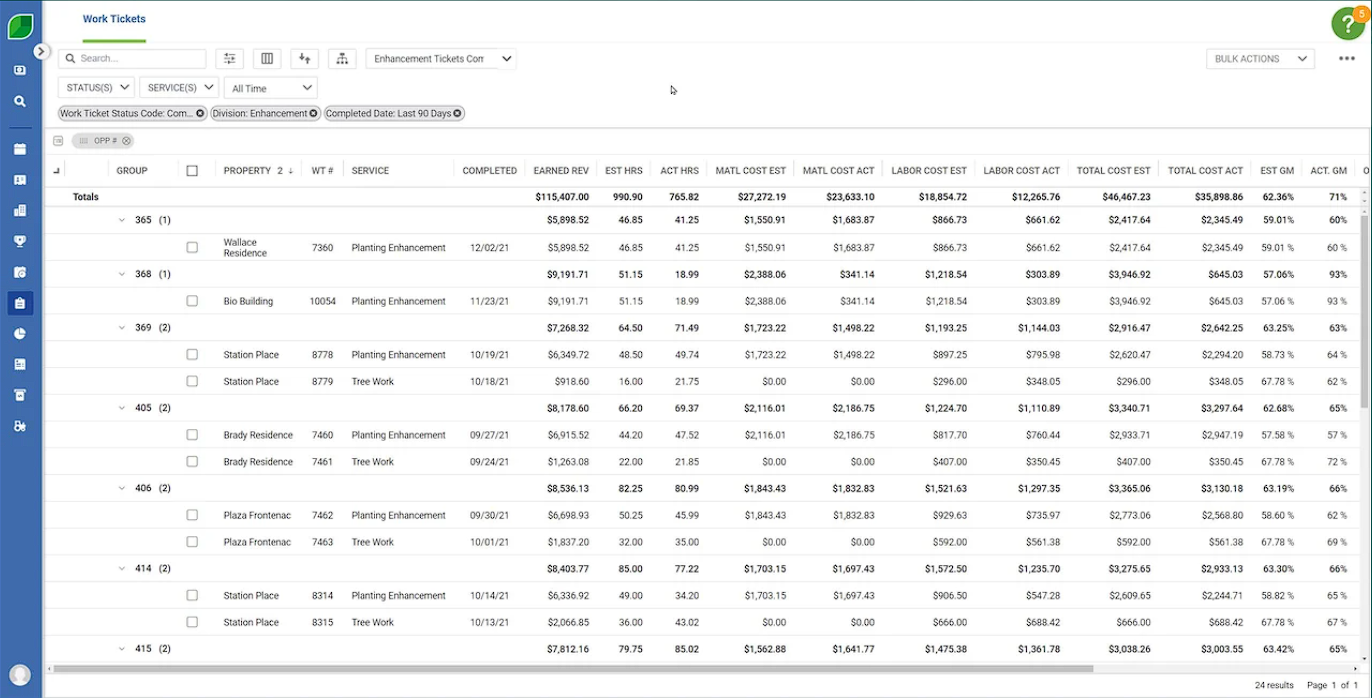
It breaks down what you actually spent for labor, materials, equipment maintenance, and overhead. This way, you can quote a project profitably using real-time data.
Streamlined proposal creation: You can build and send professional proposals to clients using templates on Aspire. Simply input client details along with the profit margins and markups you’ve established for labor, materials, subcontractors, and other direct costs, and the system will automatically factor them into your pricing for profit.
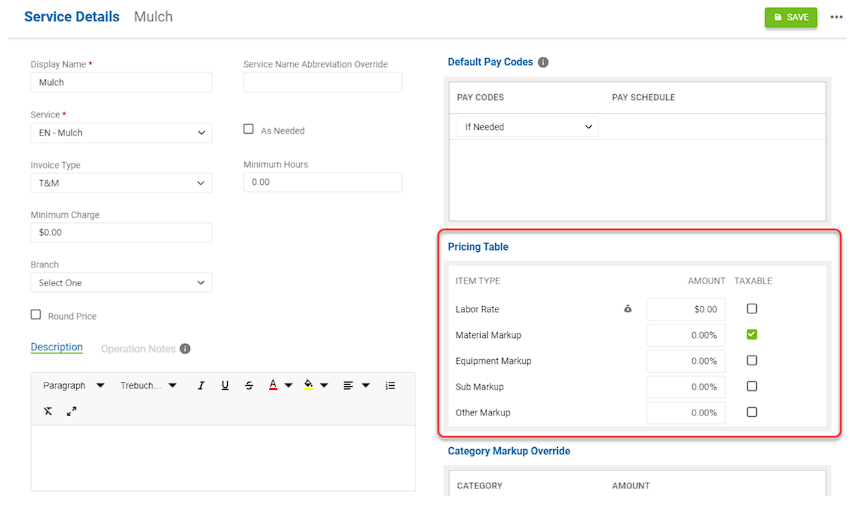
With all client, site, and service data in a centralized place, you can draft and send contracts faster and shorten the sales cycle.
Improved communication: Aspire stores all your client histories in one place, making it easy to personalize outreach, follow up proactively via email or text, and maintain consistent communication. It features a customer portal where you can provide real-time updates with project photos. In turn, clients can submit requests or report incidents directly in the snow management app.
Simplified workflows: Once the client has signed the contract, Aspire streamlines the entire workflow. You can immediately schedule tasks for a specific day and time, optimize the route, assign the job to a crew, and monitor them in real time until the job is complete.
There’s a mobile app where crews can clock in and out, take project photos, report incidents, and follow a field checklist.
This doesn’t just streamline operations; it also provides the foundation and automated processes that enable you to take on more contracts.
Detailed operational and financial insights: Thanks to its reporting feature, Aspire shows you which contracts are profitable and which are draining your resources.

You can see whether it’s expensive labor, material, or equipment maintenance costs that are the cause, or simply a poor deal. With this information, you can make informed decisions such as marketing to clients who bring in revenue, negotiating contract details, or canceling agreements that hurt your profit margins.
Wrapping up
You’ve seen how to create a snow removal contract that can help secure clients.
Now, it’s time to put these steps into action and build a contract that provides guaranteed revenue for your snow removal business, protects it, delivers clarity for clients, and sets you up for long-term success.
As you go through the guidelines, consider using management software such as Aspire to streamline proposal creation, track progress, ensure profitable contracts, and automate your workflow.
It’s an efficient system that ensures you’re better equipped to deliver exceptional service consistently, win more contracts, and scale your business.
Book a live demo to see how it works in real time.
Frequently Asked Questions (FAQs)
What types of snow removal contracts should I offer as a service provider?
You should consider offering different types of snow removal contracts because of varying client preferences.
With a per-event contract, you’re paid when snow-clearing services are rendered.
Seasonal contracts for clients who want a fixed rate for the entire winter season.
Multi-seasonal contracts ensure you have consistent revenue for more than one winter.
A full-service contract, where you offer the entire snow removal service package, from clearing to ice management.
What should a snow removal contract include to protect my business?
To protect your snow removal business, ensure the contract covers:
Service triggers
Specific areas covered
Response time
Payment terms, including when the upfront balance is due
Liability limitations and cancellation policies
What constitutes service completion
Who’s responsible for the obstacles on the property
Insurance limitations regarding damages
Clauses for extreme weather that prevent swift service delivery
How do I scale my snow removal contract business beyond one‑time jobs?
Here are some ideas to consider:
Develop relationships with clients by being proactive, providing ice-management tips, sending weather updates, and handling small tasks. This can help you identify opportunities for upselling, renewals, or referrals.
Run marketing campaigns with a special snow removal contract offer.
Optimize your routes to reduce drive time and save money for advertising, equipment purchase, or hiring staff.
Leverage management software like Aspire to automate tasks, free up time, and save costs.
Offer a year-round property maintenance bundle to increase the contract’s value. For instance, you can add landscaping services to snow removal.
What risks do I face if the contract terms are vague or incomplete?
Incomplete or vague contract terms mean you risk:
Facing payment disputes as clients can claim unmet expectations or incomplete jobs.
Liability claims when responsibilities aren’t defined.
Losing money because you have to redo jobs clients say aren’t done well.
Not being able to enforce the contract, as it’s difficult to interpret in the event of disputes.













 866-727-7473
 Schedule Demo
 390 S Woods Mill Rd #300 Chesterfield, MO 63017


