Table of Contents
Table of Contents
- Why use a snow removal pricing formula?
- How to choose the right pricing model
- How to use the formula to calculate profitable snow removal rates
- What profit margin should snow contractors target?
- How to price residential snow contracts
- How to price commercial snow work
- How do you bid on snow removal jobs?
- How can software improve snow pricing accuracy?
- Frequently Asked Questions (FAQs)
How do you price your snow removal contracts?
Is there a system/formula you use, or do you just wing it?
If you do eyeball it, you’re not alone.
There are limited resources that can help contractors price their services. With limited guidance available, many contractors default to matching competitor rates.
But this approach has a critical flaw: it doesn’t always reflect the project's labor expenses. And this discrepancy can impact your profitability.
As a snow removal company, you need to know how much to charge for your services to cover costs and make a profit.
The best way to do that?
Using this formula, which helps contractors calculate profitable rates by accounting for labor, overhead, materials, and profit margin:
Total cost = (Labor cost + overhead + materials) ÷ (1 - profit margin %)
This is the base formula for pricing snow removal services, which you can apply to residential, commercial, per-push, or seasonal contracts.
In this article, you’ll learn how to price services so you can charge clients confidently and have enough to grow your business.
Why use a snow removal pricing formula?
Using a formula helps you charge profitable rates that cover your business expenses. It lets you defend the project costs when clients object, as you can explain the ‘why’ behind your pricing.
Without a formula, you rely on rates from contractors who don’t understand your business’s reality. For instance, a snow removal business owner on Reddit might suggest charging $750 for seasonal contracts.
But their overhead, equipment costs, and labor rates aren’t yours. If you follow their advice without understanding your own costs, you could end up losing money.
A pricing formula ensures consistency across projects and makes it easy to estimate jobs as you scale your business.
How to choose the right pricing model
To calculate profitable rates for your snow removal business, you need to first decide on a model to use. The common options in the industry are:
Per push (visit): Clients pay a flat fee for each snow-clearing job. You need to factor in materials, overhead, and profit margin in this model for profitability.
Per inch: You charge based on snowfall depth brackets, e.g., 1-3” or 3-6”. You can decide on a flat fee for regular snow inches (1-3”) and increase the rates for extra inches. It’s ideal for regions with heavy snowfall.
Per hour: Snow removal is priced based on the number of hours spent on the project.
Per event: You charge clients for each snow event. If there’s a 48-hour snowstorm, you clear the snow after the event, factoring in materials, overhead, and markups.
Seasonal pricing: Customers pay a one-time fee for the entire winter season. The price accounts for the amount of snowfall in the region, event hours, overhead, markup, and profit margin.
Here’s why choosing a model is important: it defines the unit, costs, and risks you’ll be charging for, so you can calculate pricing accurately.
For instance, a seasonal model means you’re pricing for the whole winter and need to account for all snow events, including standby time and bad-weather risk.
Essentially, once you pick a model, you’re a step closer to an accurate cost estimate. The price would be the cost per unit + risks (expenses, weather delays, etc.) + profit margin.
Key takeaway: Your pricing model defines the unit, risk, and costs you must account for when applying the snow removal pricing formula.
So, how do you choose the ideal model for your business?
Know the different models: The topic has been covered above, but knowing your options can help you decide on the right model depending on the client type, budget, or weather.
Understand the clients’ needs: Knowing what clients want can guide the pricing model. Do they want a predictable cost to help with planning or a flexible service when snow falls?
Track the true cost of running projects and the business: Before choosing any model, you need to figure out the cost of executing the snow removal services you offer. How long will it take you to clear a parking lot with 3-6 inches of snow? How many people (field and office) are required? What are your fuel, materials, insurance, and equipment costs?
Consider local climate and weather risks: The weather patterns in your region can help you choose a model. In an area with consistent snowfall? Seasonal contracts, hourly pricing, or per-inch pricing work well. Unpredictable snow? Per-push, per-event, or hourly pricing protects you.
Monitor the competition: Another way to choose the right model is to analyze your competitors. Such an approach might help you understand the clients and pricing system in the region and decide on a model.
How to use the formula to calculate profitable snow removal rates
This formula lets you define rates for snow-clearing contracts:
Total cost = (Labor cost + overhead + materials) ÷ (1 - profit margin %)
To use it, you first need to calculate labor, overhead, and material costs. That’s what this section covers.
1. Labor costs
This section covers what you pay to complete a job: field workers’ wages, payroll taxes, overtime, and hours spent.
Here’s the formula to calculate it:
Labor cost = Hourly rate number of workers number of hours
(Hourly rate should include wages, insurance, and taxes.)
Say you’ll be clearing a parking lot that will take 3 hours for four workers who earn $15/hr ($20 if you include taxes and insurance); the labor cost will be:
Labor cost = $20 4 3 hours = $240
2. Material costs
If your snow removal project includes sanding or salting, you need to account for material costs in your pricing.
First, define the specific materials needed, their per-pound costs, and the total quantity required to complete the job.
Then, use this formula to calculate the material costs:
Material cost = cost/lb quantity needed for the project (for each material)
To estimate the material quantity needed for a project, use this as a guide, depending on the snow intensity:
Light snow: 2-3 lbs per 100 sq ft
Heavy snow coverage: 5-10 lbs per 100 sq ft
Calculate total quantity: (Property sq ft ÷ 100) × lbs per 100 sq ft = total lbs needed
Example: If you’re working on a 10,000 sq ft parking lot with 6 inches of snow, the quantity needed is:
(10,000 sq ft ÷ 100) × 5 = 500 lbs
Let’s assume rock salt is the material you are using, and it would cost $0.50/lb.
Material cost = $0.5/lb 500 lbs=$250
3. Overhead costs
Your overhead expenses are basically everything it takes to keep your business running: equipment and truck maintenance, fuel, insurance, software subscription, marketing, office maintenance, bills, and utilities.
To figure out this cost, add up all your business’s monthly spending and divide that total by your total sales. Then, multiply that result by 100 to get a percentage.
That means: (Total monthly overhead costs ÷ total monthly sales) x 100
Example:
Monthly overhead — $5,000
Monthly sales — $15,000
($5,000 ÷ $15,000) x 100 =33.33%, i.e., your monthly overhead percentage
For your snow removal pricing, the overhead cost is calculated by multiplying that percentage by the direct cost of labor and materials:
Overhead cost = (Labor + materials) x overhead percentage
Overhead cost = ($240 + $250) x 33.33%= $163.32
4. Profit margin
Profit is what’s left of your revenue after subtracting labor, overhead, and material costs. In the snow clearing industry, the profit margin can range from 30% to 50%. But the actual percentage is up to you.
Here’s how it factors into the pricing formula for snow removal using the example figures and targeting a 40% margin:
Total cost = (Labor cost + overhead + materials) ÷ (1 - profit margin %)
Total cost = ($240 +$163.32 + $250) ÷ (1 - 40 %)= $1,088.87
Based on this, your total labor cost is $653, and profit is $436.
What profit margin should snow contractors target?
After reviewing cost data, many contractors target profit margins of 25%-60% calculated on top of their direct operating costs.
However, the actual value depends on the supply and demand levels in the area, the competition rate, and your client’s income level.
Other factors that influence your profit margin include:
Snowfall amount: Regions with high snowfall typically command higher margins to cover risks, equipment repair, and overtime.
Route density: If you have clients along the same route, you can aim for more affordable margins. But you can charge more for isolated properties.
Upsell opportunities: Got a chance to upsell additional services to a client? That can determine whether you increase, maintain, or reduce your margins.
How to price residential snow contracts
Charging residential clients is much more straightforward than charging commercial accounts because properties, customer expectations, and project costs are typically smaller.
To get the pricing right, you need to do a trial run, clearing snow off driveways, sidewalks, or roofs to note how much time, money, and materials it takes.
Once you have your actual costs from the trial run, compare competitor rates in your region to know what to charge clients and ensure you’re competitive.
According to Homeguide, most residential snow removal companies charge between $25 and $75 per hour for common snow clearing services. Just make sure the price covers the project expenses so you don’t lose money.
Once you know the cost involved, use this formula to calculate a price you’re comfortable with.
Residential cost = (Labor cost + overhead + materials) (1 + profit margin %)
How to price commercial snow work
You can use the same formula for residential customers to price commercial accounts.
The main difference?
It’s how you approach the costing process, because lot sizes are larger and projects typically require more supplies and more expensive equipment. They also require faster service and response times.
As such, you need to know and account for the following when calculating your price:
Number of workers needed
Time needed to complete the project
Materials and equipment
Liability insurance costs
Risks and response times
Once you’re clear about that, slot the values into the formula:
Commercial pricing = (Labor cost + overhead + materials) ÷ (1 - profit margin %)
How do you bid on snow removal jobs?
You can bid on snow removal jobs by submitting a quote or proposal that outlines how you’d execute the project.
When bidding on projects, you need to visit the property to measure it, check access points, and determine how long the project will take to complete.
Then, create and send the estimate to the clients.
Using estimation software, like Aspire, simplifies the process and allows you to design estimates using templates.
It’s integrated with PropertyIntel, which helps you measure clients’ properties using digital maps. This way, you can get everything you need without visiting the site and can stay ahead of the competition.
With that information, you can create an estimate from customizable templates and add each service with set pricing and a markup.
Additionally, you can upsell services by offering them as optional line items clients can choose.
How can software improve snow pricing accuracy?
You don’t have to calculate snow removal rates each time there’s a request for proposals or quotes.
Software can improve pricing accuracy by standardizing cost inputs and tracking actual job performance.
A digital platform like Aspire offers several tools that simplify project pricing.
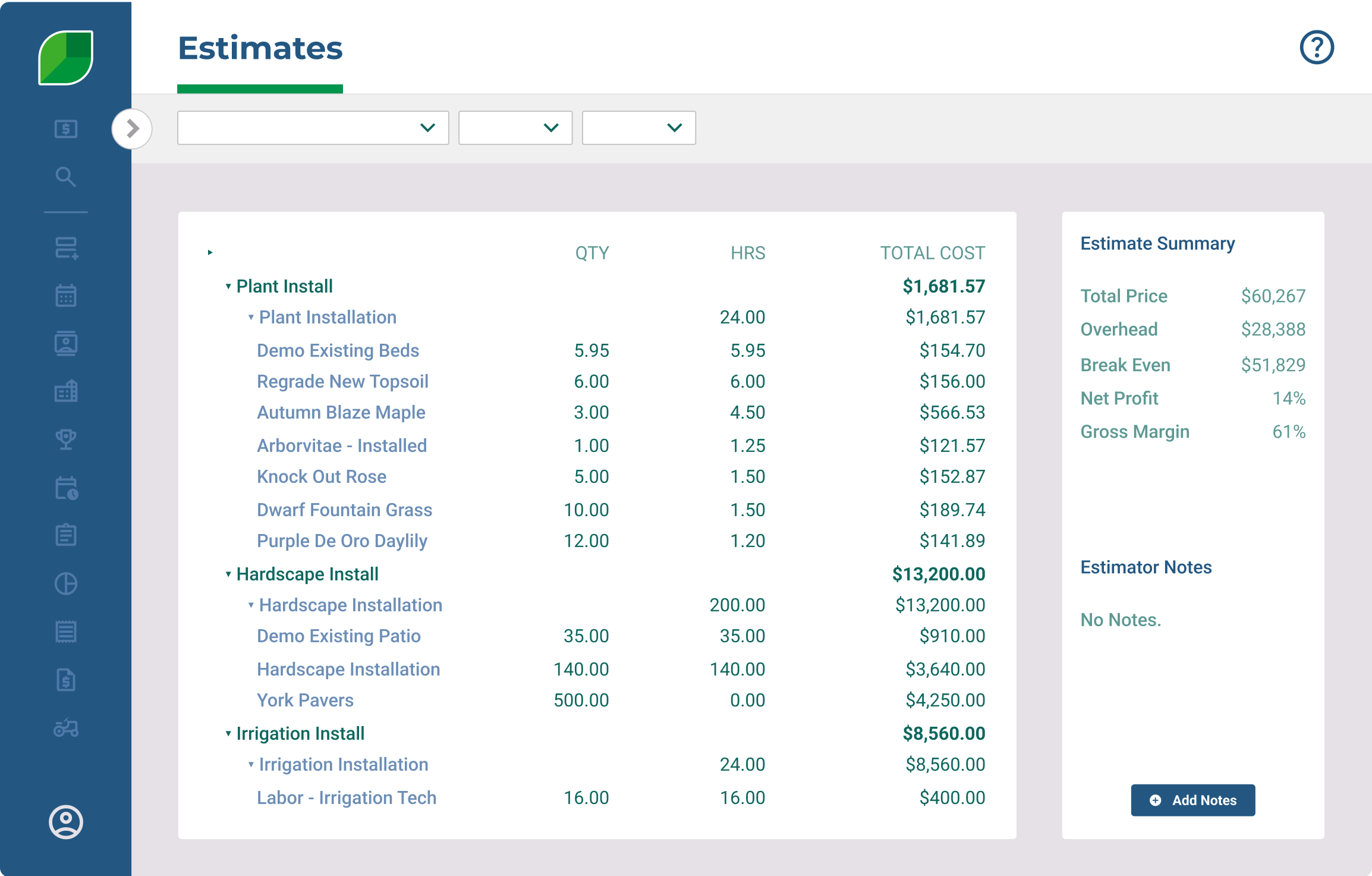
Estimating feature: This tool lets you design and send estimates to clients using preset pricing. You manually calculate your labor, material, and overhead costs for each service type upfront.
Then, when creating estimates for new projects, you simply add these preset costs as line items in the quote. No need to manually recalculate every time.
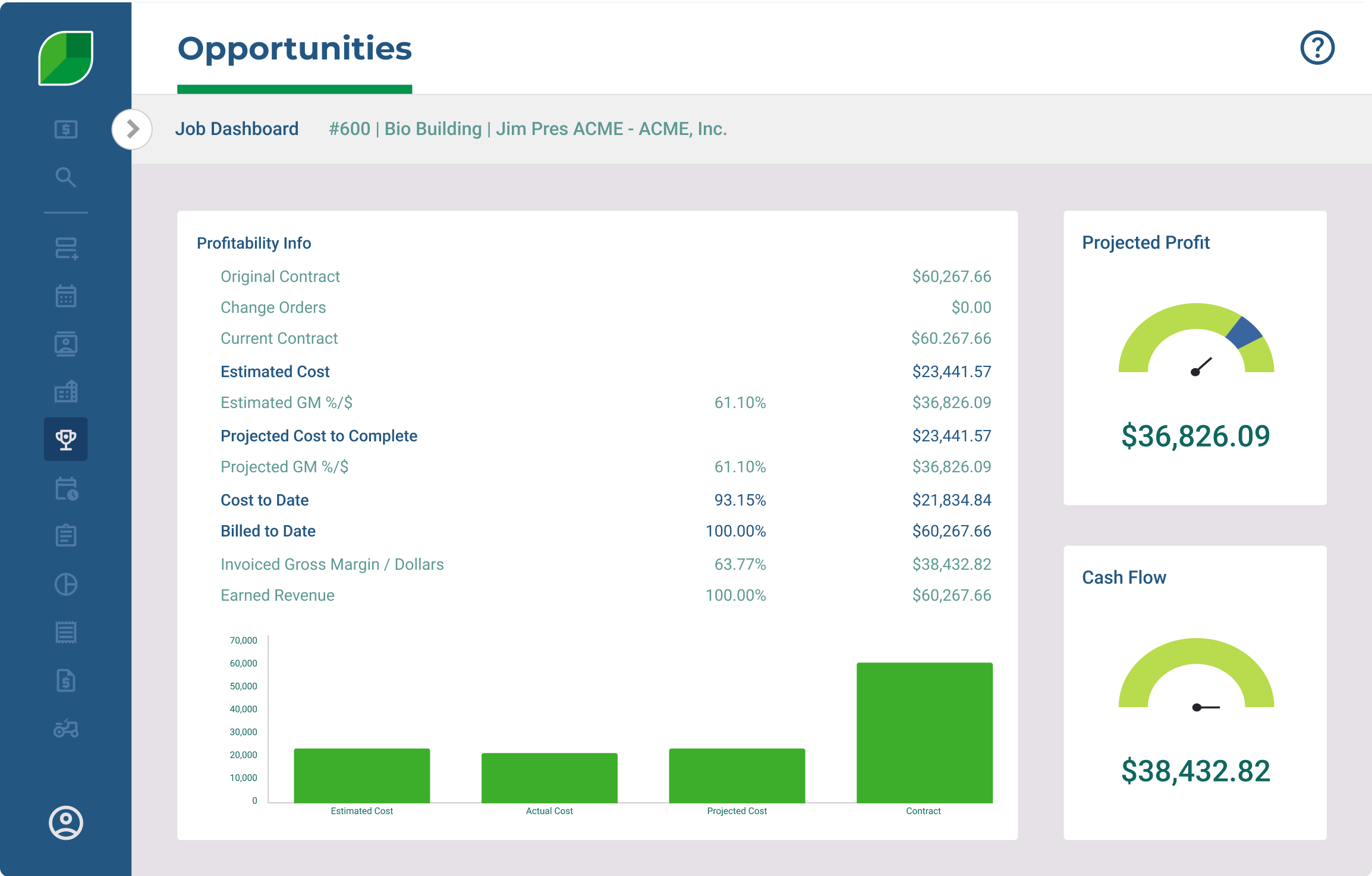
Job costing: Let’s say you get the job you bid on. This software lets you compare and track the actual cost of a project against the estimated cost.
You can assess whether current rates are profitable and make adjustments as needed. This way, you can guarantee the profitability of future estimates.
Data reporting: Aspire also has a reporting feature that lets you track all business expenses in real time. Know which service types are the most profitable, monitor labor, material, and equipment costs, and track revenue as it’s earned.
Now, beyond pricing, Aspire also helps with:
Route optimization to reduce drive time and expenses during snowstorms.
Scheduling to plan jobs as soon as estimates are won and ensure project pipelines are in order.
Invoicing to request and receive payments from customers.
CRM to manage existing contracts and maintain communication with clients to keep them happy.
Book a free demo with Aspire to see how it can help you price accurately and streamline your snow removal business.
Frequently Asked Questions (FAQs)
What is the formula for pricing snow removal?
The snow removal pricing formula is:
(Labor + Materials + Overhead) × (1 + Profit Margin).
It ensures contractors cover costs and earn consistent profit.
What is the average snow removal rate?
According to Angi, the average snow removal rate ranges between $50 and $203, with an average of $125 per visit.
Rates depend on several factors, like your region, driveway size, snowfall amount, and snow removal service type.
How often should snow pricing be updated?
You should update your prices at least once per season to reflect economic changes such as inflation, wage increases, or insurance rate adjustments. This can be done during:
Mid-winter if the cost of fuel or materials rises
After unusual weather events, like snowfall that is more or less than forecast and affects your costs
During an expansion when you plan to include commercial accounts and enter new service areas
However, you need to continuously monitor actual costs throughout the entire season using reporting tools like Aspire to make informed decisions for the next year.
What mistakes cause underpriced snow jobs?
The following mistakes can lead to underpriced snow projects:
Using competitors’ rates without understanding your business expenses or project costs.
Failing to understand everything — time, equipment maintenance, overhead, or overtime — that goes into executing snow removal projects before charging clients.
Ignoring seasonal variations and setting rates without clauses for heavy snowstorms or adjustments for snowfall frequency in your region.










 866-727-7473
 Schedule Demo
 390 S Woods Mill Rd #300 Chesterfield, MO 63017


