Table of Contents
Table of Contents
- Do you need a license to start a landscaping business in Minnesota?
- What are the types of landscaping business licenses & permits in Minnesota?
- Step-by-step process to get a landscaping business license in Minnesota
- How much does a Minnesota landscaping business license cost?
- What are the most common mistakes to avoid when getting a license?
- How Aspire helps landscaping businesses stay organized & compliant
- Over to you
- Disclaimer
Running a landscaping business in Minnesota needs more than just buying equipment and finding customers. Before you start offering landscaping services, you must understand local and state regulations, registration steps, insurance obligations, and permit requirements.
In this guide to obtaining a landscaping business license in Minnesota, you will learn:
Whether landscapers need a professional license or a business license in Minnesota
What types of permits and certifications you need if you want to provide landscaping services
A step-by-step breakdown of the licensing process, from business registration to license application requirements
Typical costs included, such as license fees, insurance, and other startup expenses
Common mistakes that can delay your license approval or create compliance issues
How using dedicated software can help you track documents, proof of insurance, contracts, and other business records
Whether your work includes plant installation, mowing, tree care, or hardscaping, this guide will explain what you can expect before expanding or launching a landscaping business in Minnesota.
Do you need a license to start a landscaping business in Minnesota?
In most cases, offering basic landscaping services in Minnesota does not require a statewide landscaping contractor license.
More specifically, if your work involves planting trees, sodding, seasonal cleanup, plant installation, mowing, or other routine property maintenance, you generally do not need a dedicated landscaping contractor license to operate.
However, you still need to obtain a business registration, choose a business structure, and comply with local licensing requirements that are specific to your city or county. Minnesota licensing for landscaping businesses differs from states such as New York, North Carolina, or Pennsylvania, where local rules lay out a different path for landscaping companies.
But if you choose to expand your services beyond basic maintenance, then the answer changes. You need additional licensing, permits, or certifications if your landscaping business provides the following:
Pesticide applications
Fertilizer applications
Tree care or arborist services
Irrigation or sprinkler system work
Certain landscape construction work
For instance, if you want to be able to apply herbicides or other pesticides for customers, you must obtain a pesticide applicator license through the Minnesota Department of Agriculture and meet testing requirements. The state also requires licensed applicators to maintain records and comply with renewal requirements.
Before agreeing to do any landscaping work, check both state and local rules and regulations. The precise licensing requirements often depend on the services you offer, project location, and whether specialized professional services are part of the job.
What are the types of landscaping business licenses & permits in Minnesota?
The licenses, permits, and registration you will need depend on the services you provide, where you operate, and what type of work you perform.
Here are the different types of licenses and permits that you might have to acquire.
General business license
Before taking on clients, your landscaping business should start with the basics.
For that to happen, you need to do the following:
Complete your business registration with the state
Select a business structure, such as an LLC (Limited Liability Company) or corporation
Obtain a federal Employer Identification Number (EIN), if required
Register for state tax accounts, when applicable
As mentioned, while Minnesota does not require a statewide general business license for most landscaping companies, some cities and counties have their own licensing requirements that apply to local contractors and service businesses.
Landscaping contractor license
Unlike Tennessee, where a contractor license is only required for projects costing more than $25,000, Minnesota doesn’t require a statewide contractor license for standard landscaping services.
A landscaping business that provides mowing, horticulture, plant installation, sodding, mulching, or other routine property maintenance services generally does not need a separate landscaping license. The same applies to many companies that focus on residential and commercial landscape maintenance, which require a landscape specialist.
Landscape construction projects that involve outdoor structures, retaining walls, drainage systems, or other jobs tied to regulated trades, on the other hand, may trigger additional requirements.
As a business owner, it’s your obligation to review project-specific rules before bidding on larger jobs.
Specialized licenses
Some services require professional certification or licensure from state agencies.
Common examples include:
Pesticide applicator license for commercial pesticide applicators
Certifications issued through the Minnesota Department of Agriculture
Tree care or arborist credentials for companies specializing in trimming and surgery
Projects that require site design, grading plans, or construction drawings may require the involvement of a licensed landscape architect
Irrigation-related approvals for certain sprinkler system projects
Depending on your trade, getting licensed may require passing an exam, paying licensing fees, completing continuing education, and renewing your credentials regularly.
Permits and local regulations
Local governments sometimes have stricter rules regarding landscaping work than the state.
Depending on the job you need to do, you might need permits for the following:
Landscape and hardscape construction
Grading and drainage work
Planting trees in public rights-of-way
Irrigation installations
Work performed near roads managed by the Minnesota Department of Transportation (MnDOT)
Some municipalities also require proof of insurance, including general liability insurance and workers’ compensation coverage.
Check local requirements before submitting a license application or starting work to avoid delays, fines, and potential project interruptions.
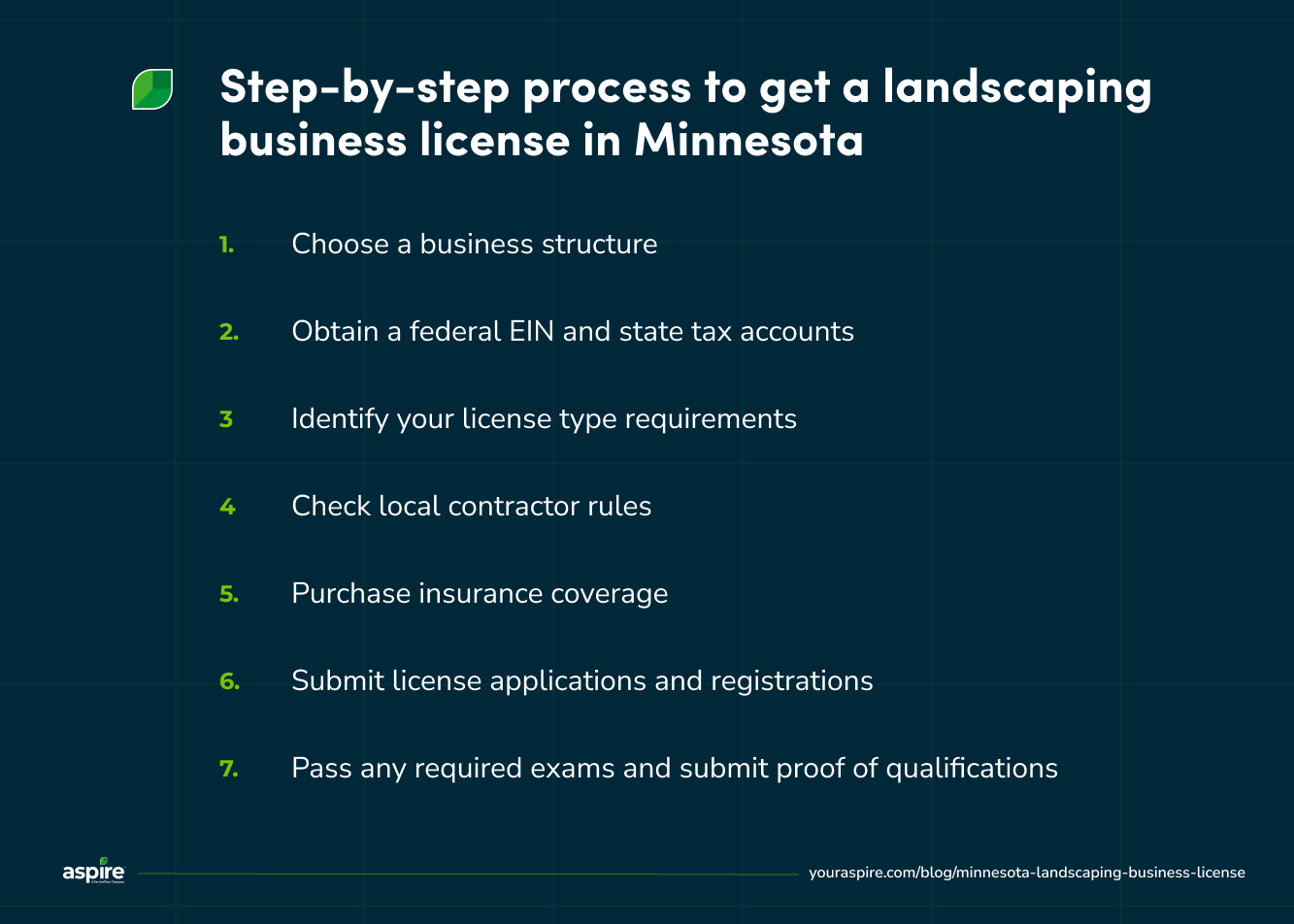
Step-by-step process to get a landscaping business license in Minnesota
Because Minnesota does not have a single statewide landscaping license, most landscaping businesses follow a series of registration, insurance, and permitting steps before taking on work.
The exact licensing process depends on the services offered and the cities where you will operate.
1. Choose a business structure
The whole process starts with you selecting a legal structure for your company.
Many landscaping businesses choose one of the following:
Sole proprietorship: No formal filing required, but offers zero personal liability protection.
Limited Liability Company (LLC): A practical choice for small owners who want to protect personal assets.
Corporation: Comes with strong liability protection, but it has more complex tax and reporting obligations.
Partnership: Works great if you want to split responsibilities, profits, and liabilities with a co-owner.
2. Obtain a federal EIN and state tax accounts
After you have a business structure, you will need an Employer Identification Number from the IRS. You can apply for an EIN through the IRS website (it’s free and takes about 15 minutes).
If you hire employees or collect sales tax on taxable products, also register for the appropriate Minnesota tax accounts. This step allows you to report payroll taxes and comply with state tax obligations.
You can apply for a Minnesota Tax ID here.
3. Identify your license type requirements
In this step, you need to determine whether the services you provide require a specialty contractor license.
A landscaping business that provides mowing and basic maintenance typically faces different requirements than one offering landscape construction, tree care, or pesticide application.
For example, if you want to become a professional landscape architect in Minnesota, you must take the required L.A.R.E. exam, provide proof of qualifying experience, and have an LAAB- or LAAC-accredited degree.
4. Check local contractor rules
You always need to review the rules of every city, county, or township where you plan to work, as local governments set their own contractor registration, permit, and inspection rules.
A landscaping company that works in Minneapolis, Duluth, Rochester, or a smaller township may need different paperwork for the same type of project.
Check local rules for projects that might involve:
Work in public rights-of-way
Retaining walls
Drainage changes
Driveway or sidewalk work
Excavation
Utility access
Street tree planting
Erosion control
Some cities will also require that you display a license number on your proposals, vehicles, or project paperwork. Others may ask for a site plan, property survey, or inspection before work can begin.
5. Purchase insurance coverage
Most commercial clients will ask for proof of insurance before offering you a job.
General liability is one of the most often-requested types of insurance, and it protects against property damage and injury claims.
Workers’ compensation coverage becomes important once you start having employees, such as a certified landscape specialist. Also, if you use vehicles for your work, you will need commercial auto insurance.
If your company performs work that falls under home improvement contractor regulations, or if you plan to obtain a residential building contractor or remodeler license with the Minnesota Department of Labor and Industry (DLI), you will also need to secure a $1,000 surety bond (a three-party contract that guarantees one party will fulfill its obligations to another).
6. Submit license applications and registrations
In Minnesota, this could mean business registration updates, local licensing forms, a pesticide applicator license application, or permits tied to specific city rules.
If you are altering the landscape, moving more than ten cubic yards of soil, or disturbing land near protected waterways, you will need a land disturbance or grading permit.
Some public works departments will also ask for a natural landscape or weeding permit if your landscape design involves vegetation exceeding twelve inches in height.
7. Pass any required exams and submit proof of qualifications
Before approval, some license types require you to pass an exam or to have proof of your work experience.
A pesticide applicator, for instance, must meet the Minnesota Department of Agriculture requirements before applying pesticides for hire. You must first determine your license type (commercial, noncommercial, or structural), then apply online and pay the nonrefundable fees.
Other regulated jobs, such as work performed by plumbers on irrigation or sprinkler systems, require the proper trade license.
To ensure your application doesn’t stall, gather the following documents:
Exam results
Training records
Continuing education records
Proof of insurance
Surety bond documents
Business registration records
Project- or trade-specific permits
You will have a much higher chance of your application getting approved when every required document matches the legal business name.
How much does a Minnesota landscaping business license cost?
The cost of a landscaping business license in Minnesota depends on the services you want to provide, your business structure, and local permit rules.
Business name or LLC registration with the Minnesota Secretary of State ranges from $0 to $155, depending on the filing method.
Expected costs differ depending on the service:
State licensing for general landscaping and lawn care is $0, but business registration fees may still apply
Pesticide or fertilizer application cost is $64 per year for a Commercial Pesticide Applicator License from the Minnesota Department of Agriculture
Specialty services, such as Subsurface Sewage Treatment Systems (SSTS), may bring your licensing cost up to $200 per year
Local municipal permit costs vary from $25 to $200 per year for a business license, tree trimmer permit, or landscaping permit
You should also factor in other costs such as license exam fees, surety bond costs, insurance, and continuing education.
What are the most common mistakes to avoid when getting a license?
One of the most common mistakes to avoid when getting a landscaping license in Minnesota is treating landscaping as one service instead of doing due diligence for each service, job type, and city rule separately.
Here is how to avoid making a poor start with your business:
1. Assuming basic lawn care rules cover every service
Basic landscaping jobs, such as mowing and seasonal cleanup, come with fewer licensing requirements than regulated work.
A landscaping business that starts with lawn care and then adds services like pesticide application, tree care, or landscape construction enters a different compliance area.
Each of the services you add deserves a fresh review before it appears on proposals or job ads.
The safer move: create a list of the services you would like to offer and match every service to the correct state agency, local office, state licensing board (when applicable), or trade rule before starting to sell the work.
2. Skipping local permit checks
Even if a project might look simple during the walkthrough, it may require a permit once it includes grading, drainage changes, or planting trees near streets.
Local offices might also require tree trimming permits, erosion control plans, or inspections.
To be on the safe side, call the city clerk, building department, zoning office, or public works department before you sign the contract. That helps you protect your timeline and price the job correctly.
3. Submitting paperwork under mismatched business names
Insurers, bond providers, licensing officers, and tax agencies need the same legal business information.
A small mismatch, such as using your LLC name on a form and your trade name on another, can significantly slow down approval. The same problem occurs when proof of insurance, tax accounts, and surety bond documents show different addresses or owners.
To make things easier, keep one master business record with your legal name, DBA, EIN, registered address, owner information, policy numbers, and renewal dates.
Clean paperwork will give reviewers less reason to pause your application and give your customers more confidence when asking for compliance documents.
How Aspire helps landscaping businesses stay organized & compliant
As your landscaping business grows, Aspire’s landscape business software gives you one place to manage work, documents, billing, schedules, and job data.
Contract & proposal management
Licensing mistakes begin to happen when sales teams sell work before checking the service details.
Aspire helps teams build solid proposals from the same customer, property, and estimate data used later in the job. When a contract includes regulated work, such as irrigation, hardscape, or landscape construction, this matters the most.
Job details all stay tied to the account, so office staff and field crews use the same job information in their work. As a result, there are fewer chances of mistakes being made.
Invoicing & payment processing
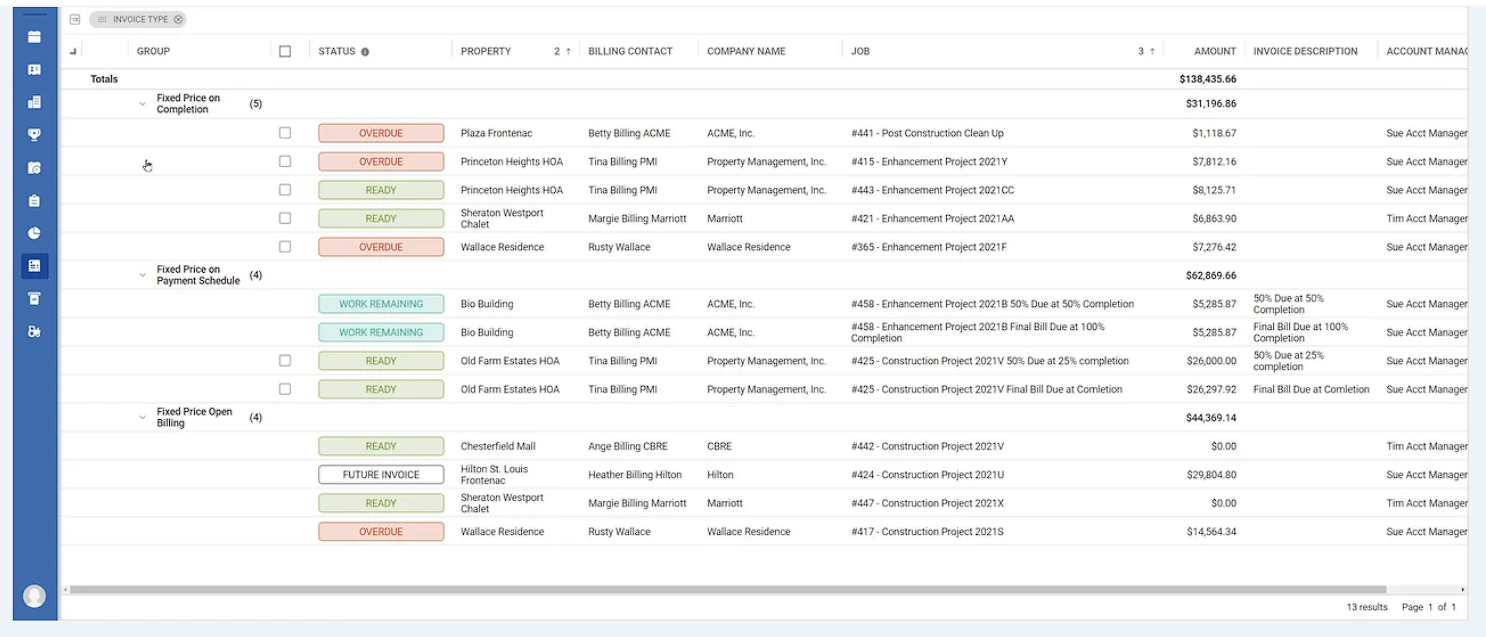
Billing gets chaotic when contracts, change orders, and one-off services live in different places.
However, with Aspire’s invoicing feature, you have everything connected in one place, from completed work to invoices and payment tracking. Teams can see what was billed, what stays open, and which customers need follow-up before cash flow tightens.
For Minnesota landscaping businesses that are handling seasonal mowing, plant installation, snow work, or specialty services, that record trail helps keep revenue tied to actual work performed.
Business reporting & documentation
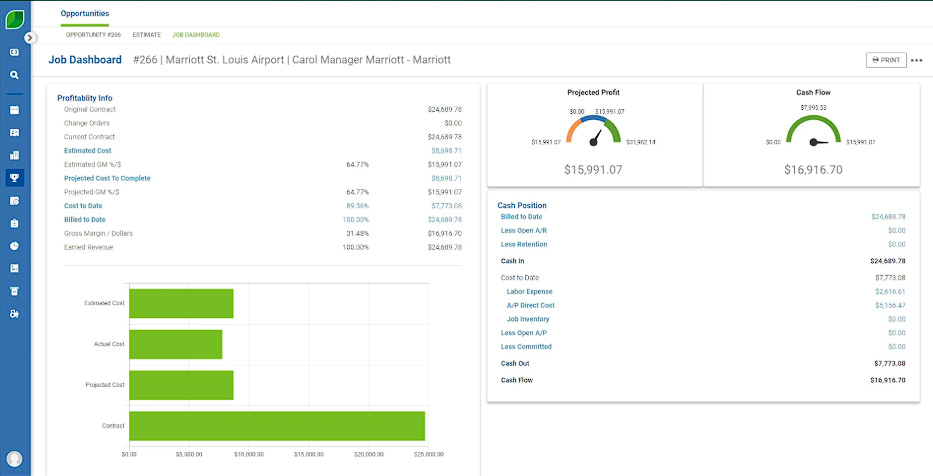
Compliance and licensing depend on easy access to business records.
The platform’s reporting feature gives you visibility into job costs, sales, labor, customer activity, and operating data. Teams can also track notes, attachments, and job details that help answer client inquiries or prepare internal reviews.
This type of record-keeping matters the most when homeowners, commercial clients, municipalities, or insurers ask for proof of insurance, job history, or signed work details.
Scheduling & job management
Field crews have to deal with weather swings, route changes, and packed service calendars.
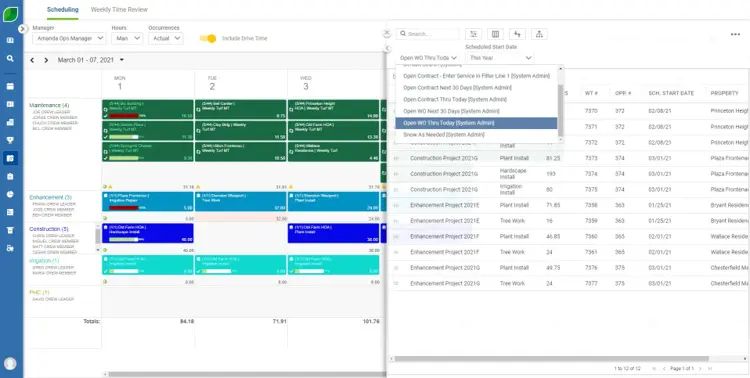
Aspire turns sold work into scheduled jobs and helps teams manage visits, crews, and job progress from both the office and the field. The scheduling feature, together with the mobile app, gives field staff access to schedule updates, work tickets, notes, photos, and property details.
With a cleaner job flow, there are fewer chances to miss details, and compliance tasks won’t get buried during busy seasons.
Over to you
Getting a landscaping business license in Minnesota comes down to filing the right paperwork, following the rules that apply to your work, and keeping all your records organized.
Licensing becomes much easier when you keep insurance documents, proposals, schedules, and invoices connected in one place. Aspire helps your landscaping business manage office and field jobs with ease, so work keeps moving, and licensing is less overwhelming.
If you are ready to bring more order to your operations, book a free demo with Aspire today.
Disclaimer
This article is for informational purposes only and should not be considered legal or financial advice. While every care was taken to use official sources, always verify current requirements through official Minnesota government resources, including state.mn.us and the websites of the agencies that oversee your work.













 866-727-7473
 Schedule Demo
 390 S Woods Mill Rd #300 Chesterfield, MO 63017


