
Southern Botanical reviewed gross margin once a month in a financial meeting, as one number pulled from Aspire. Yi Wei, a systems analyst at the Dallas-Fort Worth company, showed Ignite 2026 what that number was hiding.
In one division, in one month, the team completed about 1,000 work tickets. About 400 were more than 15 margin points above or below the estimate. On the branch report, that month looked fine.
What a monthly average hides
Gross margin from Aspire is accurate. It's also an average, and Wei said an average can't tell you whether your estimates are reliable or your production team is efficient.
Picture every ticket as a dot on a chart, with a band around the margin you estimated. One ticket lands 40 points under the estimate, and another lands 40 points over. Average them, and you get a good month. The ticket that came in high may not be good news either. Often, a cost landed on a different ticket, so the high and low can be the same problem counted twice.
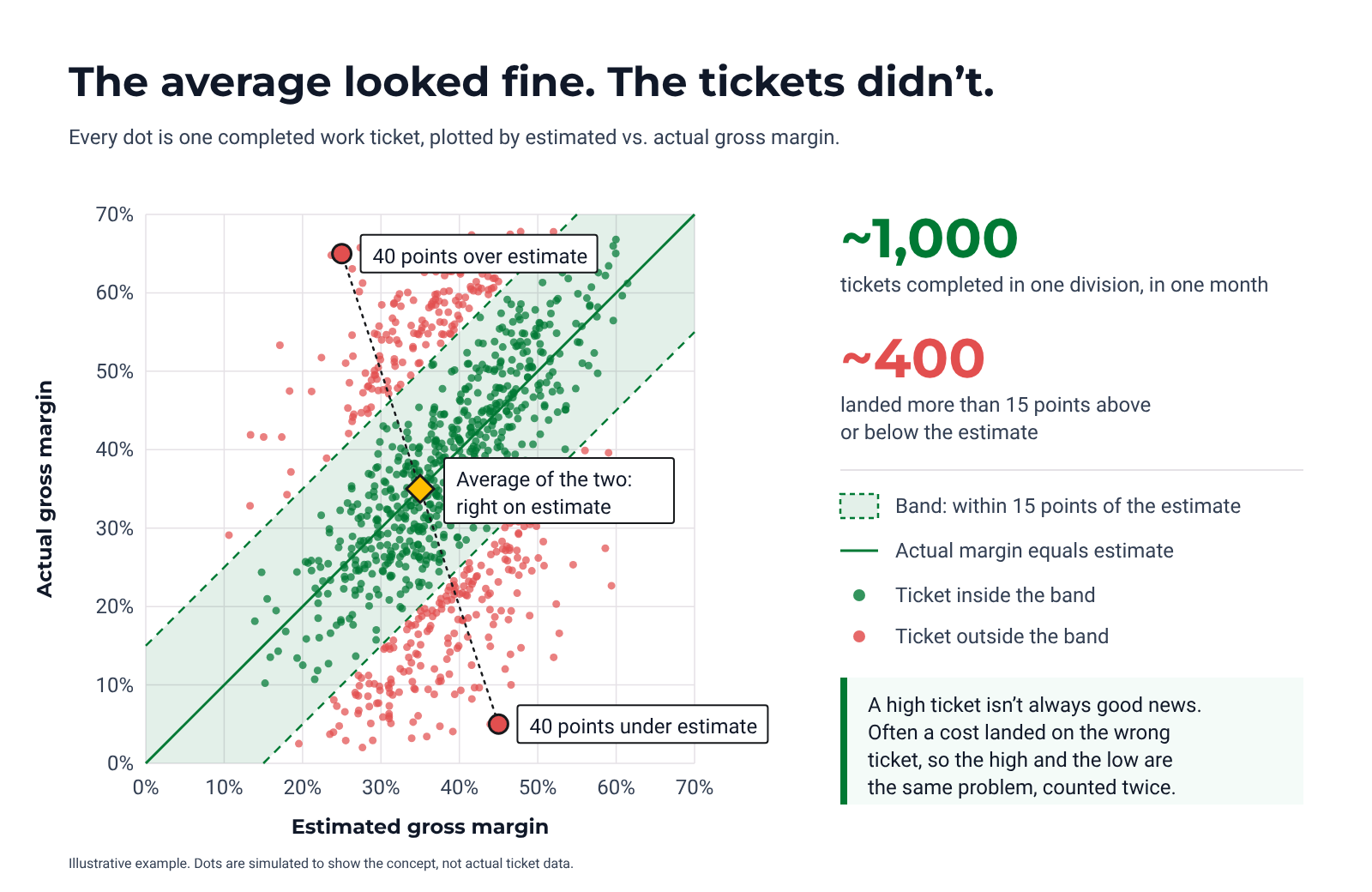
Wei asked her VP of Finance about this. Her answer: there's no perfect way to get every ticket inside the band, so don't chase that. Aim for a flatter wave. A wave that big means either the estimate wasn't reliable or something happened in production that nobody wrote down. You can fix both, and neither shows up in an average.
The optional checklist
Aspire's end-of-month checklist has one required item for completed work tickets. Under it sit seven more lists, all marked optional. One of them is "review gross margin for acceptable range." For their first two years on Aspire, Southern Botanical never opened any of them.
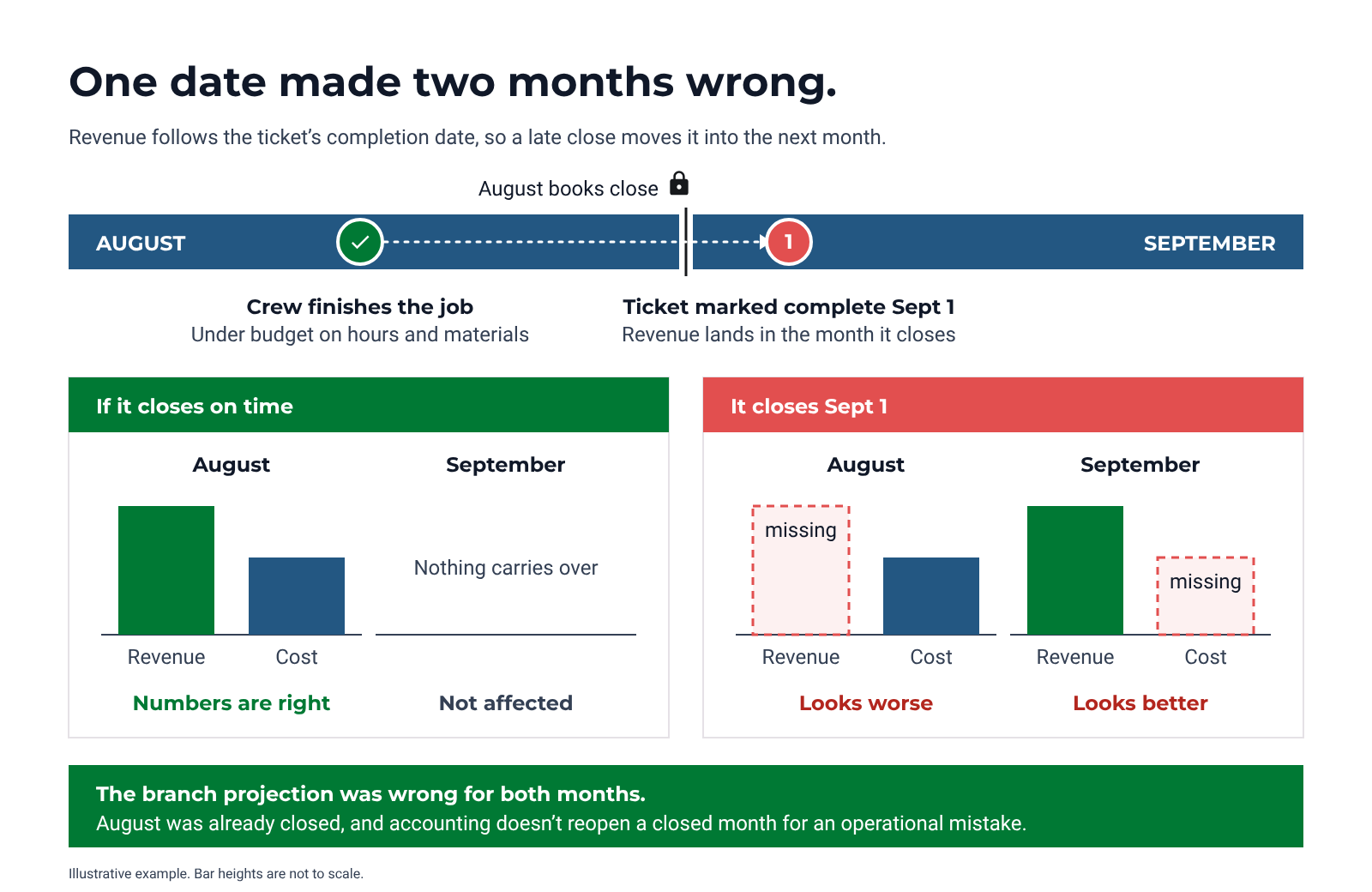
A date changed their mind. In August, the crew completed a large job under budget on hours and materials. Because the company reports earned revenue, the completion date determines which month the revenue lands in, and the ticket was completed on September 1. By the time anyone noticed, August was already closed, and the accounting team doesn't reopen a closed month for an operational mistake. So the rest of that job's revenue landed in September with no cost against it. August looked worse than it was, September looked better than it was, and the branch projection was wrong for both.
One date on one ticket made two months of numbers wrong. The list that would have caught it was sitting there, marked optional.
The pushback was fair
The accounting team proposed reviewing tickets weekly instead of finding problems at month-end. The responses:
"Is it really worth the time to dig into four hundred tickets?"
"Who is supposed to do this?"
"We already have enough to do. We are scheduling tickets and managing crews."
"I am not a data analyst. This is not my job."
Wei said none of those objections were wrong. Four hundred tickets is a lot. The team did have enough to do, and the people on the accounting team weren’t data analysts.
Then came the point that changed the conversation.
They were already paying for those 400 tickets, just somewhere else and later. Every ticket nobody had looked at showed up as a surprise at month-end close, and all you could do was explain the number.
A mistake of her own
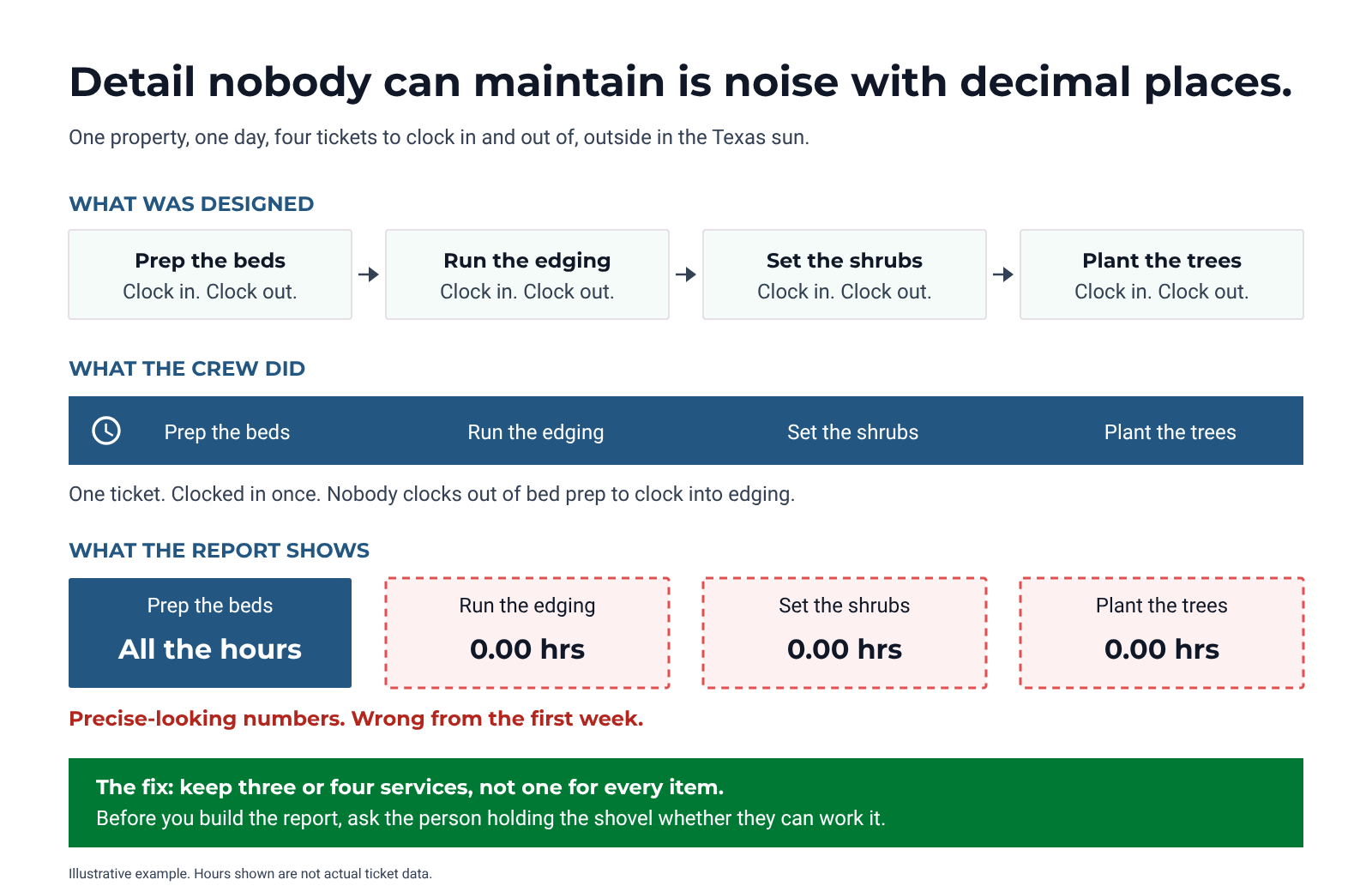
Wei spent years as a senior estimator before she joined the Aspire implementation team and eventually led it. When it came time to build service lines for the design-build division, she set up a separate service for every item: trees, shrubs, sod, edging, hardscape, decomposed granite. In construction estimating, breaking a job into small pieces helps you learn what each part costs, and she built it herself.
Then picture the crew. One property, one day. They prep the beds, run the edging, set the shrubs, and plant the trees. She had given them four tickets to clock in and out of, outside in the Texas sun. Nobody clocks out of bed prep to clock into edging. They clocked into one ticket and kept working, so the data was wrong from the first week.
Her branch managers asked her to turn them all off and keep three or four services. She argued with them, and they were right. Her takeaway: detail nobody can maintain is noise with decimal places. She had designed the system for the report she wanted and never asked the person holding the shovel whether they could work it.
She told this story before describing the review because of what it taught her about blame. Her crews and managers told her the truth about her own design, and that only happens in a culture where people don't expect to be blamed. If people think the weekly review is a hunt for who messed up, they show up ready to defend themselves, and careful answers teach you nothing. So the review runs on one question: "Where did the process break down?" She credits Michael Timms' TED talk, How to Claim Your Leadership Power, with the question. The alternative question is "Whose fault is this?"
How the weekly review runs
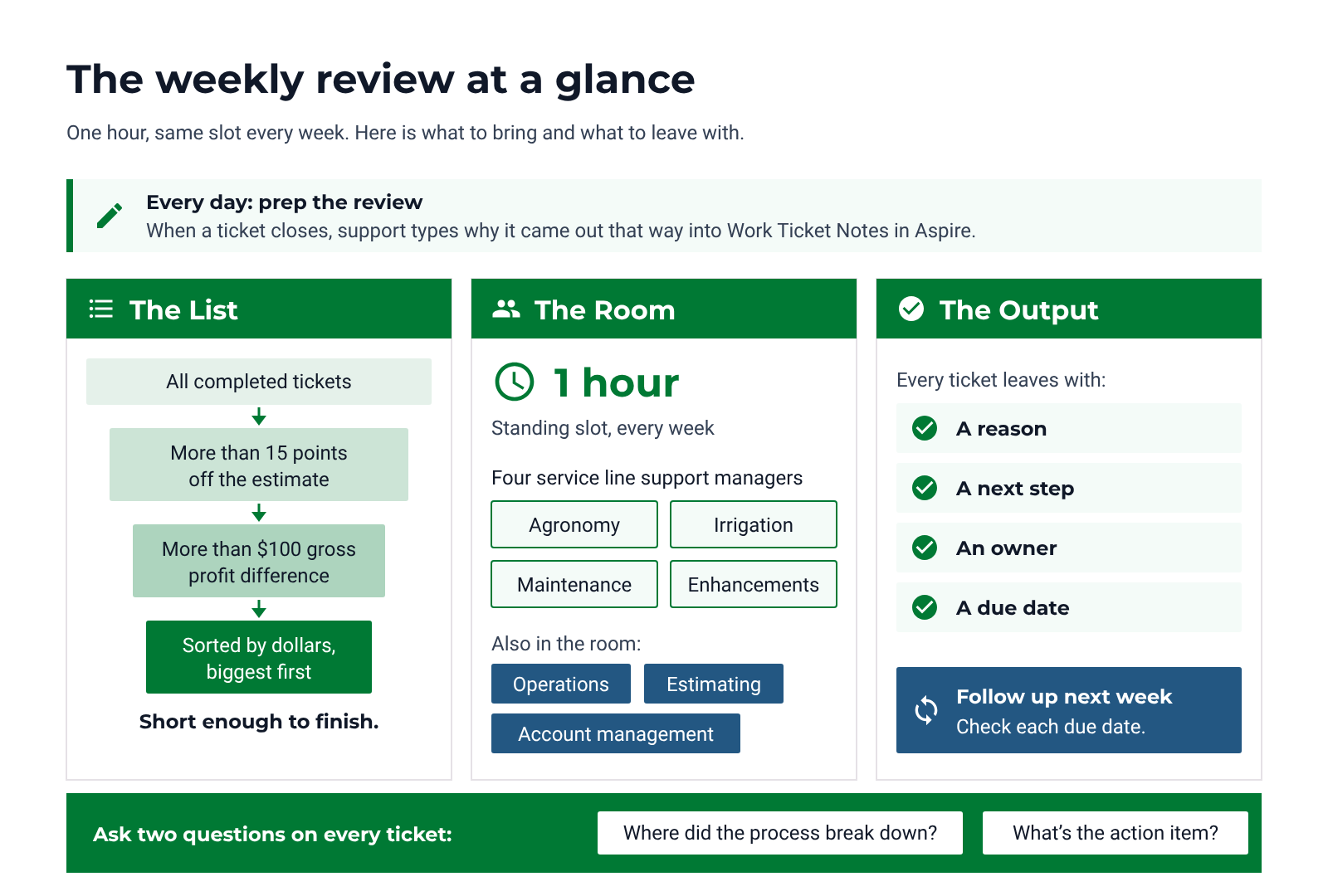
They tested it in one division, with no company-wide mandate. The group meets for one hour on a standing weekly slot. It's cross-functional: operations, account management, and estimating sit in the same room.
Wei explained why that matters. Labor drift is an estimating problem. Operations owns the schedule and account management owns the client relationship. Review them separately, and each function explains its own number away. Put them in one room, and the explanations have to stand up to each other.
Prep happens daily. When the support team completes a ticket, they type why it came out the way it did into the Work Ticket Notes in Aspire. By the time the group meets, the analysis is already written.
The list. Pull every completed ticket more than 15 points off the estimate, then narrow it to tickets with more than $100 of gross profit difference, sorted by dollars, biggest first. That keeps the list short enough to finish.
The room. Four service line support managers: agronomy, irrigation, maintenance, and enhancements. They use the same hour for equipment, manpower, purchasing, forecasting, and seasonal prep.
The output. Every ticket leaves the meeting with a reason, a next step, an owner, and a due date. The following week, they follow up.
What the review found
The count of tickets off gross margin dropped from about 400 to about 200 a month. Wei said the review found the real story.
She expected to find crews running over. The biggest pattern was how they built the estimate. Operations problems were rare, and when they appeared, the cause was usually something outside the scope that nobody had accounted for. She had been an estimator for years, so it was hard for her to accept. She came to see the process as the problem, since no single estimator has the full picture.
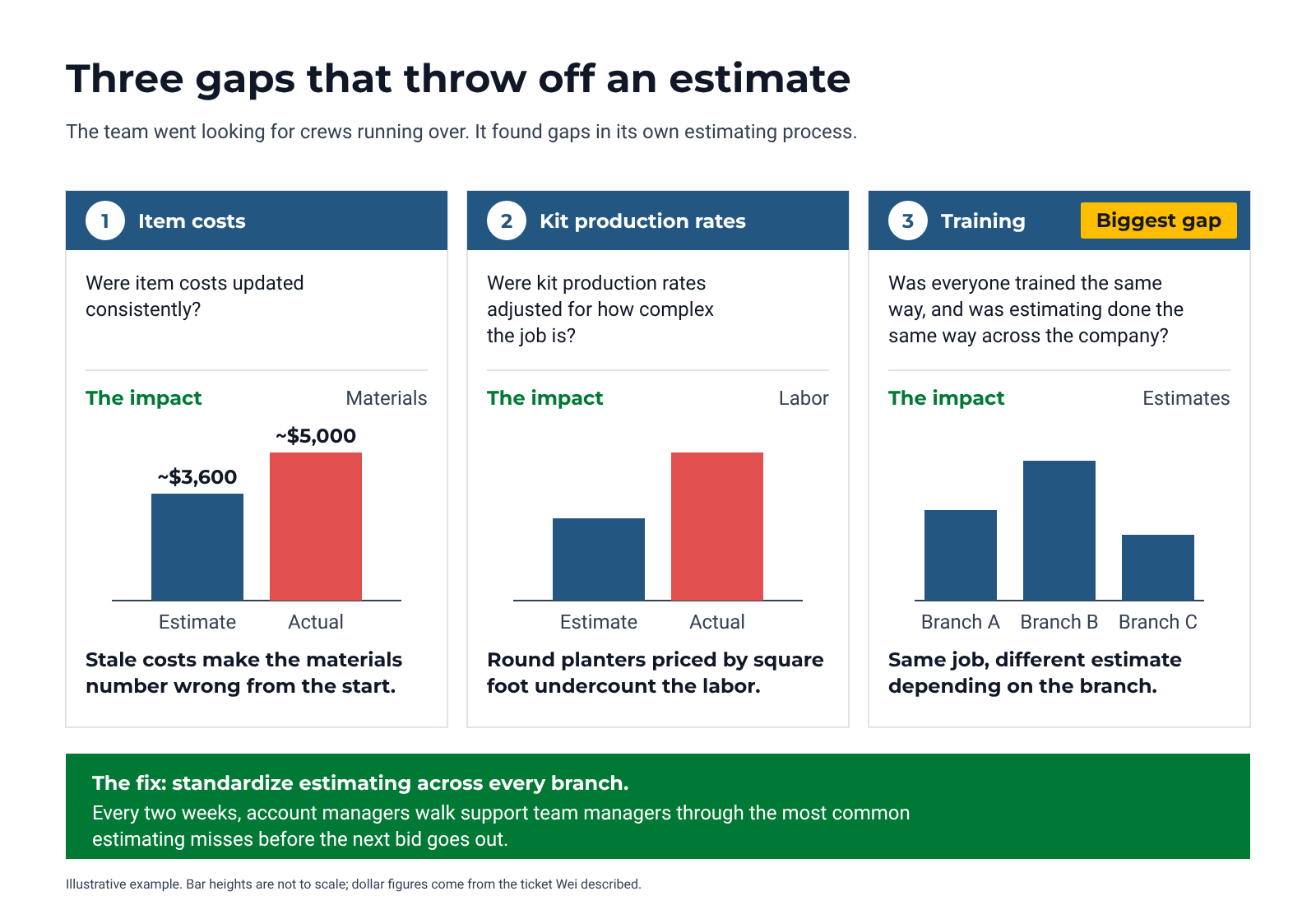
They found three gaps in the estimating process:
Item costs. Were they updated consistently?
Kit production rates. Were they adjusted for how complex the job is?
Training. Was everyone trained the same way, and was estimating done the same way across the company?
The training gap was the biggest. Estimating differed by branch and by service line. Residential leaned on kits, commercial was inconsistent, and one branch did it differently from everyone else. They're now standardizing estimating across branches. Every two weeks, account managers sit down with support team managers to walk through the most common estimating misses before the next bid goes out.
The color pot ticket showed the pattern. They had estimated pots by square foot. For round planters, square footage undercounted the labor. The labor overrun came from an estimate built on the wrong measure, so they built a new estimating method for color pots.
The second finding was inventory. Materials left inventory, but the allocation to work tickets was off. Some never made it onto a ticket, and some got loaded too heavily. Under-allocated materials show up as a big unexplained loss at month-end. Over-allocated ones throw job margins off and then produce a credit. Wei summed it up: at month-end, no branch wants the waste, and every branch wants the credit.
Three tickets, three root causes
Wei closed with three real tickets and asked the room to guess the cause.
Estimated at 7 hours, closed at about 51. Most people guess the crew was slow, and that's where the team always looked first. The client had asked for more while the crew was on site, and the crew did the work. Nobody wrote a change order. The fix lives in the paperwork: when the scope changes, the paperwork changes.
The ticket that looked like the best job of the week. The estimate included about $1,500 in materials, but the ticket showed $0, with hours logged and margin far above the estimate. The crew used materials from the company's own inventory, and they never posted them to the ticket. The ticket looked great, but the inventory looked like waste. The fix was allocation training.
Estimated at about $3,600 of material, actual about $5,000. The crew used a different product. They used exactly what the company uses today, and the kit still listed the old product. The estimate was wrong before anyone picked up a shovel. The fix was to update the kit, assign an owner, and set a due date.
None of the three came from a crew running over. They were process problems, and Wei pointed out where each one lives. Planters estimated by the square foot; five ways of estimating the same work and materials landing on the wrong ticket all sit in the office, in estimating, training, and allocation. The team went looking for crews running over and found its own processes.
On the operations side, problems were rare, and the fix was an SOP and training. They found three training topics: dates in Aspire (the purchase receipt received date and the work ticket completed date), allocating materials to the right ticket, and clocking hours into the right ticket.
What changed
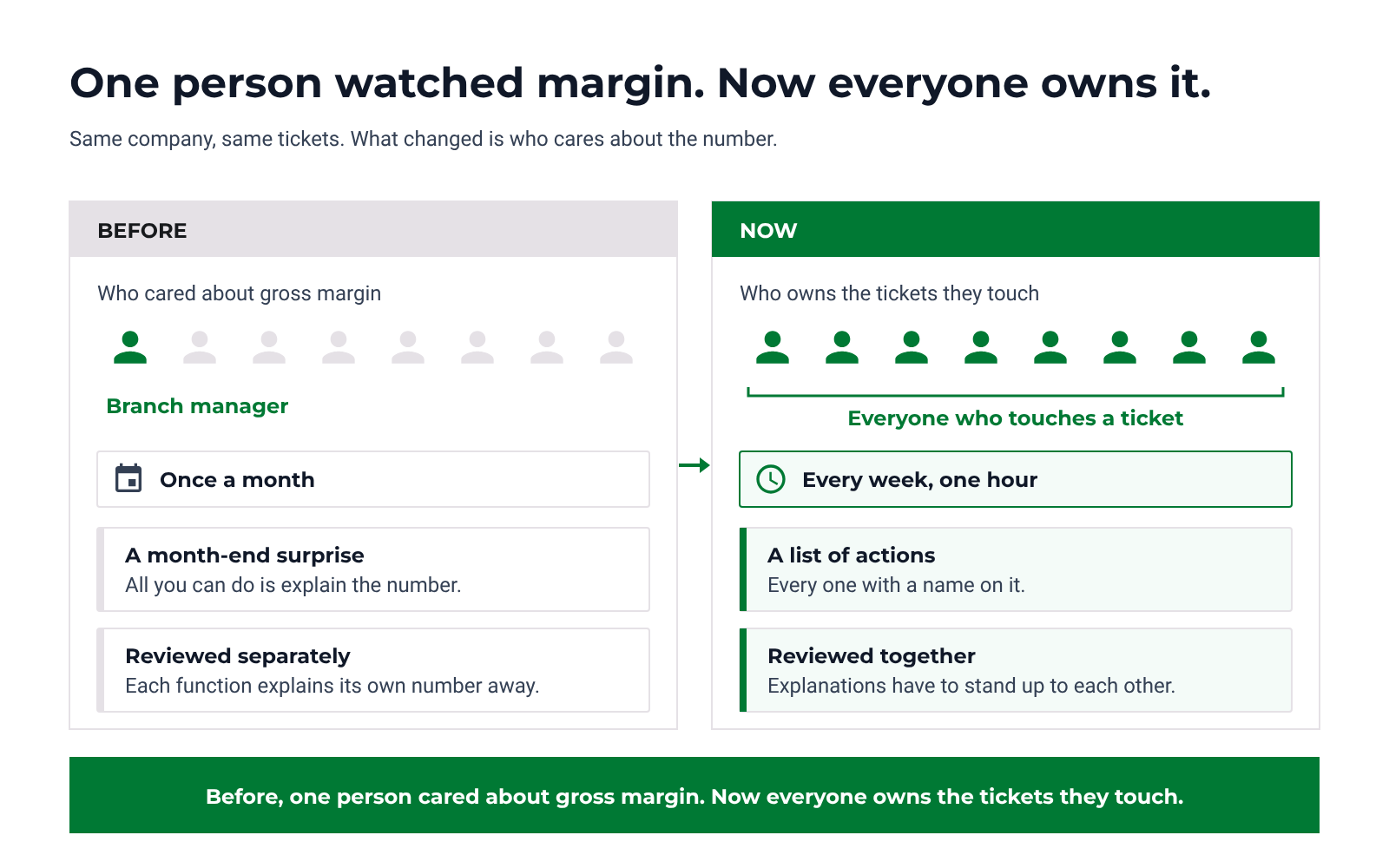
Before, one person cared about gross margin: the branch manager, once a month. Now everyone owns the tickets they touch. People arrive at the meeting expecting to explain their own tickets with a reason and a next step. The meeting turned into a list of actions with names on it. Wei also saw the office learn what the field deals with on a job site, and saw the field learn why the office schedules the way it does.
Start next week
Pick one division.
Pull the tickets that are off.
Put an hour on the calendar.
Promise your team it isn't about blame.
Answer for your own process first.
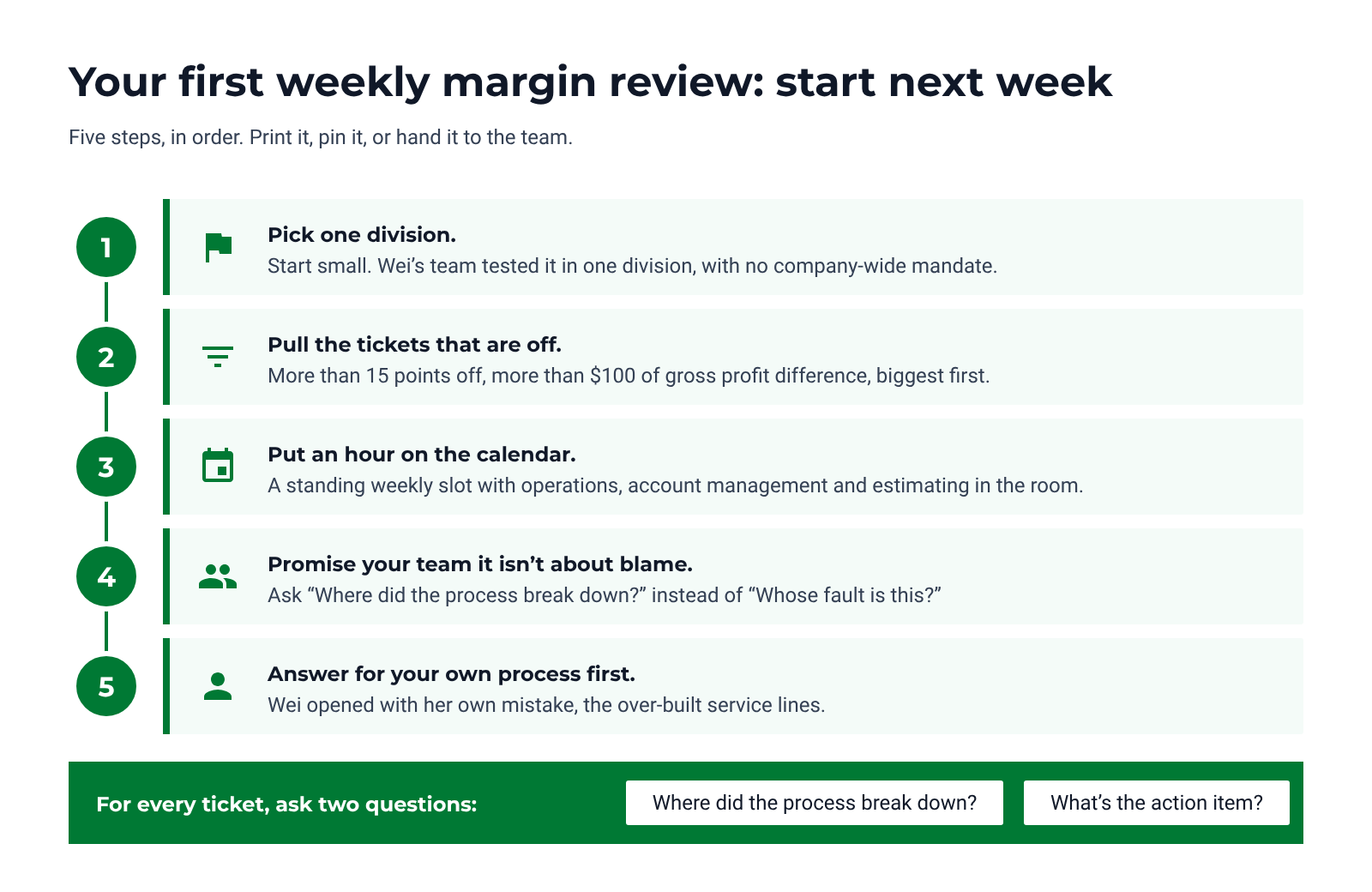
Use two questions for each ticket: where did the process break down, and what's the action item?
Wei cautioned that this process isn't finished. One division has tested it, and it's still rolling out. She shared it anyway, because waiting until a process is perfect is how good processes die in a folder.











 866-727-7473
 Schedule Demo
 390 S Woods Mill Rd #300 Chesterfield, MO 63017


