
You made $2.4M in EBITDA last year.
The P&L looked strong. The board was happy.
Then April arrived, and you’d already used 70% of your credit line with peak season just starting.
Profitable companies that can't convert earnings to cash aren't financially healthy; they're funding growth with borrowed money and hoping the timing works out. Cash conversion isn't a finance problem; it's an operational process problem.
You made $2.4M in EBITDA. Where's the cash?
Most landscape CFOs can recite last year's EBITDA from memory.
Fewer can explain why the operating account is chronically tight despite those earnings. The gap between profit and cash is where operational process failures compound into liquidity crises.
The cash paradox hits hardest at the worst possible time.
A $20M commercial landscaper reports $2.4M in EBITDA, a healthy 12% margin.
The financials look strong. But on April 1st, the start of peak season, when the company needs maximum operational capacity, the reality is different:
Operating account balance: $180K.
Line of credit drawn to 70% of the $2M facility.
Days Sales Outstanding (DSO) running at 58 days.
$1.2M in completed work is sitting unbilled because the billing team is three weeks behind.
$1.1M in outstanding AR past 60 days because invoices went out with errors that triggered client disputes.
The company is profitable on paper.
It's also functionally broken as it enters its highest-revenue quarter.
That happens when process problems are embedded in how the operation converts work performed into cash collected.
Profit is an accounting outcome. Cash is an operational discipline.
EBITDA measures earnings before interest, taxes, depreciation, and amortization. It doesn't measure how fast you bill, how accurately you invoice, or how tightly you manage the gap between service delivery and payment collection.
Those operational processes determine whether profit translates to cash or sits trapped in unbilled Work-In-Progress (WIP) and aging receivables.
For growing landscape companies, especially those ramping for peak season or funding acquisitions, cash conversion velocity is the constraint that determines what's operationally possible.
You can't hire crews, buy equipment, or execute growth plans if cash from profitable work takes 60 days to reach the bank account.
The Three Operational Levers That Drive Cash Conversion
Cash conversion isn't a single metric; it's the cumulative result of three operational processes. Each one either accelerates or delays the path from completed work to collected cash.
Invoice velocity: the days between work completed and invoice sent
Every day between job completion and invoice delivery is a day of free financing you're providing your client. For a $20M landscape company with a 45-day average invoice velocity, that delay represents $2.5M in unbilled revenue sitting in operational limbo at any given time.
Most landscape companies bill in batches rather than in real time.
The operational pattern looks like this:
Crews complete work throughout the week.
PMs compile job completion notes and send them to the office on Friday afternoon.
The billing coordinator enters time, materials, and scope into the invoicing system on the following Monday and Tuesday.
Invoices go out on Wednesday or Thursday, 7 to 10 days after the work was completed.
On recurring maintenance, that lag is manageable.
On project work and enhancements, where individual invoices can be $50K to $200K, every week of delay costs real cash flow.
A company with $8M in annual enhancement revenue running 10-day invoice velocity has $220K in unbilled work in process at any moment, work that's been completed but hasn't started the collections clock because the invoice hasn't been sent.
The operational fix is production-triggered invoicing.
When job completion flows directly from field operations into billing workflows without manual handoffs, invoice velocity compresses from weeks to days:
Crews close out completed work in the field using mobile tools.
Job completion triggers invoicing workflows automatically.
Billing reviews and sends invoices within 24 to 48 hours of work completion.
A 10-day reduction in invoice velocity on $8M in project work releases $220K in working capital without changing pricing, winning new work, or improving collections. It's pure operational efficiency converting to cash.
Billing accuracy: the invoices that don't get disputed
Invoice disputes are the silent cash conversion killer.
A disputed invoice doesn't just delay payment; it resets the entire collections timeline and often requires manual intervention to resolve.
Landscape invoicing errors fall into predictable categories:
Scope mismatches: the invoice includes work the client doesn't recognize or reflects quantities that don't match their records.
Pricing errors: rates or unit prices differ from those in the contract or the verbal agreement communicated by the account manager.
Materials charges: clients dispute pass-through materials costs that weren't pre-approved or that seem excessive relative to the visible work.
Timing errors: work billed in one period that the client expected in another, especially common on milestone-based project invoicing.
Each dispute category has the same financial impact: payment stops, the AR aging clock keeps running, and someone in operations or finance has to spend time researching, correcting, and resubmitting.
A $20M company with 8% of invoices disputed and a 30-day average dispute resolution time has about $130K in AR sitting in dispute status at any given moment, work that's been completed and invoiced but isn't progressing toward payment.
Billing accuracy starts with operational data integrity, not invoice review.
The companies with low dispute rates aren't running more rigorous invoice QA; they're capturing scope, quantities, and client expectations in structured workflows as the work happens:
Contract details, pricing, and scope are documented in the system and flow automatically into invoicing.
Materials usage is tracked at the job level and compared against estimates before invoicing.
Enhancements and scope changes generate change orders before the work is billed, not after disputes arise.
When invoicing relies on clean operational data rather than memory and spreadsheets, dispute rates drop and disputed invoices resolve faster because the documentation already exists.
Contract-to-cash alignment: billing what you're owed, when you're owed it
Enhancement and project work are particularly prone to cash leakage.
Milestone-based billing creates natural delays between work performed and payment received, and those delays compound when milestones aren't clearly defined or when billing lags behind milestone achievement.
Misaligned contract terms create structural cash conversion problems.
Consider a $150K landscape installation project with milestone billing:
30% on contract signing: $45K.
40% at substantial completion: $60K.
30% on completion: $45K.
If "substantial completion" isn't defined precisely in the contract, the billing trigger is subjective. The PM might believe the job hit substantial completion in week 6, but the client thinks it's week 8 because punch-list items remain.
That two-week gap on a $60K invoice is $60K in delayed cash. If the company runs 20 similar projects simultaneously, the aggregate delay materially impacts working capital.
The operational solution is contract-to-cash workflow alignment:
Contract terms define milestones using objective criteria: percent complete by cost, hours logged, or specific deliverables achieved.
Production data automatically signals when milestones are reached.
Billing workflows are triggered by those signals, not by a manual PM notification.
For recurring maintenance contracts, alignment problems surface differently but with a similar cash impact:
Contracts specify monthly billing, but the actual service cadence is weekly or biweekly.
Billing cycles don't align with service delivery cycles, creating perception mismatches for clients when they receive invoices.
Enhancement work performed under maintenance contracts sits unbilled because it wasn't part of the recurring billing schedule.
When contract terms, service delivery schedules, and billing automation align structurally, cash conversion accelerates because invoicing matches operational reality.
What This Looks Like in Aspire
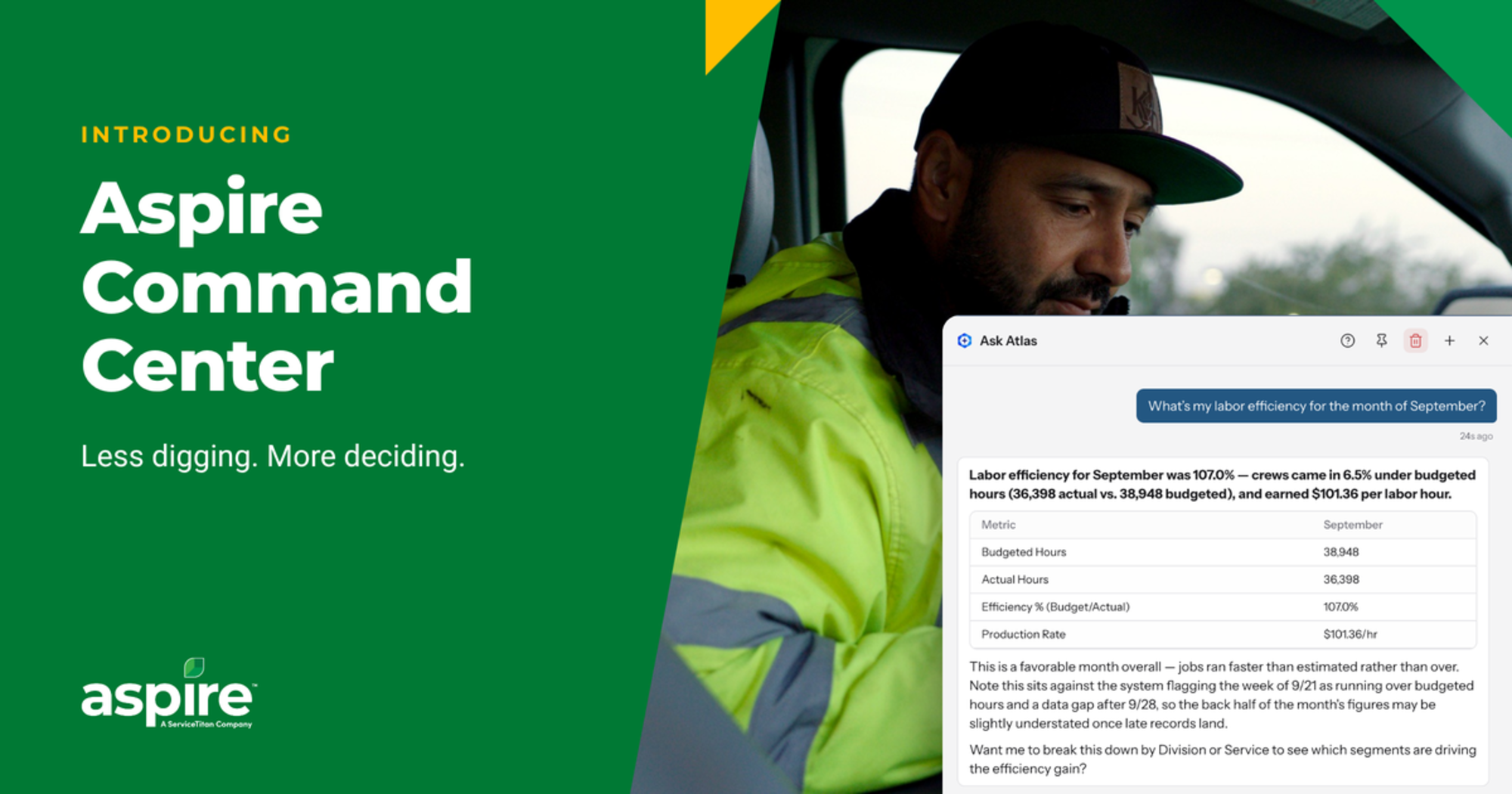
Aspire's integrated financial and operational workflows deliver the infrastructure CFOs need to compress cash conversion cycles without adding billing headcount or manual oversight.
Production-triggered invoicing that eliminates the lag between completion and billing.
When crews complete work and close out jobs in Aspire's production tracking system, invoicing workflows activate automatically.
Job completion data, labor hours, materials usage, and scope flow directly into invoice generation.
The billing team reviews and sends invoices within 24 to 48 hours of work completion, rather than waiting for weekly batch processing.
The result is invoice velocity measured in days, not weeks, thereby releasing working capital previously trapped in unbilled WIP.
Contract-aligned billing schedules that auto-generate invoices based on operational milestones.
Aspire's contract management tools link billing triggers to production data:
Milestone-based project invoicing activates when cost-to-budget or hours-logged thresholds are met.
Recurring contract billing is generated automatically based on service completion calendars.
Enhancement work performed under maintenance contracts flows into billing workflows without manual coordination between field and finance.
Nothing sits unbilled because a PM forgot to submit paperwork or because the billing coordinator didn't know work was completed.
Billing accuracy through operational data integration.
When job costing data, contract pricing, and client expectations live in the same system that generates invoices, billing errors drop:
Contract rates and pricing flow into invoices automatically, eliminating manual entry errors.
Materials usage tracked at the job level provides backup documentation for pass-through charges before disputes arise.
Scope changes and enhancements generate change orders in the workflow, not after the client questions the invoice.
Lower dispute rates mean faster payment and less AR aging beyond terms.
AR management and collections visibility that surfaces payment delays before they compound.
Aspire's financial dashboards show:
DSO by client, by service line, and by branch.
Aging AR with automated follow-up triggers for invoices approaching or exceeding payment terms.
Cash conversion metrics that track the full cycle from job completion to payment collection.
CFOs and controllers see where cash conversion is breaking down and can intervene operationally before aging receivables become write-offs.
Profit Is an Opinion. Cash Is a Fact.
A $2.4M EBITDA number on a financial statement is an accounting calculation. The $180K in your operating account on April 1st is an operational reality. The gap between those two numbers depends on how fast you invoice, how accurately you bill, and how tightly you manage the contract-to-cash cycle.
If your DSO is above 45 days, the problem isn't your clients; it's the gap between when you complete work and when you get paid for it.
Clients pay on terms when:
Invoices arrive quickly after work completion.
Invoice details match their expectations and contract terms.
Billing schedules align with service delivery, so invoices feel timely rather than arbitrary.
All three conditions are operational, not financial. They're determined by whether production data flows into billing workflows automatically or sits in manual handoff queues awaiting processing.
Close the operational gap, and the cash follows the profit.
Companies that compress cash conversion cycles don't have better clients or more generous payment terms. They have an operational infrastructure that eliminates the delays between work performed and cash collected:
Invoice velocity is measured in days through production-triggered billing.
Billing accuracy through contract and job data integration.
Contract-to-cash alignment that matches billing to operational milestones.
The result is:
✓ Working capital released from operational inefficiencies
✓ Debt capacity preserved for growth rather than consumed by slow collections
✓ Cash flow that supports peak-season operations rather than constraining them
Book a demo to see how Aspire accelerates cash conversion for commercial landscapers.









 866-727-7473
 Schedule Demo
 390 S Woods Mill Rd #300 Chesterfield, MO 63017


