Table of Contents
Table of Contents
- Do you need a license to start a landscaping business in New Jersey?
- What are the types of landscaping business licenses & permits in New Jersey?
- Step-by-step process to get a landscaping business license in New Jersey
- How much does a New Jersey landscaping business license cost?
- What are the most common mistakes to avoid when getting a license?
- How Aspire helps landscaping businesses stay organized & compliant
- Over to you
- Disclaimer
Getting a New Jersey landscaping business license starts with one question: which rules apply to the services you plan to offer?
Mowing, mulching, pesticide work, or landscape construction all follow different requirements.
Therefore, before taking on paid jobs from homeowners or commercial clients, you need to set up the right registrations, permits, insurance, and certifications.
This guide will walk you through:
When a landscaping business in New Jersey needs a state license, business registration, local permit, or trade certification
Which business license types apply to common landscaping services
How to complete the licensing process step by step
What costs to expect
What mistakes you should avoid when applying for a license
Let’s get into it!
Do you need a license to start a landscaping business in New Jersey?
New Jersey does not require a single state-level landscaping license for general lawn care, mowing, mulching, planting, and routine lawn maintenance.
However, you will still need more than a business name and starting equipment before taking on paid jobs.
New Jersey treats many residential outdoor projects as home improvement work, and the New Jersey Division of Consumer Affairs lists landscaping among the services covered under its Home Improvement Contractor rules.
That applies to landscaping businesses that work on patios, walkways, retaining walls, drainage, hardscaping, or other residential property improvements.
Pesticide work adds another layer, since the Department of Environmental Protection handles commercial pesticide applicator licensing and related rules for pesticide operators.
Local municipalities also have their own rules for business licenses, permits, noise levels, work hours, parking, and debris removal. Rules and regulations in Princeton may differ from those in Newark or Jersey City.
Before you book landscaping work, check the local requirements for each municipality where you plan to operate.
What are the types of landscaping business licenses & permits in New Jersey?
New Jersey landscaping businesses usually deal with four categories of approvals:
State business registration
Home improvement contractor registration
Specialized trade licenses
Local permits
General business license
In New Jersey, every company that plans to do business in the state needs a state business registration before starting operations.
According to business.nj.gov, all companies must obtain a Business Registration Certificate from the Division of Revenue for public contracting and other official uses.
Tax setup matters, too. The state taxes landscaping services at the sales tax rate, so companies that bill end users for these services must correctly collect and remit sales tax.
Landscaping contractor license
If you plan to start a landscaping business and offer outdoor property improvement services such as installing sidewalks, fences, driveways, garages, and similar residential work, you will fall under the Home Improvement Contractor activity.
That will require registering with the New Jersey Division of Consumer Affairs. Some professionals qualify for an exemption, but each business should confirm before advertising their services or signing contracts.
Specialized licenses
Some landscaping work falls under professional or trade-specific licensure.
For instance, a pesticide applicator license applies when a landscaping business applies pesticides for hire. The Department of Environmental Protection (DEP) requires pesticide applicators to pass the Core exam and at least one category exam.
An irrigation contractor also needs a separate certification and a business permit for landscape irrigation work. A registration for home improvement contractors does not replace this requirement.
Landscape architecture follows a different path. If you want to use the title “landscape architect” and practice landscape architecture, you need to be licensed by the New Jersey State Board of Architects.
Permits and local regulations
Each municipality can set its own rules. Construction permits, zoning approvals, tree permits, hauling rules, and local landscaper registration all depend on the town you will work in.
Hardscaping can also require extra permits in some cases. Retaining walls, drainage changes, grading, and work near wetlands or protected areas require a check by a local building officer or the Department of Environmental Protection before you start work.
Step-by-step process to get a landscaping business license in New Jersey
In New Jersey, a mow-and-blow landscaping business has a shorter setup path than a landscape construction company.
Pesticide application, irrigation contractor, or landscape architecture businesses must follow extra steps before offering services.
Use this order to keep the licensing process clean:
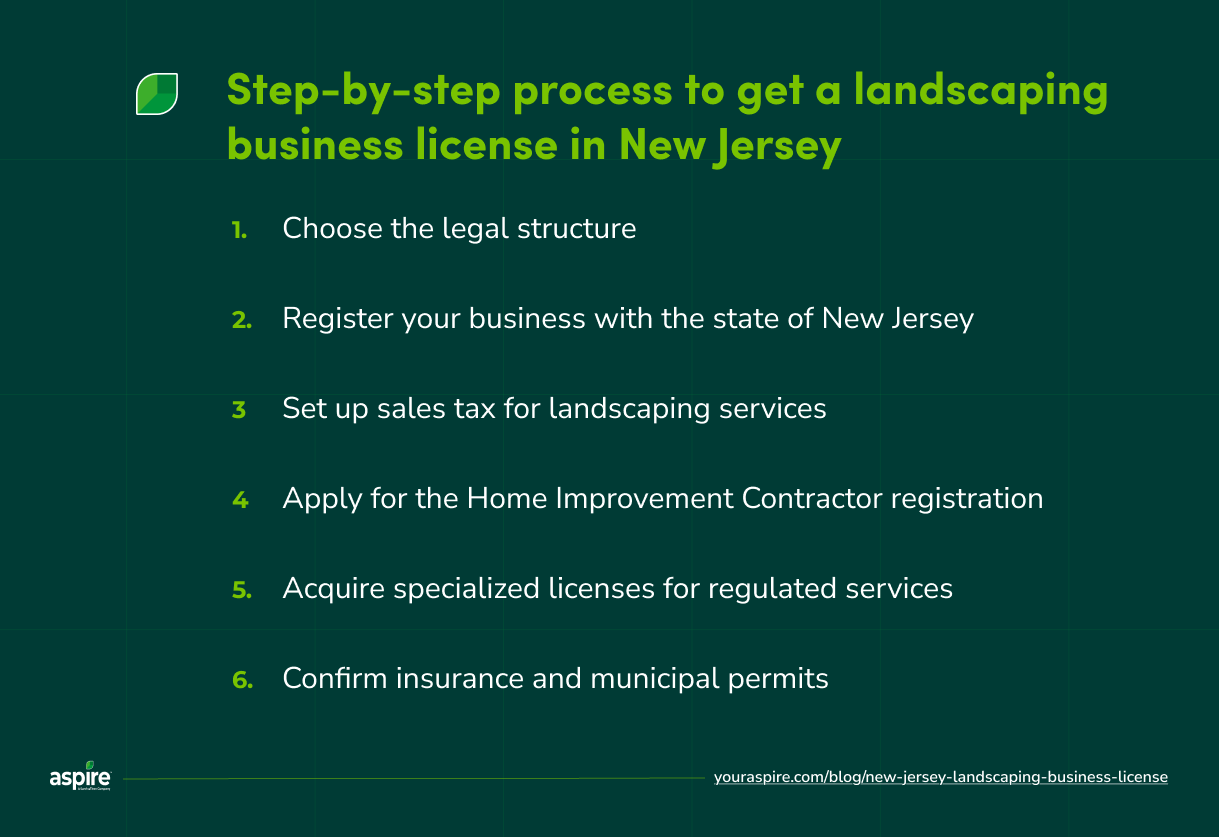
1. Choose the legal structure
Before filling out the licensing paperwork, pick your business structure.
Sole proprietors, LLCs, partnerships, and corporations follow different registration paths.
A solo lawn care owner taking small mowing jobs has a different setup than a landscape contractor that hires crews for hardscaping.
Prepare these details before starting your application:
Legal business name
Business address
Ownership details
NAICS code
Expected payroll date (if hiring employees)
Sales tax collection details
The New Jersey government site lists these details as part of the state registration process.
2. Register your business with the state of New Jersey
File with the New Jersey Division of Revenue and Enterprise Services for employer and tax purposes.
After registration, the state will issue an NJ tax ID. Businesses that collect sales tax also receive a Certificate of Authorization to Collect Sales Tax, which you must display at the business location.
If you do public jobs, you will need extra documentation. Contractors and subcontractors working with New Jersey public agencies need a Business Registration Certificate from the Division of Revenue.
3. Set up sales tax for landscaping services
New Jersey taxes many landscaping services sold to end users.
The Division of Taxation lists lawn mowing, lawn fertilizing, tree maintenance, soil aerating, weed control, and mulching as taxable repair and maintenance services.
A contractor performing taxable services for an end user collects 6.625% sales tax on the gross receipts.
Practice effective landscaping business procedures and start organizing your invoices from your very first paid job. Sales tax errors can quickly create problems when labor, materials, and subcontractor costs appear on the same invoice.
4. Apply for the Home Improvement Contractor registration
The New Jersey Division of Consumer Affairs states that home improvements include work on driveways, fences, garages, swimming pools, and landscaping on residential properties. Home improvement contractor registration is done annually unless an exemption applies.
In your application file, you should include the following:
Completed application form
Commercial general liability insurance of at least $500,000 per occurrence
Workers’ compensation insurance, unless an exemption applies
Required additional security
Application fee
The Division also requires written contracts for home improvement jobs above $500 and the display of the registration number on ads, vehicles, business cards, and business documents.
5. Acquire specialized licenses for regulated services
Before you start offering regulated services, build your service menu.
Apply for a Pesticide Applicator Business License if you want to offer pesticide application services. NJDEP also licenses pesticide operators who work under a commercial certified applicator, with a narrow exemption for direct on-site work.
If you want to offer landscape architecture services, you need to follow a separate professional licensing route through the New Jersey State Board of Architects.
Also, as an irrigation contractor, check plumbing, electrical, and local code rules before offering installed systems.
6. Confirm insurance and municipal permits
Before sending crews to work, confirm insurance requirements and town-level approvals.
As an employer in New Jersey, you will need workers’ compensation insurance or approved self-insurance, and sole proprietors need coverage if another person performs paid services for their business.
Each municipality sets rules for work hours, equipment noise levels, hauling waste, parking, road use, tree work, and construction. Contact the local clerk, building officer, or zoning officer before booking work in a new service area.
How much does a New Jersey landscaping business license cost?
A New Jersey landscaping business license usually costs a few hundred dollars before insurance, local permits, and pesticide-related testing are factored in.
An LLC certificate of formation costs $100, and an annual report costs $75. A Home Improvement Contractor Business initial registration costs $110, while the annual renewal costs $90 during the regular renewal period. Late renewal costs $25 more.
Pesticide work adds new costs. NJDEP lists the commercial pesticide applicator license at $80 per year, the pesticide operator license at $30 per year, and the pesticide applicator business license at $150 per year. Also, the Core exam costs $135.
If you want to send your crews to work in nearby states, such as New York, the costs change. For example, forming a New York LLC costs $200 for the Articles of Organization and $9 for the biennial statement. New York home improvement work adds a $100 two-year license fee, a $50 exam fee, and a $200 trust fund enrollment fee.
You should budget for insurance and security, too. The home improvement application needs proof of commercial general liability coverage and added security, such as a bond or a letter of credit, so pricing depends on the insurer or surety.
What are the most common mistakes to avoid when getting a license?
Most licensing mistakes occur when business owners treat paperwork as a one-time task rather than an integral part of daily operations.
1. Forgetting to check local rules before scheduling work
State paperwork does not cover every job site.
Each municipality sets its own rules for landscapers, especially in dense residential areas, shore communities, and towns with strict noise or environmental ordinances.
A crew that works legally in one municipality still needs to confirm regulations before taking jobs in another.
Local requirements vary by town, but they usually involve:
Registration with the municipal clerk
Approved work hours for power equipment
Leaf blower restrictions
Tree removal permits
Dumpster, hauling, or parking approvals
Soil, grading, or drainage permits
Check the town website or call the clerk before adding a new service area. One phone call takes less time than rescheduling a whole crew after a stop-work notice.
2. Offering pesticide services before the right person holds the license
Weed control, fertilization with pesticides, tick treatments, and similar add-on services require more care than a standard upsell.
NJDEP states that pesticide operator licensing applies to people using pesticides under the direct supervision of a commercially certified pesticide applicator. This rule has a narrow exemption when the supervising applicator stays present at the application site.
A pesticide business also needs licensing for each office location, and the license year ends on October 31.
Confirm your licensing category before advertising these services. Match the certified person, product type, service location, and renewal date to the work on the schedule.
3. Treating insurance and staffing as afterthoughts
Insurance gaps create problems during registration, bidding, and claims.
New Jersey requires workers’ compensation insurance or approved self-insurance if you have employees or another person performs paid services for your landscaping business.
Keep insurance certificates, registration documents, contracts, and renewal dates in one place. Proper paperwork helps you run a successful landscaping business after the first approval, especially if you plan to expand.
How Aspire helps landscaping businesses stay organized & compliant
Aspire is an end-to-end software solution that provides landscaping businesses with a unified platform to manage contracts, billing, reports, and schedules.
Here are the main Aspire features that can help streamline your business.
Contract & proposal management
A signed job starts with the right scope, price, and customer details.
Aspire centralizes customer information, estimates, site notes, renewals, and sales activity under one roof. Sales teams have full pipeline visibility and access to historical bid data, site audits, budgets, and profitability reports.
Office staff doesn’t have to click through multiple platforms and tabs to confirm the customer, property, approved scope, pricing, and contract details before a crew shows up at the job site.
Invoicing & payment processing
Clean billing protects cash flow and reduces admin work after a job is successfully completed.
Aspire’s invoicing feature lets users search, filter, and view outstanding invoices, then sync billing data with accounting tools such as QuickBooks and Acumatica.
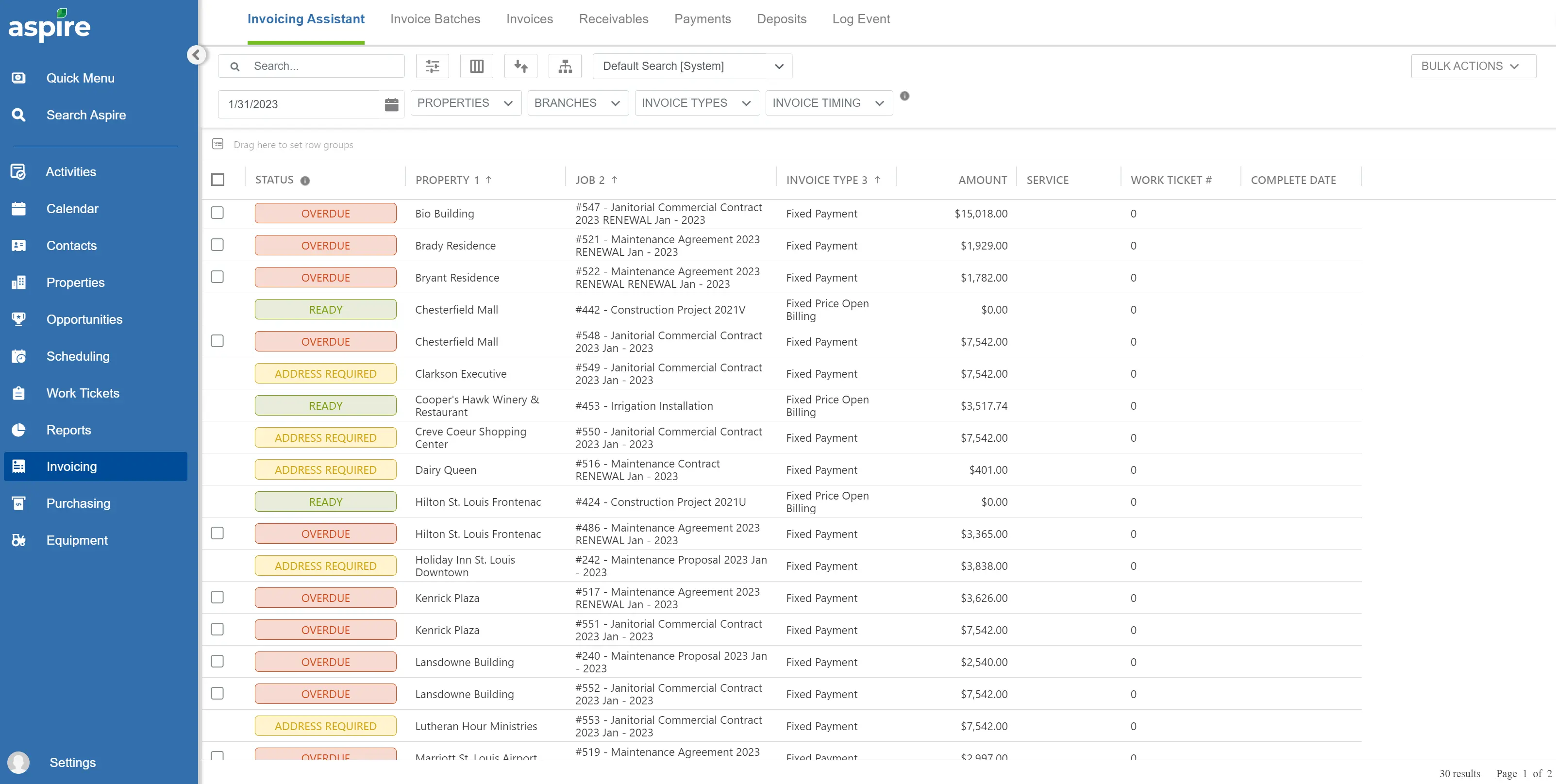
That helps you track paid and unpaid jobs without sorting through paper folders, text threads, or separate apps.
Faster billing also makes sales tax records, job changes, and customer balances easier to review.
Business reporting & documentation
Good record-keeping makes compliance easier to manage as your business grows.
Reporting, job costs, accounting and payroll, purchases, equipment management, and other related tools are all included in Aspire’s reporting feature.
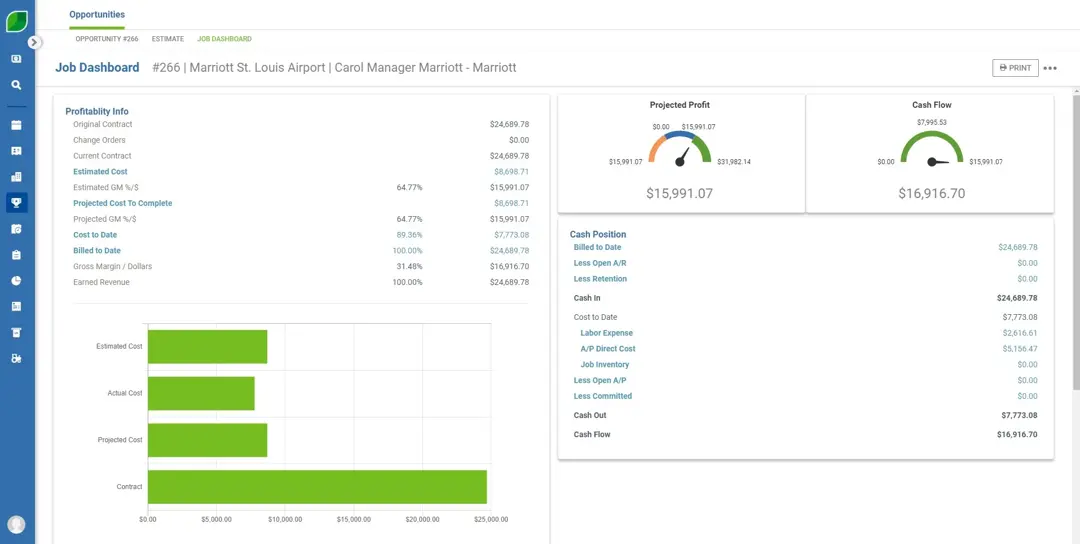
You get real-time reporting, dashboard views, and job cost data tied to actual labor and material costs. That helps office teams review margins, renewal dates, job history, and business performance without chasing updates from every crew lead.
Scheduling & job management
Scheduling connects the office calendar with the field crew’s daily work.
The Aspire platform includes a scheduling feature that incorporates ticket management, site inspections, crew management, and a mobile app for field updates.
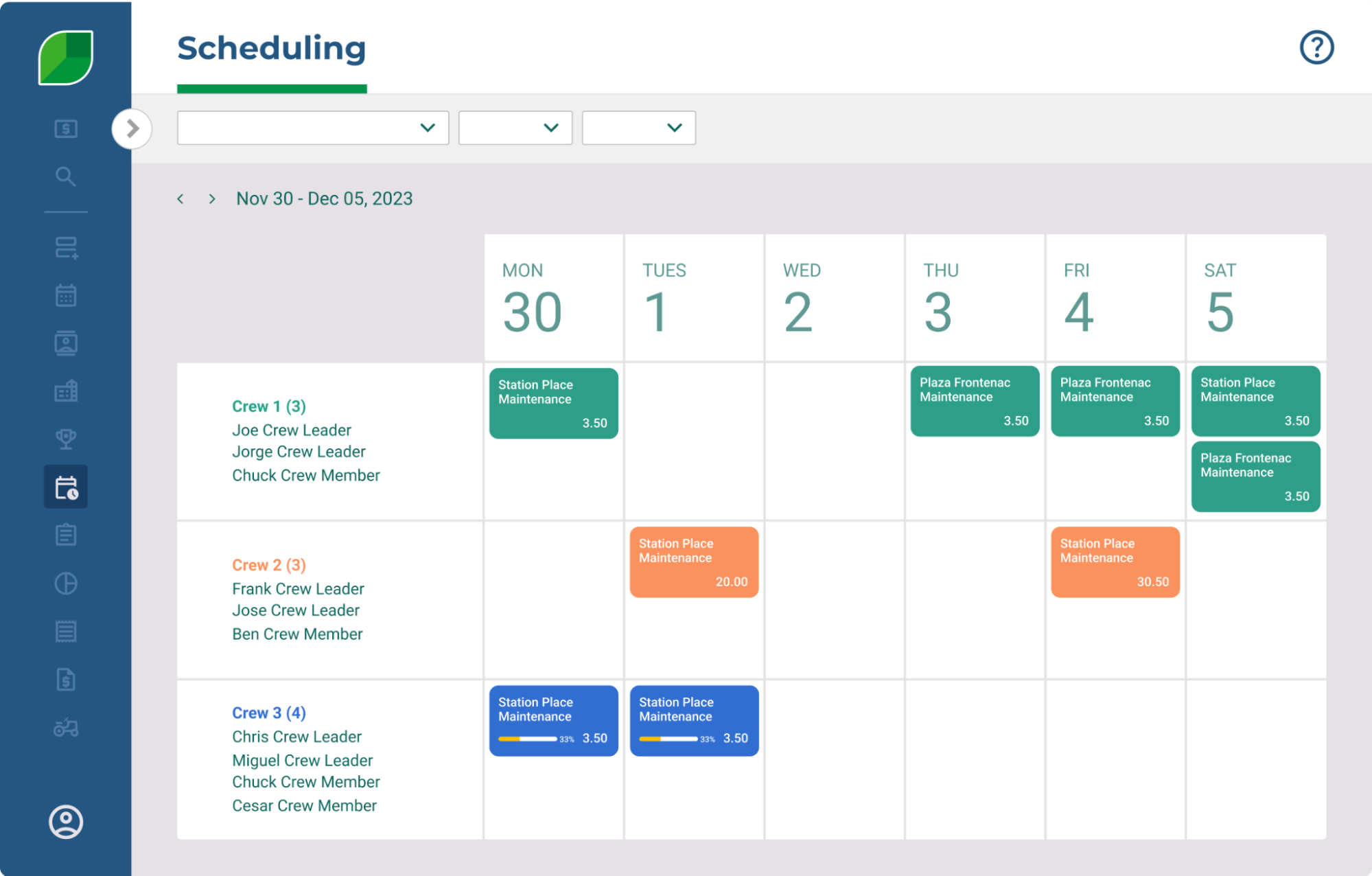
The scheduling drag-and-drop calendar helps teams assign work, update jobs, and track work tickets from estimate to invoice.
Field crews receive all job details and updates on their mobile devices, reducing missed notes, wrong-site visits, and extra windshield time.
Over to you
Getting a New Jersey business license does not need to slow down your launch plans or pull attention away from paid work.
Aspire helps your landscaping business manage contracts, invoices, schedules, job records, and renewal dates in a single connected system. Your office teams and field crews have a better way to stay organized while you add more services, customers, and locations.
Ready to start your landscaping business with fewer headaches? Book a free demo with Aspire today.
Disclaimer
This article is for informational purposes only and should not be considered legal or financial advice. While every effort was made to use official sources, you should always verify requirements on the New Jersey government websites.











 866-727-7473
 Schedule Demo
 390 S Woods Mill Rd #300 Chesterfield, MO 63017


