Sean Laux sat his department down and had everyone explain their workflows out loud, in front of everyone else.
The gaps and overlaps showed quickly. Sales had a workflow, Laux said, and production’s response, as he told it, was blunt: “I don’t know why you do it that way. We don’t want that information.”
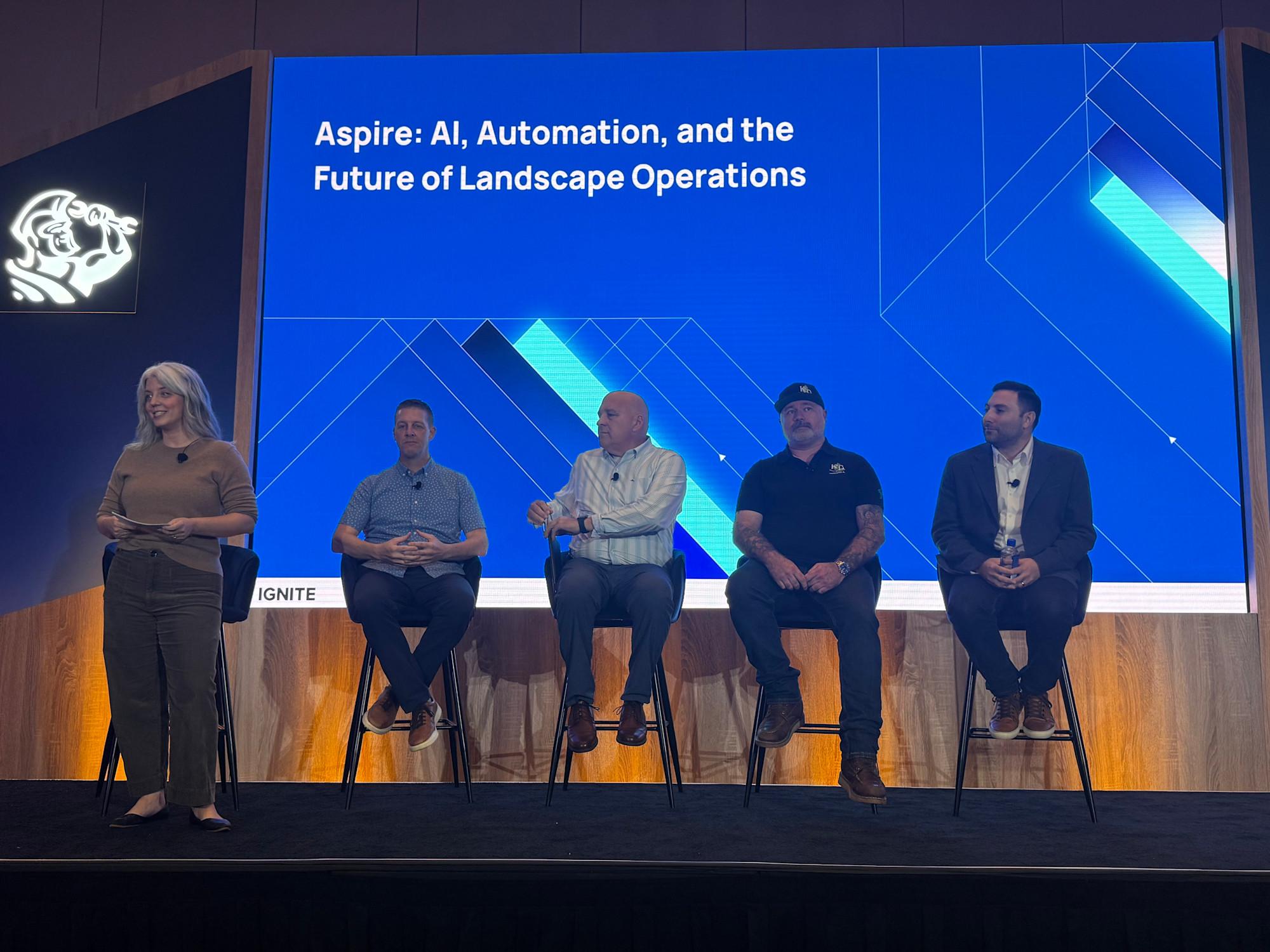
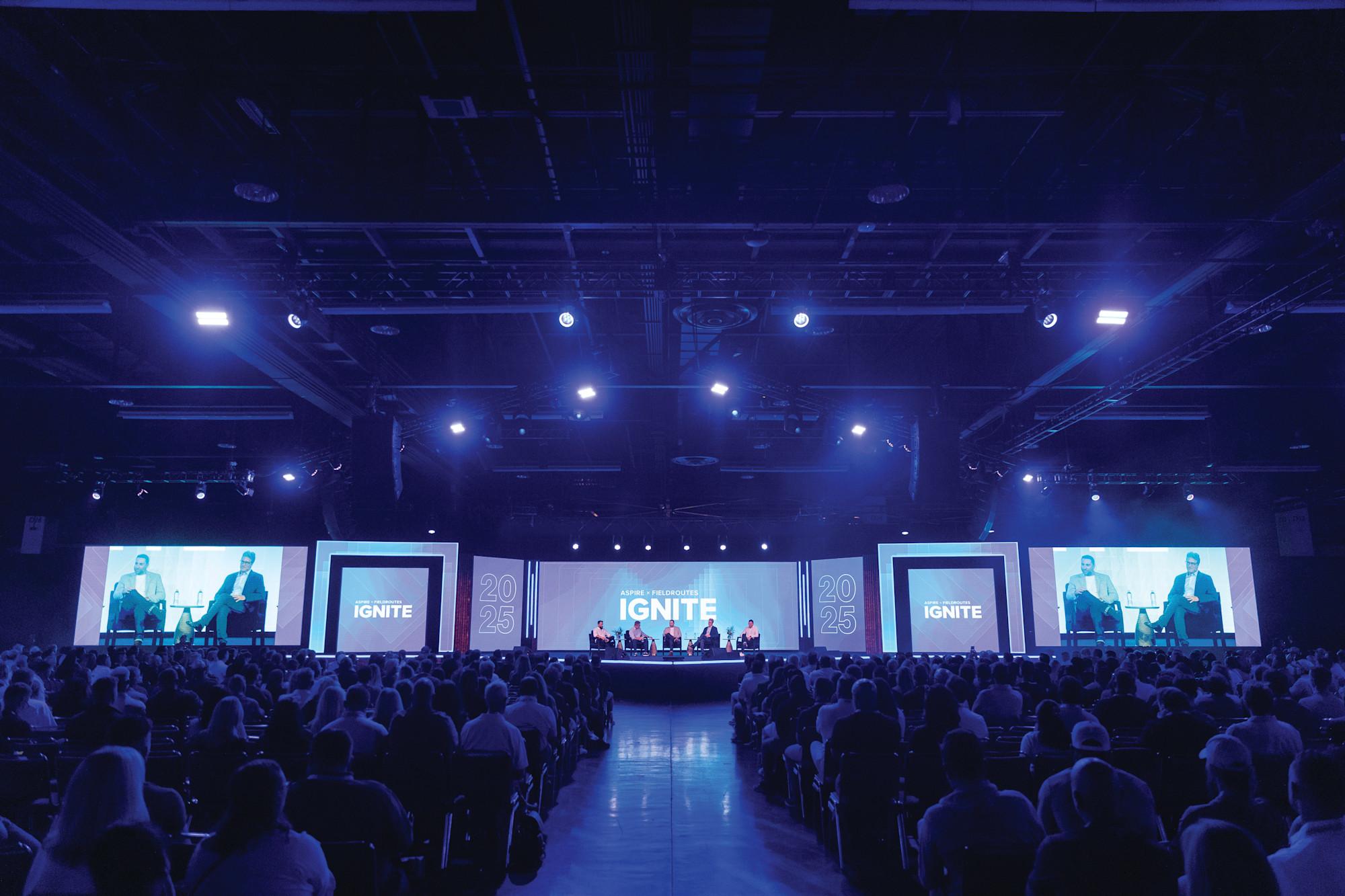
Laux, of K&D Landscaping in Watsonville, Calif., was one of four Ignite 2026 panelists who discussed how landscape companies use AI today. The session “AI, Automation, and the Future of Landscape Operations” was moderated by ServiceTitan’s Amanda Salvatore.
The meeting Laux described showed where those workflows did not match.
“You have to understand what’s happening in your business before you try to apply technology,” he said. Applying technology to a messy system “is just going to give you a faster mess.”
The other members of the panel were Todd Reinhart, CEO, Reinhart Landscaping & Snow, Bloomington, Ill., Mark Pyrah, President, Peak Landscape, Inc., Portland and Seattle and Eli Zevin, general manager, Aspire.
Start with strategy, not software
All the contractors gave the same advice as Laux — understand the business before you add technology.
Pyrah's team learned early that the answer to "can AI do this?" is almost always yes, and that answer creates its own problem. His company now designs its workflows first, confirms they're tight, and then applies technology in the right place.
Laux’s workflow meeting resulted in written SOPs for every department and uses AI to close the gaps and overlaps.
"Know the business," he said. "Know what's true first."
Zevin described a turning point inside Aspire. In mid-2025, ServiceTitan brought all the Aspire leaders to its headquarters in person. “We had a strategy conversation, and basically it was defined as part of that strategy that incorporating AI into our processes, and what we are delivering our customers, is the North Star going forward,” he said.
Zevin said leadership mindsets shifted after that meeting. His advice for operators just starting out:
Get started and try something.
Buy an enterprise account so your data stays protected.
Meet with your leadership team and define what you want AI to do.
Where AI shows up in field operations
Laux's team built a simple voice-first app for crews. Crew members talk, take a picture or two when it helps, and skip the note-taking. The team made it quick on purpose because crews don't want a complicated process, and the field is where the work and the revenue happen.
Pyrah's team built custom Gemini Gems for its irrigation crews. A crew member can ask a troubleshooting question directly to the app. “They can just speak in Spanish to it,” Pyrah said, “and it will answer in Spanish, and it makes them much more effective.”
Pyrah went on to say the goal for every role, whether technician, account manager, or salesperson, is to reduce the decisions people have to make. His team stays model-agnostic and picks the tool that fits each role. An AI tool that works well for sales may not be the best one for research.
Reinhart connected Claude directly to Aspire and now asks it operations questions while on his commute. Only a few people on his team have access so far while they work out the best way to roll it out.
Reinhart also built what he calls a "center brain," where the company's mission, core values, and the books that shaped its approach are loaded as skills. His team recently started month-end reminders that tell people which items are still open days before the deadline. Laux's team built a model-routing system on top of a centralized database, so simple tasks run on lower-cost models and complex reasoning goes to stronger ones.
What happens to the operations manager
Reinhart said AI will change the operations manager's job. The work shifts from moving jobs around a screen to building one-on-one relationships with crews, and he sees stronger customer and employee retention as the payoff. Laux added that many operators are already seeing this happen by accident as org charts change. His advice is to plan for it with intention, including change in management and a focus on people.
Zevin said Aspire's vision matches that.
“Things that are not going to get automated — not anytime soon — is the work that you do in the field and the connections your people have with each other,” he said. “AI cannot replace them. We want Aspire to be able to replace everything else.”
Where the ROI shows up
Time saved. Laux tracks usage on his team's enterprise account. He reported about 75 hours saved and uses the reporting to decide where to focus training.
Better data in the right hands. Pyrah's team used AI to build a dashboard for one branch manager with three or four KPIs. The manager watched labor efficiency closely and improved it by about 10 points, according to Pyrah. Gross profit rose about 26%. Pyrah said Aspire data powers the dashboard.
Outcomes over activity. Zevin said ServiceTitan once tracked how many prompts each team member ran per day and found the number wasn't useful. The better measure is whether you get the same or better results in the areas you already track, such as labor efficiency. Pyrah added the saying "what gets measured is what gets done."
A tool that rides along. Reinhart compared AI to the skid steer. No one sends a crew out without one now, and he expects AI to become just as standard.
What's overhyped and what's underrated
Laux said AI works best when you focus on behaviors, people, and workflows first. He called plugging AI in to fix problems the weakest first step. He also cautioned against building more software than your team can maintain, since added complexity works against scaling.
Laux also said some of his team's resistance came from concerns about AI's environmental impact. He said leaders need to explain why the technology matters and give people a working knowledge of it. He quoted a line he'd heard, “AI won't take your job, but someone using AI might.”
Zevin named security as the most underrated piece. He said enterprise-grade security takes most of the time Aspire spends building its AI products, including Command Center, so that customers don't put their data at risk.
“The Enterprise-grade security that your business needs isn’t something that's easy to run — so that is what we put a ton of time into,” he said. “By using (Command Center) you're not putting your data at risk.”
“Your data is incredibly valuable. And if you take that for granted, it's going to bite you.”
Autonomous mowers and the new crew
Reinhart said his company runs robotic mowers across well over 100 acres a day and is testing autonomous mowers across nearly every major manufacturer.
“What started out as a running joke has become the truth,” Reinhart said. “We are a technology company that happens to be in the landscape business.”
His company has also moved nearly half of his crews to one-person crews. “It's the only way that I can see that we can scale is by continuing to add more single individuals, very highly motivated single individuals out doing routes by themselves.”
Engineering interns from the University of Illinois helped show him that the people entering the trades now know GPS, electronics, and precision agriculture. He recommends naming an internal champion for each new technology, someone curious who can solve problems.
Laux said his team is also working with autonomous mower manufactures to give equipment makers feedback early, which gets crews direct access to the developers building the products.
Reinhart's advice for operators who haven't tried autonomous mowing is to buy a low-power unit and run it at home. He compared the experience to using AI for the first time. Mowing is also a low-margin service, he said, and commercial customers prefer to have contractors manage the equipment for them.
One step for Monday morning
The panel closed with practical advice.
Start with one system. Pyrah recommended picking one system, mapping the workflow, and talking to the people who run it.
Try it yourself. Reinhart recommended running a low-power autonomous mower on your own yard.
Stay curious. Zevin encouraged attendees to pick one AI tool and use it at work and at home. The panelists also told the room that feeling overwhelmed is normal.






 866-727-7473
 Schedule Demo
 390 S Woods Mill Rd #300 Chesterfield, MO 63017


