
Table of Contents
Table of Contents
- Do you need a license to start a landscaping business in Missouri?
- What are the types of landscaping business licenses & permits in Missouri?
- Step-by-step process to get a landscaping business license in Missouri
- How much does a Missouri landscaping business license cost?
- What are the most common mistakes to avoid when getting a license?
- How Aspire helps landscaping businesses stay organized & compliant
- Over to you
- Disclaimer
You want to start a landscaping business in Missouri because of the state’s growing housing market, strong demand for landscaping services, and relatively low operating costs.
But before the first mow or the first client invoice, you'll need to meet licensing requirements, follow legal requirements, and handle fees and paperwork.
This guide walks you through:
The types of licenses and permits required to start a landscaping business in Missouri
A step-by-step process to get licensed and registered
How much a Missouri landscaping business license costs
Common mistakes to avoid when getting a license
Do you need a license to start a landscaping business in Missouri?
No, Missouri does not require a statewide landscaping license for landscapers providing services like:
Mulching
Basic landscaping maintenance
Planting flowers and shrubs
General yard cleanup
That said, operating legally in Missouri still requires meeting several requirements, depending on the services you offer and where you operate.
If you offer pesticide application, herbicide application, or chemical treatments as part of your services, you need a Commercial Applicator Certification from the Missouri Department of Agriculture. This is the closest Missouri equivalent to a pesticide applicator license for landscaping businesses.
Also, you need a Nursery Dealer License if you sell or distribute nursery stock, such as trees, shrubs, or plants.
Beyond service-specific certifications, most Missouri cities, counties, and municipalities require a local business license before you can legally operate within their jurisdiction. St. Louis, Kansas City, Springfield, and Columbia each have their own rules.
What are the types of landscaping business licenses & permits in Missouri?
Get these landscaping business licenses and permits to avoid compliance issues and fines from the Missouri authorities:
General business license
Missouri does not issue a statewide general business license. However, most cities and counties require one before a business can legally operate.
Apply for a local business license (often called an occupation license) from the city hall or county clerk’s office where your business is physically located. For example:
Kansas City requires a city-issued Kansas City Business License.
St. Louis handles municipal licensing through the city’s License Collector.
Springfield processes applications via the Springfield Business Licensing Department.
Landscaping contractor license
Landscaping projects involving construction tasks such as installing patios, hardscaping, decks, or irrigation systems require a local contractor license or a building permit, depending on the city or county. These rules often apply to landscaping companies working as specialty contractors on construction-adjacent projects.
St. Louis, for example, requires specific permits for irrigation and hardscaping work. Kansas City also requires plumbing or electrical permits for installing an irrigation system.
Always check with the local city or county clerk’s office before starting any construction-related landscaping work.
Specialized licenses
Two state-level certifications apply specifically to landscaping businesses in Missouri:
Commercial Applicator Certification: Required if your services include applying commercial pesticides, herbicides, or chemical treatments. The Missouri Department of Agriculture issues it.
Nursery Dealer License: Required if your business sells or distributes nursery stock, including trees, shrubs, or plants. Register through the Missouri Department of Agriculture’s Plant Industries Division.
Note: You need a professional license as a landscape architect if your work involves landscape design, drainage planning, or site grading. The Missouri Board for Architects, Professional Engineers, Professional Land Surveyors, and Professional Landscape Architects (APEPLSPLA) governs this license.
Permits and local regulations
Local permit requirements in Missouri vary by city. Common permits landscaping businesses need include:
Land disturbance and grading permits for projects that alter natural features
Building permits for structural landscape features like retaining walls
Backflow prevention permits for irrigation systems connecting to the public water supply
Tree removal permits for trees on public property or protected zones
If your landscaping work affects public roads, drainage, sidewalks, or right-of-way access, you may also need to confirm requirements with the local public works office or department of transportation before starting the project.
Now that you have a clear picture of the licenses involved, the next step is understanding how to obtain them.
Step-by-step process to get a landscaping business license in Missouri
Getting licensed in Missouri means applying through multiple agencies and local offices. Taking it one step at a time keeps the application process manageable.
Here’s how to do it:
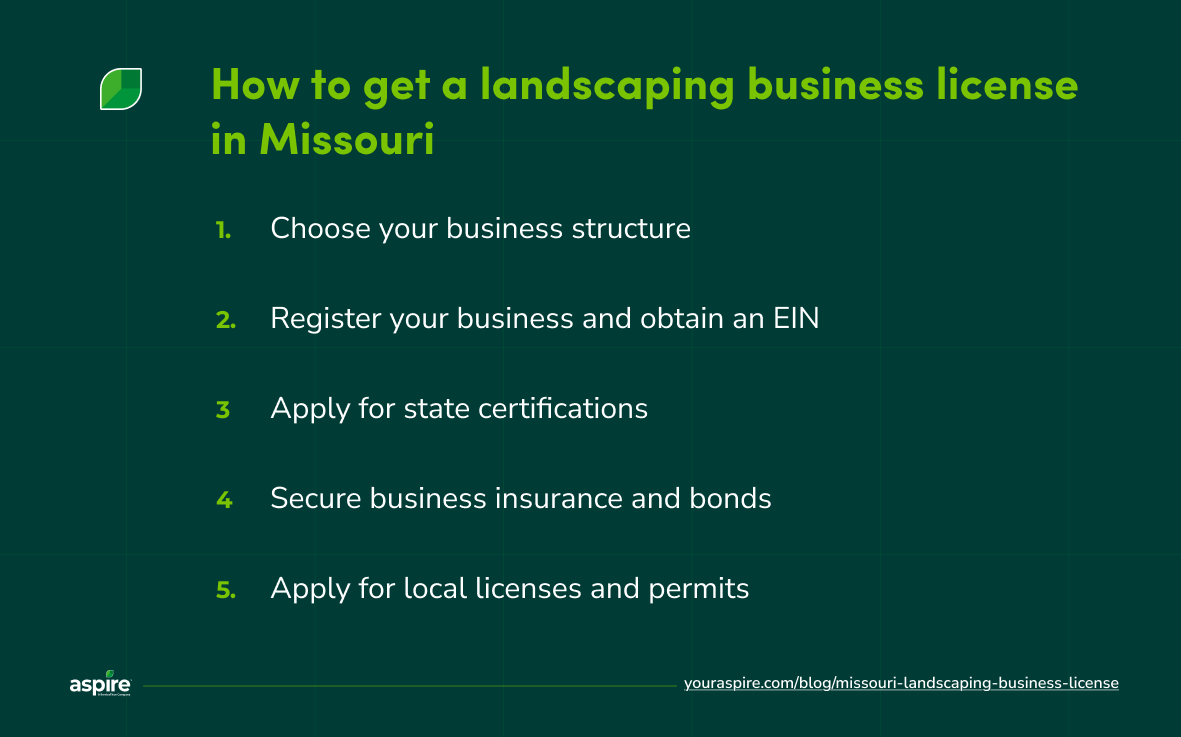
1. Choose your business structure
Your business structure determines your tax obligations, personal liability, and administrative requirements. Choose the one that fits your goals before filing any paperwork.
The four main options for a landscaping business in Missouri are:
Sole proprietorship: The simplest structure to set up, but it offers no personal liability protection. Your personal assets are at risk if the business faces legal action.
LLC: Protects personal assets and keeps taxes straightforward. The most popular choice for small businesses in Missouri.
Partnership: Works well when starting the business with a co-owner, splitting responsibilities, profits, and liabilities.
Corporation: Offers the strongest liability protection but comes with more complex tax obligations. Best suited for businesses planning to scale or bring in investors.
2. Register your business and obtain an EIN
Once you've selected a structure, register your business with the Missouri Secretary of State. This is an important early step for any landscaping startup that wants to operate under a formal business entity.
If you plan to operate under a name different from your legal business name, register a Doing Business As (DBA) with the Missouri Secretary of State at the same time.
Next, apply for an Employer Identification Number (EIN) through the IRS website. The application is free and takes about 15 minutes. An EIN is required to:
Hire employees
Open a business bank account
File payroll taxes
Finally, register with the Missouri Department of Revenue through the MyTax Missouri portal to obtain a Sales Tax License. You need this license if your business sells taxable goods like plants, mulch, soil, or other landscaping materials.
3. Apply for state certifications
After registering your business, apply for state-level certifications based on the services you offer. These certifications include:
Commercial Applicator Certification
The application of pesticides, herbicides, or other chemical treatments requires a Commercial Applicator Certification from the Missouri Department of Agriculture. To qualify:
Pass the General Standards of Competence Examination (CORE)
Pass at least one category examination at Pearson VUE
Provide proof of financial responsibility, such as general liability insurance or a surety bond
Study materials and exam schedules are available through the Missouri Department of Agriculture. This state agency also manages several agriculture-related licensing and certification programs that may apply to landscaping businesses.
Nursery Dealer License
If you sell or distribute trees, shrubs, or nursery stock as part of your services, register for a Nursery Dealer License through the Missouri Department of Agriculture’s Plant Industries Division.
4. Secure business insurance and bonds
Most local contractor licenses and client contracts (especially commercial ones) require proof of insurance before work begins. Here’s what to have in place:
General liability insurance: Covers property damage and third-party bodily injury claims.
Workers’ compensation insurance: Required by Missouri law as soon as you hire your first employee.
Commercial auto insurance: Covers vehicles used to transport crew, equipment, and materials between job sites.
Surety bond: Required in some jurisdictions for construction-related landscaping work, such as hardscaping or irrigation installation.
The right insurance coverage protects your landscaping business from claims that could otherwise disrupt operations or create major financial exposure.
Landscaping business insurance is often available the same day your business entity is established. Get it sorted before applying for any local licenses.
5. Apply for local licenses and permits
After handling state-level requirements, contact the city or county clerk’s office in every city where your business plans to operate. Key cities to check:
St. Louis: Requires a business license and specific permits for irrigation or hardscaping work. Contact the St. Louis License Collector’s office for details.
Kansas City: Requires plumbing or electrical permits for irrigation system installation.
Springfield: Processes business license applications through the Springfield Business Licensing Department.
Columbia and Independence: Each has its own local business licensing office with specific requirements.
For projects involving land disturbance, grading, retaining walls, or irrigation systems connecting to the public water supply, apply for the relevant building or construction permits through the local planning and zoning department before breaking ground.
Track every license expiration date from day one. Renewal timelines vary by city, and a lapsed license puts your ability to operate and win new contracts at risk.
How much does a Missouri landscaping business license cost?
The total cost of obtaining a landscaping business license in Missouri depends on the services you offer and the cities where you operate. Here’s a pricing breakdown of what to budget for:
Business registration
Missouri LLC filing fee: $50 online and $105 by direct mail (one-time)
DBA registration: $7 to $10 (one-time)
Sales Tax License: Free to register
State certifications
Commercial Applicator Certification: $65 per annum
Nursery Dealer License: $50 to $125 per year, depending on your annual retail sales of nursery stock
Local licenses
Occupational/business license: $20 to $100 annually, depending on the city
Insurance
General liability insurance: $400 to $1,500 annually
Workers’ compensation insurance: $600 to $2,000 annually
Bond
Surety bond: Starting at $1,000, depending on your city
Note: Budget for renewal fees every year. Missing a renewal deadline often triggers late penalties in addition to the standard license fees.
What are the most common mistakes to avoid when getting a license?
Missouri’s decentralized licensing system makes it easy to miss something. Here are common mistakes new landscaping business owners make and how to avoid them.
1. Assuming no statewide license means no requirements
Many new operators hear “Missouri doesn’t require a landscaping license” and stop there.
State-level certifications still apply, depending on the services you offer. As discussed earlier, operating without a Commercial Applicator Certification while offering pesticide or chemical treatments violates the Missouri Department of Agriculture’s regulations and exposes your business to fines.
Selling nursery stock without a Nursery Dealer License carries the same risk.
Verify every requirement that applies to your specific services before launching.
2. Skipping local licensing requirements
Missouri pushes most licensing decisions to the city and county level. What applies in Kansas City does not automatically apply in Springfield or Columbia.
Operating in a city without the required occupational license or local contractor permit puts every contract at risk.
Contact the city or county clerk’s office in every location you plan to work before taking on jobs.
3. Allowing licenses and certifications to expire
An expired license can trigger late penalties, suspended operating permissions, and an inability to bid on new contracts during the gap.
Commercial Applicator Certifications, for instance, require annual renewal. Local occupational licenses follow their own renewal schedules that vary by city. Some certifications may also require continuing education before renewal, especially for regulated chemical application services.
Track every renewal deadline with calendar reminders from day one.
How Aspire helps landscaping businesses stay organized & compliant
Aspire brings every aspect of your landscaping business operation into one place.
As Christina P. noted in her Capterra review, “Aspire is a great software for the landscaping industry. We enjoy having an all-in-one feature for our scheduling, invoicing, proposals, and estimating jobs.”
Here’s how the platform’s features help landscaping businesses:
Contract & proposal management
Winning jobs and staying compliant start with having the right paperwork in order. Aspire’s contract and proposal management feature keeps all your documentation in one place:
Store and manage service agreements that comply with local licensing requirements
Update and share agreements for lawn care, design-build projects, and chemical application services
Attach proof of insurance, pesticide certifications, and nursery licenses directly to proposals
Maintain accurate records that protect your business in the event of a dispute
If your lawn care business offers recurring maintenance, seasonal cleanup, or fertilization packages, keeping the right contracts and licenses attached to each job helps reduce compliance gaps.
Invoicing & payment processing
Processing payments and managing billing manually eat into time that should go toward more important operational tasks.
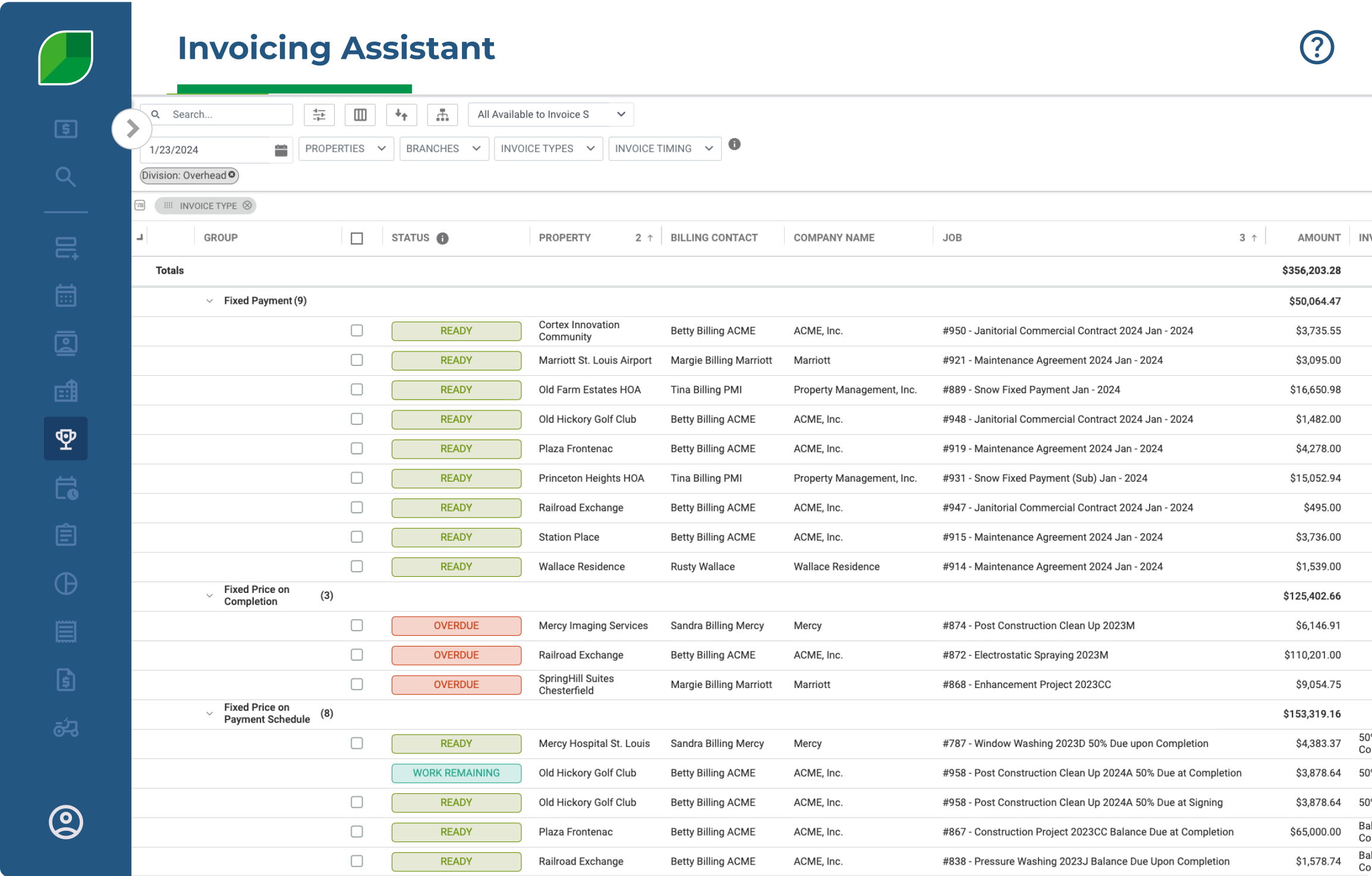
Aspire’s invoicing tool eliminates that friction by:
Automating billing for recurring maintenance contracts to improve cash flow
Tracking payments and revenue across multiple service locations
Sending invoices individually or in bulk through email or the client portal
Simplifying Missouri tax filings with accurate, organized financial records
One Capterra reviewer called the tool a “game changer and time saver.” According to them, there was no longer a need for manual spreadsheets or handwritten tickets due to seamless integration with payroll and invoicing processes.
Business reporting & documentation
Aspire’s reporting tool gives you real-time visibility into every corner of your business. You can:
Access job costing data instantly without waiting for end-of-month reports
Track license renewals and certification deadlines from a single dashboard
Monitor crew performance, material costs, and project profitability in real time
Generate custom reports on financials, sales, and KPIs without manual data entry
Lacey B., an Aspire user with over five years of usage, shared how Aspire helps her stay organized by providing insights into her business operations.
She said, “We’ve been with Aspire for 5 years, and it has helped us in many ways. We can look at data all in one spot and not have multiple spreadsheets to track hours, materials, purchase orders, equipment service logs, etc.”
Scheduling & job management
Aspire’s scheduling tool can coordinate crews across multiple Missouri job sites while keeping everyone running on time. You can:
Assign jobs based on employee certifications, ensuring only licensed applicators handle pesticide treatments
Use drag-and-drop scheduling to update crew assignments and routes in real time
Track project timelines and crew availability across all active job sites
Sync last-minute schedule changes directly to the crew’s mobile app, eliminating confusion in the field
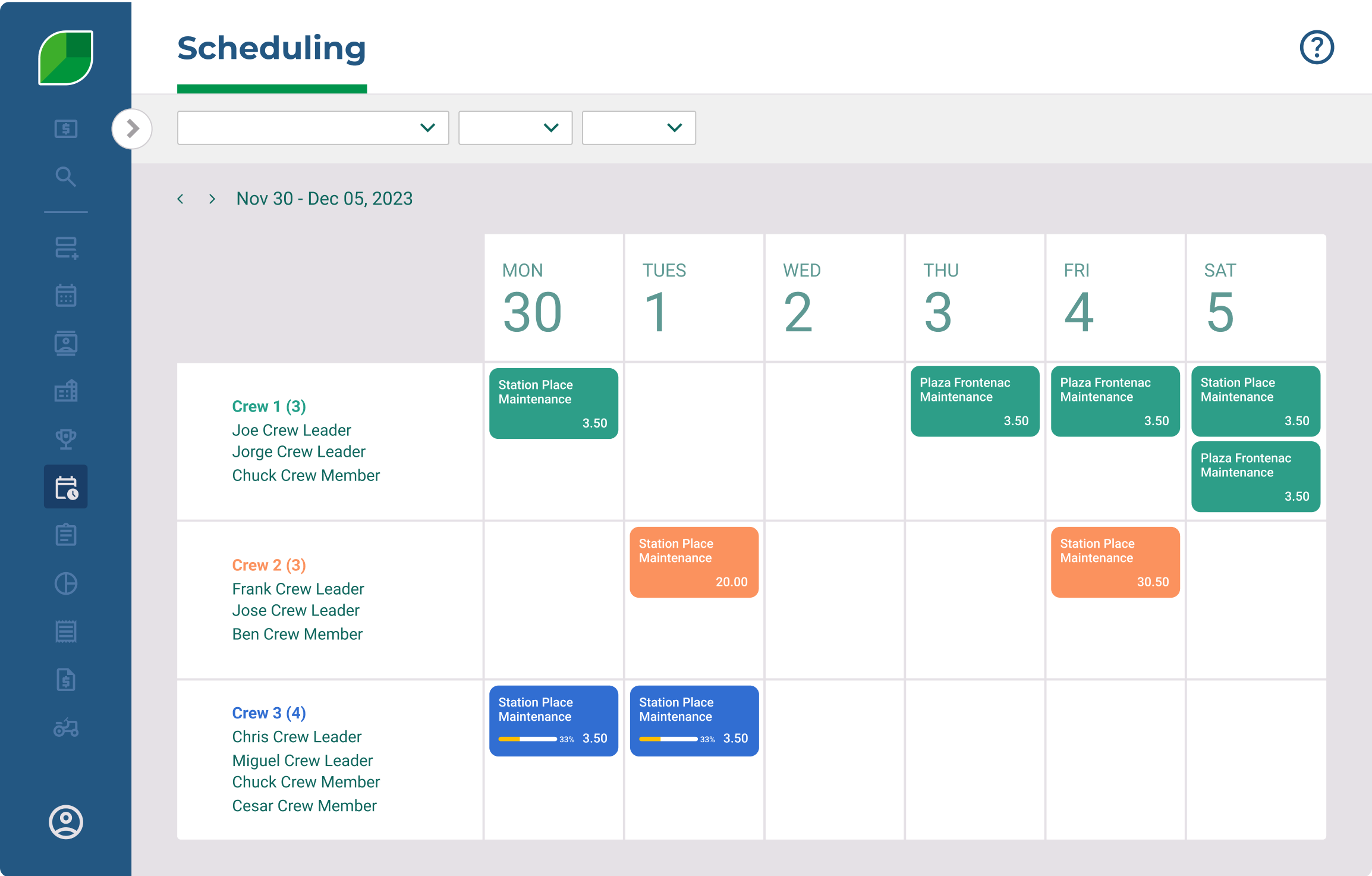
Aspire can also help you schedule recurring lawn mowing, tree trimming, and turf maintenance jobs while keeping crew assignments, equipment, and customer details organized in one system.
Over to you
Register your business, secure the right certifications, get your insurance in place, and check in with every city you plan to operate in. Do that, and your Missouri landscaping business launches on solid legal ground with no risk of fines, shutdowns, or unenforceable contracts.
The next challenge is running and growing that business efficiently once it’s off the ground. That’s where the right landscaping business tool makes the difference.
Aspire’s end-to-end business management platform gives licensed landscaping businesses full visibility into contracts, invoicing, scheduling, job costing, and compliance, all in one place. This is especially valuable for companies with multiple crews or expanding service areas, or for companies with several years of experience that are moving from spreadsheets to a more centralized system.
Book a demo today and find out how Aspire helps Missouri landscaping businesses stay compliant and scale faster.
Disclaimer
This article is for informational purposes only and should not be considered legal or financial advice. While every effort was made to use official sources, you should always verify requirements on the Missouri government websites.









 866-727-7473
 Schedule Demo
 390 S Woods Mill Rd #300 Chesterfield, MO 63017


