
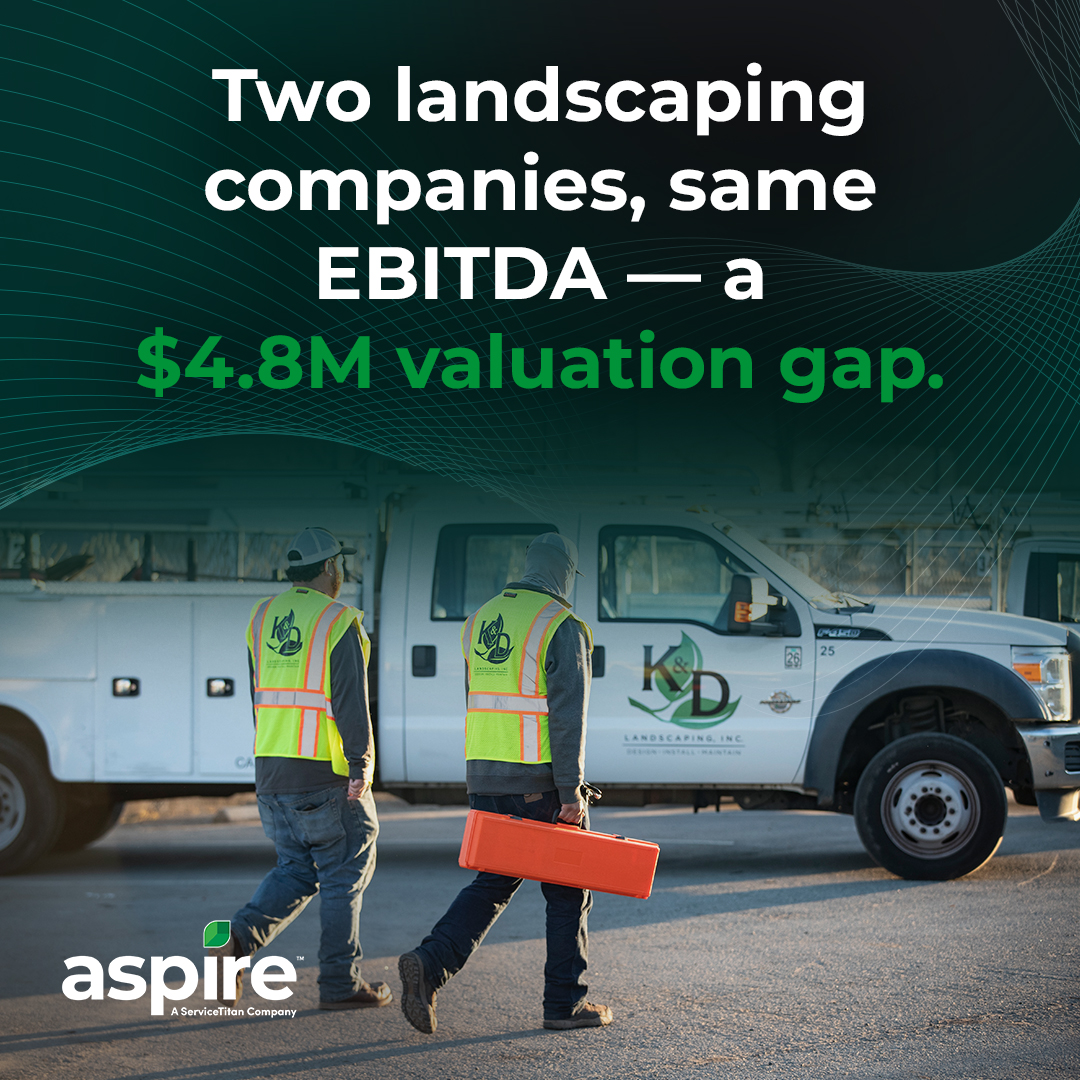
Two landscape companies.
Same revenue, same EBITDA.
One sells for $12M. The other for $16.8M.
The $4.8M valuation gap has nothing to do with profit and everything to do with the systems behind it.
Buyers pay a premium for companies whose margins are system-driven and auditable, not owner-dependent and anecdotal. Operational infrastructure is a valuation lever.
Same EBITDA. Different multiple. Why?
Company A and Company B both generate $20M in annual revenue and $2.4M in EBITDA, producing a 12% margin. On paper, they look identical. In practice, they command dramatically different valuations.
Company A operates on QuickBooks, spreadsheets, and institutional memory.
The owner personally knows which jobs are profitable.
Estimating occurs in Excel using production rates set three years ago and never reconciled against actuals.
Client relationships are personal, renewal dates are tracked on paper calendars, and the branch manager texts the owner when a big contract is up for review.
Financial reporting takes three weeks post-month-end because the controller manually consolidates data from three disconnected systems.
The margin is real, but it's unexplainable. When a buyer asks, "How do you know this service line is profitable?" The answer is, "We just know."
Valued at 5x EBITDA: $12M.
Company B runs on an integrated operational platform.
Margin is auditable by service line, branch, and client.
The company tracks estimating variance weekly and calibrates production rates to actuals after every job.
Client contracts are documented with renewal dates, profitability data, and multi-threaded relationship ownership. Financial close occurs within 5 business days because the platform automatically consolidates data.
When a buyer asks, "How do you know this service line is profitable?" The answer is a dashboard that shows margin by property, crew utilization by branch, and estimating variance by estimator. The margin is defensible because it's system-driven, not owner-driven.
Valued at 7x EBITDA: $16.8M.
The $4.8M valuation gap is the premium buyers pay for operational infrastructure.
Earnings that depend on one person walking out the door are worth less than earnings embedded in repeatable processes and auditable data. Buyers discount Company A because the margin might evaporate when the owner transitions out. They pay a premium for Company B because the infrastructure survives the change in ownership.
This is happening across the M&A landscape.
Two companies with identical financial performance command different multiples depending on how the operations are structured, not just on what they produce.
Four Infrastructure Signals that Command a Premium
Buyers conducting operational diligence look for specific attributes that separate system-driven companies from owner-driven companies.
These four signals drive multiple expansion.
Data integrity and reporting speed
Can the company produce a consolidated P&L by service line within five business days of the month-end?
If yes, the buyer trusts the numbers and the management team's ability to make real-time decisions. If financial reporting takes three weeks and requires an accountant with institutional memory to reconcile disparate systems, the buyer discounts the earnings quality.
Fast financial close is a proxy for data integrity.
When numbers close quickly, it signals that the underlying data is structured, consistent, and automated. Branch-level reporting flows into consolidated financials without manual reconciliation. Job costing data feeds directly into margin analysis.
The system produces accurate numbers because it's built to.
Slow financial close signals fragile infrastructure.
When reporting takes three weeks, it means someone is manually stitching together data from QuickBooks, spreadsheets, and tribal knowledge.
Those manual processes break when key people leave, when the company scales, or when PE sponsors demand a faster reporting cadence. Buyers price that fragility into the valuation.
The infrastructure question buyers ask during diligence: how long does your month-end close take, and how many people touch the data before it reaches the CFO?
If the answer is "five business days with full automation," the buyer sees a company ready to scale. If the answer is "two to three weeks depending on branch manager availability," the buyer sees integration risk and discounts accordingly.
Estimating accuracy with a feedback loop
Does the company track estimated vs. actual on every job and use that data to recalibrate production rates?
This is the difference between a company that accidentally makes money and one that systematically makes money. Buyers pay a premium for the latter because the margin is defensible and can be improved.
Estimating without a feedback loop is guesswork that scales poorly.
If production rates are set once and never updated based on actuals, the company prices work on assumptions that may be three years out of date. Crews get faster, scopes change, and client expectations shift.
When estimates aren't reconciled against reality, margin accuracy drifts without anyone noticing until a quarterly review surfaces the variance. By then, hundreds of bids have gone out based on flawed assumptions.
A closed-loop estimating system is self-correcting.
When the system captures actual crew hours, materials usage, and margins at the job level and compares them against estimates, it learns. Production rates improve with every completed job. Estimators see which service lines are consistently underbid and adjust accordingly.
Margins tighten because the pricing model is grounded in operational reality rather than legacy spreadsheets.
When buyers ask, "What's your estimating-to-production variance by service line, and how often do you recalibrate your production rates?"
If the answer is, "We track variance weekly and update rates quarterly based on actuals," the buyer sees a margin engine that compounds value over time. If the answer is, "We don't really track that," the buyer assumes the margin is accidental and prices the risk into the offer.
Client revenue that's not owner-dependent
Are client relationships managed through a system with documented contracts, renewal histories, and multi-threaded relationships, or does the owner hold them personally? Owner-dependent revenue is discounted in every acquisition model due to transition risk.
Personal relationships are an asset until they become a liability.
In owner-operated landscape companies, the CEO or founder often personally manages the top 10 client relationships. Property managers call the owner's cell phone. Renewals happen through handshake conversations. Contract terms live in the owner's memory. This works until the owner exits.
When ownership transitions, those relationships become at-risk revenue. Buyers model 15% to 25% churn on owner-dependent accounts and discount the purchase price accordingly.
Systemized client relationships survive ownership transitions.
When contracts document renewal dates, pricing history, scope details, and service-level expectations, the relationship becomes institutionalized. When multiple people at the company regularly interact with the client, the relationship is multi-threaded.
When account management happens through a platform that tracks touchpoints, issues, and upsell opportunities, the client belongs to the company, not to the departing owner.
When buyers ask during diligence, “Which clients require the owner's personal involvement, and what's the revenue concentration in those relationships?”
If the answer is, "Our top clients are managed by account managers with full visibility in the system," the buyer sees revenue that transfers cleanly. If the answer is, "The owner handles our eight largest accounts personally," the buyer models retention risk and lowers the multiple.
Scalable operations, not heroic operations
Can the company add $2M in revenue without adding management headcount? If the ops model requires the COO to approve every large estimate and personally review every crew schedule, growth requires either more leaders or longer hours.
Neither scales. Buyers pay more for companies whose systems handle scaling.
Heroic operations depend on exceptional people working unsustainable hours.
In companies without operational infrastructure, growth creates more work for the same small leadership team. The COO approves estimates because there's no standardized production-rate library. The ops manager builds routes manually because there's no scheduling system in place. The CFO reconciles financials by hand because the data doesn't flow automatically.
These companies grow by hiring more heroes, which is expensive and fragile.
Scalable operations encode expertise into systems.
When production rates are stored in a shared library, any estimator can price work accurately without waiting for COO approval. When route optimization occurs through a platform that accounts for geography and crew capacity, the ops manager spends time on exceptions rather than building every route from scratch.
When financial data is consolidated automatically, the CFO can analyze trends instead of compiling spreadsheets. The company scales because the system absorbs complexity that would otherwise require more headcount.
Buyers ask, “If you doubled revenue over the next two years, how many additional managers would you need to hire?”
If the answer is, "Minimal additions because our systems handle the incremental complexity," the buyer sees a scalable platform. If the answer is, "We'd need another COO and two regional managers," the buyer sees an ops model that doesn't scale and adjusts the valuation accordingly.
What This Looks Like in Aspire
Aspire provides the integrated operational platform that buyers look for when they're evaluating landscape companies for acquisition.
The infrastructure signals that drive multiple expansions are built into the platform's design.
Data integrity and reporting speed through unified financial and operational data.
Aspire consolidates estimating, job costing, time tracking, and invoicing in a single platform, eliminating the reconciliation layer that creates reporting lag.
Branch-level P&Ls roll up automatically into consolidated financial reporting without manual intervention. Month-end close happens in days, not weeks, because the data is structured and consistent from the point of capture.
CFOs and operating partners get real-time visibility into margin by service line, branch, and property without waiting for month-end accounting cycles. When buyers ask, "How fast can you close your books?" companies running on Aspire demonstrate the operational maturity that justifies premium multiples.
Estimating accuracy with production-rate feedback loops to recalibrate.
Aspire's integrated estimating and job costing workflows connect every bid to actual production data.
Estimated crew hours, materials usage, and margins are compared against actuals at the job level, creating a variance report that surfaces estimating drift before it compounds.
Users can update production-rate libraries based on completed work, so the next estimate starts from operational reality rather than legacy assumptions. Estimators see which service lines are consistently over or under budget and adjust accordingly. The result is a self-correcting margin engine that improves with every job.
Buyers conducting operational diligence see this feedback loop and recognize it as the infrastructure that separates companies that make money by accident from those that make money systematically.
Client revenue that's system-managed, not owner-dependent.
Aspire's contract management and account visibility tools document client relationships at the property level. Contracts include renewal dates, pricing history, scope details, and profitability data.
Account managers have full visibility into service history, client touchpoints, and upsell opportunities without relying on the owner's personal knowledge.
Multi-threaded relationship management becomes the default because the system gives every relevant person access to the same client data. When ownership transitions during an acquisition, the institutional knowledge transfers with the platform.
Buyers see documented client relationships and adjust their pricing accordingly.
Scalable operations where systems absorb complexity instead of people.
Aspire's route optimization, crew scheduling, and production tracking tools encode operational expertise into repeatable workflows.
Route planning automatically accounts for geography, crew capacity, and contract cadence. Crew assignments happen through a dispatch interface that shows real-time utilization and capacity constraints.
Production tracking captures labor hours at the task level without requiring manual timesheet reconciliation. The platform handles incremental complexity as the company scales, reducing the need to hire additional managers to manage growth.
When buyers ask, "How would you scale this operation?" companies running on Aspire can show an infrastructure that scales without proportional headcount increases.
Demonstrating operational maturity during the diligence process.
Companies running on Aspire can produce the operational data buyers need in the format and speed they expect.
Job profitability reports by service line. Crew utilization dashboards by branch. Estimating variance analysis by the estimator. Renewal pipeline visibility by the account manager.
Aspire reporting doesn’t compile transactional data; it surfaces metrics that guide daily business decisions. That distinction matters to buyers, because it signals that infrastructure is intrinsic to how the business runs.
Build the Infrastructure That Earns the Multiple
Whether you're building toward an exit or positioning your platform for the next round of PE investment, operational infrastructure is the fastest path to multiple expansion. The systems you invest in today show up in the valuation two to three years from now.
Buyers pay a premium for companies where margins are auditable, estimates are calibrated to actuals, client relationships are documented, and operations scale through systems rather than heroics. These aren't soft factors; they're valuation drivers that show up in the purchase price.
The infrastructure investment compounds over time.
The question isn't whether you can afford to build operational infrastructure; it's whether you can afford the valuation discount if you don't.
A $4.8M valuation gap on a $20M company is a 2x multiple difference driven entirely by operational maturity. Across the M&A landscape, buyers pay premiums for companies that can demonstrate system-driven margins, and they discount those where margins depend on the departing owner's personal knowledge.
Book a demo to see how Aspire helps landscape companies build the operational infrastructure that commands premium valuations.







 866-727-7473
 Schedule Demo
 390 S Woods Mill Rd #300 Chesterfield, MO 63017


