
Table of Contents
Table of Contents
- 1. Leveraging Data-Driven Estimating for Predictable Profitability
- 2. Elevating the Customer Experience Through AI and Automation
- 3. Building Connected Teams: Uniting Field and Office for Real-Time Decision-Making
- 4. Engineering Efficiency as a Growth Multiplier
- 5. Investing in People as a Long-Term Competitive Advantage
- Growth by Design, Not by Chance
- The five growth levers work together
You have professional systems. Your operations run smoothly.
Crews know their schedules, invoices go out on time, and clients get consistent service.
Congratulations—you’ve achieved operational stability that most landscaping businesses can only dream of.
Now what?
High-performing companies in 2026 will stand out not just for efficiency, but for having engineered their operations for intelligent, scalable growth. They’re combining data-driven insights, strategic automation, and empowered leadership to redefine what sustainable development looks like.
This is the next level: moving from day-to-day management stability to long-term performance engineering.
The 2026 Industry Report shows that while 79% of contractors are focused on growing revenue, only 41% are optimizing processes to support growth sustainably. The gap between activity and achievement separates companies that scale profitably from those that just get busier without getting better.
These five levers separate next-level performers from the pack—tactics available to businesses that want to engineer growth rather than chase it.
1. Leveraging Data-Driven Estimating for Predictable Profitability
Growth starts with precision.
Inaccurate estimates create margin leaks that compound as businesses grow—a 5% estimation error on a $10,000 job costs $500, but that same error on 1,000 jobs per year erases $500,000 in profit. What seems like acceptable variance at a small scale becomes an existential threat at scale.
Advanced estimating systems use multiple data inputs for accuracy:
Historical job cost data tracks actual labor hours, material consumption, and equipment time from similar completed projects, eliminating guesswork
Crew productivity benchmarks empower realistic timeline estimates with performance data to show how teams perform on install and maintenance
Dynamic cost updates prevent estimates based on outdated pricing, which destroys margins when actual purchasing occurs
Property-specific variables, including site complexity, access challenges, and special requirements, are documented through PropertyIntel and inform labor multipliers
Seasonal adjustment factors with data showing how efficiency varies by weather, temperature, and daylight hours
Companies using Aspire to build consistent cost libraries across divisions achieve tighter profit control through standardized pricing intelligence.
TruCo Services’ transformation illustrates this power—moving from “maybe we did well on this job” uncertainty to data-backed confidence. Kale Stevenson says: “We have the data to support our decision… other companies don’t know their true costs and hours. We do.”
At scale, a 3% improvement in estimating accuracy can translate into hundreds of thousands in annual net profit.
For a $15M revenue company operating at 10% margins, improving estimate accuracy from 85% to 88% captures an additional $450,000 in profit, equivalent to winning 30 more jobs without additional operational capacity.
Precision estimating isn’t administrative busywork—it’s a strategic competitive advantage that compounds with every proposal submitted, enabling profitable growth while competitors underbid themselves into losses.
2. Elevating the Customer Experience Through AI and Automation
The new competitive edge isn’t equipment or pricing—it’s customer experience powered by technology.
Commercial property managers juggle dozens of vendor relationships; residential clients balance busy schedules with home maintenance needs. Both value contractors who eliminate friction through proactive communication and transparent operations.
AI-driven automations transform client relationships through systematic touchpoints:
Automatic service notifications provide clients with texts or emails when crews are en route, eliminating “when will you be here?” anxiety
Project status reports provide automated updates showing completion progress, timeline adjustments, and milestone achievements
Digital customer portals with self-service access to service history, invoices, upcoming appointments, and photo documentation
Proactive renewal reminders for automated outreach before contract expirations, including performance summaries demonstrating value delivered
Satisfaction tracking, including post-service surveys that flag issues immediately, enabling manager intervention before clients cancel
Commercial clients using Aspire's client portal view job progress, invoices, and completion photos in real time—eliminating the need to call office staff for status updates.
Property managers overseeing multiple locations can access consolidated service documentation across their entire portfolio, making vendor management easy.
This transparency builds trust big time.
When clients see timestamped photos proving their property was serviced at 6:47 a.m., disputes disappear. When they can download invoices instantly without requesting copies, payment cycles speed up.
The best businesses are using automation to enhance human connection, not replace it.
Technology handles routine updates and documentation, freeing account managers to focus on strategic relationship development, problem-solving, and consultative selling that automation can’t replicate.
Automation creates capacity for human interaction by eliminating the administrative burden that previously consumed time for relationship-building. The result: clients get the efficiency they expect from technology and the personal attention they value from trusted partners.
3. Building Connected Teams: Uniting Field and Office for Real-Time Decision-Making
Growth bottlenecks often stem from poor communication between crews and management.
Field workers have operational intelligence—what jobs are running over estimate, where client expectations don’t match scope, when equipment is underperforming—but that knowledge stays in their heads or gets lost in end-of-day verbal reports nobody documents systematically.
Mobile field apps and integrated dashboards bridge the field-office communication gap:
Real-time job updates because crews mark tasks complete the moment they finish, updating office visibility instantly
On-site photo documentation as workers capture completion evidence, site conditions, or issues requiring manager attention without waiting for office return
Time and material logging so labor hours and materials used get recorded in real-time, feeding accurate job costing immediately
Issue escalation with problems requiring management decisions flagged instantly, rather than discovered hours later
Two-way, in-app communication between the field and office for schedule changes, priority adjustments, or client instructions
Foremen update job costs in Aspire on-site, providing operations with real-time visibility into labor and materials consumption.
When a crew finds extensive irrigation repairs during routine maintenance, managers see the time variance immediately—enabling instant client communication about additional charges rather than surprise invoices weeks later that could generate disputes.
Jacob Silvis says, “Aspire allows everything to flow smoothly together and to have clear documentation in one area. Scheduling the tickets, closing the tickets, getting the bill out to the client.”
This seamless flow eliminates the information lag that previously required constant phone calls, text chains, and guesswork.
Information flow defines growth velocity.
The faster your data moves from the field to the office, the quicker your business can respond to opportunities and problems.
Decisions based on real-time intelligence outperform decisions based on yesterday’s data or last week’s anecdotes—creating a competitive advantage that competitors can’t match with fragmented communication systems.
4. Engineering Efficiency as a Growth Multiplier
Operational audits are the secret to scalable growth.
Most businesses focus on revenue growth—landing more clients, adding services, expanding into new territories—while overlooking the profit multiplier hidden in eliminating operational waste that already drains resources.
"Efficiency engineering" means systematically identifying and eliminating waste:
Time tracking analysis to see where labor hours disappear between productive work—excessive drive time, disorganized job starts, unclear instructions requiring callbacks
Process data examination to identify and eliminate redundant steps, unnecessary handoffs, and bottlenecks that are slowing completion
Elimination of unproductive movement—crews returning to the shop for forgotten materials, driving inefficient routes, and backtracking for missed details
Resource utilization optimization so that equipment and crew capacity are deployed where they generate the highest returns
Administrative burden reduction by automating repetitive tasks consuming disproportionate staff time
A company using Aspire time logs and routing data to optimize crew travel finds teams spend 18% of the workday driving between jobs.
Route optimization and geographic clustering cut unnecessary windshield time by 40%, reclaiming 7.2% of total labor capacity—equivalent to adding nearly two full-time crew members without hiring anyone.
At an average labor cost of $25/hour across 10 crew members working 2,000 hours annually, that’s $36,000 in recaptured productivity, which converts directly to profit or additional revenue capacity.
Efficiency creates capacity.
More work completed with the same resources equals exponential profit growth:
Same crews complete 15% more jobs
The same equipment generates higher utilization returns
The same overhead supports a larger revenue base
Same management capacity oversees expanded operations
The Hidden Profit Killer ebook documents TruCo Services discovering 3,000 to 5,000 unallocated labor hours each month; time disappearing without revenue generation. Eliminating that waste didn't require hiring; it required visibility, enabling optimization.
Engineering efficiency isn't cost-cutting—it's capacity creation that enables growth without proportional resource expansion, improving margins while scaling revenue.
5. Investing in People as a Long-Term Competitive Advantage
Growth isn't sustainable without a strong leadership pipeline.
Companies can scale revenue temporarily through aggressive sales, but operations collapse when leadership capacity maxes out. The bottleneck isn't client demand—it's qualified managers capable of executing consistently across expanding operations.
The strategic shift: from "hiring labor" to "developing leaders."
Structured training programs create systematic capability development:
Technical skills progression with clear pathways from basic crew work through specialized certifications
Leadership development so crew members learn scheduling, client communication, and problem-solving before promotion
Software proficiency by training on systems like Aspire ensures future managers operate with data fluency
Teaching crew leaders to understand profitability, efficiency metrics, and client value
Formal programs ensuring consistent standards for safety and compliance across a growing workforce
Aspire's performance tracking provides objective metrics revealing high performers: completion rates, efficiency ratios, quality scores, and client satisfaction data. Quarterly reviews based on data rather than manager opinion systematically identify promotion candidates.
Clear career paths retain ambitious employees:
Entry-level crew member → Skilled specialist → Crew leader → Foreman → Operations manager
Defined competencies and timelines for each transition
Pay increases tied to skill acquisition and performance milestones
Visible examples of employees who advanced through ranks
Companies using Aspire performance data in quarterly reviews identify high performers objectively—the crew leader whose teams consistently exceed productivity benchmarks, the foreman whose sites generate zero client complaints, the specialist whose technical expertise solves complex problems.
The 2026 Industry Report identifies recruiting and retaining employees as the third-ranked business goal (43%).
Employees who see measurable career growth stay longer, accumulating institutional knowledge that improves service quality, client relationships, and operational consistency—creating competitive advantages competitors can't replicate by simply hiring more people.
Investing in people development isn't an expense—it's infrastructure, creating sustainable competitive advantage through superior execution that compounds season over season.
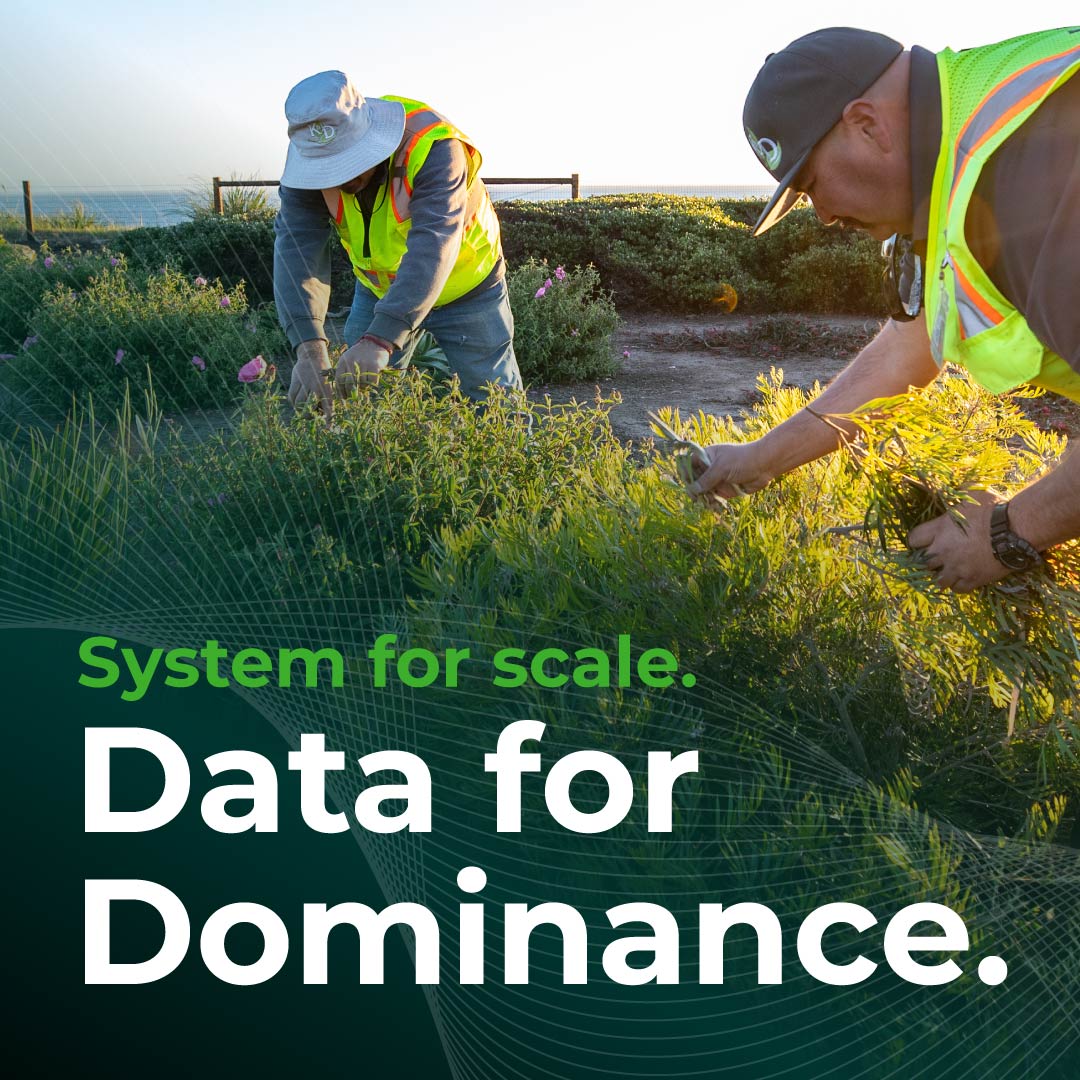
Growth by Design, Not by Chance
High-performing businesses in 2026 are engineering growth through deliberate systems, actionable data, and intentional culture—not hoping more challenging work produces better results.
They’ve moved beyond operational stability into strategic optimization, where every lever pulls towards predictable, sustainable growth.
The five growth levers work together
Precision estimating ensures every proposal protects margins at scale
AI-enhanced customer experience builds loyalty through transparency and convenience
Connected field-office communication accelerates decision-making through real-time intelligence
Engineered efficiency creates capacity without proportional resource expansion
Leadership investment builds the human infrastructure for long-term growth.
Growth isn’t about doing more—it’s about doing better, smarter, and more consistently.
The landscaping companies taking market share aren’t necessarily the busiest; they’re the most intentional about eliminating waste, optimizing resources, and developing capabilities that compound competitive advantage.
The Hidden Profit Killer ebook shows this pattern over and over: companies move from chaotic operations to systematic excellence through integrated platforms that provide visibility that’s impossible with fragmented systems.
Learn how Aspire helps leading landscaping companies standardize profitability and build scalable systems for the future.
Discover the platform designed for businesses ready to engineer growth rather than chase it.




 866-727-7473
 Schedule Demo
 390 S Woods Mill Rd #300 Chesterfield, MO 63017


