Table of Contents
Table of Contents
- Do you need a license to start a landscaping business in Alaska?
- What are the types of landscaping business licenses & permits in Alaska?
- Step-by-step process to get a landscaping business license in Alaska
- How much does an Alaska landscaping business license cost?
- What are the most common mistakes to avoid when getting a license?
- How Aspire helps landscaping businesses stay organized & compliant
- Over to you
- Disclaimer
You’re familiar with Alaska’s unique climate and how it’s shaped by long winters and short summers.
You even know how to plan and design outdoor spaces to bear the weight of heavy snow, and tweak sandy or silty soils with the right nutrients to improve the root systems.
That sounds like you’re ready to launch your own landscaping company in the state. However, you’re unsure what specific permits, besides a general license, are needed. Or how to get them.
This article provides a comprehensive guide to obtaining a landscaping license in Alaska, including the requirements and costs. It also covers mistakes to avoid on this journey and tech tools to ensure you run an organized and scalable landscaping operation.
Do you need a license to start a landscaping business in Alaska?
Yes, you need a license to start a landscaping company in Alaska.
The business will need an Alaska Entity Number, secure landscaping licenses, and a business permit to operate legally.
Plus, depending on other services you intend to provide, you may need licenses to apply pesticides or design outdoor spaces.
The next section outlines all the licenses your landscaping business needs in Alaska.
What are the types of landscaping business licenses & permits in Alaska?
Your landscaping company will need the following licenses to run the business or advertise your services.
Business license
In Alaska, all new businesses must be registered with the Division of Corporations, Business and Professional Licensing to operate in the state. Plus, those working as a corporation, LLC, or partnership need to register the entity and get an Alaska Entity Number.
If you want to go solo, you won’t need one.
Next, companies also need a business license from the Division.
The license typically includes a DBA (also known as a doing-business-as name), business name, or trade name. It’s the name the business operates and advertises under in the state.
Specialty contractor license
To install plants, trees, or irrigation in Alaska, you need a specialty contractor license from the Division of Corporations.
It also lets you:
Grade, fill, and level the ground
Haul fills, gravel, topsoil, sand, and similar construction materials
Construct water drainage systems, dewatering, and ponds
Perform hydro-seeding
The application requires insurance coverage, a bond, and workers’ compensation for approval.
There’s even a caveat during registration that says if the Alaska Child Support Enforcement Division confirms that you are in arrears on child support, you will only be issued a nonrenewable temporary license valid for 150 days. So, keep that in mind as you apply.
Certified applicator licenses
You need an applicator license from the Division of Environmental Health to:
Apply pesticides to residential or commercial properties.
Use or supervise the use of pesticides at a school.
Use or supervise the use of pesticides at a public place, including parks, common areas of apartment buildings, or government offices.
Use, purchase, or sell any RUPs.
Landscape architecture license
If you want to offer design services, such as grading designs and drainage systems that affect how water flows and land is used, you need a landscape architecture permit from the Division of Corporations, Business, and Professional Licensing.
It’s one permit that allows you to apply through the LARE exam or by comity.
The comity is an allowance that permits professional landscape architects from other states, territories, and foreign countries to work at the discretion of the board and in compliance with statutes and regulations.
Permits and local regulations
Local municipalities in Alaska may have additional licensing requirements for you to run a landscaping business in their city.
As such, you need to visit the city’s website, the clerk’s office, or the department of works at the city hall to verify what’s needed to begin landscaping operations.
Step-by-step process to get a landscaping business license in Alaska
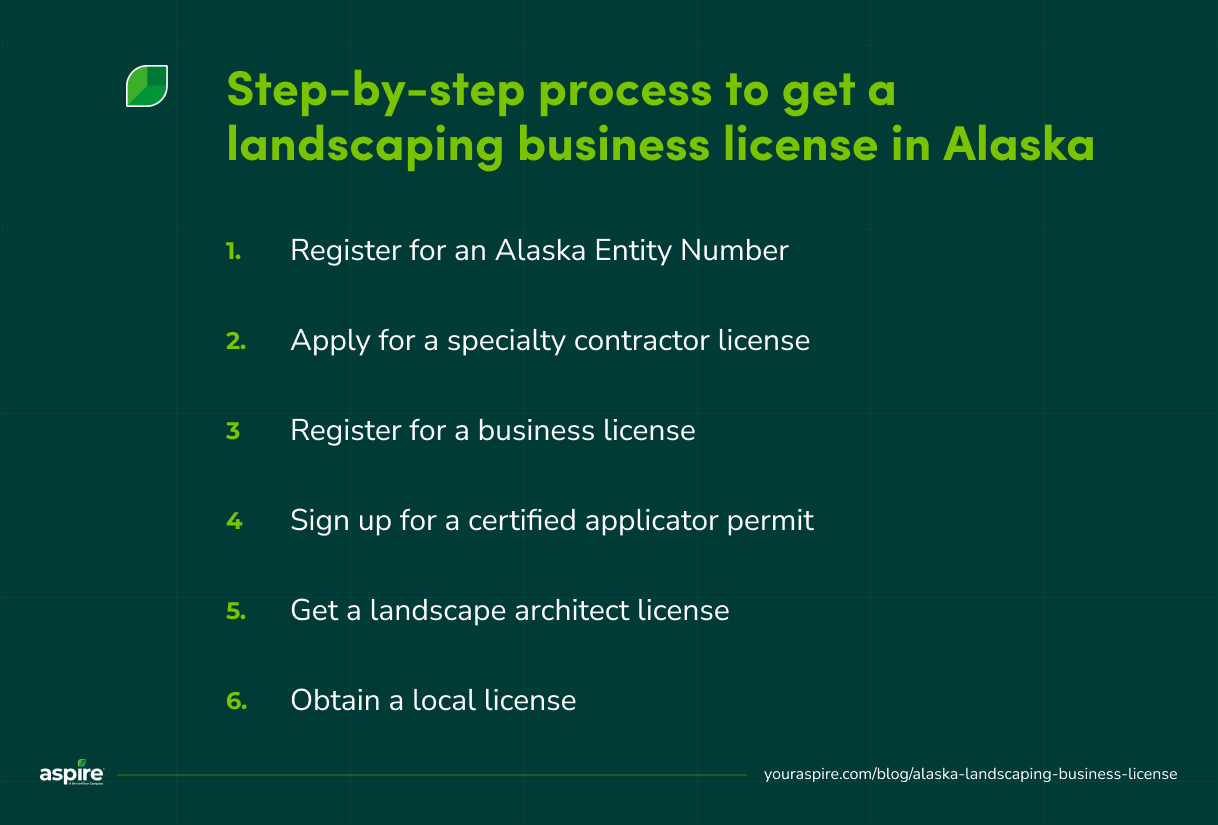
To get a landscaping business license in Alaska, you need to register the business for an Alaska Entity Number before you can apply for the licenses needed to begin your landscaping operation.
Here’s a detailed process on how to get started.
1. Register for an Alaska Entity Number
Your first step is to decide on a legal structure for your landscaping business and choose a name.
Here are common structures you can choose in Alaska:
Sole proprietorship: As the name suggests, you manage the landscaping business alone. No partnership, no reporting to anyone. But if any legal issues arise, your personal assets are at risk.
Limited liability corporation (LLC): The business is run alongside other individuals, corporations, other LLCs, or foreign entities. The business doesn’t pay taxes; it’s passed through to the partners’ personal tax returns. And in the face of disputes or claims, it offers personal liability protection, i.e., personal assets are protected.
Limited liability partnerships (LLP): Similar to an LLC, an LLP is owned and run by two or more partners. Each partner is protected from personal liability for the negligence or misconduct of the other partners, though they remain responsible for their own actions. Profits and losses pass through to each partner’s personal tax return, avoiding double taxation.
Limited partnerships (LP): An LP consists of at least one general partner and one limited partner. The general partner manages day-to-day operations and carries full personal liability, while limited partners are essentially investors — their liability is capped at the amount they’ve contributed to the business and they have little to no role in management decisions.
Corporation: Choose this if the landscaping business will have partners and you want to transfer shares easily, especially since it offers strong liability protection. Plus, shareholders are not liable for debts or lawsuits. Profits, on the other hand, are taxed twice: on the business and on partners’ profits.
If you decide to go solo, you don’t need an entity number, only a Doing Business As (DBA) if business activities will be done under a name different from your legal name.
You do, however, need an entity number and DBA for other business structures.
But before applying for any entity:
Keep in mind that there are filing fees associated with creating an entity, e.g., LLC & Corporations: $250, LP & LLP: $150.
Ensure you complete the correct application for your entity type and review all data entry. Once your application is submitted, filing fees are non-refundable, and the application becomes part of the public record.
Making corrections after filing invites additional forms and filing fees.
2. Apply for a specialty contractor license
Since you intend to operate in a professionally licensed field (landscaping), you need the right permit to legally do business in the state and get a business license.
You can apply for this permit online or via paper applications.
Here’s what you need to secure a specialty contractor license:
DBA name
Name and an Alaska Entity Number for LLCs and corporations
Application ($100) and registration ($250) fees paid to the state of Alaska
Proof of current general liability insurance (not less than $20,000 for property damage and $50,000–$100,000 for injury, including death). A Certificate of Insurance Coverage form from the division or a certificate issued by an insurance provider.
A certificate from a workers’ compensation insurance carrier authorized by the Alaska Division of Insurance to transact business in Alaska.
A bond of $10,000 from one of the following: a surety bond, a cashier’s check, or a time certificate of deposit or savings passbook.
3. Register for a business license
Once you have the number and your professional license, you can proceed to obtain the business license from the division to operate in Alaska.
To get the business license, visit this page and complete the registration.
You’ll need to provide the business name, entity number, address, email, phone number, and any other information needed.
You’ll also be required to pay a $50 fee for one year or $100 for two years. There’s a 50% discount for veterans or seniors.
4. Sign up for a certified applicator permit
If you intend to offer pesticide application services to residential, commercial, or public clients, you need this license from the Division of Environmental Health (Pesticide Control Program).
To get a certified applicator license, you need to:
Be at least 18 years of age (which you probably are).
Pass all three sections of the Core Exam and at least one Category Exam with a score of 70% or higher.
Provide proof of liability insurance.
Submit a $25 fee.
5. Get a landscape architect license
You need this permit for landscaping design services in Alaska. And there are two ways to get it: either by successfully passing an exam, or through comity. Comity is granted to applicants who are already registered in other states, territories, or foreign countries, subject to the discretion of the board and in compliance with applicable statutes and regulations.
You can apply online or through paper applications.
If you’re going the comity route, here’s what you need to apply:
Application ($200) and registration ($100) fees.
Verify your transcripts, exam, and registration.
Verify work experience by submitting your experience in months under a registered landscape architect’s supervision.
Complete a board-approved Cold Regions Design course (listed on the board’s website).
When applying by exam, here’s what you need:
Application ($200) and registration ($100) fees.
Provide application transcripts.
Verify work experience.
Complete a board-approved Cold Regions Design course.
Then, you can register for the exam.
6. Obtain a local license
When you get the permits required for your landscaping company at the state level, it’s time to check in with your city’s website or clerk’s office to identify the different permits your business may need.
Confirm whether you require zoning permits or some special licenses to operate in the city.
How much does an Alaska landscaping business license cost?
The cost of securing the licenses your landscaping business needs to operate in Alaska depends on the legal structure and permits needed.
Here’s an overview of the typical costs to expect:
Alaska Entity Number fees
LLC & Corporations: $250
LP & LLP: $150
General business license
Annual fees: $50
Biennial fees: $100
Specialty contractor license
Application fees: $100
Registration fees: $250
Certified applicator license
Exam fees: $30–$50 per test
Application fee: $25
Landscape architect license
Application: $200
Registration: $100
What are the most common mistakes to avoid when getting a license?
Getting licensed in Alaska is a bit different from other states, and the wrong step can delay the opening day for your landscaping business.
Here are common mistakes to avoid when applying for a license in The Great Land:
1. Confusing an entity number with business license registration
To run your landscaping business as an LLC or corporation in the state, you’re first required to apply for an Alaska Entity Number, which is synonymous with articles of incorporation in other states. It lets you form the entities.
However, it’s only one side of the equation that allows you to secure the specialty contractor license.
You can’t begin operations in Alaska with the number alone. You also need to get the business license before you can do business within the state.
The process is Alaska Entity Number > Professional license (specialty contractor) > Business license, and then you can start. And not Alaska Entity Number > Professional license (specialty contractor).
2. Applying for a business license without a professional registration
The status of your professional registration, i.e., specialty contractor permit, will impact the status of the associated business license.
A professional registration does not bypass the need for a business license. If (and since) a business license is required, it must be obtained after the initial professional registration has been issued.
3. Overlooking insurance
Landscaping businesses in Alaska need to provide proof of current general liability insurance and a bond of $10,000.00 to secure the specialty contractor and business licenses.
Without these, your application won’t even be approved, nor will the associated license.
If you intend to provide pesticide control services, you also need to submit proof of liability insurance to cover incidents.
How Aspire helps landscaping businesses stay organized & compliant
The landscaping season in Alaska is one of the shortest in the country. To be organized, effective, and provide quality landscaping service, you need a system beyond expertise to streamline operations.
Without one, managing operations becomes difficult, resulting in missed planting or fertilizing time for a customer, double-booking jobs, or unpaid invoices.
Aspire makes managing a landscaping business simple by providing the tools needed for daily operations like estimation, scheduling, invoicing, and reporting.
Now, you can estimate and bid on a project, manage schedules, and send invoices without switching between multiple tools or doing them manually.
Here’s the lowdown on some of Aspire’s features:
Contract & proposal management
Every landscaping project begins with estimation.
How much material is needed? How many workers? How many hours? What equipment is a good fit?
Then, you can send a proposal to the client for them to sign.
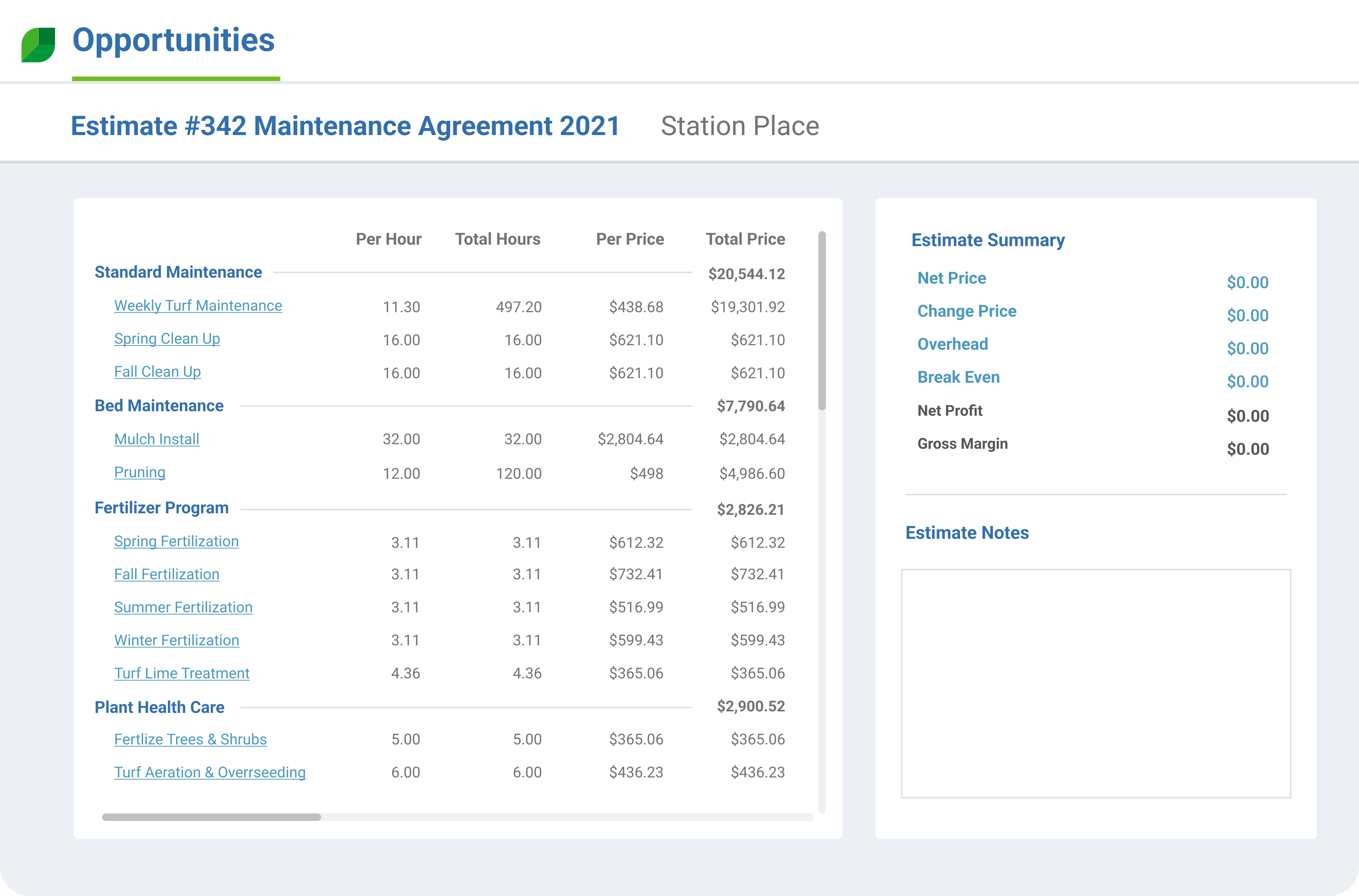
Aspire has an estimating feature that simplifies this process. Using your past projects and industry knowledge, you can preset labor, material, and overhead costs to create professional estimates.
“But I’ll need to know the property size to estimate materials.”
Rather than visit clients’ properties, Aspire integrates with PropertyIntel, an industry-leading software for virtual measurements and takeoffs.
You can then import that data back into the Aspire platform to calculate the project’s materials and supplies, alongside labor and overhead.
There’s a customizable proposal template where you can add the specific landscaping service you’re estimating from an existing catalog. To ensure it’s profitable, you can define margins and markups for labor, materials, and overhead, so they’re automatically factored in.
Once it’s ready, send the proposal via email or Aspire’s dedicated customer portal for clients to sign.
Invoicing & payment processing
Your project is in progress, and you need to invoice a client or collect payments.
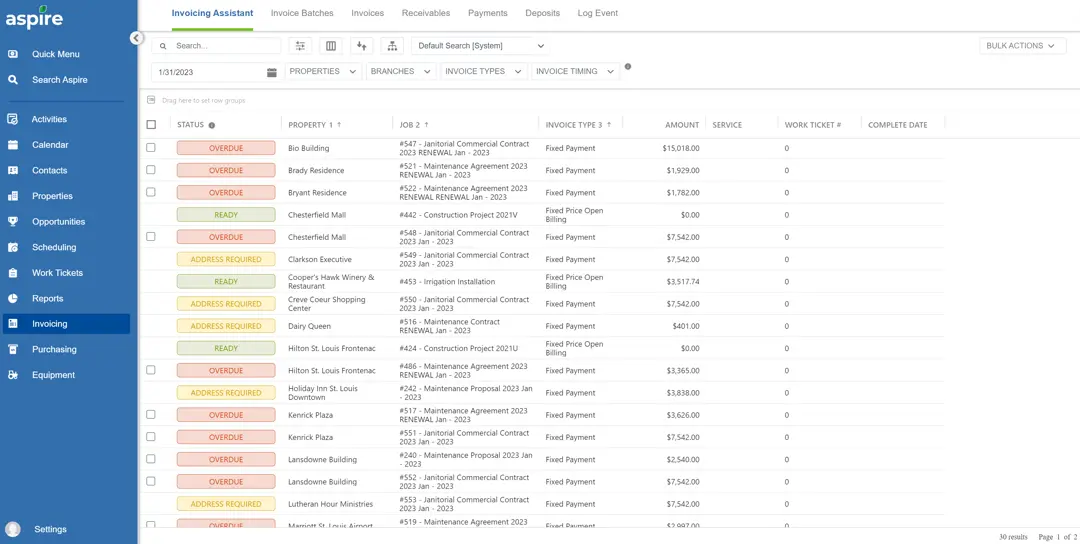
Aspire converts estimates into invoices for you, thanks to Aspire’s invoicing feature.
The data to draft an invoice already exists within Aspire. So, you simply need to generate a new invoice, enter the date and invoice number, pick the client, and send.
It also allows you to monitor an invoice’s status — from paid to pending and overdue. And you can receive payments from credit cards, debit cards, or even checks on Aspire.
Plus, Aspire integrates with professional accounting software like QuickBooks, enabling you to log paid invoices into your accounting system and keep detailed records.
Business reporting & documentation
Running a landscaping business means keeping tabs on a lot of moving parts, including:
How many contracts you have
Services you typically offer
Profit-to-loss ratio
Employee productivity
Estimated seasonal revenue
These can make or break your growth. And Aspire’s reporting tool puts all of this at your fingertips.
It lets you uncover these insights and answer other questions you may have about your landscaping business’s operations.
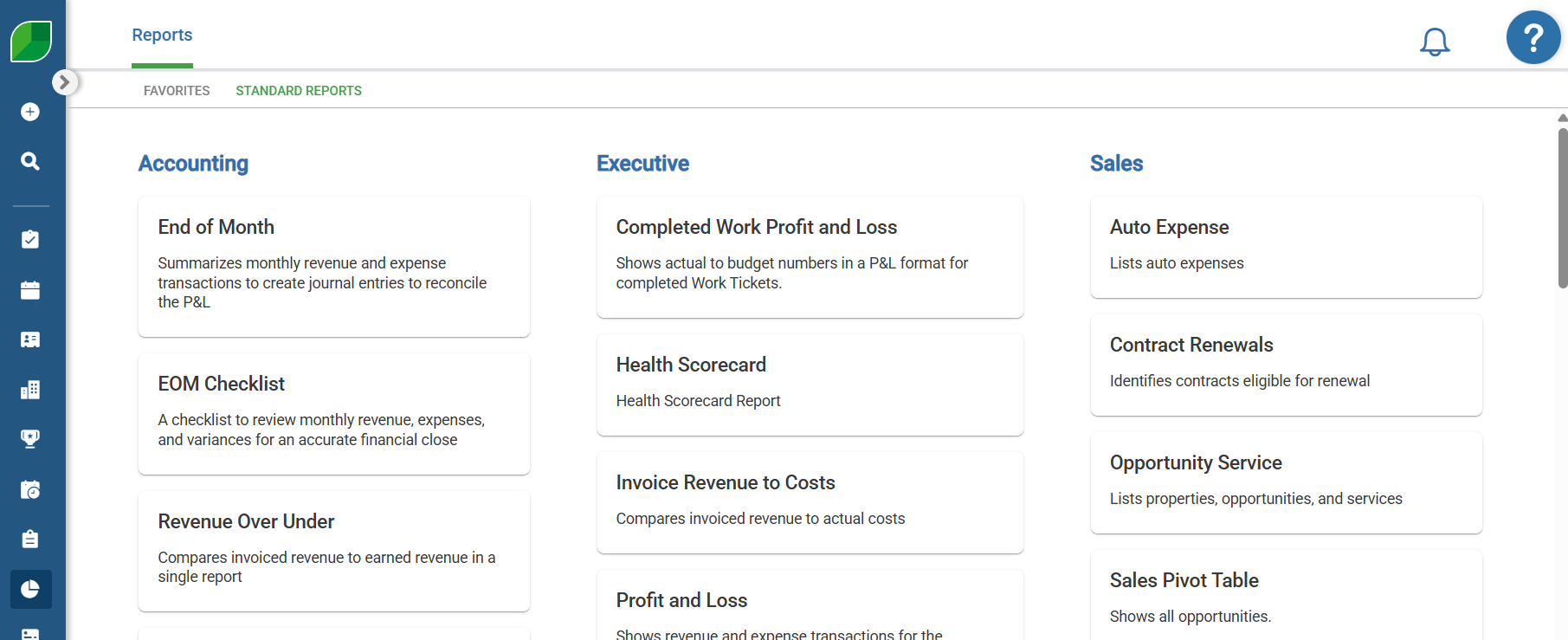
Here, you always know where the business stands, allowing you to make informed decisions when needed.
Think of it as the engagement metric button on social media that shows how many views, likes, or comments a post has, but for your landscaping business and with more details.
Scheduling & job management
Considering the short landscaping season in the state, it’s important to have a clear view of your schedule to plan future projects and ensure crews meet deadlines.
Aspire’s scheduling software gives you that with its calendar-like outlook that shows your current projects and the crew assigned to them.
You can see which day is free when onboarding a new client to avoid double-booking.
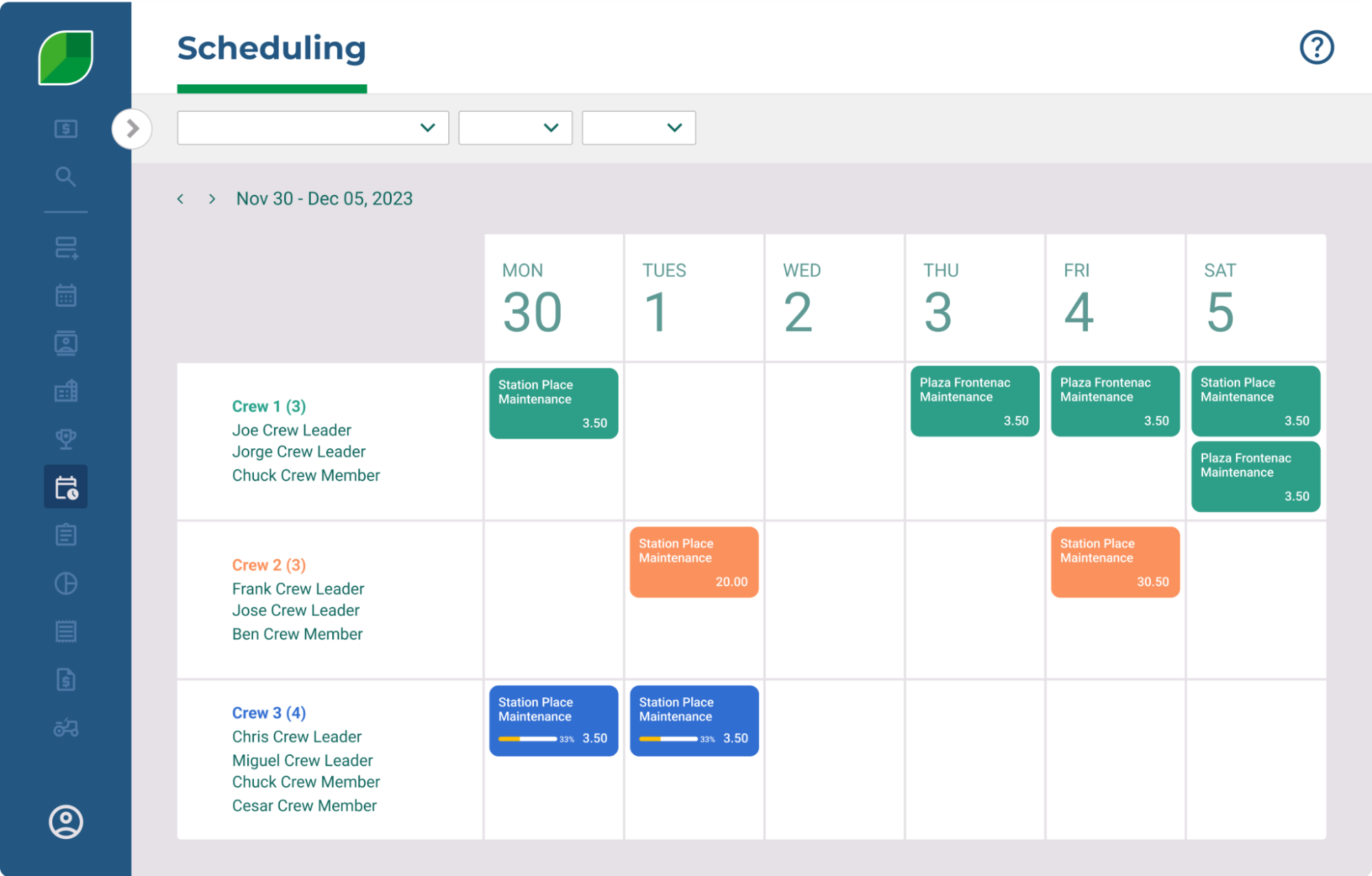
Beyond viewing projects, you can schedule and adjust them as needed, create checklists for crews to follow on-site, and monitor their progress.
This ensures you have a smooth workflow. Clients know when to expect you. Crews don’t miss deadlines. The business doesn’t go over the estimated labor costs.
Simply put, Aspire lets you manage how landscaping projects happen, who handles them, and when they get done from a centralized location.
Over to you
Starting a landscaping business in Alaska involves:
Deciding on a business structure for the company
Applying for an entity number
Applying for a specialty contractor license
Registering for a business license
After getting the license, you can proceed to secure other permits you may require based on the landscaping services to be provided.
Want to keep things smooth, stay organized, and automate landscaping operations for scalability?
You need a tool like Aspire to take control of the business while you focus on what you do best — being an amazing landscaper.
Schedule a free demo to see how Aspire works in real time.
Disclaimer
This article is for informational purposes only and should not be considered legal or financial advice. While every care was taken to use official sources, you should always verify requirements on the Alaska government websites.








 866-727-7473
 Schedule Demo
 390 S Woods Mill Rd #300 Chesterfield, MO 63017


