Table of Contents
Table of Contents
- What does a landscaping business owner do?
- What skills are essential for a successful landscaping business owner?
- What are the daily tasks of a landscaping business owner?
- How does a landscaping business owner manage finances?
- What is the landscaping business owner’s role in customer relations and sales?
- How does a landscaping business owner handle marketing?
- What is involved in strategic planning for a landscaping business?
- How do owners ensure quality control in landscaping projects?
- What are the responsibilities during the startup phase?
- How much can a landscaping business owner earn?
- Over to you!
When you decided to start a landscaping business, you had an idea of how much it would stretch you in terms of managing finances, teams, operations, and client relationships.
But what you probably didn’t expect was the responsibilities you’re dealing with now:
Time-consuming administrative tasks
Inconsistent processes
Inefficient workflows
Cash flow challenges
Turnover rate
Difficulty tracking job costs and profitability
The truth is, every landscaping business owner is responsible for leading the company. But to do that effectively, you must understand the responsibilities involved. This way, you’re prepared for each phase of growth, know what to delegate and when to delegate it, and provide actionable guidance to move the business forward.
In this guide, you’ll learn what responsibilities to expect as a landscaping business owner, so you’re ready for anything.
What does a landscaping business owner do?
A landscaping business owner manages field crews, schedules, and daily operations. They run the whole show, from securing clients and estimating jobs to overseeing crews, managing finances, and ensuring quality work is delivered on time.
In new companies, owners often take on multiple roles because of limited resources. They work alongside field crews and handle sales, scheduling, and administrative tasks.
As the business grows, an owner’s role shifts toward strategic management, including planning, team management, systems development, operational scaling, and delegating day-to-day fieldwork to trained crews and managers.
Here’s how Bruce Bachand of Carol King Landscape Maintenance describes what a landscaping business owner does:
“As a landscaping business owner, my role goes far beyond the work in the field. I meet with crews and staff, review schedules, manage daily operations, and visit job sites and customers.
Beyond projects, I develop careers across specialties (water management, arbor care, turf, sports fields), provide job security and long-term viability, and create opportunities for people to grow.”
What skills are essential for a successful landscaping business owner?
To excel at managing your landscaping operation, you need to be a great communicator, a leader, and someone who understands the industry.
Specifically, you’ll need these skills to be a successful landscaping business owner:
Operational and technical skills: To lead a landscape company, you must be familiar with all forms of fieldwork, from equipment operation to addressing challenges related to pests, plants, site conditions, and landscaping design.
You must know how to execute projects and handle physically demanding tasks. Regarding operations, you should be skilled in scheduling, dispatching, coordinating equipment, and even sequencing jobs to ensure a smooth workflow.
Business and management skills: Knowing how to market your company, even at a basic level, is important. Can you comfortably convince a prospective customer to hire your landscaping company immediately or in the future?
You should also know how to manage relationships with clients and workers. So, think client relationship management, leadership skills, people management, systems building or process development, problem solving, decision-making, and financial management.
Soft skills and mindset: Beyond operational and business acumen, you need good people skills to manage a landscaping company. For example, strong verbal communication skills are essential for working effectively with clients and workers.
Being dependable, trustworthy, detail-oriented, client-focused, and entrepreneurial are equally crucial skills for inspiring customer loyalty.
Plant and soil knowledge: You must also understand different plants, plant care, soil types, irrigation, and seasonal needs. Clients should judge how knowledgeable you are by the suggestions you make, as this expertise can be the difference between hiring your company and another.
What are the daily tasks of a landscaping business owner?
Your daily responsibilities as a landscaping business owner will vary depending on the stage your lawn care company is in.
As a new or mid-sized landscaping company, you may be actively involved in fieldwork, project planning and preparation, client consultations, and administrative duties.
Tyler Kachnovich, president of T&T Landscape and Masonry Inc., for example, has a hands-on owner-operator approach. He splits his day between equipment and asset management, executing fieldwork, overseeing multiple jobs, fleet management, logistics, maintenance, and problem-solving.
Established landscaping business owners with years of experience and sufficient manpower, like Bruce Bachand, tend to focus more on people coordination, scheduling, field oversight, and client interaction.
They’re also responsible for managing the sales pipeline, customer satisfaction (yes, again), financials, and gaining overall insight into business operations.
A tool like Aspire can help centralize and streamline daily operations, such as project monitoring, scheduling, and real-time incident response.
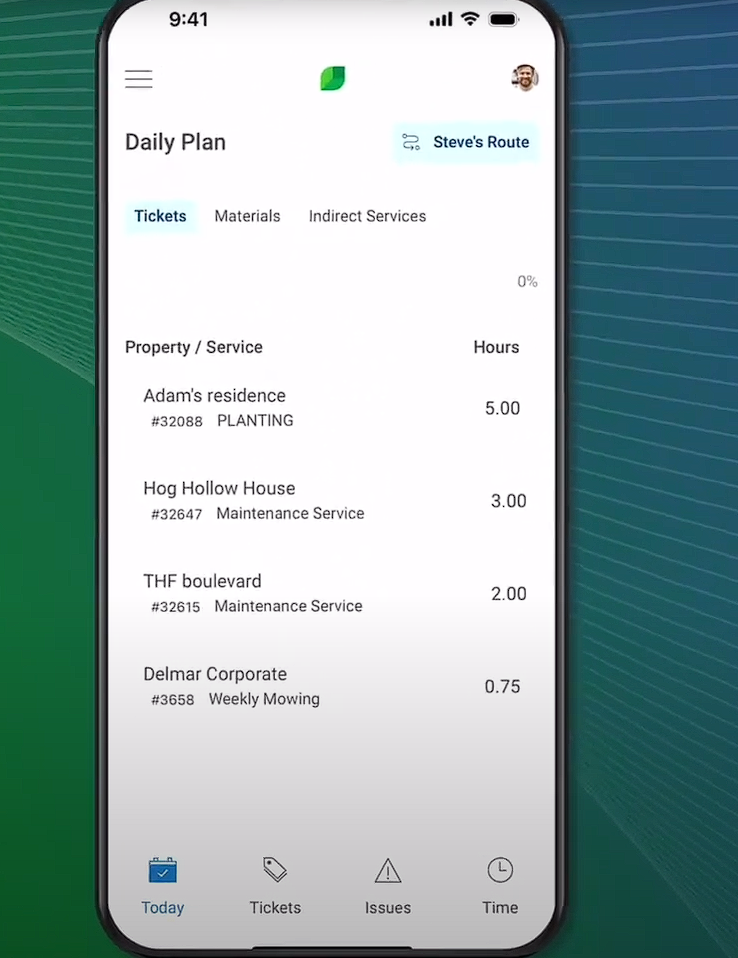
Its mobile app allows field crews to log information and communicate with the back office. This way, you’re up to date on every activity and can manage your company more efficiently.
How does a landscaping business owner manage finances?
In a webinar on organizing money in landscaping, leading landscaping influencer and business owner Keith Kalfas recommends intentionally separating accounts, formalizing payroll and taxes, saving consistently, and tracking every dollar through structured systems.
To be specific, a landscaping business owner can manage finances by:
Separating personal and business finances: You need a business checking account to direct all revenue. This will help with tax clarity, financial protection, and legitimacy.
Formalizing the business structure: If you don’t have an LLC or corporation, you need to form one to create a legal and financial separation between the owner and the business.
Being intentional about paying yourself: Instead of casually taking money out, consider setting yourself up on a payroll or paying yourself through owner distributions.
Creating a budget: Budgeting your finances helps you allocate resources, avoid cash shortages, build reserves, know when to secure off-season jobs, and identify where you’re losing money.
Tracking costs: Another way to manage finances is to track labor, materials, and equipment to find profitable services. You also need to monitor and reduce unnecessary expenses (fuel, insurance, rent).
Use Aspire’s job costing software to evaluate how much was spent on each project compared to the estimate.

This gives you visibility into the cash flow and profitability of jobs. The field management software also integrates with QuickBooks, allowing you to review balance sheets and profit and loss statements and assess your business’s financial health.
What is the landscaping business owner’s role in customer relations and sales?
As a landscaping business owner, you’re the face of the business, whether it’s new, growing, or established.
Your role is whatever is needed, and that includes (but isn’t limited to):
Building and maintaining client relationships: You meet with clients, understand their needs, set and manage expectations, and keep the relationship going in person beyond the initial sale.
Think about visiting after a project is completed, sending personalized texts or emails, and calling occasionally.
Managing client satisfaction: Even with someone else managing daily communication, there are moments when you need to step in, especially when the company’s reputation is at stake.
You also need to hold your landscaping team accountable to high-quality standards and address escalated issues.
Setting pricing and profitability standards: You’re responsible for defining the pricing strategy, profit margins, and service or client fit.
Overseeing the sales pipeline and supporting the sales team: Your job involves evaluating each potential opportunity and deciding which aligns with your business’s goal in terms of profitability, capacity, and availability.
You sign off on estimates and proposals, train sales staff on closing and client management, and provide tools to track leads, proposals, and follow-ups.
Ensuring quality control: Part of your duties includes defining quality standards for landscaping projects and ensuring that the services provided meet the requirements.
As your business grows, managing all these tasks manually becomes increasingly difficult to sustain.
A platform like Aspire supports your role by centralizing the sales and customer lifecycle in a single location.
With its marketing tools, you can capture and manage leads, create professional estimates using the estimation software, and track approvals.
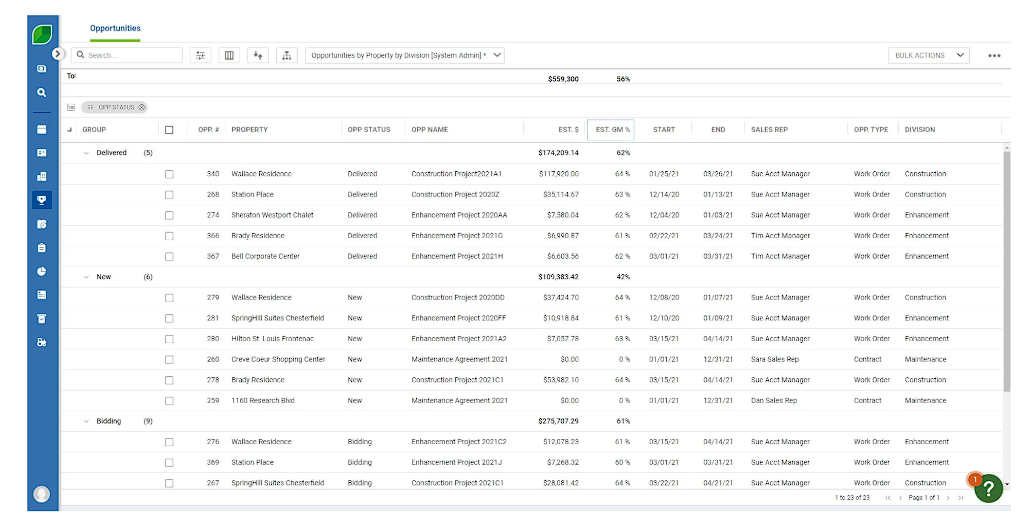
Aspire also includes CRM features to maintain client histories, support ongoing communication, and strengthen customer relationships as your workload increases.
How does a landscaping business owner handle marketing?
Most landscaping business owners combine traditional and digital marketing strategies to advertise their companies.
Traditional marketing targets people in their community and leaves a physical reminder for prospects. This includes creating and sharing flyers, brochures, yard signs, catalogs, and door hangers.
Some even place transit ads on subways or buses, share business cards with people in their community, and send postcards to prospects’ mailboxes.
Landscapers also use digital marketing campaigns for the reach they offer. With a solid online presence, e.g., an SEO-optimized website, social media profile, or Google Business Profile, potential clients can search for terms like “landscapers in Pasadena,” and the landscaper’s business comes up.
Digital marketing helps showcase the services a landscaping company offers while providing proof, like reviews, photos, and testimonials, that build trust before a prospect ever calls.
It also allows owners to run targeted ad campaigns that reach people actively looking for their services.
Tools like Aspire’s Marketing Pro enable landscapers to launch effective ads across multiple channels from a single platform.
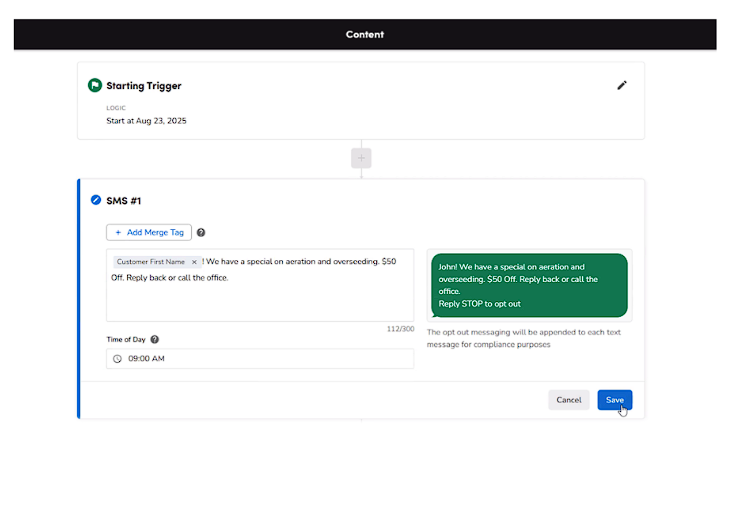
Owners can create email, text, and direct mail campaigns that deliver the right message at the right time, using existing client data within Aspire to build targeted audience lists.
Other marketing strategies landscaping business owners use include:
Networking with property owners in their neighborhood
Connecting with other business owners at local events
Attending city- or state-sponsored events
Launching referral programs that incentivize existing clients to bring in new customers
What is involved in strategic planning for a landscaping business?
Planning the company’s growth and the goals it must meet is another crucial responsibility of landscaping business owners.
Strategic planning here involves creating a roadmap that takes the company from where it is to where the owner expects it to be.
Given the seasonality of the landscaping industry, leaving growth to chance often results in staying at the same revenue level and client count year after year.
With a plan in place, however, you build a landscaping business with a clear, consistent growth path — one your team can align with and that people want to be part of.
It’s focusing on the bigger picture and taking time away from daily site work to decide how the company will grow and operate.
This process typically includes:
Building a planning team: You need people who understand the business’s operations and can brainstorm what’s possible or not. This can include team leads, operations managers, crew leaders, and even a consultant, if you’ve never done strategy planning before.
Setting growth goals: Define revenue targets, client types, business size in [X] years, and ideal time to begin succession plans. The goals must be specific, measurable, achievable, realistic, and time-bound. For instance, how many clients do you want to have per month in the next three years?
Creating an action plan: You’ll need one for each goal you set — an outline of how you intend to achieve it, so they’re not just ideas.
Doing a SWOT analysis: Understand your business’s strengths, weaknesses, opportunities, and threats, so you can decide which services to prioritize, expand, or phase out based on profitability and demand.
Assessing competitors: Analyze your competitors’ positioning and tactics to identify what’s working, find gaps to fill, and get your landscaping business to stand out.
How do owners ensure quality control in landscaping projects?
Landscaping business owners ensure quality control by setting expectations for field crews and clients, monitoring work in progress, and holding teams accountable.
In practical terms, this involves:
Defining quality standards: Establish what a great landscaping service looks like for the company in terms of workmanship, safety, cleanup, and customer relations. This way, the team is aligned on what “done right” means for a completed project.
Standardizing processes: To maintain consistency with established standards, owners create checklists outlining procedures for different types of landscaping projects.
Aspire’s work ticket management system, for example, includes customizable visit checklists to ensure projects are completed in the correct order.
Team training: Providing regular training, from the onboarding process through ongoing skill development, helps crews understand proper techniques and what a successful project should look like. Training takes them from knowing what a quality landscaping job is to knowing how to make it happen.
Inspections: Personally reviewing completed work or assigning a supervisor to review it before final sign-off helps verify that projects meet company standards, client expectations, and contract requirements.
What are the responsibilities during the startup phase?
During the startup phase, landscaping business owners often wear two hats: entrepreneur and landscaper.
They’re not only responsible for delivering quality landscaping services but also for operating legally, managing finances, and promoting their business to attract clients.
In this phase, their responsibilities include:
Creating a business plan: Owners have to define their goals and objectives, including how to achieve them. Outline specific landscaping services to provide, list required equipment, define a target market, research the competition, and, basically, hash out every detail of the business.
Setting up the business legally: This involves business registration, securing landscaping licenses, obtaining insurance, and opening business accounts.
Marketing and lead generation: New landscapers are responsible for promoting their services using different marketing strategies.
This may include word-of-mouth, door-to-door visits, flyer distribution, yard signs, community networking, or local digital marketing campaigns to attract clients.
Managing finances: Owners must set rates that cover overhead and generate profit. They also handle invoicing, track income and expenses, and ensure that taxes are planned and paid on time.
Client communication: This involves meeting with clients, preparing and sending estimates, outlining expectations, and maintaining relationships to build repeat business.
Operational planning: In the early stages, landscaping business owners often perform the work themselves, handling tasks such as mowing, cleanups, installations, and maintenance to deliver services and generate initial revenue.
They’re also responsible for scheduling work, managing equipment and supplies, and handling administrative duties (such as sourcing materials) to keep operations running.
How much can a landscaping business owner earn?
Earnings for landscaping business owners vary widely depending on company size, revenue, location, and the owner's level of involvement in daily operations.
According to Landscape Industry Careers, a landscaping business owner can earn between $60,000 and $186,000 per year, with benefits such as medical and dental coverage and paid vacation time.
Jacob Godar, CEO of Scooter’s Lawn Care Inc., suggests $100,000 per year as a baseline for business owners, especially those generating $1 million or more in revenue.
For owners below that mark ($800k in revenue), Mike Andes, CEO of Augusta Lawn Care, recommends $60k–$70k, plus a cash distribution at the end of each year.
Over to you!
As a landscaping business owner, your responsibilities extend beyond delivering exceptional work in the field.
This also involves leading people, communicating, managing finances, planning for growth, maintaining standards, and building lasting relationships with clients and workers.
When the business grows, these responsibilities become complex and harder to manage manually.
However, with a system like Aspire, you can stay in control, manage operations, make informed decisions, and grow while keeping track of what happens in the landscaping business.
Aspire brings estimating, scheduling, financial tracking, client management, and reporting into one place, enabling you to execute specific responsibilities with ease.
It provides insights and helps you reduce operational blind spots, so you can spend more time leading your business forward.
Schedule a free demo to see how helpful Aspire can be to your landscaping business.











 866-727-7473
 Schedule Demo
 390 S Woods Mill Rd #300 Chesterfield, MO 63017


