Table of Contents
Table of Contents
- Do you need a license to start a landscaping business in Michigan?
- What are the types of landscaping business licenses & permits in Michigan?
- General business license
- Landscaping architect license
- Pesticide applicator license
- Nursery license
- Permits and local regulations
- Step-by-step process to get a landscaping business license in Michigan
- 1. Choose a business structure and name
- 2. File formation paperwork and register for state taxes
- 3. Get a federal employer identification number (FEIN)
- 4. Get a landscaping architect license
- 5. Obtain a pesticide applicator license
- 6. Secure a nursery permit
- 7. Apply for local licenses
- 8. Renew the permits
- How much does a Michigan landscaping business license cost?
- What are the most common mistakes to avoid when getting a license?
- 1. Not checking local rules
- 2. Not understanding the two-year requirement for a pesticide applicator license
- 3. Not realizing you need separate nursery licenses for multiple locations
- How Aspire helps landscaping businesses stay organized & profitable
- Simplified proposal management
- Invoicing & payment processing
- Business reporting & documentation
- Scheduling & job management
- Disclaimer
- How Aspire helps landscaping businesses stay organized & profitable
- Simplified proposal management
- Invoicing & payment processing
- Business reporting & documentation
- Scheduling & job management
- Disclaimer
- What are the most common mistakes to avoid when getting a license?
- 1. Not checking local rules
- 2. Not understanding the two-year requirement for a pesticide applicator license
- 3. Not realizing you need separate nursery licenses for multiple locations
- How Aspire helps landscaping businesses stay organized & profitable
- Simplified proposal management
- Invoicing & payment processing
- Business reporting & documentation
- Scheduling & job management
- Disclaimer
- How much does a Michigan landscaping business license cost?
- What are the most common mistakes to avoid when getting a license?
- 1. Not checking local rules
- 2. Not understanding the two-year requirement for a pesticide applicator license
- 3. Not realizing you need separate nursery licenses for multiple locations
- How Aspire helps landscaping businesses stay organized & profitable
- Simplified proposal management
- Invoicing & payment processing
- Business reporting & documentation
- Scheduling & job management
- Disclaimer
- Step-by-step process to get a landscaping business license in Michigan
- 1. Choose a business structure and name
- 2. File formation paperwork and register for state taxes
- 3. Get a federal employer identification number (FEIN)
- 4. Get a landscaping architect license
- 5. Obtain a pesticide applicator license
- 6. Secure a nursery permit
- 7. Apply for local licenses
- 8. Renew the permits
- How much does a Michigan landscaping business license cost?
- What are the most common mistakes to avoid when getting a license?
- 1. Not checking local rules
- 2. Not understanding the two-year requirement for a pesticide applicator license
- 3. Not realizing you need separate nursery licenses for multiple locations
- How Aspire helps landscaping businesses stay organized & profitable
- Simplified proposal management
- Invoicing & payment processing
- Business reporting & documentation
- Scheduling & job management
- Disclaimer
- What are the types of landscaping business licenses & permits in Michigan?
- General business license
- Landscaping architect license
- Pesticide applicator license
- Nursery license
- Permits and local regulations
- Step-by-step process to get a landscaping business license in Michigan
- 1. Choose a business structure and name
- 2. File formation paperwork and register for state taxes
- 3. Get a federal employer identification number (FEIN)
- 4. Get a landscaping architect license
- 5. Obtain a pesticide applicator license
- 6. Secure a nursery permit
- 7. Apply for local licenses
- 8. Renew the permits
- How much does a Michigan landscaping business license cost?
- What are the most common mistakes to avoid when getting a license?
- 1. Not checking local rules
- 2. Not understanding the two-year requirement for a pesticide applicator license
- 3. Not realizing you need separate nursery licenses for multiple locations
- How Aspire helps landscaping businesses stay organized & profitable
- Simplified proposal management
- Invoicing & payment processing
- Business reporting & documentation
- Scheduling & job management
- Disclaimer
- Do you need a license to start a landscaping business in Michigan?
- What are the types of landscaping business licenses & permits in Michigan?
- General business license
- Landscaping architect license
- Pesticide applicator license
- Nursery license
- Permits and local regulations
- Step-by-step process to get a landscaping business license in Michigan
- 1. Choose a business structure and name
- 2. File formation paperwork and register for state taxes
- 3. Get a federal employer identification number (FEIN)
- 4. Get a landscaping architect license
- 5. Obtain a pesticide applicator license
- 6. Secure a nursery permit
- 7. Apply for local licenses
- 8. Renew the permits
- How much does a Michigan landscaping business license cost?
- What are the most common mistakes to avoid when getting a license?
- 1. Not checking local rules
- 2. Not understanding the two-year requirement for a pesticide applicator license
- 3. Not realizing you need separate nursery licenses for multiple locations
- How Aspire helps landscaping businesses stay organized & profitable
- Simplified proposal management
- Invoicing & payment processing
- Business reporting & documentation
- Scheduling & job management
- Disclaimer
To start a new landscaping business in the Great Lakes State, you must understand all the paperwork and legal requirements to avoid potential fines or business disruptions.
Will you need to get a specific landscaping license, purchase a bond, or register as a general business?
This guide breaks down the licensing process, so you can launch and grow your business without unnecessary delays.
You will discover:
The types of permits a Michigan landscaping business needs and their cost.
How to get licensed, step-by-step.
Errors to avoid in the process.
How to leverage digital tools to stay organized and boost your business.
Do you need a license to start a landscaping business in Michigan?
Michigan doesn’t require a state-level landscaping license for new businesses.
But if you intend to provide services such as pesticide application or landscaping design, you need special licenses from the relevant state licensing agency.
You may also need a permit from the city where your landscaping business will be situated.
Read on to discover the exact licenses you’ll need to begin operations in Michigan.
What are the types of landscaping business licenses & permits in Michigan?
You’ll need to get the following permits to start your landscaping business in the state…
General business license
Your first step is to register the business with the Michigan Department of Licensing and Regulatory Affairs (LARA) and register for taxes with the Michigan Treasury Online (MTO).
You’ll need to:
Create a profile with the MTO
Get a federal employer identification number (EIN)
Determine your business’s legal structure
Register your business name
Complete the application online or mail the form to their office
Landscaping architect license
Will you offer services such as hardscape design, grading plans, or public landscaping? A landscape architect license is required from the Michigan State Board of Landscape Architects.
As an applicant, you must have the required degree and transcripts, relevant experience, pass a licensing examination, and provide references.
Pesticide applicator license
A permit from the Michigan Department of Agriculture and Rural Development (MDARD) is required to apply pesticides for commercial purposes.
Similar to the landscape architect license requirements, applicants must pass the Commercial Core exam and one category exam to demonstrate their knowledge of responsible pesticide use.
The department also has recertification seminars for existing applicators who want to stay licensed.
Nursery license
A nursery license is required from MDARD if you intend to grow, sell, or resell winter-hardy perennial plants, such as trees, shrubs, perennials, fruit trees, berry plants, rose bushes, vines, herbs, rhubarb and asparagus crowns, strawberries, bulbs, and other plants capable of surviving the winter, without special care.
There are four license types you could get:
Nursery grower, if you grow and sell plants.
Small-scale nursery grower for growing and selling plants on less than 1/4 acre outdoors or 200 sq. ft. of greenhouse space.
Nursery dealer, if you only buy and resell plants.
Registered nursery dealer for buying and selling homegrown plants in Michigan.
Permits and local regulations
Several Michigan cities require landscaping business permits for you to operate in the region. Once you’re done with the state-level licenses, make sure to confirm your local government's requirements.
Some may need a specific city business license or tax permits before they can begin operations. Others might need contractor permits or a one-time landscaping license for the business.
To be on the safe side, check in with city officials, agents, or lawyers to verify what’s needed.
Step-by-step process to get a landscaping business license in Michigan
Wondering what steps to take to get licensed and begin operations in Michigan?
This section breaks it down for you.
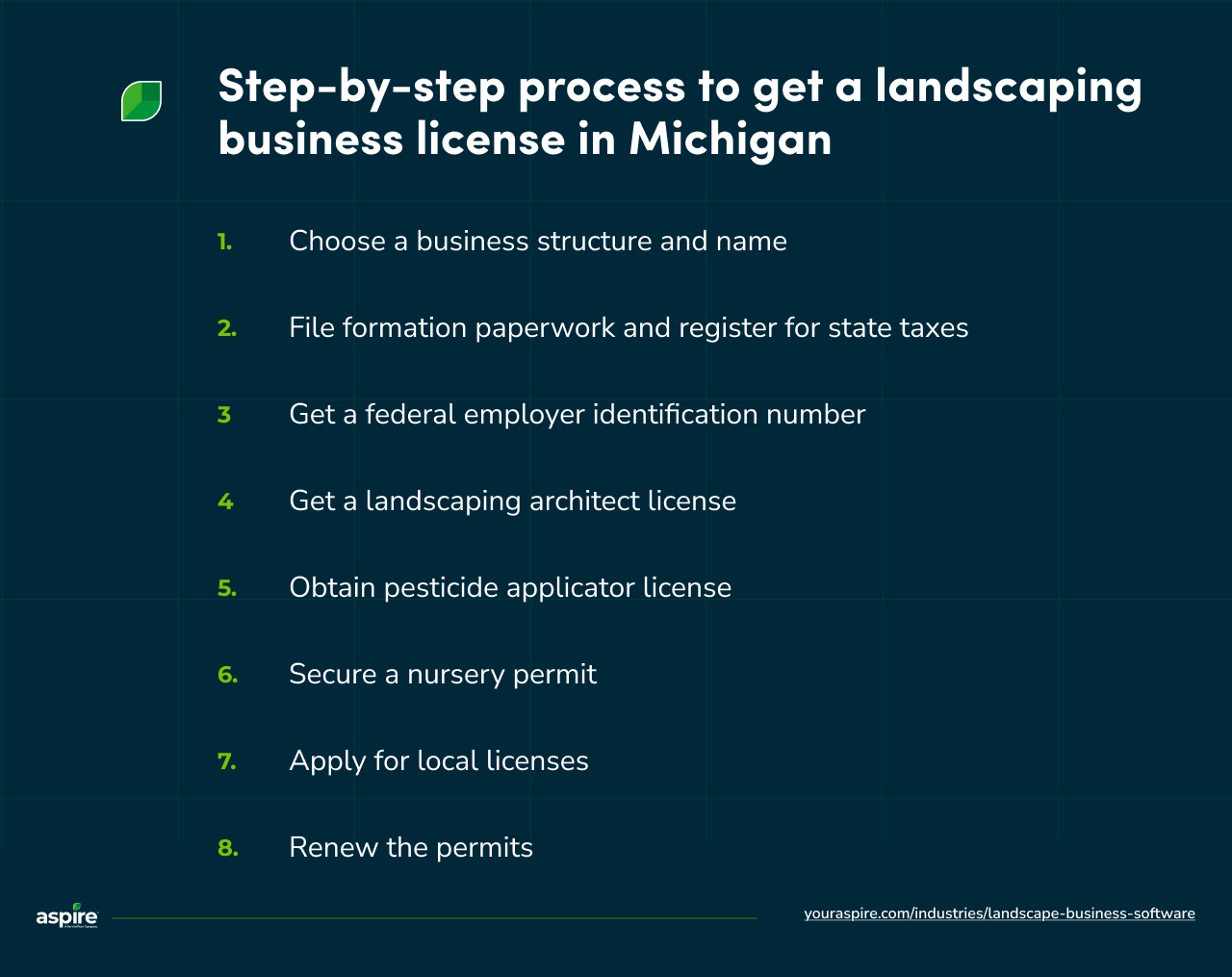
1. Choose a business structure and name
Determine the ideal legal structure for your business, as this defines the registration process, liability, legal requirements, and, in some cases, tax requirements.
Here are the options you can choose:
Sole proprietorship: If you intend to run solo, you’ll need to file a Doing Business As (DBA) name. Keep in mind, though, that you will be personally responsible for any liabilities to the business.
LLC: If you want to be in partnership with others, an LLC protects your personal assets against liabilities such as financial losses or lawsuits.
Corporations: If you intend to invite investors at some point, this structure offers greater protection against liabilities but comes with additional formal complexities.
Then, choose a unique name for your business to make it memorable to prospects and clients. Use the LARA business entity search tool to verify that the name you choose isn’t already taken.
2. File formation paperwork and register for state taxes
Once you’re clear on the structure and business name, you need to file formation documents with the LARA Corporations Division through the MiBusiness Registry Portal.
This ensures your business remains compliant with state laws and regulations.
You also need to register for state taxes with the state treasury department. It will require you to get an EIN, as that will also be your Treasury business account number.
You may need to register for sales tax, corporate income tax, or withholding tax, depending on the different business activities.
3. Get a federal employer identification number (FEIN)
An EIN or FEIN is essential for:
Filing employment taxes and paying business taxes
Opening a business bank account
It’s also needed to process and pay state taxes in Michigan. To get the EIN, you’ll need a Social Security Number and a business structure.
With that, you can visit the IRS website and complete an application for the FEIN.
4. Get a landscaping architect license
If your landscaping business includes planning, designing, and managing outdoor spaces to be visually appealing and sustainable, you need an architect license from Michigan’s LARA department.
Here’s how to get one:
Meet the education requirements: Ideally, one of the following:
Option 1: A bachelor’s degree from an LAAB or LAAC-accredited program with at least three years of experience working a minimum of 4,500 hours, verified by the supervising landscape architect.
Option 2: A master's degree from an LAAB or LAAC-accredited program with at least two years of experience working a minimum of 3,000 hours, verified by the supervising landscape architect.
Option 3: A total of seven years combining education credits (max. five years, earning 30 semester hours or 45 quarter hours per year) and experience credits (max. seven years, working a minimum of 1,500 hours per year) verified by a supervising landscape architect.
Send your official transcripts to the LARA office in Michigan and provide documentation demonstrating the establishment of a Council of Landscape Architectural Registration Boards record.
Pass the required Landscape Architect Registration Examination and get at least five references from individuals unrelated to you who know your experience in landscape architecture.
A minimum of three references must be from a licensed or registered landscape architect who can vouch for your experience.
Complete the online application at www.michigan.gov/miplus, filling in all fields, answering all questions, and uploading supporting documentation.
Provide your Social Security Number (or SSN affidavit form if exempt or you don't have one), answer good moral character questions regarding your ability to serve the public fairly, and pay a $320 application fee.
5. Obtain a pesticide applicator license
If pesticide application will be part of your landscaping service offering, you need this license. There are two separate types you require:
An individual certification for anyone who applies pesticides.
A business license for your company.
For the individual certification, the person needs to:
Be 18 or older.
Pass a Core and category exam (3A for turf or 3B for ornamentals).
Pay a $75 application fee and submit their application to the Michigan Department of Agriculture and Rural Development (MDARD).
Once that’s done, they will get the certification card in the mail.
For the business certification, you need:
To have worked as an employee of a commercial pesticide applicator for two application seasons, or have a bachelor’s degree in a discipline that provides education regarding pests and pest control, and one application season working as an employee of a commercial applicator.
An individual certification. You, an employee, or a partner must already be licensed as an individual pesticide applicator.
To have registered your business with the state and the county you’ll be operating in.
After that, follow the steps below to get a license:
Complete a Notarized Letter of Experience Form (PI-217), notarized by a Notary Public.
Provide proof of required insurance coverage to the MDARD. The policy should cover bodily injuries and property damage arising from pesticide application. All license categories require a minimum coverage of $100,000 for bodily injury and $25,000 for property damage.
Pay the $100 application fee and submit a signed application form to the Department in Lansing, Michigan.
Wait four to six weeks for MDARD to process your business license, and you’re good to go.
6. Secure a nursery permit
A nursery permit from MDARD is required if you want to grow, buy, sell, or resell winter-hardy plants. The Department offers four options, as outlined earlier.
Regardless of the option you pick, here’s how to get a license from the state:
Apply online via the licensing portal or complete the nursery grower or dealer application form.
Pay the $35–$100 license fee, depending on the permit type you need.
Submit the application form and wait for your license to be processed.
7. Apply for local licenses
Once you’ve secured the permits needed at the state level, check with the city you’ll operate in about any additional licenses your business might need.
Cities such as East Grand Rapids, Southfield, Detroit, Livonia, and Farmington Hills all require landscaping and lawn care companies to get a landscaping license before launching.
For most of them, here’s what you need to get a landscaping license:
Insurance policies covering equipment, workers’ compensation, and general liability.
Bonds to protect your clients if incidents happen.
Social security number.
Application fees.
Background check.
Sales tax license number.
Services offered.
Business name and legal structure.
To ensure you have everything needed to successfully apply, visit the local government offices to understand the licensing requirements.
8. Renew the permits
Licenses need to be renewed with the state annually and biannually.
Ensure all business documents, insurance, and permits are up to date as you begin operations. Record the renewal dates in your calendar to ensure you remain compliant and avoid fines.
How much does a Michigan landscaping business license cost?
Considering budgeting is a huge part of business planning, here’s how much it will cost to secure the different licenses your new company needs.
General business registration fees:
Corporation/LLC filing with Michigan LARA: $50–$60.
Annual report fee: $25.
Pesticide applicator license:
Individual applicator certification: $75.
Examination fee: $55–$65.
Business license: $100 application fee, expires annually on December 31.
License renewal fee: $100.
Landscape architect license:
Application fee: $320.
Relicensure fee: $340.
Renewal fee (bi-annual): $120.
Nursery license:
Nursery Grower or Nursery Dealer: $100 per year.
Small-scale Nursery Grower: $40/yr.
Registered Nursery Dealer: $35/yr.
Additional notes:
Local municipalities may require separate business licenses (fees vary by location).
Insurance requirements vary by service type.
What are the most common mistakes to avoid when getting a license?
To ensure you get licensed and start your landscaping business in Michigan without any issues, here are some key mistakes you need to avoid:
1. Not checking local rules
It’s easy to assume that Michigan’s lack of a statewide landscaping license means no local license is needed, or that a general contractor permit covers everything.
But that couldn’t be further from the truth, as different cities and towns have specific licenses that landscaping businesses require to operate legally.
For example, East Grand Rapids requires each company vehicle used for landscaping to be listed on the permit application.
As such, ensure you check the website of your city’s business licensing department for information. If possible, visit the office in person to ask for more details.
2. Not understanding the two-year requirement for a pesticide applicator license
To become a commercial pesticide applicator (to get a business license for applying pesticides) in Michigan, you must either have:
Two years of work experience as an employee of a commercial applicator, or
A bachelor’s degree in a discipline that provides education regarding pests and pest control, plus one year of working experience with a commercial applicator.
It’s easy to confuse this requirement with the individual certification for people who apply pesticides.
3. Not realizing you need separate nursery licenses for multiple locations
Since this is a new business, you will likely start from a single location. However, if you expand to multiple locations, you need a nursery license for each location.
Each selling location needs its own permit, per the MDARD requirement.
How Aspire helps landscaping businesses stay organized & profitable
Licenses and permits help you get the landscaping business started. But that’s just one part of the equation; the other is ensuring you stay organized and profitable as the business grows.
That’s where Aspire comes in.

As a field service management tool for landscaping businesses, Aspire helps you with:
Simplified proposal management
Landscaping businesses need to bid on new projects and submit professional-looking proposals to clients quickly.
The traditional method involves measuring the property physically first, then returning to the office to prepare estimates and send proposals. This wastes a lot of time, giving competitors a chance to submit earlier and win contracts.
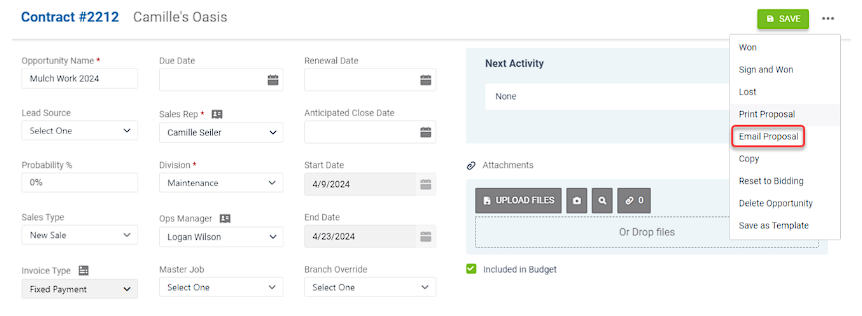
With Aspire, however, you can significantly reduce the time spent creating proposals.
First, with tools like PropertyIntel, you can accurately measure properties from digital maps without physically visiting the site.
Second, you have access to customizable proposal templates in Aspire that let you send bids to clients quickly. You can add the desired services, items, and corresponding pricing from your preset catalog to the estimate, and the platform handles the rest.
This saves you time and reduces the risk of errors from manual entry.
In addition, you can deliver the proposal to clients via email or directly through Aspire for them to sign.
Invoicing & payment processing
When it comes to invoicing and payments, Aspire’s setup ensures your finances are in order.
The invoicing feature lets you create, send, and track digital invoices with ease. It pulls data from a project estimate for its invoice, ensuring accurate pricing is sent to the client.
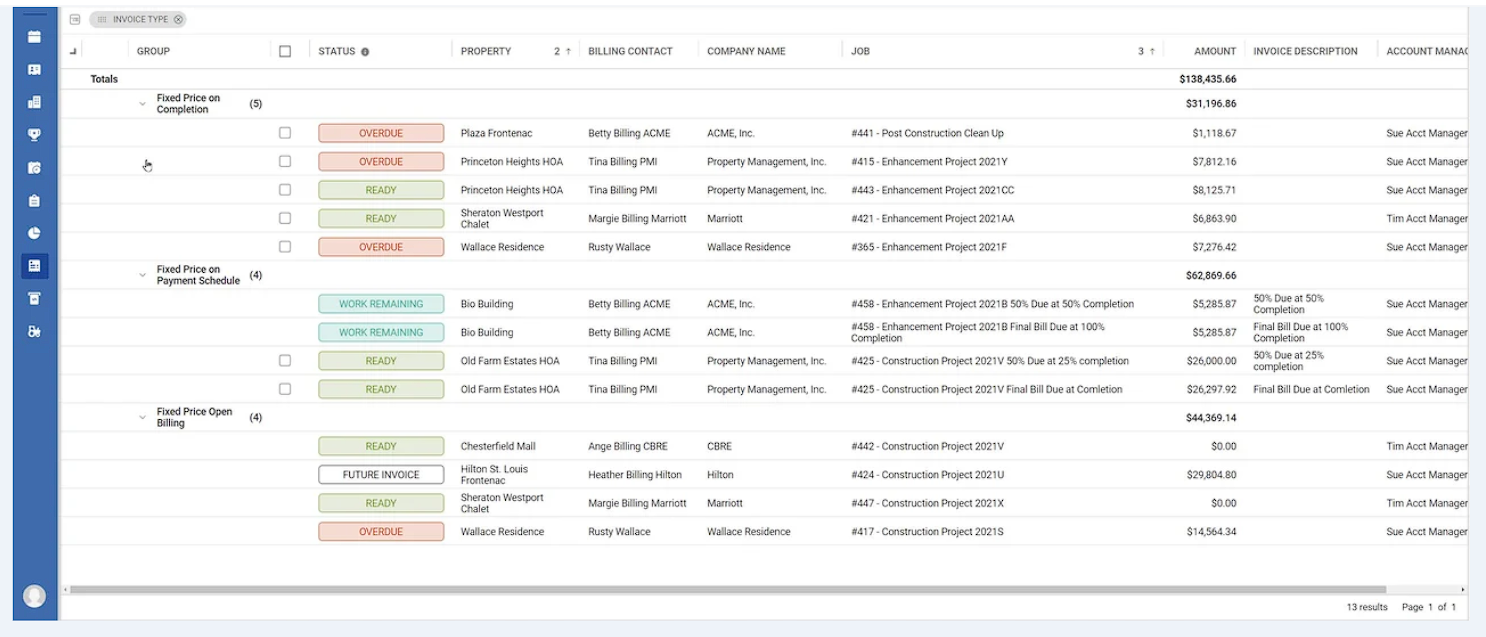
You can also monitor paid, outstanding, and overdue invoices to stay on top of your finances.
Aspire also allows you to receive payments from clients via wire transfer, the client portal, and credit/debit cards using integrated payment processors.
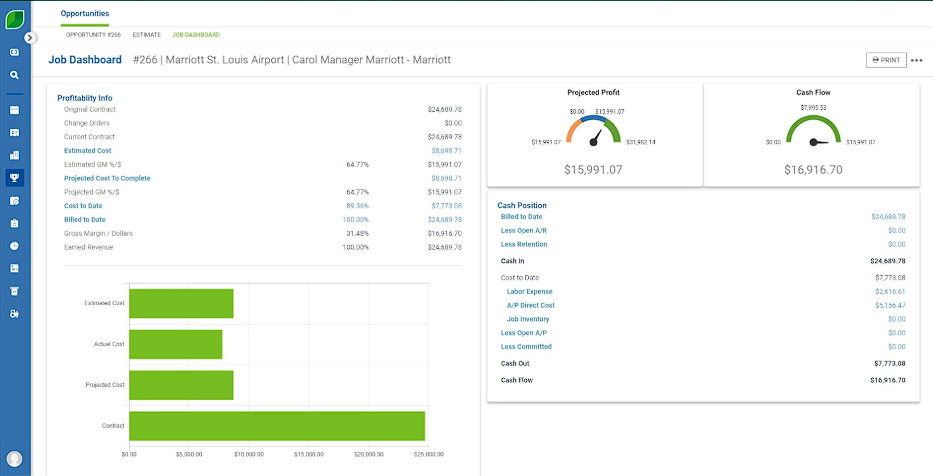
Business reporting & documentation
As a business owner, it’s crucial to have a deep insight into every aspect of your operations. This helps you know whether the business is profitable or losing money, and whether it is getting new clients or maintaining old accounts.
With Aspire’s reporting feature, you have access to such information. More specifically, you uncover data related to:
Client retention rates
Total cash inflow and outflow
Job inventory
Current losses
Crew productivity
Labor and material costs
Tax filings
Work tickets
Retention rate, and more
Scheduling & job management
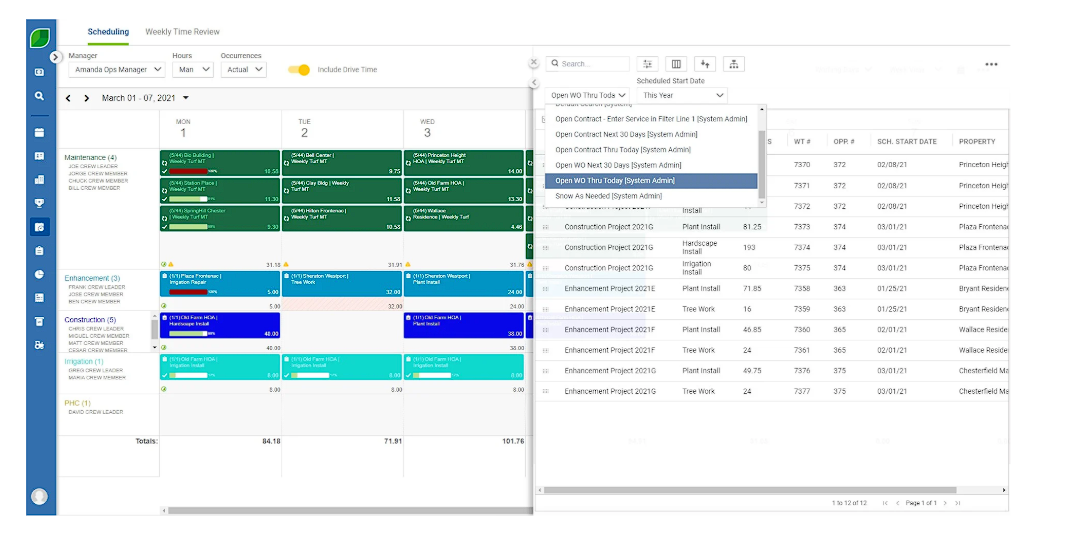
To stay organized, you need a system to schedule projects and assign jobs to your landscaping crew. This system should help you plan, avoid double-booking, and manage your workload.
Aspire’s scheduling feature enables you to do just that. Instead of relying on a calendar and a physical map to optimize your route and schedule, Aspire helps you plan projects based on your crew’s availability and proximity to a site.
Schedule a free demo to see how Aspire helps you be productive, organized, and profitable.
Disclaimer
This article is for informational purposes only and should not be considered legal or financial advice. While every care was taken to use official sources, you should always verify requirements with the Michigan government's websites.












 866-727-7473
 Schedule Demo
 390 S Woods Mill Rd #300 Chesterfield, MO 63017


