Table of Contents
Table of Contents
- Do you need a license to start a landscaping business in Hawaii?
- What are the types of landscaping business licenses & permits in Hawaii?
- Step-by-step process to get a landscaping business license in Hawaii
- How much does a Hawaii landscaping business license cost?
- What are the most common mistakes to avoid when getting a license?
- How Aspire helps landscaping businesses stay organized & compliant
- Over to you
- Disclaimer
Looking to start a landscaping business in Hawaii?
You need to register the business with the Department of Commerce & Consumer Affairs and apply for a landscaping contractor license.
But that’s only the first step to launching a lawn care company in this state.
For the rest, this article exists. It’ll cover the entire process step-by-step:
The different licenses your landscaping business may need in Hawaii and how to apply for them
The typical costs associated with registering a business and applying for the license
Errors to avoid when getting a license
How to streamline your business and scale operations successfully
Do you need a license to start a landscaping business in Hawaii?
Yes, you need a license to start a landscaping company in Hawaii.
Before you can set up shop, you need to register the business and apply for a landscaping contractor license.
Plus, depending on the services you intend to provide, you may need licenses for pesticide application, plant distribution, or designing outdoor spaces.
Listed below are licenses your landscaping business may need to kick things off.
What are the types of landscaping business licenses & permits in Hawaii?
In Hawaii, your licensing requirements go beyond a landscaping contractor’s license — what you need depends on what you do.
For instance, offering irrigation or tree services on top of general landscaping means additional permits to account for.
Here’s a breakdown of the licenses involved.
General business license
Hawaii requires all new businesses to register with the Department of Commerce & Consumer Affairs. Here, you’ll need to choose a business structure and a business or trade name.
After that, you can proceed to apply for the permits the business needs.
Registering gives clients the confidence to engage your landscaping services. It lets you pay taxes, apply for commercial insurance, and request business loans.
Landscaping contractor license
You need this permit to provide and advertise landscaping services in Hawaii.
It’s classified under a contractor license, with unique applications for sole proprietors and business entities such as LLCs, corporations, or partnerships.
To get this license, you’re required to have:
A good reputation for honesty, truthfulness, financial integrity, and fair dealing.
Liability and workers’ compensation insurance.
A licensed individual contractor designated as a Responsible Managing Employee (RME).
You’re also going to need additional license classifications to provide tree trimming, tree removal, irrigation, ornamental fencing, and lawn sprinkler installation services.
Thankfully, you can apply for all relevant classifications in a single contractor application.
Pesticide business licenses
If you want to offer pesticide application services, you need a pesticide applicator license.
And to get this permit, you’ll need to pass a state examination and provide proof of liability coverage.
Landscape architect license
This permit lets you design outdoor spaces and draw detailed plans for patios, walkways, retaining walls, and drainage systems.
You have to provide proof of experience and education, plus pass the Council of Landscape Architectural Registration Boards (CLARB) and the Hawaii State (Plant Materials) examination, before you can be licensed.
Unlike some states, Hawaii doesn’t license by reciprocity, only via endorsement (if you’re licensed in another jurisdiction) or an exam.
Applying by endorsement means you have to verify your license by having the state board where you’re licensed send proof to the Hawaii board.
Permits and local regulations
Certain cities in Hawaii require specific landscaping requirements before you can operate freely in the region.
Because the requirements vary, you need to research the permits needed in the census-designated places (CDPs) to confirm what’s needed.
Some might demand a landscaping license, regulate where you operate, limit operating hours, or ask you to seek approval before executing certain projects.
Step-by-step process to get a landscaping business license in Hawaii
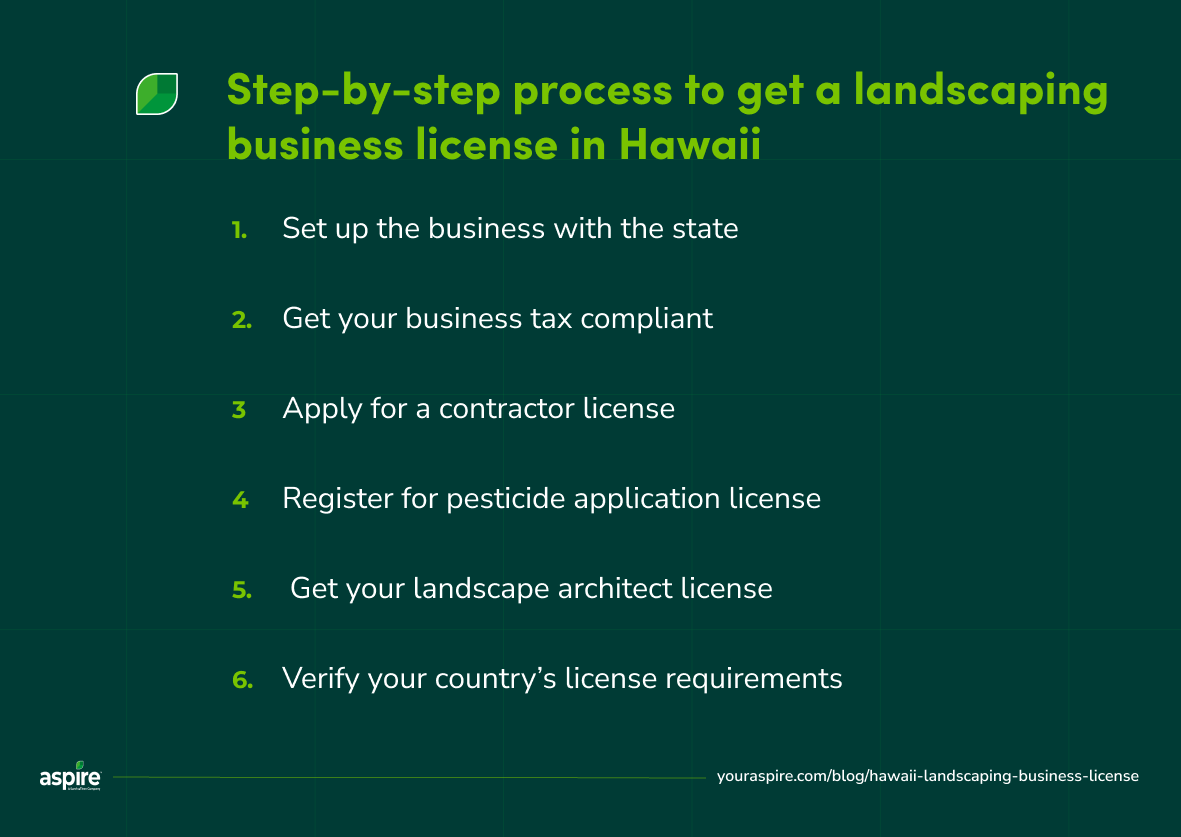
The licenses your landscaping business needs depend on the services you intend to provide. Since you’ve seen what permits you require, here’s how to get them.
1. Set up the business with the state
Before applying for any landscaping license on the tropical island, you need to register the business. Here’s what that looks like.
First, choose a business structure, which means deciding on how you will own and operate the business. This affects personal liability, business management, and your tax filing responsibilities.
Common business structures to consider include:
Sole proprietorship: The business is run by you with minimal setup, but your personal assets are exposed to business debts or legal claims. You’re also responsible for taxes.
Limited liability companies (LLC): A flexible structure that separates your personal assets from business liabilities while allowing profits to pass through to your personal tax return.
General partnerships: You and two or more people share ownership and management responsibilities equally. But each partner carries full personal liability for the business’s debts and obligations.
Corporations: You form a separate legal entity that offers the strongest liability protection for shareholders. Profits are taxed at both the business and individual levels.
Limited liability partnerships (LLP): Similar to general partnerships, but each partner is protected from personal liability for the actions or negligence of the other partners.
If you’re going with a sole proprietorship, register the business online and pay for a trade name (DBA) if you’d prefer to operate under a name other than your own.
For other business structures, you need to form an entity with the Department of Commerce & Consumer Affairs’ Business Registration Division.
You can do that online or by completing paper forms on this website. For the paper option, you simply select an entity and follow the on-screen instructions to complete the process.
Keep in mind that there are fees associated with registering a business:
Trade name: $50
Corporation: $50
General partnership: $15
LLC: $50
LLP: $25, and $25 for an expedited process.
2. Get your business tax compliant
Businesses in Hawaii are required to pay federal, state, and county taxes. Here’s how to prep your landscaping business for that:
Sign up with the IRS to get a Federal Employer Identification Number (FEIN).
Apply for Hawaii’s General Excise Tax License. Register at Hawaii Tax Online, complete the Form BB-1, State of Hawaii Basic Business Application, BB-1 Packet, and pay a one-time $20 registration fee.
Visit your county’s tax billing website to learn more about how to pay for real property taxes.
For more information on taxes, consult an expert and visit the state’s tax website.
3. Apply for a contractor license
Landscapers need one or more of the following license classifications to operate in Hawaii:
C-27—Landscaping contractor: The core license for general landscaping work
C-27a—Hydro mulching contractor: To offer hydro mulching services
C-27b—Tree trimming and removal contractor: For tree services
C-37b—Irrigation and lawn sprinkler systems contractor: To install or service irrigation systems
You can either apply for everything in a single application or apply for one and secure the rest as add-ons later.
If you go for all, you’ll need Responsible Managing Employees (RMEs) who are qualified and examined for every classification.
To apply for a contractor license as an entity, you’ll need:
Financial statement prepared by a licensed CPA
Credit reports for each officer, partner, manager, or member
Hawaii State Tax Clearance
Entity registration with the Business Registration Division
RME appointment letter
Workers’ compensation and liability insurance certificates
If you’re applying as a sole proprietor, you need to provide proof of experience (4 years of supervisory experience within the past 10 years). And instead of an RME taking the exams, you will take the tests.
Now, how do you apply?
Submit your application (as an entity or sole proprietor), a $50 non-refundable fee, and all supporting documents to the Board’s Honolulu office by the first Tuesday of the month.
The Board reviews complete applications the following month and notifies you of approval, disapproval, or deferral.
If approved, you (as a sole proprietor) or an RME (for entities) registers with a separate testing agency to take the exam for the contractor classification(s).
Once you or the RME passes, the Board notifies you of the remaining license requirements.
You submit those requirements, and the Board issues the license.
4. Register for a pesticide application license
This permit is obtained by passing pest control examinations. Here’s the process:
Purchase study packets from the University of Hawaii, College of Tropical Agriculture and Human Resilience, Cooperative Extension Service, to prepare for the exam.
Schedule your exam through the Pesticides Education Portal. Contact your district pesticide branch office if you have any questions about scheduling.
Pay the $50 exam fee per examination.
Once you pass the exam, licenses will be mailed to you. The license costs $100, while a duplicate or replacement license costs $50.
After you’re certified, you need to earn recertification credits through Continuing Education Training (CET) classes. These credits can be earned through seminars, online courses, and open-book quizzes. And online course credits only count toward 75% of each category’s credit hour requirement.
Learn more about the pesticide application program here.
5. Get your landscape architect license
There are two ways to secure this license—via endorsement or via exams.
To apply via endorsement, you need to provide proof that you’re licensed in another state.
But for either path, you must:
Have the proper education and/or experience required for the application.
Pass the CLARB exam (L.A.R.E).
Pass the Hawaii State exam (Hawaii Plant Materials).
Possess a verification of supervision form completed by your licensed landscape architect supervisor.
Pay a non-refundable application fee of $150 for endorsement or $100 for the exam. A separate $80 exam fee will also be paid to take the State Exam.
If your application is approved, a fresh license fee will be required by the board.
6. Verify your county’s license requirements
Once you’ve secured the state permits your landscaping business needs, confirm what you might require to get at the city or county level where your business will operate.
For instance, Kauai and Maui may demand grading permits for projects involving the excavation or fill of soil or similar material, including the grubbing of vegetation.
Ensure you visit the city’s website or clerk’s office to confirm what your landscaping business needs.
How much does a Hawaii landscaping business license cost?
The cost of securing a license varies based on your preferred business structure and the landscaping services you intend to offer.
Here’s what to expect:
Business registration fees
Trade name (DBA): $50
LLC: $50
Corporation: $50
General partnership: $15
LLP: $25
Expedited processing (optional): $25
General excise tax license
One-time registration fee: $20
Contractor license (for landscaping and related classifications)
Application fees: $50
Pesticide applicator license
Exam fee: $50 per exam
License fee: $100
Duplicate/replacement license: $50
Landscape architect license
Endorsement path: $150
Exam route: $100
State exam fee: $80
License fee: Available upon application approval
What are the most common mistakes to avoid when getting a license?
There are rules that landscaping business owners applying for any license or registering a business in Hawaii must follow or risk delay, fines, or setbacks.
Here are common mistakes to avoid:
1. Failing to provide the right financial information
When applying for a contractor license, you need to submit a current (not more than a year old) compiled, reviewed, or audited financial statement along with an independent accountant’s report.
The accountant must be a licensed or certified public accountant holding a current permit to practice.
Failure to provide this documentation will delay the licensing process and the landscaping business’s launch day.
2. Skimping on your employer responsibilities
If you plan to hire employees, you need to provide workers’ compensation insurance coverage and pay unemployment insurance taxes to the Hawaii Department of Labor and Industrial Relations.
The proof of insurance must be sent along with confirmation that the board will be notified if the policy is ever withdrawn or canceled.
Assuming you’re exempt can leave your business exposed and put the license at risk.
Only single-member LLCs and qualifying corporations with no employees and majority RME ownership can file an exemption form instead of coverage.
Joint ventures have no exemption option and must submit certificates regardless.
3. Sending a payment that doesn’t clear
Your licenses may sometimes be sent before the fee payment clears, giving the impression that you’re good to go.
But if the payment is rejected by your bank for any reason, the license becomes invalid, and you can’t legally operate under it. Plus, you’ll be required to pay a $25 returned payment fee on top of the regular amount.
As such, always confirm that the payment from your bank has cleared to ensure the license doesn’t become invalid.
How Aspire helps landscaping businesses stay organized & compliant
Building a landscaping business from the ground up requires a lot of work.
After crossing the licensing hurdles, you need to advertise your landscaping services, estimate projects, send proposals, create invoices, manage clients and employees, oversee projects, and grow the business.
When you have to do all that manually, it becomes difficult to keep a solid operation because you’ll be burnt out and perhaps make lots of costly mistakes.
To avoid such situations, you need a management tool like Aspire to stay organized and manage daily operations, so you can consistently provide quality service and have the right foundation to scale.
Here’s a peek into how Aspire helps you.
Contract & proposal management
Aspire makes it easy for you to create estimates for any project and convert them into a proposal using customizable templates.
Translation?
You can preset labor, material, and overhead costs, so estimates for future jobs are simplified and consistent.
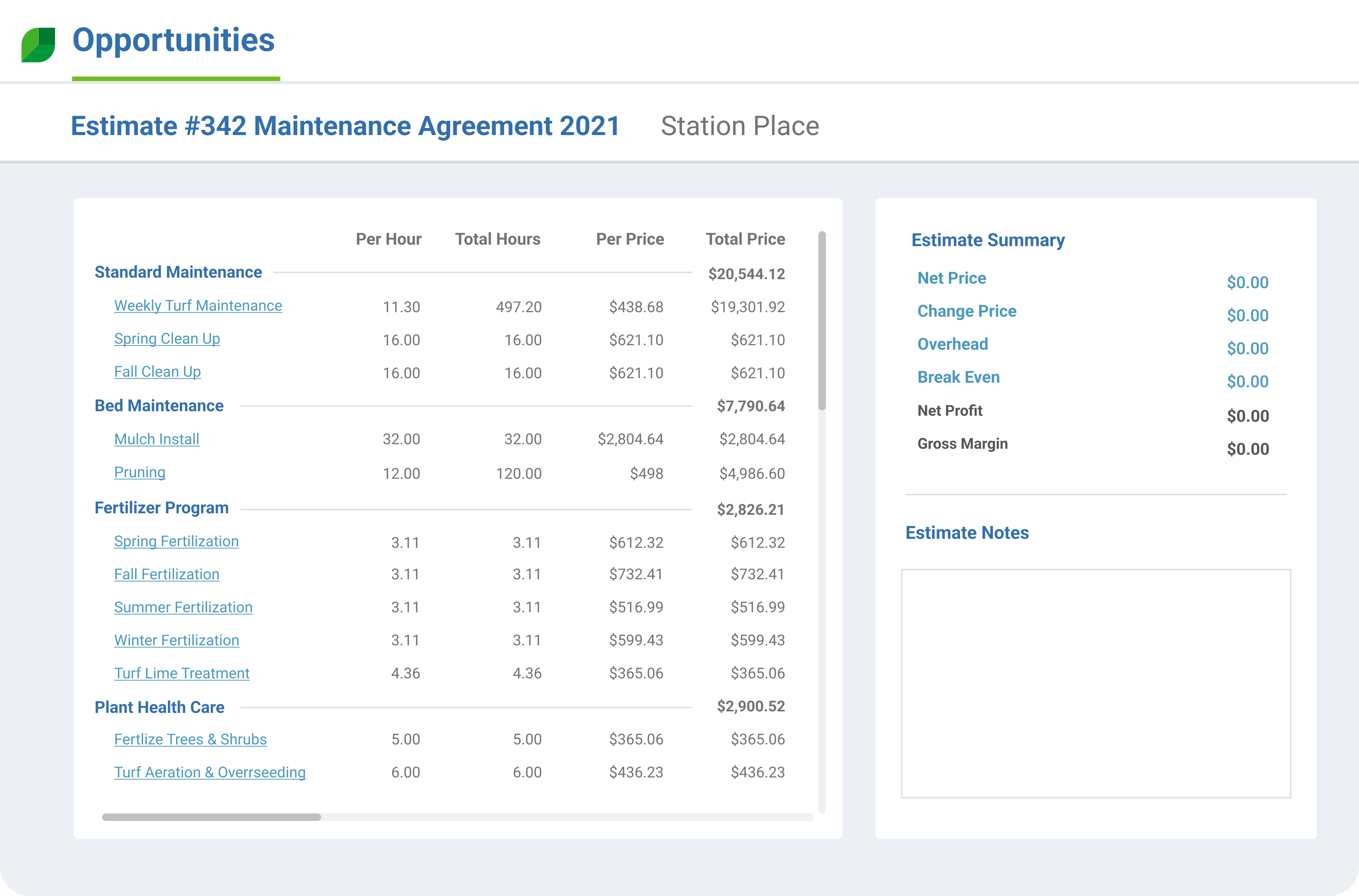
You can define margins and markups for labor, materials, and overhead to ensure profitability before sending the proposal to clients.
Using this estimating feature lets you estimate multiple jobs and send multiple proposals simultaneously. It saves time and keeps contracts in a centralized location for easy access.
Aspire also lets you send the proposal via email or a customer portal for the client’s approval.
Invoicing & payment processing
Invoicing is an administrative task that Aspire lets you automate. Since the information typically needed to create invoices is available in Aspire, creating one takes just a few clicks.
Instead of sitting down to build new invoices from scratch, you generate a new one by selecting the client and typing in the date and invoice number.
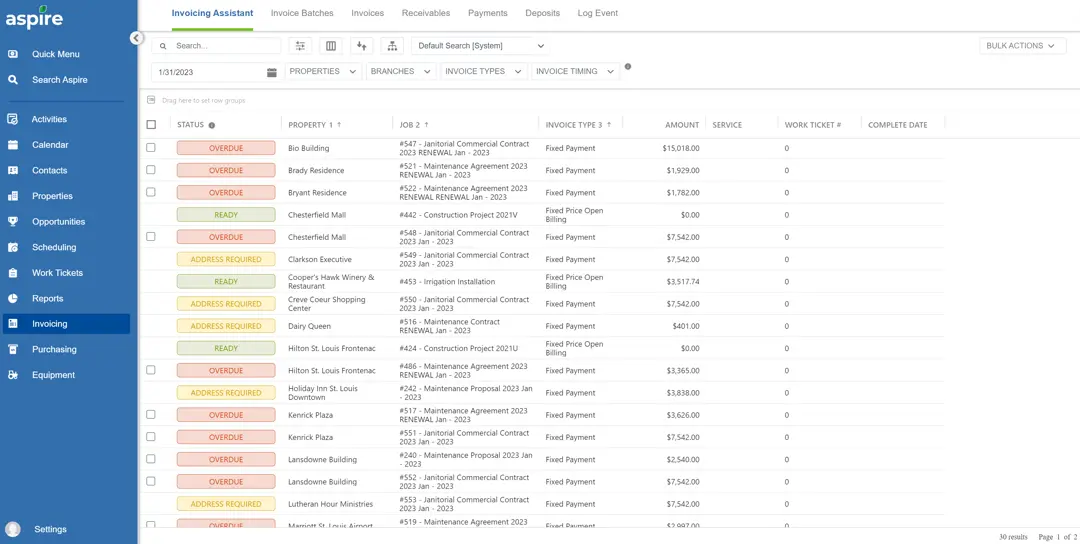
With Aspire’s invoicing, you can also:
Track each invoice’s status to see if it’s been paid, still pending, or long overdue.
Receive payments from credit cards, debit cards, or even checks on Aspire.
Organize and record transactions to keep detailed financial documentation.
Business reporting & documentation
Stay in the loop with all that goes on in your landscaping business with Aspire’s reporting feature.
Discover which services have been profitable, track profit-and-loss ratio and worker productivity, and assess business performance to make proactive decisions.
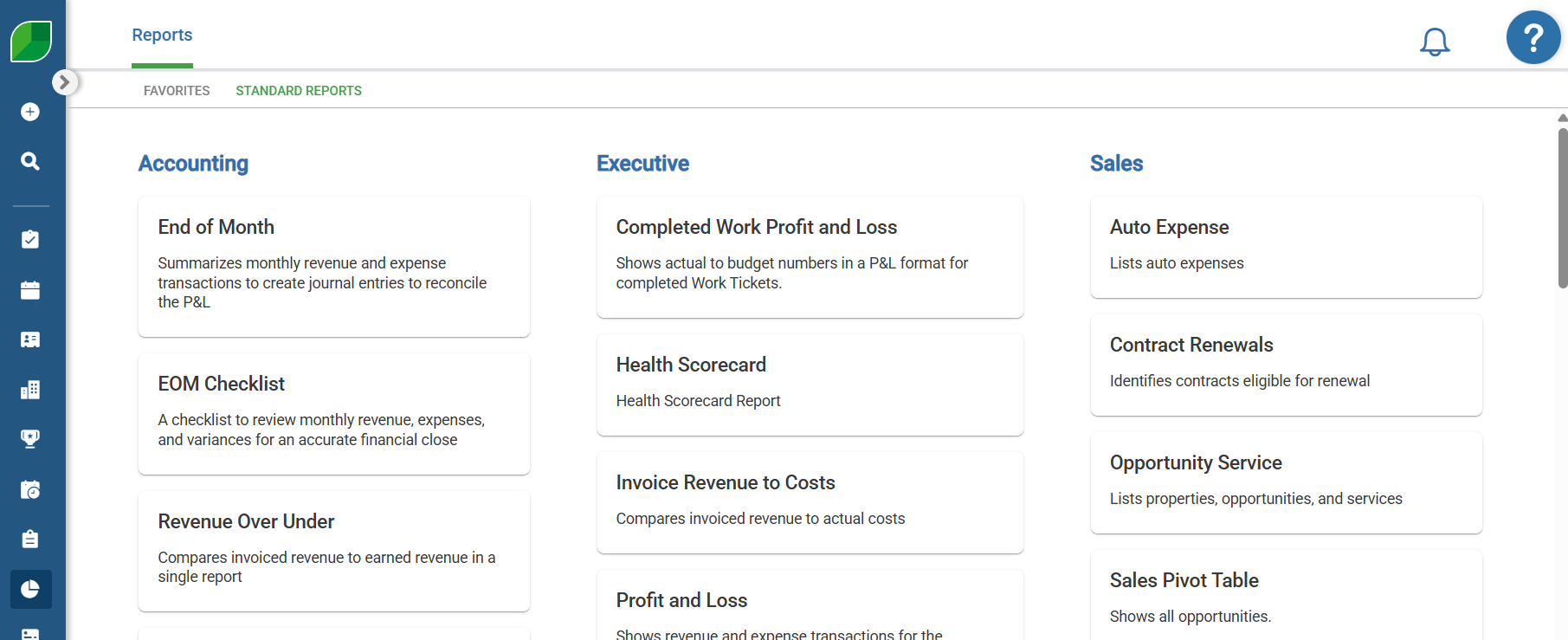
Aspire’s reporting tool provides both overviews and detailed insights, allowing you to do a deeper analysis of your business operations.
It’s like a business partner that can help you understand how to improve the company with actionable insights from across different departments.
Scheduling & job management
Aspire helps you plan jobs and assign roles to reduce chaos and ensure you have a smooth workflow. It makes it easy to manage multiple projects and take on new jobs.
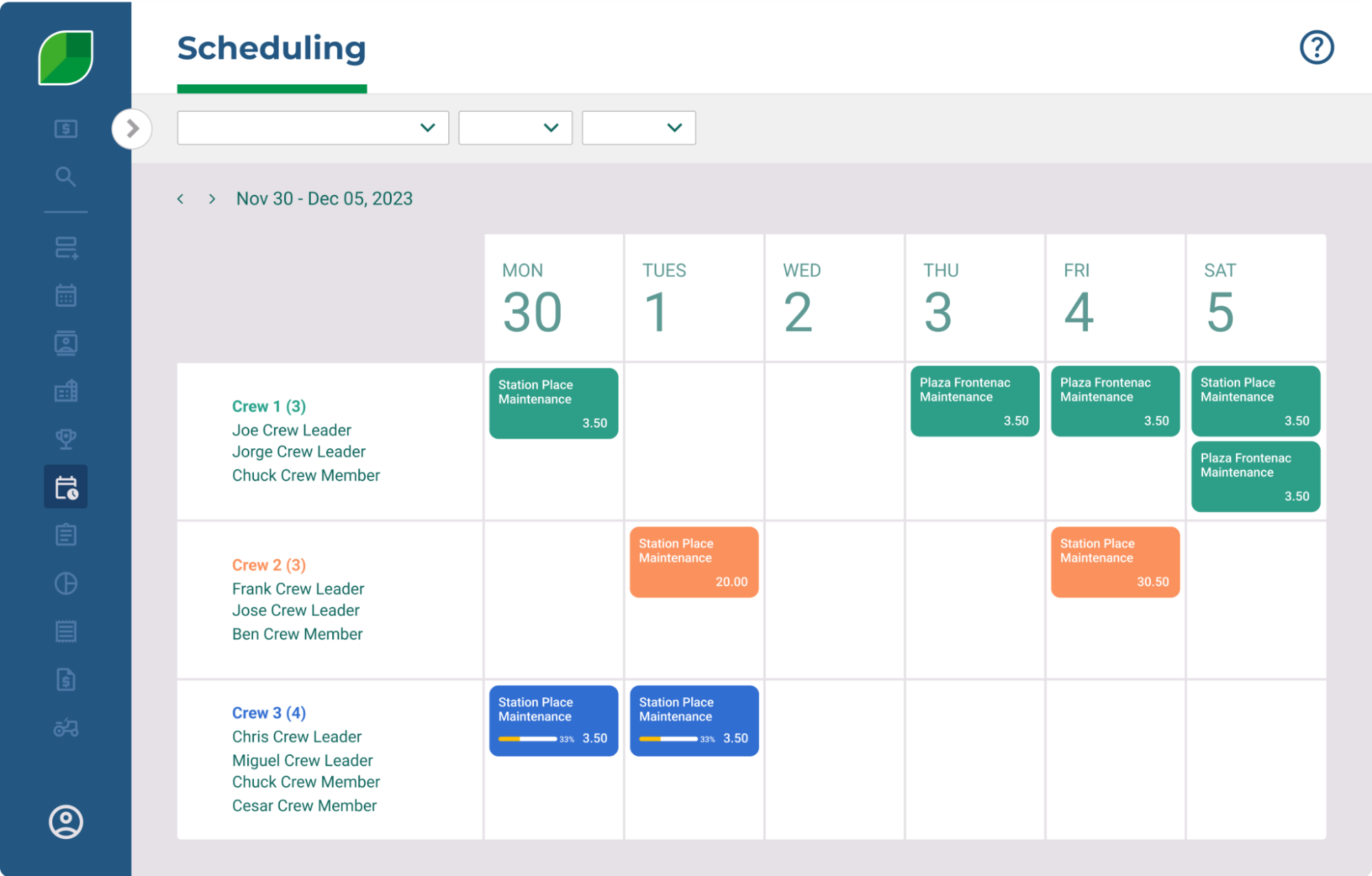
You can view all projects on a calendar, making it easy to plan schedules and assign responsibilities.
The result of using this feature is that:
Clients know when their project can be completed
Resources and manpower are used judiciously
You have zero scheduling conflicts
All your projects follow a pattern, ensuring consistent quality
Over to you
You’ve seen the permits — contractor license, pesticide application permit, landscape architect license, and local county permits — your landscaping business needs to launch.
This guide has also explained how to register the business and apply for the licenses required.
So now you’re ready to start. Well, almost.
In addition to these, you need an effective system, like Aspire, to manage operations and keep you in control of the landscaping business.
Aspire ensures you’re always organized and have the right foundation to scale your landscaping company.
Book a free demo to see how Aspire helps your business.
Disclaimer
This article is for informational purposes only and should not be considered legal or financial advice. While every care was taken to use official sources, you should always verify requirements with the Hawaii government’s websites.









 866-727-7473
 Schedule Demo
 390 S Woods Mill Rd #300 Chesterfield, MO 63017


