Table of Contents
Table of Contents
- Do you need a license to start a landscaping business in Delaware?
- What are the types of landscaping business licenses & permits in Delaware?
- Step-by-step process to get a landscaping business license in Delaware
- How much does a Delaware landscaping business license cost?
- What are the most common mistakes to avoid when getting a license?
- How Aspire helps landscaping businesses stay organized & compliant
- Over to you
- Disclaimer
Delaware has long been a top choice for business formation, thanks to its legal protections, tax advantages, and corporate privacy laws.
Combine that with your passion for the green industry, and it’s easy to see why you’re setting up a landscaping shop here. It’s literally a great place to plant roots.
But what does it take to launch a landscaping business in Delaware?
This article breaks it all down:
Permits and licenses you’ll likely need to begin landscaping operations
A step-by-step walkthrough of where and how to apply
Registration and licensing costs to expect and budget for
Pitfalls to avoid during the licensing process
How to keep your business running smoothly from the start
Do you need a license to start a landscaping business in Delaware?
Yes, you need a business license to launch a landscaping operation in this state. However, there’s no specific statewide landscaping license needed for general landscaping, installation, maintenance, or irrigation projects.
If you intend to offer pesticide application services, design landscapes, and distribute plant materials, nursery stock, or horticultural products, there are additional permits you’ll need.
Besides, you must register with the Delaware Division of Unemployment Insurance, the Delaware Division of Corporations, and the Delaware Office of Workers’ Compensation.
Outlined below is a list of the different permits or registrations businesses need in this state.
What are the types of landscaping business licenses & permits in Delaware?
In the First State, landscaping permits are more administrative than professional in nature. Here’s a list of what you typically need to get started:
General business license
If you’re going to run a landscaping business in the State of Delaware, the first thing that’s required is a business license from the Division of Revenue.
This covers landscaping services you’ll be providing in the state. Basically, you’re creating an entity that Delaware recognizes, allowing you to hire workers, have property, and generate sales.
You also need to form the business as an entity, registering it as a limited liability company (LLC), corporation, or partnership with the state.
Workers’ compensation and unemployment insurance
If you’re going to hire employees for the landscaping business, you need to register with Unemployment Insurance to guarantee that workers can claim unemployment benefits if they’re laid off or let go.
And Workers’ Compensation keeps your employees covered if they’re injured on the job, protecting your business from bearing the full financial burden of a workplace injury claim.
Pesticide business license
You need this permit from the Department of Agriculture to apply pesticides — restricted or general use — on other people’s property in Delaware.
To apply for it, you have to be a commercial applicator in one or more categories of pest control and have at least one certified applicator with a minimum of two years of practical experience under the supervision of a certified applicator.
Nursery license permits and local regulations
If you’re going to distribute plants, plant products, plant material, nursery stock, or horticultural products as part of your landscaping service, a nursery license from the Department of Agriculture is required.
Landscape architect permits
For services such as the design of outdoor spaces and drawing plans for patios, walkways, retaining walls, or drainage systems, a permit from the Board of Landscape Architects is needed.
You may be required to provide proof that you meet the Board’s standards for education, exam, and experience if you’re licensed in another state.
If not, you may need to pass an exam before applying for the permit.
Permits and local regulations
Cities in Delaware typically have specific requirements for permitting a local business to operate within their borders.
You may need to visit the city’s website to find out what’s required for your landscaping business. The permits can range from contractor licenses to zoning laws, irrigation licenses, and noise permits.
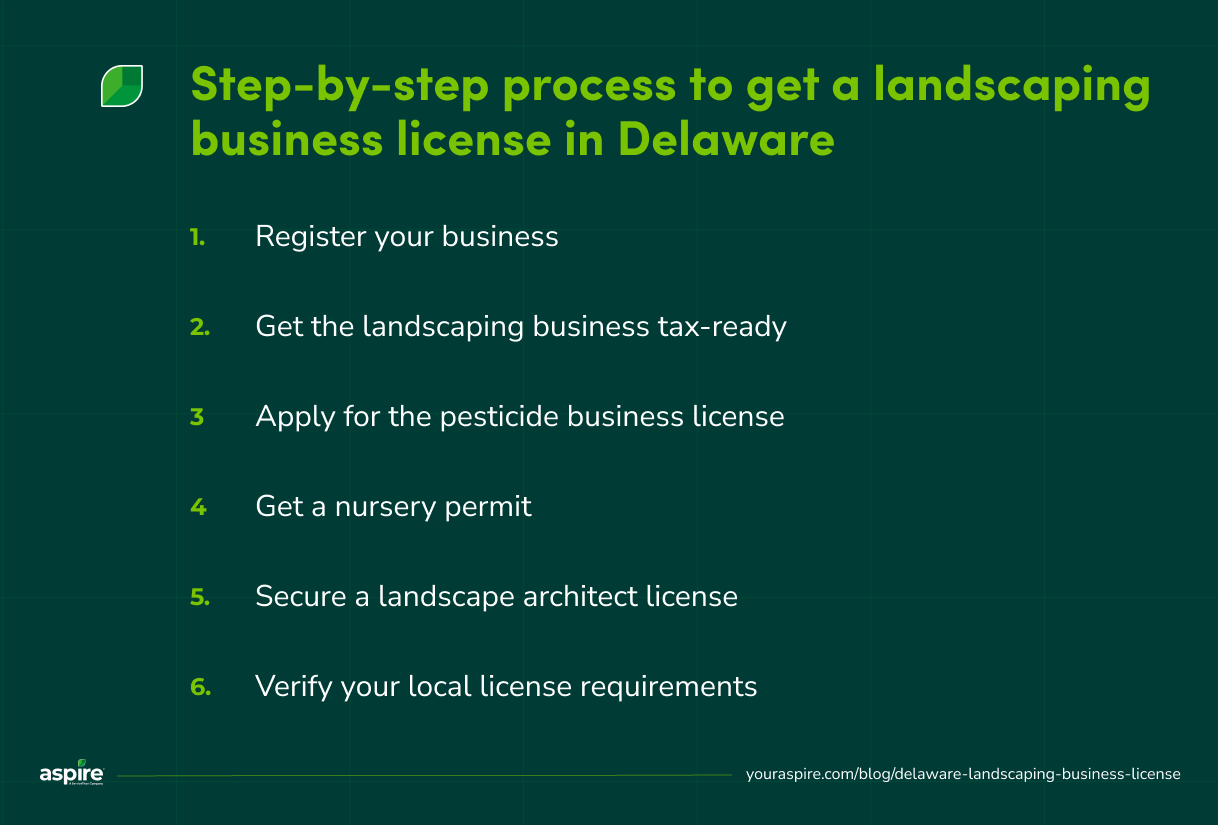
Step-by-step process to get a landscaping business license in Delaware
To get licensed to operate in Delaware, you need to register with the state and apply for additional licenses for pesticide application, plant sales, or landscape design.
Here’s how to get started:
1. Register your business
This first step begins by deciding on an ideal legal structure for your landscaping business, which shapes how your business is owned, how profits are taxed, and how much your personal assets are protected.
Sole proprietorship: You own and run the business alone. Simple to set up, but your personal assets are on the line if anything goes wrong.
LLC: A flexible structure that protects your personal assets from business debts while keeping taxes straightforward.
Limited partnership: Two or more partners run the business, with at least one taking on full liability and the other(s) acting as investors with their personal assets protected up to the amount they’ve invested.
Corporation: Best if you plan to grow big. It offers the strongest liability protection but comes with more paperwork and double taxation — on personal and business profits.
If you decide to run a sole proprietorship, you can proceed to register and get the business license. Create an account on Delaware’s One Stop platform, follow the instructions to get started, and pay a $75 fee.
For other structures, you need to create the entity with the Division of Corporations online or through PDF paper forms.
Visit the OneStop platform to form the entity.
And for the paper application, visit this forms page. To complete the process, you’ll need to have a registered agent and pay the necessary filing fees (LLC: $110, Partnership and Limited Partnership: $200, Corporation: $109).
Once the entity is formed, sign up for a business license on the OneStop platform. While you’re there, register as a withholding agent with the Division of Workers’ Compensation and Delaware Division of Unemployment Insurance.
2. Get the landscaping business tax-ready
In Delaware, corporations must file an annual report with the Division of Corporations and pay franchise tax (typically between $175 and $200,000) annually. Missing it attracts a fee with monthly interest.
If you run an LLC, LP, or GP, you don’t need to file a report. However, you must pay a flat $300 tax by June 1.
You also need to sign up with the IRS to obtain a Federal Employer Identification Number (FEIN). It’s your tax ID for filing returns, paying taxes, and reporting payroll.
The FEIN separates your personal and business finances, determines how your business is taxed based on its structure, and is required the moment you bring on employees.
Overall, it lays the groundwork for staying compliant and keeping your finances organized from day one.
3. Apply for the pesticide business license
The Department of Agriculture requires you to become a certified commercial applicator before applying for a pesticide business license.
You also need to have at least one certified applicator with a minimum of two years of practical experience under the supervision of a certified applicator.
To become a commercial applicator, you need to:
Pass a core and a category exam. Sign up for the exam by accessing the Pesticide Management Online Services.
Fill out and send an application to the Department of Agriculture.
Pay a $30 fee.
For the pesticide business license:
Complete an online application, or
Fill out a paper application
Provide either a surety bond or a liability insurance policy
Submit the $50 fee
4. Get a nursery permit
You can apply for a nursery license to sell and distribute plant stock or related materials in the state by signing up on the License Application Website.
There, you can create your account, follow the on-screen instructions, and receive your license.
Keep in mind, though, that the cost associated with this permit isn’t available on the website.
5. Secure a landscape architect license
There are two ways to obtain a landscape architect license:
By examination, if you’ve passed or intend to take the Council of Landscape Architectural Registration Boards (CLARB) uniform national examination.
By reciprocity, if you’re licensed to practice landscape architecture in another jurisdiction within the U.S.
To apply either way, you need to have a DELPROS user account. So, visit the page and select Go on the Apply/Manage a License and Service Requests title. Follow the on-screen instructions to complete the application and pay the $368 license fee.
When applying by exam, you’ll need to provide:
Proof that you successfully passed the CLARB exam or a related test from an accredited body.
Official transcript(s) sent directly from a school or college of landscape architecture.
A Supervisory Reference form documenting your landscape architecture experience from each licensed landscape architecture supervisor.
Application by reciprocity demands State/Jurisdiction Licensure Verification sent directly to the Board office from each state or jurisdiction in which you currently hold or have ever held a license.
6. Verify your local license requirements
When you’ve secured the permits needed at the state level, visit your city or county’s website or office building to check additional licenses the landscaping business requires to operate.
Cities like Delaware City, Newark, and Middletown typically require a contractor permit. Since requirements vary, confirm what your city will need before launch.
How much does a Delaware landscaping business license cost?
Here’s what it would typically cost to get the permits needed to run your landscaping business in Delaware:
General business registration
Business license fee: $75
Filing fees:
LLC: $110
Partnership and Limited Partnership: $200
Corporations: $109
Pesticide business license
Commercial applicators:
License fee: $30
Exam fee: $30
Business license application fee: $50
Landscape architect license
Application fee: $368
You also need to pay monthly premiums for insurance policies and plan for other additional licensing fees from your city.
What are the most common mistakes to avoid when getting a license?
Delaware provides extensive resources for new business owners. But with so many moving parts to the licensing process, it’s easy to miss a step or even misread a requirement.
Here are common mistakes to avoid along the way:
1. Failing to renew a license or file an annual report
The Division of Corporations requires all domestic corporations to file an annual report before March 1st. Failure to do so results in a $200 penalty.
In the same vein, the Department of Agriculture demands that pesticide business licenses be renewed no later than October 1st of each year. Renewals submitted after that will incur a late penalty fee of 20%.
The best way to avoid forgetting to renew or file is to schedule it in your calendar a month in advance.
2. Forgetting to keep a record of pesticide application
If you’re offering pesticide application service in Delaware, you must keep a record of the following for two years for each application:
Brand name of the pesticide and EPA registration number
Dilution rate and the amount applied per area (e.g., gallons/A)
Date and specific area treated
The pest to be controlled
The applicator’s full name
Weather conditions when drift precautions are listed on the label
This can save your business from liability claims in the future.
3. Reserving your business name without cause
Name reservation is an optional step in Delaware that costs $75 and holds your business name for 120 days. It’s only worth it if there’s a significant gap between choosing your name and officially registering your entity.
If you plan to register within a few days, skip it — it’s an unnecessary cost.
How Aspire helps landscaping businesses stay organized & compliant
Securing the right permits for your landscaping business helps you get the ball rolling in Delaware. You can take on clients and bid on projects without fear.
But if you want the company to thrive and scale with ease, you need a simplified system like Aspire to streamline operations and keep you in control.
Here’s how Aspire helps you:
Contract & proposal management
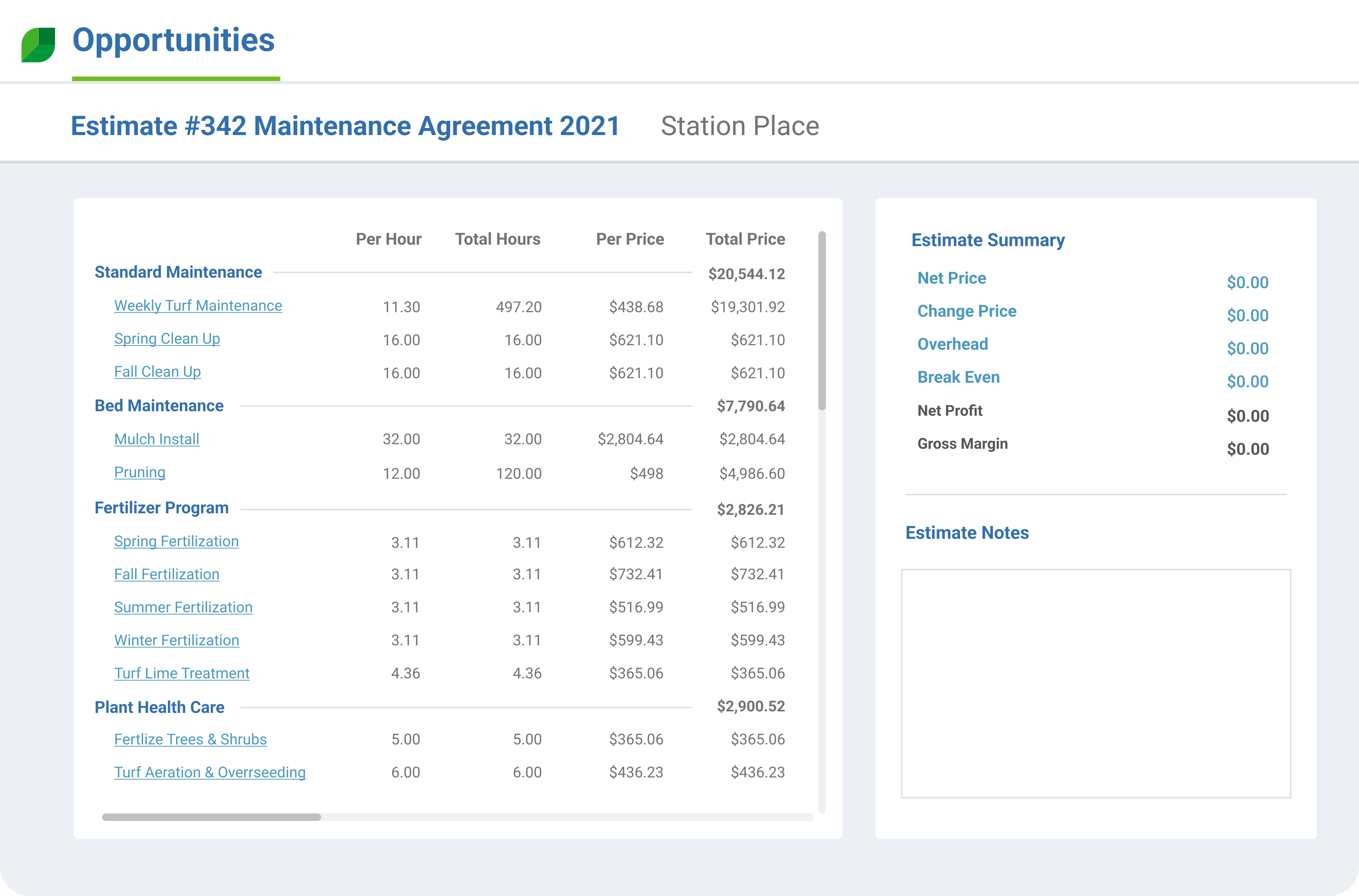
Aspire makes estimating and proposal creation easy for landscapers. It leverages previous projects and industry knowledge to create a catalog of services and pricing.
There, you can preset labor, material, and overhead costs, making it easy to create project estimates.
When you need to measure a property’s size to estimate the required materials, you can leverage Aspire’s PropertyIntel — a software tool for virtual measurements and takeoffs that lets you measure properties from digital maps.
That data is readily available within the Aspire platform, enabling you to calculate the project’s materials, labor, and overhead.
After estimation, Aspire lets you create and send proposals to clients. There are ready-to-use templates where you add a specific landscaping service and include the job’s estimates.
Now you can be sure any proposal shared with clients on Aspire is profitable because it automatically factors in margins and markups for labor, materials, and overhead.
And when you’re done, send the proposal to clients via email or Aspire’s dedicated customer portal.
Invoicing & payment processing
Sending invoices and receiving payment is a breeze for Aspire users because they leverage its invoicing feature to convert estimates into invoices.
All the information you need to create an invoice already exists within Aspire. Think hours spent, labor per hour, overhead, and material costs.
So, your job is to simply generate a new invoice entry, slot in the date and invoice number, select the client, and send.
If it’s a long-term customer, you can automate the invoice to be a fixed payment, fixed on completion or scheduled, open billing, or one-time payments.
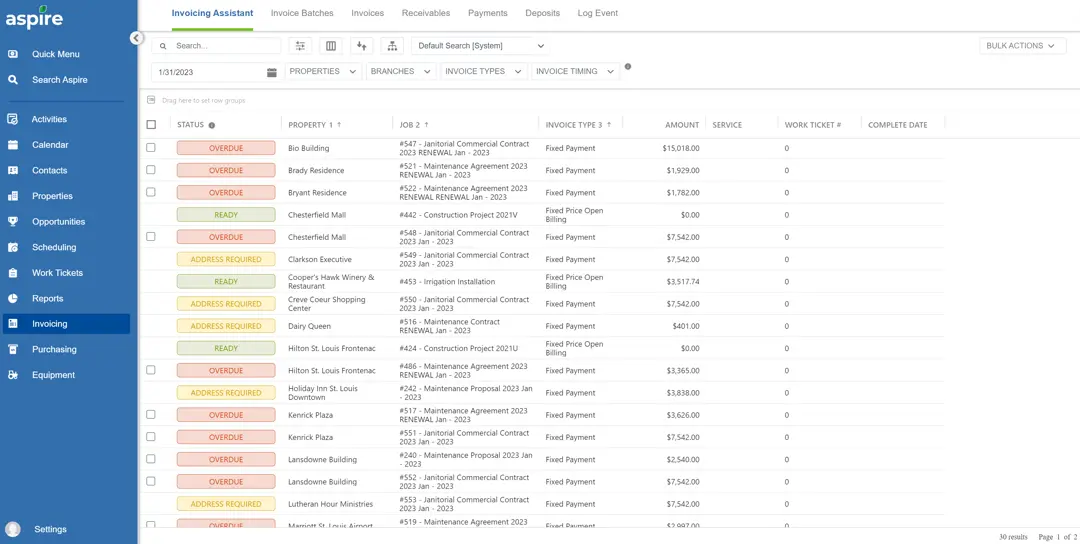
You can also:
Monitor an invoice’s status, from when it’s paid to pending and overdue.
Receive payments from credit cards, debit cards, or even checks.
Keep detailed financial records and log invoices into accounting software like QuickBooks.
Business reporting & documentation
A crucial part of running a business is understanding everything that happens on a day-to-day and monthly basis.
The more visibility you have into daily and monthly operations, the better positioned you are to grow. Aspire’s reporting tool gives you the clearance to pull insights on everything from active contracts and employee productivity to seasonal revenue and profit margins.
Instead of depending on reports from your account manager or field supervisor, you can track contract volume, client activity, and sales performance to forecast revenue and identify growth opportunities.
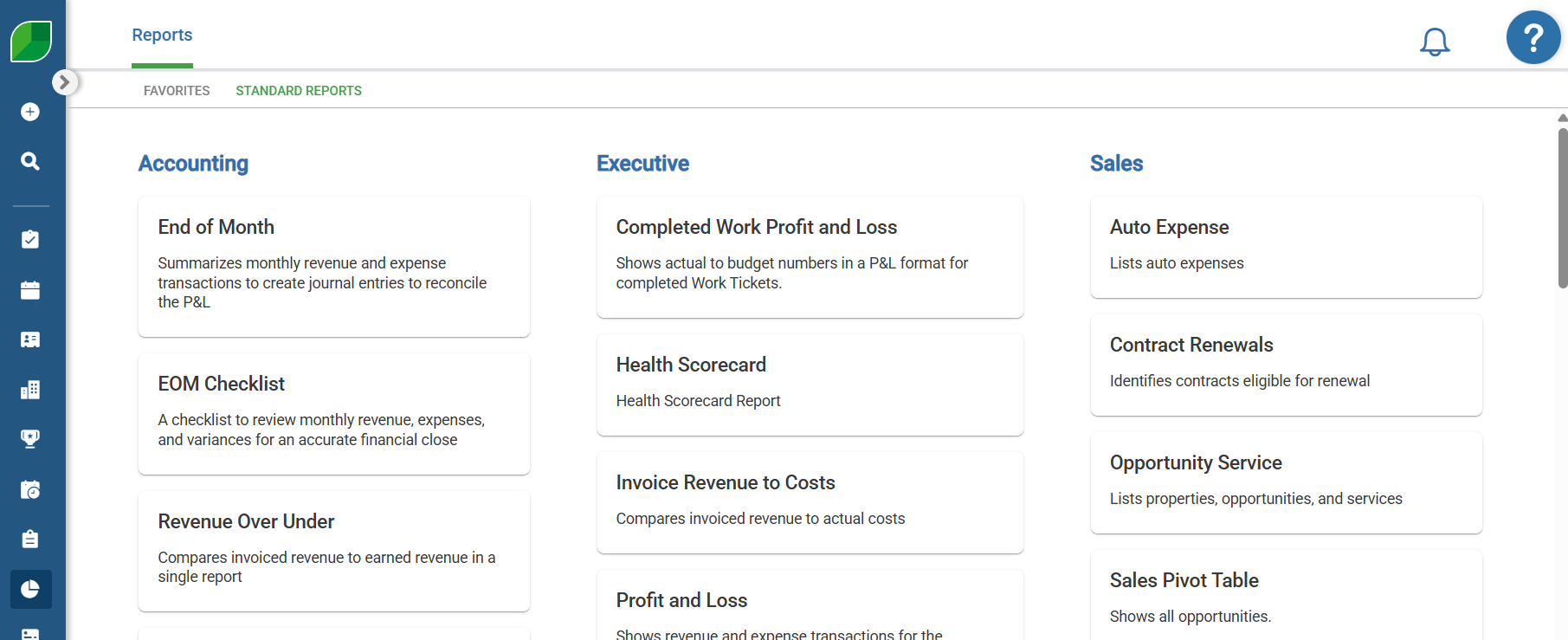
Here, you can get an overview or granular information on every aspect of your landscaping operation.
How do you have access to such data?
Because Aspire is a centralized tool handling different aspects of your landscaping business — estimation, field management, customer management, invoicing, scheduling, equipment management, and job costing.
This collaborative system ensures you can keep an eye on things and generate specific reports when you need them.
Scheduling & job management
Landscaping projects can be tedious, and without a proper scheduling structure, you might take longer on a job, double-book, or miss out on new opportunities.
Aspire’s scheduling tool keeps you organized and on track, ensuring you have a system for booking jobs correctly.
It replaces a physical calendar with a digital one where you can see existing project dates. This way, you know when or how to schedule landscaping jobs when they’re won based on the crew’s location and availability.
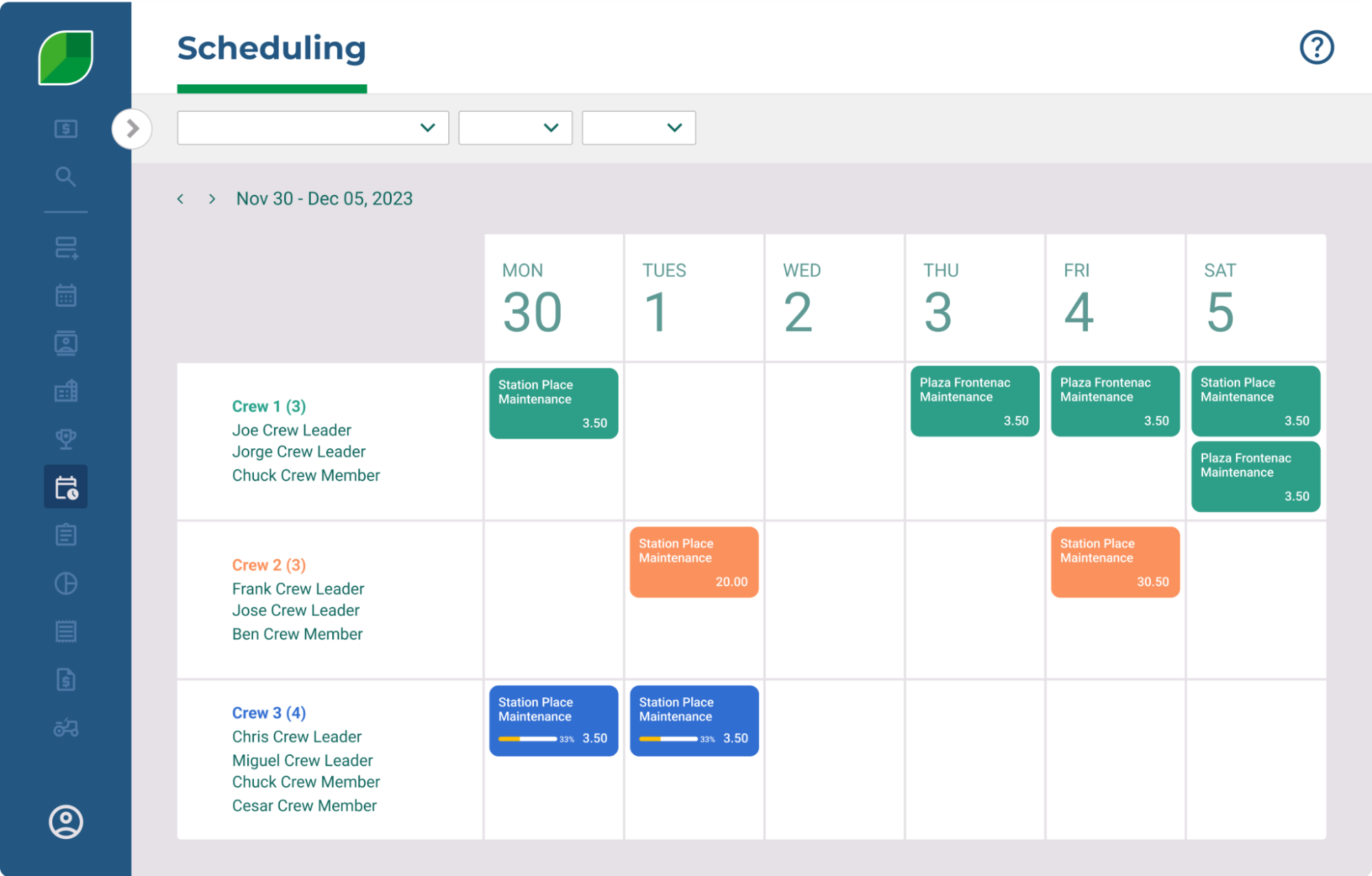
This system ensures smooth workflows, as customers trust your word, landscaping crews are punctual, and potential losses are minimized.
Aspire also lets you modify schedules as needed and create detailed checklists that field crews can follow for uniform quality.
Over to you
In summary, Delaware doesn’t have a specific landscaping license for lawn care services.
Landscaping entrepreneurs looking to launch a business in the state need to register their company and secure additional licenses depending on the services they intend to provide.
As the landscaping business grows, managing operations and growth becomes a bit more tedious because there are several moving parts — clients, opportunities, crews, and projects.
Leveraging field service tools like Aspire becomes essential to streamline operations and keep things organized.
Aspire automates processes, like site measurements, estimation, invoicing, reporting, client communications, and equipment management, and identifies growth opportunities to scale the business.
Want to see how it does this?
Schedule a free demo with Aspire today.
Disclaimer
This article is for informational purposes only and should not be considered legal or financial advice. While every care was taken to use official sources, you should always verify requirements with the Delaware government’s websites.









 866-727-7473
 Schedule Demo
 390 S Woods Mill Rd #300 Chesterfield, MO 63017


