Table of Contents
Table of Contents
- What is a hospitality building cleaning checklist template?
- Why is a cleaning checklist important in hospitality?
- What should be included in a hospitality building cleaning checklist?
- What are the daily cleaning tasks for hospitality buildings?
- What are the weekly cleaning tasks in hospitality buildings?
- How do you use a hospitality building cleaning checklist?
- What are common mistakes with cleaning checklist templates?
- How do you train staff to use cleaning checklist templates?
- Going beyond templates: Streamline your hospitality cleaning operations with Aspire
Keeping a clean and sparkling environment is one of the things that sets hospitality businesses apart. It gives customers a good first impression of your company, setting the tone for future interactions and referrals.
But even though cleanliness and good hygiene are tied to a hospitality business’s success, maintaining a high-quality standard can be challenging when scaling across multiple locations with different cleaning teams.
Different teams may follow different routines or have different levels of extensiveness.
Multiple locations make it difficult for managers to inspect cleaning work and enforce adherence to standards.
Scaling also means new cleaners with varying cleaning training levels.
To ensure your hospitality building maintains a high cleanliness standard, develop a standard operating procedure or cleaning checklist.
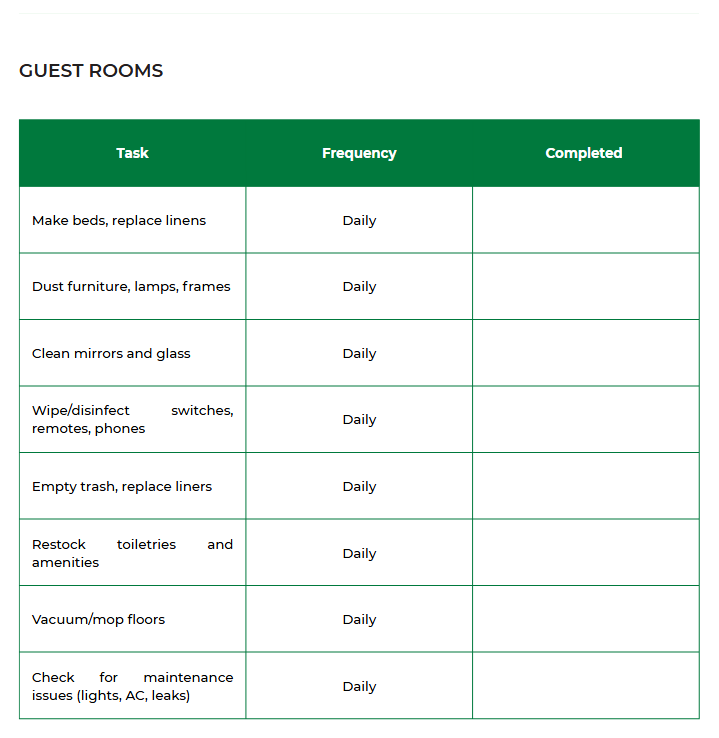
Here’s a hospitality building cleaning checklist template you can use to ensure quality control and consistency in cleaning and hygiene.
What is a hospitality building cleaning checklist template?
A hospitality building cleaning checklist is a structured document outlining various cleaning tasks, the order in which they should be executed, and areas to be cleaned in a hospitality building.
Consider it a step-by-step cheat sheet that cleaning managers can follow to ensure thoroughness and consistency in housekeeping routines.
Following the steps listed in the checklist means you get the same great results every time: clean spaces, happy guests, and no complaints.
Now, a checklist template should include key components, such as:
Sections or areas to be cleaned, e.g., public areas, bathrooms, guest rooms, kitchen, or lobby.
Specific cleaning tasks, e.g., disinfecting, dusting, mopping, or vacuuming.
The workers who are responsible for each task.
Frequency of each task, e.g., daily, weekly, etc.
It can be used by:
Cleaning supervisors to monitor standards and train new members.
External cleaning services providers to meet contract requirements and client expectations.
Housekeeping staff to ensure they follow cleaning routines and maintain quality standards.
Why is a cleaning checklist important in hospitality?
A cleaning checklist can help your hospitality business:
Achieve consistent cleaning and hygienic quality: This ensures you maintain the same sparkling environment at all times, across multiple locations or with different cleaning teams.
Hold teams to high standards: It’s easy to monitor the quality of the cleaning team’s work with a checklist. You can tell whether they follow instructions and take ownership of their output.
Enforce thoroughness: A cleaning checklist is a guide that helps janitorial crews do a thorough job and maintain consistent cleanliness. It ensures that no steps are skipped and that every detail is covered.
Enhanced guest satisfaction: A sparkling, clean hospitality building gives guests a positive and satisfying experience.
Ensures time management: Checklists take guesswork out of the equation by providing clear direction on how to approach cleaning tasks, when to do them, and how to execute them.
This means your janitorial crew can work more efficiently, stay on schedule, and finish tasks without doubling back since they know what to do.
What should be included in a hospitality building cleaning checklist?
Your checklist should cover the specific areas the crew needs to clean, the cleaning methods, the schedule, and any additional considerations.
The specific areas in either hotels, restaurants, cruise lines, theme parks, or casinos could include:
Guest rooms: A well-kept room signals comfort, attention to detail, and care to clients, giving them a good impression of the brand.
Lobbies: Areas where guests and clients gather must always be kept clean—sitting areas, game spaces, and waiting areas. It shows the hospitality business’s commitment to good service.
Restrooms: Clean restrooms signal how much you respect guests and clients. This includes toilets, showers, bathtubs, sinks, floors, trash, and stocking areas.
Coffee/tea station: Spots like this are constantly in use so they need to be kept spotless—from the floor area to spoons, saucers, coffee maker, and mugs.
Minibar/fridge: It’s essential to clean them inside and out, check expiration dates, and replenish stock when necessary.
Windows/drapery: Clean windows and drapes speak to attention to detail. Ensure you dust the rods, drapery, sills, and track.
The checklist should include cleaning methods such as:
Thorough vacuuming and mopping for high-traffic areas.
Surface cleaning to remove spills or stains from countertops, tables, or electronics.
Disinfecting high-touch surfaces, e.g., doorknobs, light switches, telephones, or remote controls, to prevent the spread of germs.
Odor removal to ensure proper ventilation across all spaces.
Trash removal from receptacles across the facility.
Next, include a cleaning schedule in the checklist. For instance, how often and when should the crew clean the guest room or lobby?
What are the daily cleaning tasks for hospitality buildings?
Different cleaning tasks must be performed daily to achieve the high cleaning standard your hospitality business needs. Some of these tasks include:
Deep cleaning and disinfecting toilets, urinals, washrooms, and sinks.
Dusting and disinfecting high-touch surfaces, such as doorknobs, switches, elevator buttons, reception counters, handrails, and remote controls.
Vacuuming and mopping floors in meeting rooms, staircases, hallways, breakrooms, restrooms, and lobby areas.
Dusting and wiping down desks (workspaces), chairs, countertops, tables, and light fixtures.
Emptying trash cans and replacing liners.
Restocking handwash, air freshener, and toilet paper.
Changing towels and replacing bathing soaps, shampoo, and toothpaste.
Cleaning table linen, kitchen staff uniform, and napkins.
Dusting shelves and cupboards.
Washing dishes and utensils, and cleaning appliances.
What are the weekly cleaning tasks in hospitality buildings?
In addition to daily cleaning, your janitorial crew needs to perform specific cleaning tasks weekly to prevent the accumulation of dirt and dust. This could involve:
Deep cleaning carpets or doormats in the reception area, conference rooms, hallways, and rarely used areas.
Cleaning upholstered furniture.
Thoroughly cleaning glass or polished surfaces, such as windows (external and internal), shower enclosures, or decorative glass.
Washing and replacing trash cans.
AC-vent cleaning to prevent dust accumulation.
Fridge and mini bar maintenance.
Cleaning tissue holders to maintain hygiene.
Dusting the walls where necessary in the kitchen, lobby, or hallway.
How do you use a hospitality building cleaning checklist?
Once a checklist is created, it becomes a guide for supervisors and cleaning staff. Both professionals use it to see what needs to be cleaned, and how, when, and by whom.
Cleaning crew can use the checklist to:
View the tasks assigned to them.
Perform the job in a specified order, e.g., strip bed, sweep and mop floor, clean bathroom, and make the bed.
Mark off each task on the list as they finish it.
Call the supervisor for review.
Conversely, supervisors use the same checklist to visually inspect the work and hold the crew accountable. It helps them confirm if the cleaner skipped a step or meets the company’s cleaning standards, ensuring everyone is on the same page.
What are common mistakes with cleaning checklist templates?
A hospitality building cleaning checklist can help keep teams on track and maintain high-quality cleanliness standards. But it only works if you avoid these common mistakes:
Neglecting to clean high-touch areas, which leads to hygiene gaps. It’s essential to include this in the checklist to ensure the crew always takes it seriously.
Forgetting to update or modify the checklist to suit the building’s needs. The checklist may not be as practical if you use one version for all the properties under your care. While they might be similar, each facility is unique. It’s essential you treat them as such if you want the crew to follow the steps in the checklist effectively.
Speeding through the checklist. This means rushed work, missed areas, and subpar cleaning jobs. Always advise your cleaning workers to review every item on the checklist before contacting their supervisor.
Cleaning in the wrong order, e.g., cleaning the floor before dusting. This not only spreads germs but also results in rework and reduced efficiency. Ensure the tasks outlined in the checklist follow the proper order before sharing it with the cleaners.
Skipping staff training. Equip your cleaners with the right training to use the checklist or execute tasks your company's way to ensure consistent cleaning quality.
How do you train staff to use cleaning checklist templates?
Here are some ideas to help train the cleaning crew to use the checklist:
Incorporate it during onboarding: Let new hires know from day one that the cleaning checklist is part of your standard operating procedure. Then, walk them through it step-by-step so it becomes second nature. This way, it’s easy for them to get used to it.
Provide hands-on demonstrations: Don’t just tell the crew about the checklist, show them how to follow it during a real cleaning task so the staff can see how it fits in their workflow.
Partner new hires with existing staff: Seeing how older colleagues use the checklist can motivate new employees to adopt it into their routine.
Regularly review the checklist use with your staff: Ask for their feedback to improve the checklist.
Going beyond templates: Streamline your hospitality cleaning operations with Aspire
When most people think of checklists, they picture a printed sheet with boxes to tick. While that can work, it quickly becomes burdensome.
You can imagine how stressful it would be for cleaners to move around, juggling papers and pens while trying to meet turnaround times. It’s inefficient, error-prone, and easy to lose track of.
Aspire’s cleaning software makes this a breeze. It allows you to digitize the checklists, making it easy for the cleaning crew to track what needs to be done.
Instead of papers and pens, they only need a smartphone with Aspire’s mobile app installed. They can clock in and out of work there, complete task checklists, and log issues on the job site using photo or video documentation. The app is useful offline and online, ensuring data is backed up when the user is back online.
Essentially, Aspire ensures:
Teams have real-time updates, making it easy for managers and workers to track progress.
Consistent cleaning standards across locations with Aspire’s digital checklist.
Errors by team members are minimized.
Effective documentation for accountability.
Detailed inspection of checklists, ensuring every item is done.
In addition, Aspire provides a centralized platform to streamline all your cleaning operations.
Whether assigning tasks, sending estimates, monitoring employee performance, tracking cleaning equipment usage, reporting and resolving issues, analyzing trends, or needing a checklist template like the one provided here, Aspire does it all.
Download the free cleaning hospitality building cleaning checklist, and book a demo to explore how Aspire optimizes and grows cleaning operations.







 866-727-7473
 Schedule Demo
 390 S Woods Mill Rd #300 Chesterfield, MO 63017


