
Table of Contents
Table of Contents
- What are landscaping mergers and acquisitions?
- How does the landscaping M&A process work?
- 1. Strategic planning
- 2. Initial inquiry
- 3. Valuation
- 4. Due diligence
- 5. Negotiation
- 6. Closing
- 7. Integration/Transition
- Why are landscaping companies merging or being acquired?
- What are the benefits of mergers and acquisitions in landscaping?
- What challenges do landscaping M&A deals face?
- How does commercial landscaping M&A differ from residential?
- When is the right time to sell a landscaping company?
- How can owners prepare their landscaping business for sale?
- What should buyers look for in a landscaping acquisition?
- What are common mistakes in landscaping M&A deals?
- How can Aspire support landscaping businesses during mergers and acquisitions?
- Creates financial clarity
- Standardizes processes
- Scales smarter
Landscaping mergers and acquisitions (M&As) are transforming how contractors scale their businesses, with deals ranging from small business acquisitions to multi-million-dollar purchases.
This guide offers a comprehensive intro to M&A deals to help you capitalize on your next acquisition or sale. You’ll learn:
M&A fundamentals, from strategic planning to closing and integration
Common challenges to avoid and ways to mitigate risk
Ways for sellers to maximize valuation
Key factors for buyers to consider when evaluating companies
Whether you’re considering selling your company or exploring acquisition opportunities, keep reading for insights into how to make your next deal a success.
What are landscaping mergers and acquisitions?
Landscaping M&As are when two landscaping companies merge to form a single business entity, or when one company purchases another.
They tend to be more complex than typical ‘plug-and-play’ acquisitions in other sectors. Scaling is more of a challenge, and traditional valuation methods may not accurately capture revenue concentration during the '100 Days of Hell' in the spring and summer.
A cautious approach is essential for success. Business partners who understand the unique dynamics of the landscaping industry will be better positioned to make informed deals.
How does the landscaping M&A process work?
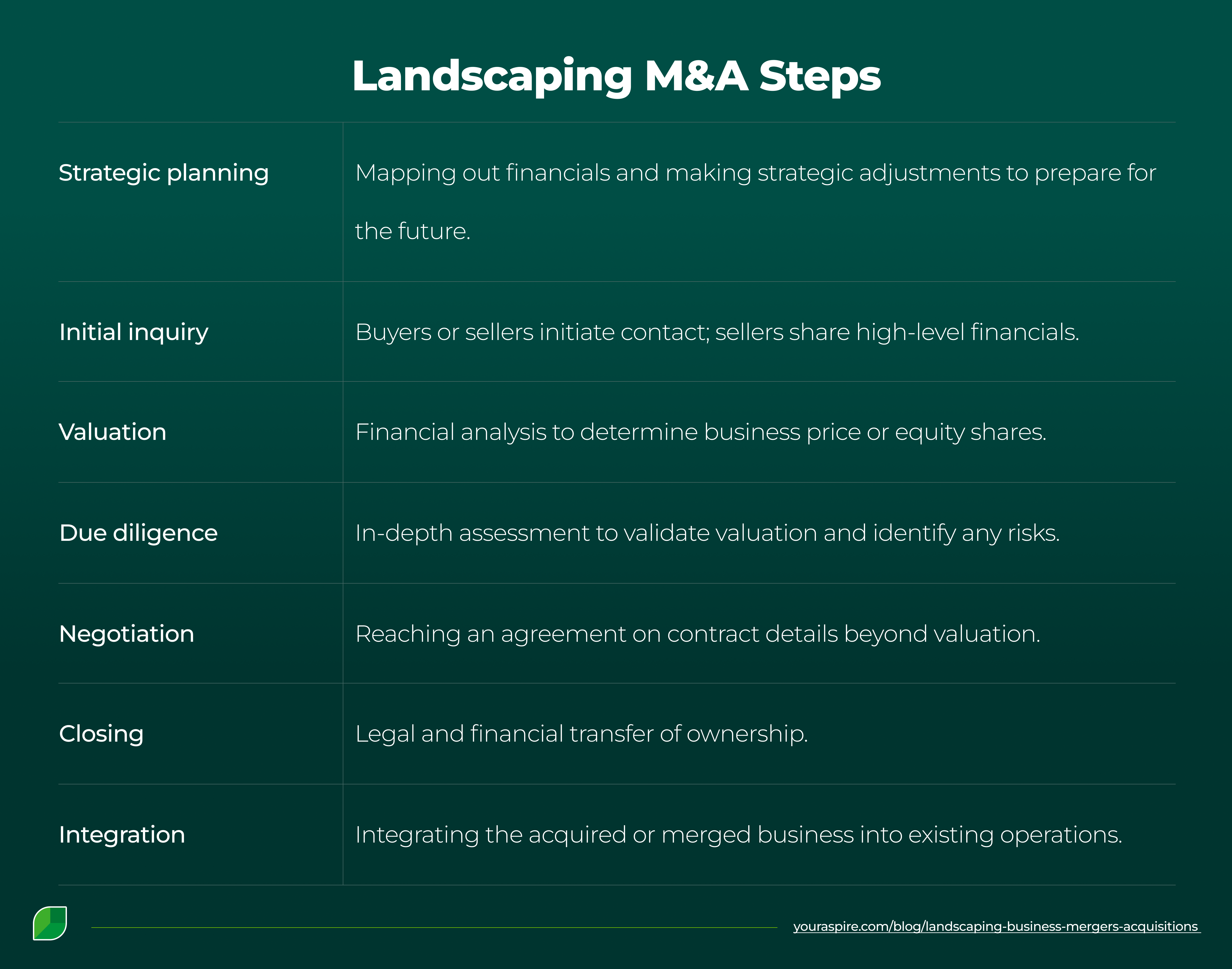
Landscaping M&A deals involve a meticulous process that typically spans six to 18 months, from planning to integration.
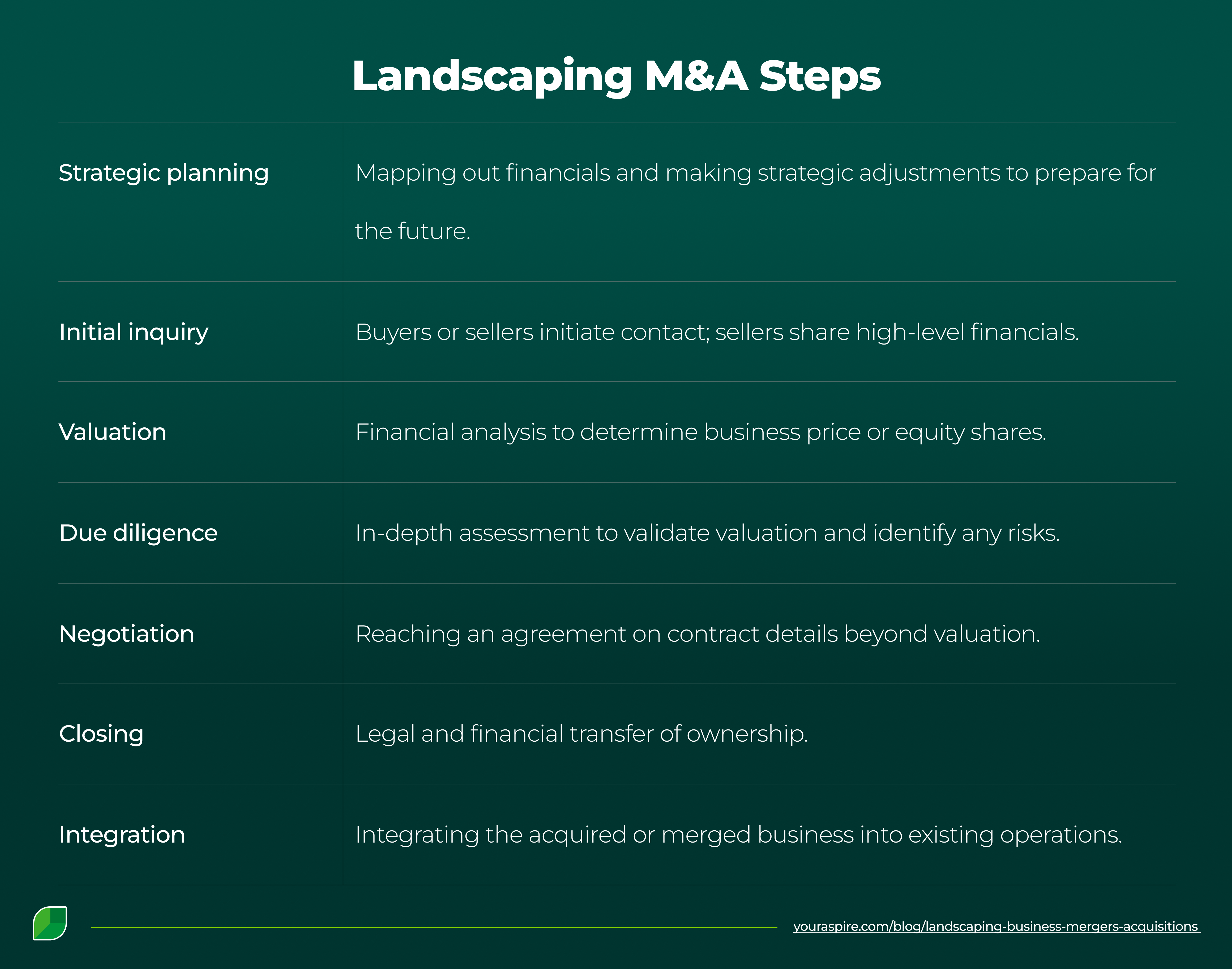
If you’re thinking about buying or selling a landscaping business, understanding this process can help you make better decisions about timing, preparation, and expectations.
1. Strategic planning
Successful M&As in landscaping don’t just happen—they start with strategic planning that often stretches for months before the initial inquiry.
For buyers, this usually means gathering data and planning:
Deciding on the target company size and market
Setting a budget range and target payback period
Assembling accountants, lawyers, and advisors for due diligence
For sellers, this means improving their position to maximize valuation:
Cleaning up financial processes and operational weaknesses
Managing transition plans, including post-sale involvement goals
Improving competitive positioning
This planning phase helps ensure that M&A deals flow more smoothly.
2. Initial inquiry
In this phase, buyers and sellers initiate contact, either through business brokers or direct outreach. Typically, buyers initiate the inquiry; however, sellers may also approach competitors, private equity firms, or strategic partners for M&A deals.
During the initial inquiry, sellers will share high-level financial information, including revenue ranges, general profitability, and basic business metrics. At this stage, both parties may also sign NDAs and engage in preliminary discussions to gauge fit.
3. Valuation
Promising discussions will lead to a comprehensive business valuation, which involves a thorough analysis of finances, assets, and business operations to estimate what the business is worth.
Valuation typically involves assessing earnings before interest, taxes, depreciation, and amortization to determine the selling business’s core earning power. Revenue multiples are also commonly used to determine an appropriate price point, especially given the industry’s variable seasonal cash flow patterns.
In mergers, both companies undergo valuation to determine their equity share and how they’ll split ownership.
4. Due diligence
In the due diligence phase, the buyer’s team of accountants, lawyers, and industry experts conducts an in-depth assessment of the seller’s business to spot any financial, operational, or legal risks.
This not only validates the information in the valuation but also uncovers issues that could affect business performance in the future.
For example, some common discoveries might include:
Equipment that’s in worse condition than represented in the valuation
Customer contracts with high churn risk
Seasonal cash flow issues that weren’t fully disclosed
Regulatory compliance gaps
Findings like these could cause the buyer to adjust their offer or even walk away if there are significant issues. Both buyers and sellers usually have due diligence checklists to ensure that nothing gets overlooked.
5. Negotiation
Negotiation typically begins with a Letter of Intent (LOI)—a non-binding agreement that outlines key deal terms, including price, payment structure, and timeline.
Once both parties have signed the LOI, negotiations begin on the more detailed aspects of the contract. This includes issues such as the seller's expected duration of involvement in the business and the guarantees they can provide regarding the business's condition after the merger or acquisition.
This phase can last anywhere from 30 to 90 days, depending on the complexity of the deal and the progress of the negotiations.
6. Closing
The closing phase involves the formal legal and financial transfer of ownership, as well as immediate practical steps to ensure the business continues to run smoothly. Both parties sign all agreements, complete monetary transactions, and transfer ownership of all business assets, including equipment, customer contracts, and licenses.
In landscaping deals, this also involves notifying customers and employees about the ownership change and beginning the process of integrating operations.
7. Integration/Transition
This phase typically lasts from six to 18 months and determines whether the M&A transaction is a success. Integration involves a number of steps to take after buying a landscaping business, including:
Customer introductions and potential contract renegotiations
Crew, facility, and route integration, including cross-training teams
Systems integration, such as software and vendor consolidation
It’s a significant amount of work, but for many companies it pays off in the long run, giving them the potential to scale in ways that wouldn’t be possible otherwise.
Why are landscaping companies merging or being acquired?
Landscaping M&A deals happen for a variety of reasons, but a key factor is growth. In 2025, growing revenue was a top concern for 79% of landscaping contractors, and landscaping companies offer stable, recurring services that attract private equity firms.
Selective acquisitions are a key strategy for Daniel Currin, owner of Green Leaf Group. In an interview with Lawn & Landscape, he noted that established brands can bring incredible value in scaling his business: “We saw a lot of value in these brands that were already established in their marketplace. They’d been in the industry and had created great companies and great brands.”
Other reasons landscaping companies pursue M&A deals are:
Market consolidation: Larger companies have a competitive advantage when they’re the dominant player in a market—creating an incentive for smaller businesses to consolidate.
Succession planning: Acquisitions often play a crucial role in succession planning for owners nearing retirement, especially if they lack family to pass the business on to.
Access to capital: Smaller companies often struggle with equipment costs, maintaining working capital, and funding expansion without going into debt. Acquisitions offer an influx of new capital to cover costs.
Often, it’s a combination of drivers; for example, a retiring owner might sell to a growing company for both access to capital and as a succession plan.
What are the benefits of mergers and acquisitions in landscaping?
Mergers and acquisitions have a broad range of benefits that go beyond simple growth objectives.
Risk transfer: Sellers are no longer personally liable for business debts or insurance claims, while buyers may have a larger pool of capital to pay off debts.
Earn-out opportunities: Sellers can receive cash payments tied to specific metrics, as outlined in their contract.
Instant market presence: Buyers are operational in new territories right away, rather than spending years building from scratch.
Career advancement: Employees benefit from the potential to grow within a larger organization, where they can assume more specialized and management roles.
Streamlined operations: All parties benefit from more integrated supplier relationships, streamlined processes, and increased route density when acquisitions are concentrated in a single region.
Benefits like these help explain why mergers and acquisitions (M&As) are attractive to all parties, even when the process itself is challenging.
What challenges do landscaping M&A deals face?
One of the main challenges that landscaping M&A deals face is messy financial records.
However, that’s just one of many common hurdles:
Valuation disputes: Business valuation involves subjective judgment calls about future performance and risk, making it a significant source of disputes about market conditions, operational efficiency, and other risk factors that affect valuation.
Operational issues: Data migration between different software, vendor relationship disruptions, and equipment redundancy can all complicate integration.
Cultural integration: Sudden changes in management style, communication, and compensation structures can affect employee retention.
Client retention: Loyal customers may have concerns about service continuity and quality during ownership transitions, leading to client churn.
While these challenges can be tough, experienced buyers and sellers who prepare well can navigate them successfully.
How does commercial landscaping M&A differ from residential?
M&A deals look vastly different depending on whether they target commercial or residential landscaping companies.
This affects everything from valuation multiples to integration strategies, meaning both types of M&A require a distinct approach despite involving the same industry.
The key difference lies in scale and complexity: commercial deals are often larger and more complex, whereas residential M&A transactions are often faster and more straightforward.
Commercial M&A deals also prioritize long-term revenue and professional relationships, while residential deals focus on operational efficiency and local market penetration.
When is the right time to sell a landscaping company?
The best time to sell a landscaping company is when business performance is strong and market conditions are good.
Hot markets tend to create competitive bidding and higher valuations. Larger players are often actively acquiring businesses during periods of intense economic activity or when interest rates are low.
However, individual business performance matters too: selling after two to three years of strong revenue growth is ideal, especially when customer retention and contract renewals are at their highest.
Whether or not to sell your business is a deeply personal decision, and it should depend on your individual retirement or lifestyle goals, as well as the level of involvement you want to continue having in your business.
How can owners prepare their landscaping business for sale?
Once you’ve decided to sell, take concrete steps to value and prepare your landscaping business to attract buyers. This should include:
Assessing business value: Conduct a formal business valuation to understand your company’s market value.
Financial cleanup: Clear outstanding debts, reduce unnecessary expenses, and streamline your financial records.
Organizing documentation: Create a comprehensive file of financial statements, tax returns, customer contracts, and equipment records.
Operational streamlining: Document processes and develop management systems that allow the business to operate efficiently.
Working with advisors: Brokers, accountants, and M&A attorneys can guide you through the process and help you find qualified buyers.
Being fully prepared to sell will help you meet buyers’ acquisition criteria and sell with less hassle.
What should buyers look for in a landscaping acquisition?
For buyers, clear acquisition goals and thorough due diligence are crucial for choosing a profitable business. They should assess:
Client contracts and revenue: Focus on businesses that have recurring contracts and a diverse customer base, rather than being overly reliant on a few large clients.
Financial performance and cash flow: Look for stable finances and cash flow, even during slower winter months.
Crew retention and skill set: Take note of employee turnover rates and skill sets to assess how smoothly their team will integrate with yours.
Equipment condition and capital needs: Inspect trucks, mowers, and machinery to understand any upcoming costs that could impact your valuation.
Reputation: Take a look at online reviews, customer testimonials, and local brand recognition to assess their competitive position and reputation.
Overall, look for well-organized operations with documented processes—these businesses will make the operational transition easier post-acquisition.
What are common mistakes in landscaping M&A deals?
Even well-intentioned M&A deals can fail when buyers and sellers overlook important details. Staying aware of these common pitfalls helps create better outcomes for your business and employees:
Poor integration planning: Many businesses underestimate the complexity of combining routes and crews, resulting in disorganized projects and customer churn.
Overpaying: In the excitement of closing deals, buyers sometimes rush valuations or skip due diligence steps—then discover hidden maintenance costs or operational issues that incur unexpected expenses.
Communication failures: Business transitions can create uncertainty and fear among employees and customers. Customers and employees who feel left in the dark may decide to leave.
Ignoring cultural fit: When formal, process-driven companies acquire family-style operations (or vice versa), the cultural clash can drive away employees and customers who preferred the original approach.
Inadequate financial planning: Underestimating integration costs, seasonal cash flow needs, or equipment replacements can strain finances after closing.
Adequate preparation, thorough due diligence, and an awareness of what to expect after closing can make the difference between successful deals and costly mistakes.
How can Aspire support landscaping businesses during mergers and acquisitions?
Aspire’s end-to-end landscape business software provides the financial flexibility, operational clarity, and scalable systems that make M&A deals run smoothly for both buyers and sellers.
Creates financial clarity
Aspire delivers real-time job costing and comprehensive reporting across every operational touchpoint, giving potential buyers the accurate financial data they need for valuations.
![Product Screenshot | Job Costing [Work Tickets]](https://images.ctfassets.net/3cnw7q4l5405/70yx3qC8yD1iwaXuZK2SZu/f84f06fe73d3575da5e5c62dfdc9f192/Job_Costing_01.Hero__1_.webp)
As Palmer Higgins, partner at Chenmark, notes: “If [a company] is on Aspire, it is glorious as a buyer. It’s rare to see a business on a system as sophisticated. It puts you in a position to frame your business in a way that can be objectively verified by a buyer that might not know [the owner] or the business.”
Standardizes processes
Aspire’s integrated CRM, scheduling, and job costing tools eliminate the chaos of combining disparate systems during acquisitions. Import bulk project data via .xlsx files for seamless integration, while standardized workflows minimize disruptions during ownership transitions.
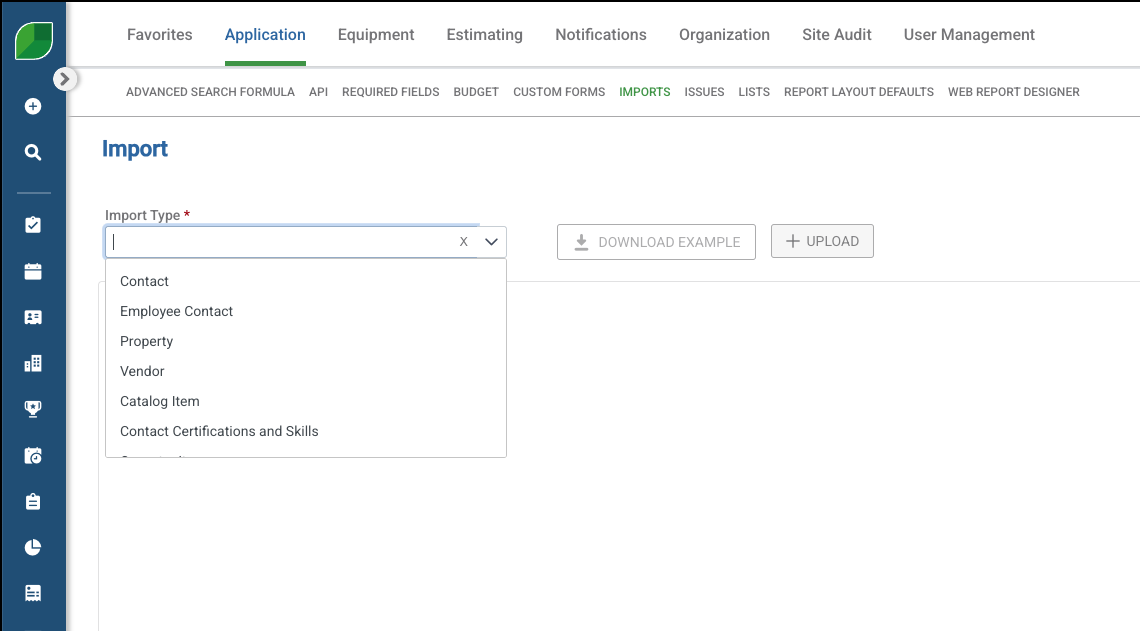
Teams can immediately access unified customer data, route information, and operational procedures to stay on top of work from day one.
Scales smarter
Businesses looking to grow through acquisition need systems that work without owner involvement. Aspire supports that scalability with industry-leading tools trusted by 35% of the top 150 landscaping companies.
![Product Screenshot | Job Dashboard [Marriott]](https://images.ctfassets.net/3cnw7q4l5405/56RYQK4PRMa6cgvbCSc4Vs/06fe96e68bba334f4b4213bea8118fb0/CRM_03.2__1_.webp)
When Fay-Ark Lawn Co. chose Aspire, the visibility gained helped scale the business from $1.2 million in annual revenue in 2022 to $3.2 million in 2023. VP Amanda Rhodes sees the potential for even more growth: “Aspire is our game changer. It’s exactly what [my boss] Eric and I have been waiting and looking for to help take our company to the next level.”
Whether you’re preparing to sell or planning your next acquisition, Aspire can give you the financial and operational clarity you need for successful M&A deals. Book a demo to see how Aspire can help you take your next big step forward.










 866-727-7473
 Schedule Demo
 390 S Woods Mill Rd #300 Chesterfield, MO 63017


