Table of Contents
Table of Contents
- Do you need a license to start a landscaping business in Kansas?
- What are the types of landscaping business licenses & permits in Kansas?
- Step-by-step process to get a landscaping business license in Kansas
- How much does a Kansas landscaping business license cost?
- What are the most common mistakes to avoid when getting a license?
- How Aspire helps landscaping businesses stay organized & compliant
- Over to you
- Disclaimer
Kansas offers a straightforward licensing process, enabling you to launch a landscaping business within a specific timeframe.
The main question is, how do you navigate the licensing process efficiently so that work begins without unnecessary delays?
To operate in Kansas, you need to register your new landscaping business with the Secretary of State and obtain the required licenses, or risk starting the business later than planned or incurring fines.
In this guide, you’ll find a detailed overview of all that’s needed to complete the licensing process and set up shop in Kansas.
Here, you’ll find:
Types of landscaping licenses Kansas requires
How to get a landscaping business license in the city
Cost of registering your business and being licensed
Errors to avoid during the licensing process
Ways to streamline your new landscaping business
Do you need a license to start a landscaping business in Kansas?
In Kansas, landscaping businesses need permits to:
Buy live plants or move them with the intent to plant them for others
Apply pesticides on other people’s properties
Design outdoor landscape spaces
Depending on the service offering, multiple licenses from different agencies are required.
Licensed contractors also need to register the business with the Kansas Secretary of State (KSOS) and the Department of Revenue.
To keep the business running smoothly, you must define your landscaping services early and understand the permits needed before operations begin.
What are the types of landscaping business licenses & permits in Kansas?
Landscaping companies in this state need the following types of licenses:
General business license
Every new business owner in Kansas, landscaping or otherwise, must register with the KSOS to ensure they operate within Kansas’ legal framework and have the right protections.
You also need to register for business tax with the federal and state governments to stay compliant.
Live plant dealer license
This license is required from the Kansas Department of Agriculture to grow, buy/resell, or move live plants with the intent to plant them for compensation.
It’s especially useful if you intend to install plants, shrubs, sod, or turf on clients’ properties.
And there are three types:
Regular: If your landscaping business buys or sells plants worth over $10,000/year in gross receipts.
Reduced fee: If sales are under $10,000/year.
Special event: For non-profits running short-term plant sales.
Pesticide applicator licenses
The state requires landscaping businesses that want to engage in pest control or pesticide and herbicide application activities to hold an applicator license.
There are seven categories of pesticide business licensing, and the typical choice for landscapers in Kansas is the Ornamental, Turf Pest Control, and Interior Landscape category to control pests in the maintenance and production of ornamental trees, shrubs, flowers, and turf.
To qualify, you must hold a business license and either be a licensed commercial applicator or have one on staff in the category you’re applying for.
You’re also required to register any certified technician or unlicensed person applying pesticides for the business.
Landscape architect permit
For services such as site design, grading, and planning outdoor spaces, you need a landscape architect permit.
To get this license, you must hold an accredited degree in landscape architecture, complete the required hours of supervised experience, and pass the CLARB-administered Landscape Architect Registration Examination (LARE).
If you’re already licensed in another state, you’re eligible to apply by reciprocity instead of retaking the exam.
Permits and local regulations
Check with your city/county for what’s needed for the landscaping business to operate.
Licensure requirements typically vary across cities. Some have zoning laws, contractor licenses, noise restrictions, irrigation laws, building permits, or tree removal permits.
Visit the clerk’s office or the city’s website to confirm the regulations required.
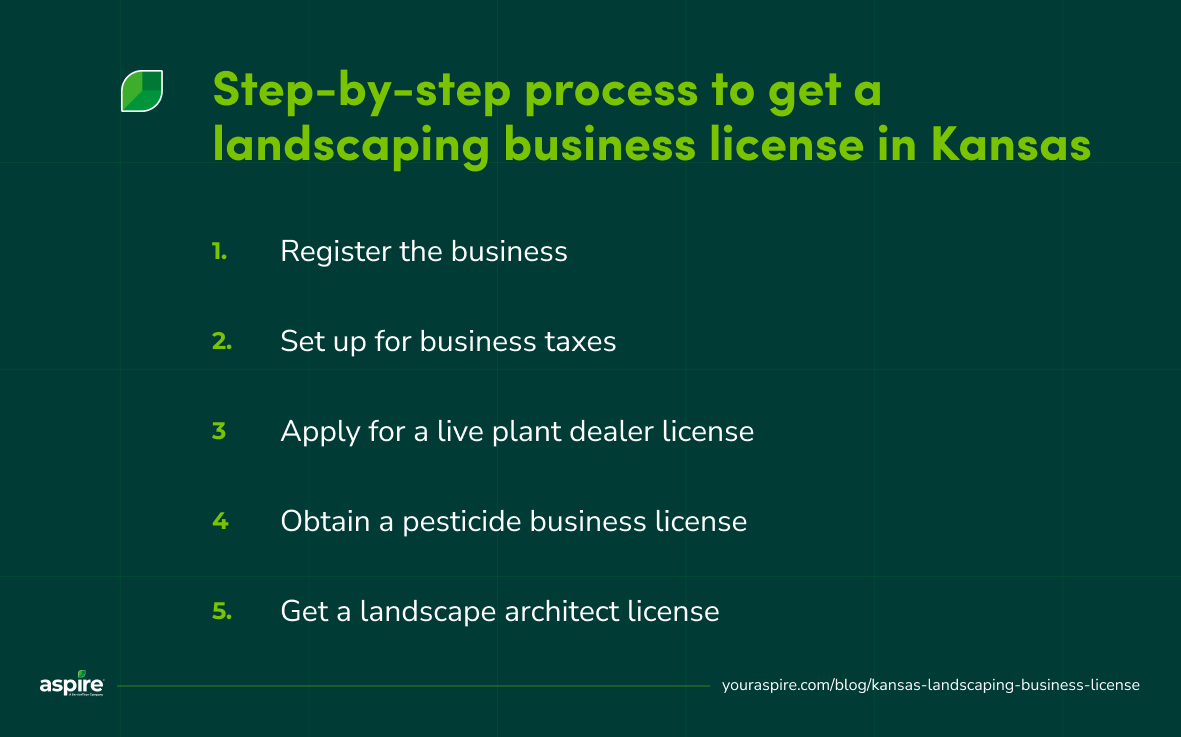
Step-by-step process to get a landscaping business license in Kansas
Below is a walkthrough of each stage of the licensing process, from business formation through to getting permits for services provided.
1. Register the business
To register a landscaping company in Kansas, you need to first decide on a business structure based on your goals or needs. You can choose:
Sole proprietorship: No liability protection (personal assets at risk); income is taxed directly on the owner’s personal tax return.
Limited liability company (LLC): Provides personal liability protection; offers flexible taxation (pass-through by default or corporate tax election).
Corporation: Strong liability protection; taxed separately or as a pass-through.
Limited partnership (LP): General partners have liability, limited partners are protected; typically taxed as a pass-through entity.
Limited liability partnerships (LLP): Offers liability protection to all partners; income is usually passed through to partners for taxation.
Sole proprietorship businesses do not need to register with the KSOS, only with the Kansas Department of Revenue for tax purposes.
Other business types — LLC, LP, LLP, or Corporation — need to register with the KSOS by filing online or on paper. You’ll need a registered agent to receive important documents and stay compliant.
Here’s how to file online:
Select your preferred entity type
Choose the online or paper form option
Complete the application and provide the necessary information (entity name, registered agent details)
Pay the fee (paper filings $90; online filing $85)
2. Set up for business taxes
Businesses need to register for federal and state taxes. To register for federal taxes, you need to get a Federal Employer Identification Number (FEIN) from the IRS.
Visit their website and sign up.
For Kansas State Business Taxes, you need to:
Create an account with the Department of Revenue Customer Service Center. Follow the instructions to register.
Complete a questionnaire on the page that will tell you the business taxes that apply to you.
If you will hire employees, you might be required to register with the Department of Human Resources for unemployment taxes. The Customer Service Center provides an application service for this as well.
3. Apply for a live plant dealer license
Here are the licensing requirements needed for this permit:
Business information: Name, address, FEIN or SSN (for sole proprietors)
List of your business locations and suppliers
Pick a live plant dealer license type, like regular or reduced fee
Once you have all that information, you can register for it online or via paper forms.
Complete the application and pay the required fees.
Regular live plant dealer license: $100/location, excluding temporary locations. An additional $5 fee for the plant pest emergency response fund for each location.
Reduced fee live plant dealer license fee: $30/location plus the $5 plant pest emergency response fee.
There is also an additional 6% fee for all paper applications.
4. Obtain a pesticide business license
You need the following to get a pesticide business license:
A certified commercial applicator for the category you want to apply for. This can be you or one of your employees.
Proof of financial responsibility. Certificate of insurance (not less than $25,000 for bodily injury liability or $5,000 for property damage liability for each occurrence) or a surety bond of at least $6,000 for general liability.
A registered business with the SOS that’s in good standing.
Then, you can apply for the license by completing this application and paying the corresponding fees:
License application: $140 per category
Uncertified Applicator: $15 per uncertified individual employed to apply pesticides
Registered Technician: typically $40
If you want to apply as a commercial applicator, you need to pass the general exam and a category or subcategory exam to become certified. The exams cost $45/test.
You can skip the exams if you’ve been licensed in Indiana, Minnesota, Missouri, Nebraska, Oklahoma, or Texas.
But whether you’re applying by exam or reciprocity, you’ll need to submit an application and pay the required fee before receiving your certification.
5. Get a landscape architect license
You can apply for a landscape architect permit by passing the CLARB exam or through reciprocity (if licensed in another state).
For both options, you need:
CLARB record
Official transcripts from your institution
Record of qualifying experience
Professional references
Then, you can complete this application and submit the appropriate fees: $60 for exam applicants and $250 for reciprocity applicants.
How much does a Kansas landscaping business license cost?
Here’s a breakdown of the cost of getting licensed in Kansas:
General business registration
Filing fees for LLC, LLP, LP, and Corporations:
Paper filing: $90
Online filing: $85
Live plant dealer license
Regular live: $100/location + a $5 fee for the plant pest emergency response fund per site
Reduced fee: $30/location + a $5 plant pest emergency response fee
Pesticide applicator license
Business license application: $140 per category
Uncertified Applicator: $15 per uncertified individual
Registered Technician: $40
Commercial applicator exams: $45 per exam
Commercial applicator by reciprocity: $75 per category
Landscape architect license
Application by exam: $60
Application by reciprocity: $250
What are the most common mistakes to avoid when getting a license?
Getting your landscaping business certified in Kansas can be seamless. To avoid unnecessary delays or fines in this process, steer clear of the following mistakes.
1. Forgetting to register for withholding tax or workers’ compensation
Landscaping contractors hiring workers need to sign up with the tax department to pay withholding taxes and workers’ compensation.
Workers' Compensation becomes a requirement once your gross annual payroll crosses $20,000.
Now, even if coverage is through a third party, it needs to be active and available.
Failing to pay withholding taxes makes you liable for the unpaid amount plus penalties. And without workers’ compensation, you risk paying out of pocket for workplace incidents and facing lawsuits.
The penalties are steep: civil fines of twice the annual premium or $25,000, whichever is greater. Plus, the state can shut your business down.
You can avoid this by making this a top priority right after registering your business with KSOS.
2. Engaging in business with only a commercial applicator license
While you may be required to become a commercial pesticide applicator before getting a business pesticide license, you can’t use the commercial applicator permit to provide work for compensation.
A commercial applicator license allows you to perform pesticide application work only if you’re employed by a licensed pesticide business or obtain your own.
This is the law, and violating it leads to a Class A misdemeanor, with each separate violation constituting an offense.
Ensure you get the pesticide business license before advertising, selling, or performing pesticide application services.
3. Ignoring the live plant dealer license
Many sources online are quick to say Kansas doesn’t have a state license for landscaping businesses. But that’s quite far from the truth.
The law requires anyone who delivers, sells, plants, transplants, or moves live plants within Kansas with the intent to plant them for others in exchange for a fee to obtain a live plant dealer permit.
Engaging in such service without a permit can result in daily violations, court orders to cease operations, and fines of up to $2,000.
How Aspire helps landscaping businesses stay organized & compliant
Licenses pave the way for your landscaping business to advertise and start taking on new projects.
But if operations aren’t organized, things can get chaotic fast. Think delayed payments because invoicing is done manually, crews assigned to the wrong location because you were using spreadsheets and Slack, or trying to find contract documents because files are stored in different locations.
A field service management software like Aspire can keep things organized and ensure smooth operations, especially for small businesses.
Here’s how:
Contract & proposal management
Winning new landscaping contracts starts with creating accurate proposals and estimates.
But when you’re already juggling multiple projects, finding time to build estimates from scratch can be a challenge. It could lead to rushed numbers and missed margins, which can cause you to under- or overcharge clients.
That’s where Aspire comes in. It lets you create estimates from digitized maps and costs from a preset catalog. This ensures you’re not starting from scratch every time.
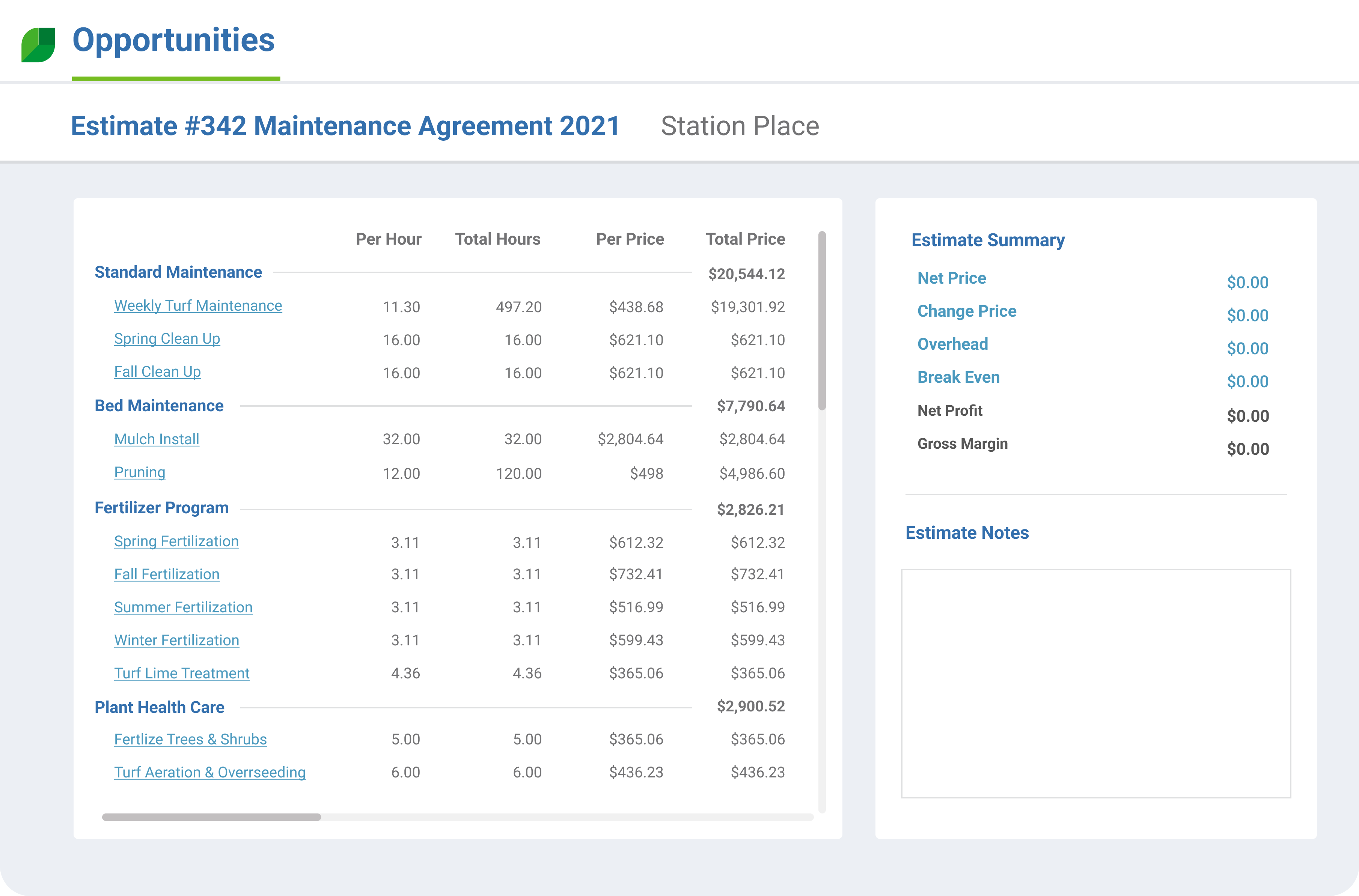
When the estimate is done, build, send, and track professional proposals in one place.
Aspire helps you standardize contract terms and price jobs in a way that protects your profit margins and markups.
So next time an opportunity comes while you’re in the field, you can bid for it while the business keeps moving.
Invoicing & payment processing
Many times, landscaping businesses lose money because invoicing is slow, inconsistent, or disconnected from what was actually done in the field.
They might have active projects in the pipeline, but nothing to show for it financially.
With Aspire, you can generate invoices directly from estimates, proposals, and completed work, so billing reflects reality and goes out on time.
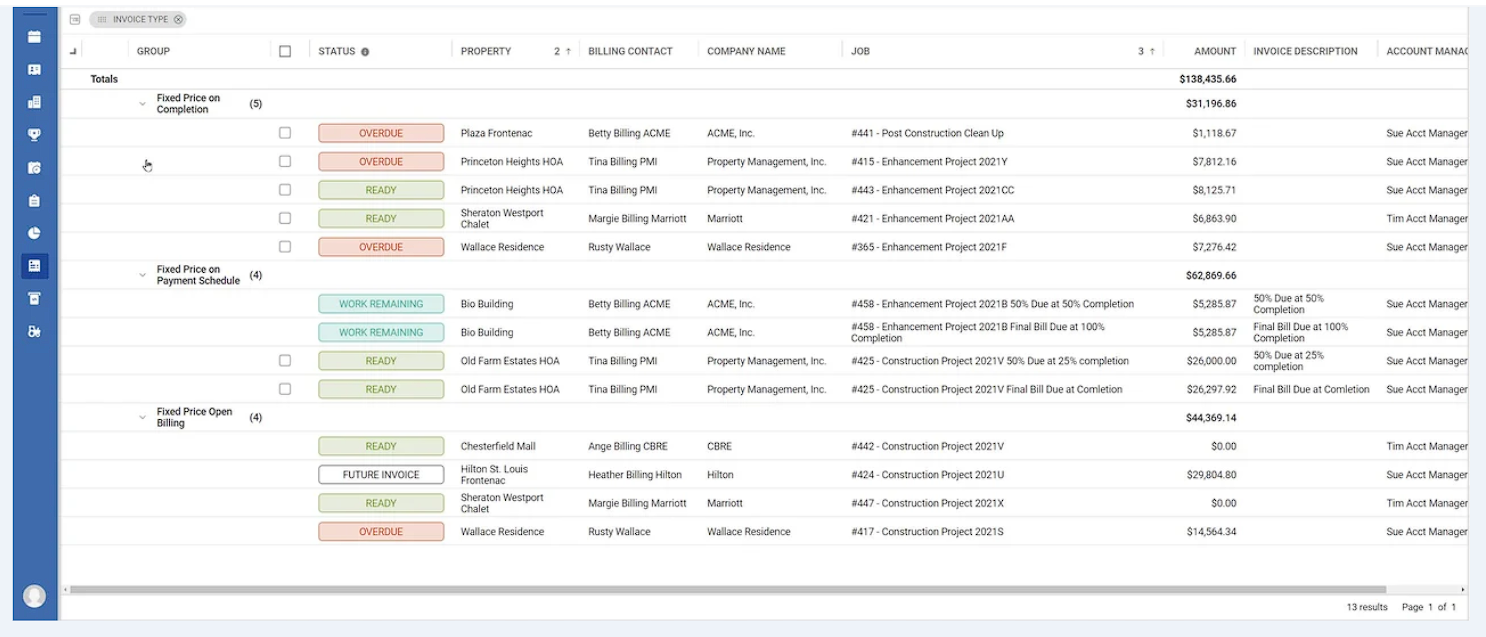
It lets you automate the invoicing process, creating invoices based on the client’s preference. And if you want invoices after the project is completed or periodically as milestones are reached? That can be done on Aspire.
You could also monitor the status of each invoice, from paid to pending or overdue.
There’s a clear audit trail for every transaction, which also means tax season and financial documentation are less of a headache.
Business reporting & documentation
Need to grow your landscaping business? You need real-time data, or it’s like mowing blindly.
It’s crucial to understand everything that goes on in the business, so you can make informed decisions.
Aspire’s reporting feature lets you know whether your business is breaking even, losing money, or ready to expand.
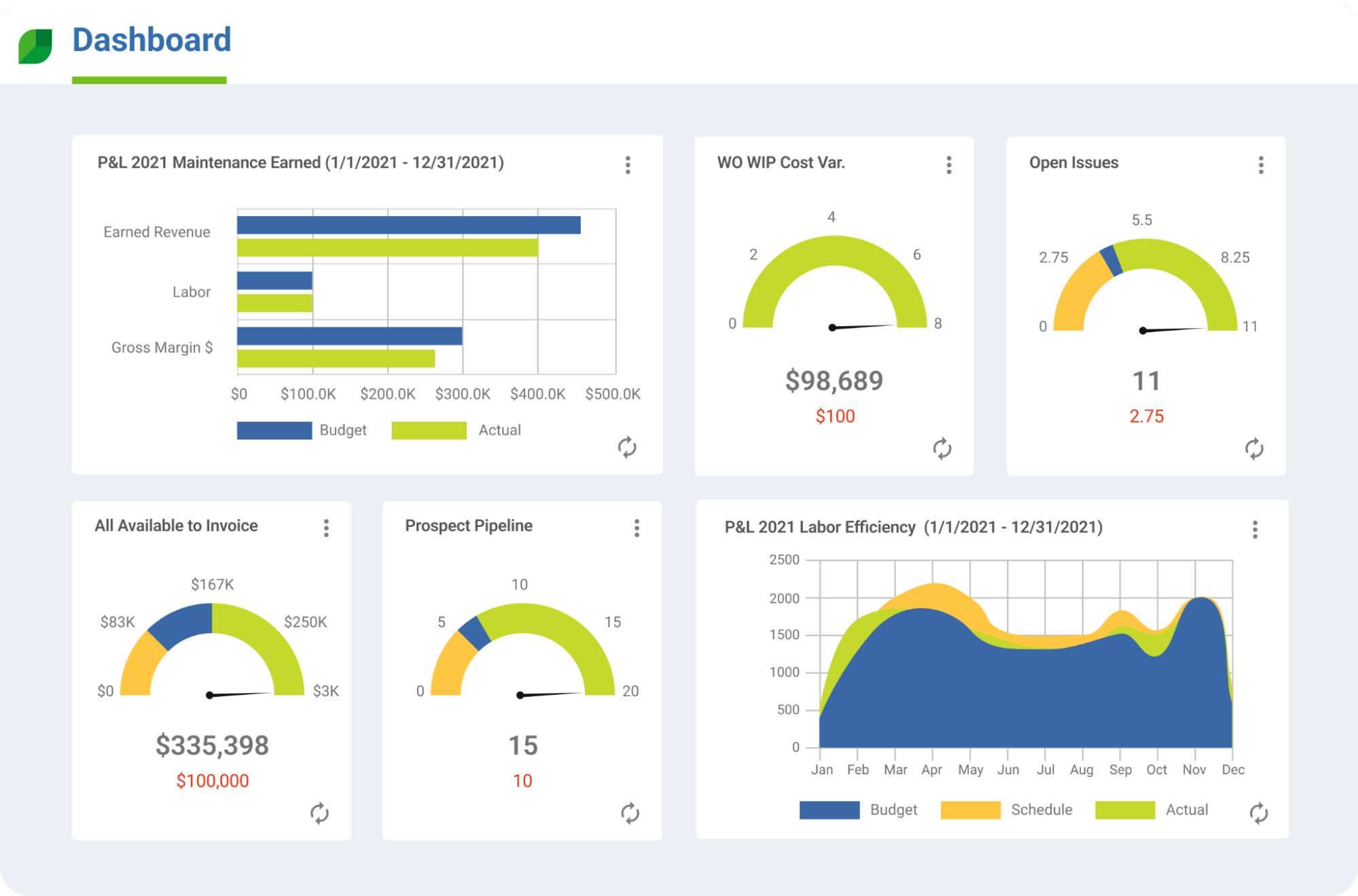
It provides visibility into the numbers and data behind every job, including team productivity, equipment usage, job costs, profit-and-loss ratio, earned revenue, and top-earning landscaping services.
Pull historical data from different timelines and keep an organized record of everything. Access to such timely information ensures all your business moves are data-driven.
Scheduling & job management
Without a proper schedule, your crews are frustrated, and money is lost. Think about it: missed appointments, overlapping projects, annoyed clients, and incomplete jobs that make clients lose trust in you.
In a competitive market like Kansas, that’s something to avoid, and Aspire’s scheduling feature helps you do that.
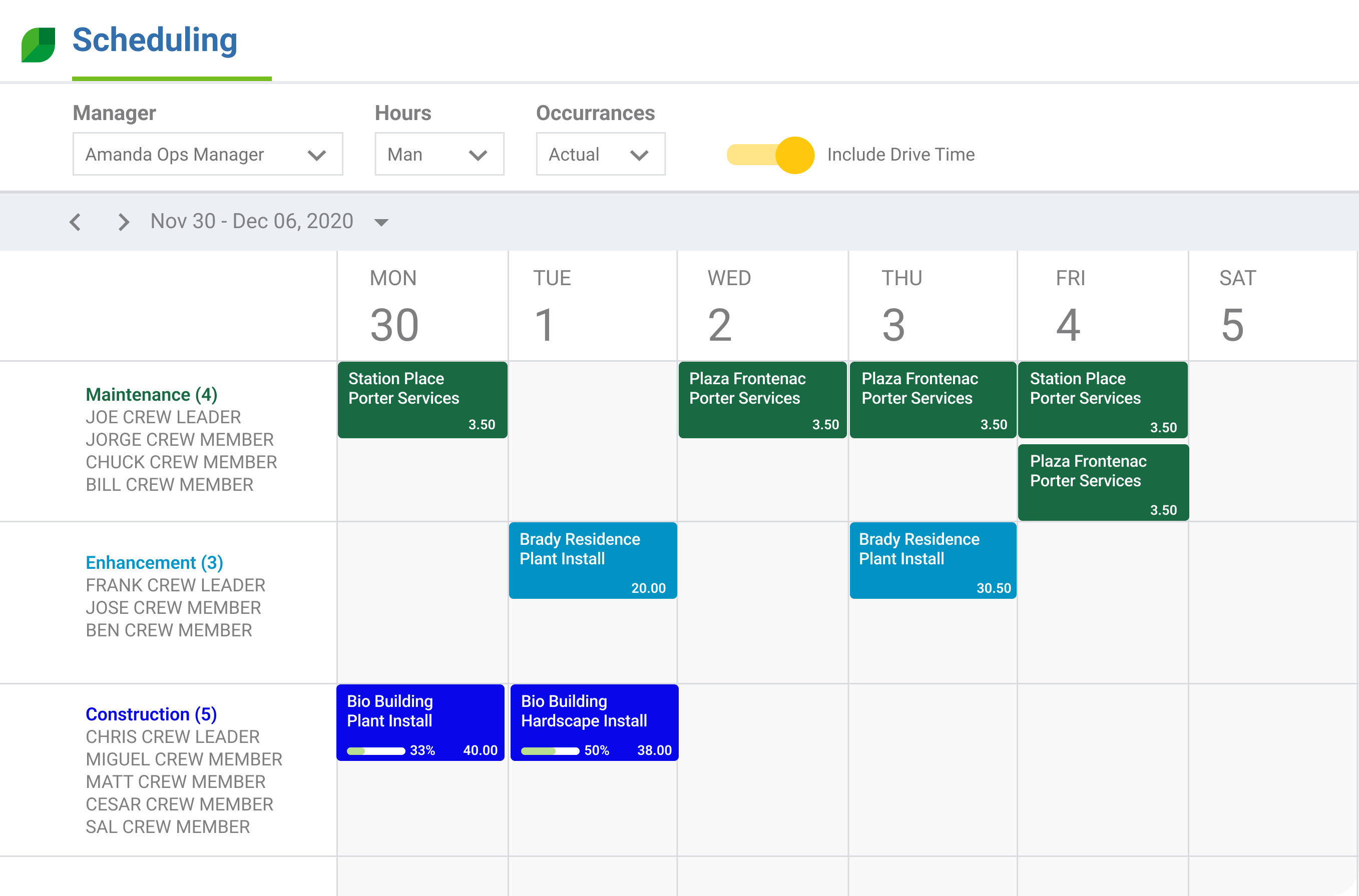
Once a project is won, it lets you schedule projects based on the team’s availability. From there, you can assign the right crew and create a checklist for them to follow, along with equipment, passcodes, or permits they might need.
Aspire lets you track job progress and manage workloads across weeks or months at a glance.
This way, everyone knows where they need to be and what needs to get done. It also provides a clear operational record of services performed, keeping your team accountable and your clients confident.
Over to you
This guide has walked you through each step of business registration, tax compliance, and the permits you need, depending on the services you plan to offer.
Now that you know what’s required, you can get the ball rolling.
And when projects start coming in, Aspire will keep everything running smoothly.
Scheduling, reporting, proposals, job costing, equipment management, and client communication, all in one place.
See Aspire in action. Book a demo today.
Disclaimer
This article is for informational purposes only and should not be considered legal or financial advice. While every care was taken to use official sources, you should always verify requirements on the Kansas government websites.









 866-727-7473
 Schedule Demo
 390 S Woods Mill Rd #300 Chesterfield, MO 63017


