
Table of Contents
Table of Contents
- Why do landscaping businesses sell their accounts?
- How do you value a landscaping account for sale?
- What steps are needed to sell landscaping accounts?
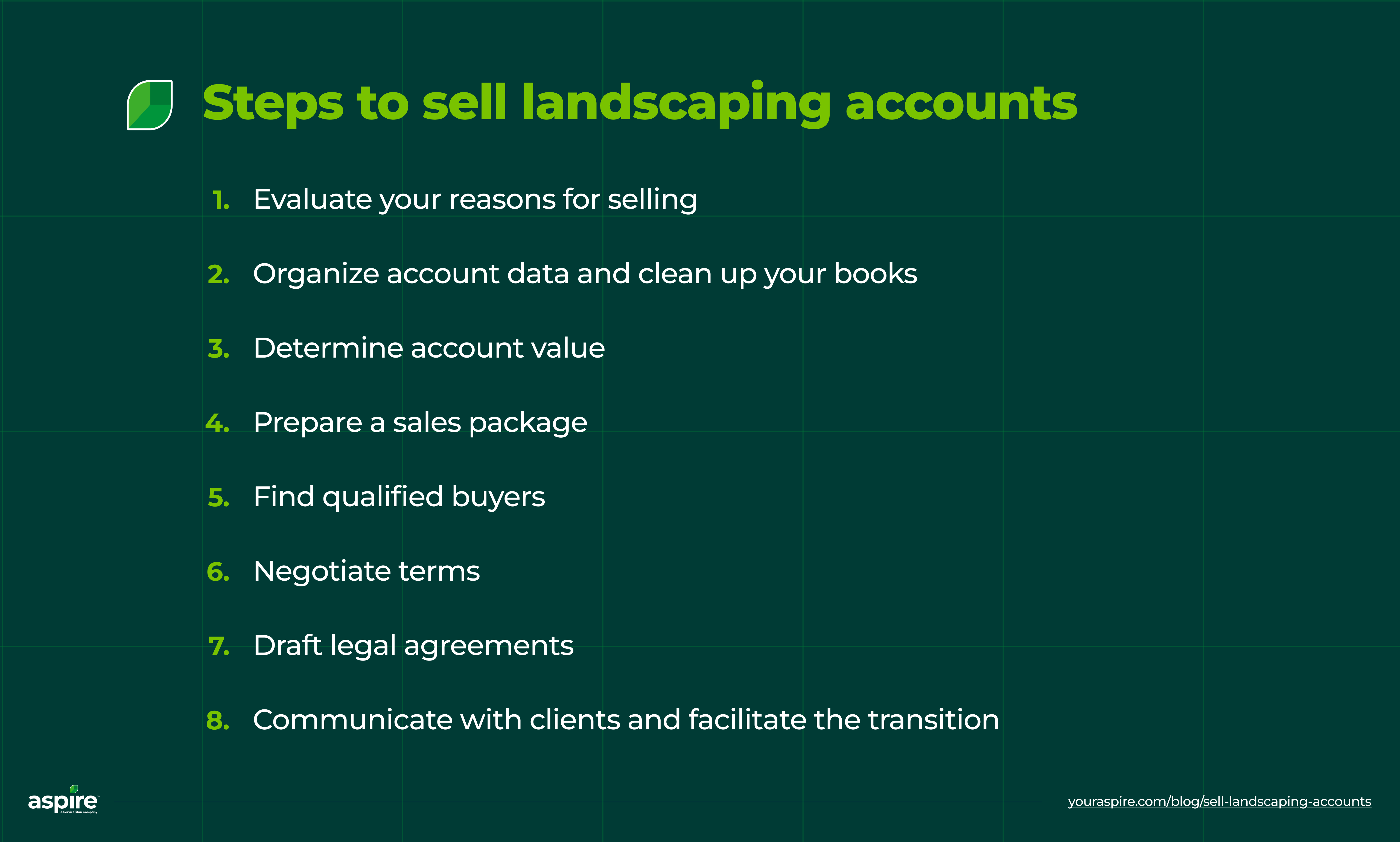
- 1. Evaluate your reasons for selling
- 2. Organize account data and clean up your books
- 3. Determine account value
- 4. Prepare a sales package
- 5. Find qualified buyers
- 6. Negotiate terms
- 7. Draft legal agreements
- 8. Communicate with clients and facilitate the transition
- What information do buyers need before purchasing accounts?
- How do you price a client list for landscaping services?
- What are common mistakes when selling landscaping accounts?
- What should you include in a landscaping account sale agreement?
- How do you maximize the value of your landscaping accounts before selling?
- How can Aspire help streamline the process of selling landscaping accounts?
You’ve stumbled on a new strategic opportunity for your landscaping company. However, to capitalize on it, you need to let go of some of your existing accounts.
That's where things get a little fuzzy. Right now, you don’t know how to:
Value landscaping accounts
Find qualified buyers for the accounts you wish to offload
Manage the financial and legal aspects of the sales
But not to worry; that’s what our guide is about. It’s a deep dive into how to sell your landscaping accounts, where you’ll learn:
How to value landscaping accounts
Steps involved in selling an account
Information buyers need before purchasing a landscaping account
Mistakes to avoid in the process.
Tips for preparing a landscaping account sale agreement
Without further ado, let’s get started.
Why do landscaping businesses sell their accounts?
Selling landscaping accounts involves transferring client contracts and agreements to another business with the customer’s consent.
Most landscaping business owners typically sell for the following reasons:
Business exit: They’re leaving the landscaping industry or moving to another state, but don’t want to leave their clients stranded. They can sell accounts to other local landscaping businesses but keep the equipment.
Retirement: It’s time for the business owner to move on after a successful career. They want to hand over clients to an active business that can take care of their customers.
New opportunities: Landscaping business owners who land bigger clients need to sell smaller accounts to accommodate their new schedule.
Personal reasons: Owners can decide to sell for health reasons or to simplify their lives. They could be burnt out or no longer find landscaping fulfilling.
Financial reasons: Selling can sometimes provide emergency cash that business owners can infuse into the company. It’s a good way to maximize the business’s value, especially if funds are tied up.
How do you value a landscaping account for sale?
To value an account, you need to estimate the landscaping account’s annual revenue multiplied by a valuation multiple.
A formula you can use:
(Account's Annual Revenue) × (Valuation Multiple based on quality)
Let’s break down how to get it done:
First, determine the account’s recurring revenue by multiplying its monthly fee by 12 months. For example, it could be $50 x 12 = $600 per year.
Apply a valuation multiple. These multiples aren’t random but chosen from industry reports. They’re typically used when valuing landscaping businesses, but can also be used for accounts. They range from 0.5x to 2x, depending on industry trends, economic conditions, and growth potential.
Using the above formula with a 0.5x multiple: $600 x 0.5 = $300.
That means the sale price is $300.
To improve an account’s value, you can also provide:
The account’s books: Labor and material costs, equipment usage, and average travel time.
The account’s strength: The signed agreement with a long-term contract, a clear scope of work, and a billing history.
Transferability: Is the account easily transferable? Clients with a professional relationship (not tied to the owner personally) are easier to transfer. Even better if the account has clear SOPs, documentation, and history.
Proximity and opportunity for upselling: Accounts located along the buyer’s route incur lower costs and yield higher profits for them. You can also show the client’s upsell history. How often have they paid for another service in addition to their original plan?
What steps are needed to sell landscaping accounts?
Once you’re ready to sell, here’s how to go about it:
1. Evaluate your reasons for selling
Be clear about why you want to sell the accounts. Are you moving to a new venture or state?
Is there a new opportunity for which you need more resources, time, and crew? Or are you downsizing?
Assessing your ‘why’ helps:
Determine the account’s value: Your motivation will influence pricing. Say you’re retiring, for example. The cost of selling a long-term contract with upsell opportunities will be higher than if you wanted to focus on a larger, more profitable account instead.
Identify the right buyer: Exiting the industry? Any landscaping company can be the buyer. But if you’re diversifying in the same location? You want to ensure that the company that buys the account can do a good job, as it could improve your brand’s rep.
2. Organize account data and clean up your books
Before approaching buyers, compile relevant information about the account to make it easy to understand. Here’s what you need to organize:
Service agreements
Pricing details
Scope of work and service frequency
Travel time
Feedback and incident history
Account revenue
Profitability data
Payment history (on-time and late)
This helps you correctly value the account and ensure transparency with potential buyers. Detailed information helps them in decision-making.
3. Determine account value
Review the account’s financial performance, longevity, and upselling opportunities, then price it fairly.
If you can, consult professionals such as M&A advisors, business valuators, or industry consultants to determine the account’s value.
Alternatively, use the formula shared above to do it yourself.
4. Prepare a sales package
Like all good products, the account needs to be well packaged to make it attractive and easy for the buyer to understand.
Here’s what you need to do:
Compile the account data (listed above).
Demonstrate its stability by including client reviews, renewal history, upsell or add-on records, and referral lists.
Help buyers understand the cost of servicing the client. List the equipment needed, the number of crew members required, seasonal adjustments to pricing and service frequency, and any special instructions.
Outline growth opportunities. Business owners will be willing to invest if the account has a good ROI. So, highlight additional services the client has shown interest in, lead opportunities in the neighborhood, and upsell opportunities.
Present all this information in a visually appealing PDF file. You can use graphs to show financial performance while keeping sensitive details, such as the client's address, out until an agreement is signed.
5. Find qualified buyers
Get in touch with local competitors about potential sales. If you have a relationship with other landscaping companies, present the sales package to them.
Target businesses in your area, as they’ll have travel times to the client’s addresses similar to yours.
You can also leverage industry networks or contact business brokers to help facilitate a deal.
6. Negotiate terms
Once there’s interest, move into detailed discussions with potential buyers.
Negotiate:
Pricing
Number of landscaping accounts included in the sale
Payment structure (up front or installments)
Transition period along with responsibilities
Non-compete and confidentiality agreements
Compile everything into an agreement to protect the deal and your interests.
7. Draft legal agreements
Consult an attorney to draft a legal contract outlining the transfer terms and each party’s responsibilities.
An agreement not only facilitates a smooth transfer, but also:
Clarifies what’s being sold.
Covers legal obligations, e.g., non-compete, client data privacy, or liability for past work.
Prevents misunderstandings. Written agreements ensure both parties agree to the terms of payment and responsibilities.
8. Communicate with clients and facilitate the transition
Once an agreement is reached, notify clients of the upcoming changes to maintain trust throughout the process.
Explain why it’s also a good move for them and that you will be available to oversee the handoff.
Once they’re on board, introduce the buyer to them. If you can, be present for the first booking to ensure everything goes smoothly.
You also need to support the buyer with operational insights, property-specific instructions, and valuable tips to help them maximize profits from the new account.
What information do buyers need before purchasing accounts?
Landscaping accounts are like investments, and the investors (buyers) need to know the potential risks before making a decision.
Here’s the kind of data they typically need:
Service scope and agreements: List services provided (mowing, irrigation, hardscaping, etc.), service frequency, contract duration, renewal terms, price adjustment rules, and cancellation terms.
Financial data: Annual revenue of the account, service prices, material and labor costs, profit margins, outstanding balance, and payment history.
Account performance and risk factors: Length of client relationship, add-on services requested, notes on client reliability, service disputes, and incident reports.
Operational information: Equipment typically needed to service the account, including the number of crew members and subcontractors, upsell opportunities, and challenges unique to the account, e.g., special permits required or difficult terrain.
Account details: Property type (e.g., residential or commercial), location (not a specific address until a contract is signed), and travel time from your office.
How do you price a client list for landscaping services?
You can price a client list using any of the following strategies:
Flat fee: You set a fixed price for the entire account list, regardless of revenue or the number of accounts. It’s a good option for a quick sale, as there’s less drawn-out negotiation. But you risk getting lower prices for high-value accounts.
Percentage of annual revenue: Price the list as a percentage of what all of your accounts earned in the past year. Depending on account stability and contract terms, this could be 30–80% of the revenue.
It’s best for accounts with high, consistent income, and allows you to sell at a price consistent with the earning potential. However, buyers will require accurate financial records for this pricing strategy, as they’ll need to confirm their potential revenue.
Per-account pricing: You value each account individually, especially if some clients on the list are more valuable than others. It allows you to price based on location, property size, and account type (residential, commercial, or municipal).
Installment sale: With this option, the buyer pays you over time (monthly/quarterly), based on the sold account’s performance. It’s residual income for you, providing a steady cash flow after the sale and reduced risk for the buyer.
The final price of the account can be influenced by factors like:
Contract length and terms: Long-term contracts typically have higher value than month-to-month contracts.
Profit margins: Accounts with higher margins have higher multiples and prices than those with lower margins.
Service scope: You will get more for a client with year-round service needs than for seasonal-only accounts.
Market demand: Properties in competitive areas with high referral prospects will sell reasonably well because they offer an opportunity to increase the buyer’s client list.
Payment reliability: Few late payments mean greater buyer confidence in the account.
What are common mistakes when selling landscaping accounts?
To maximize the value of your landscaping account, ensure you avoid the following errors:
Inadequate documentation: Provide buyers with detailed financial and operational account data to help them make informed decisions. Inadequate information means they can’t see the potential profitability they stand to gain.
Lack of client consent: While you need to secure a buyer before informing a client, closing the deal without their permission could risk losing their trust, and the buyer will likely request a refund.
Poor valuation: If your landscaping account prices are below their actual value, you risk losing money. If their valuation is too high, you could scare away prospects.
Neglecting the transition plan: Failing to outline how the handover will work, e.g., client-buyer introduction and overlapping service weeks, can be disastrous. This can damage client trust and prevent the buyer from maximizing the account’s value.
What should you include in a landscaping account sale agreement?
A sales agreement protects both you and the buyer, formalizing the transfer and the parties' responsibilities.
Here’s what it should include:
Parties involved (seller and buyer): Share their legal names, contact details, and business names.
Description of the account being sold: Indicate property type, location, scope of work, and specific exclusions.
Purchase price and payment terms: Include the total price of the account, payment terms (installments, lump sum, or performance-based), and any deposit or down payment.
Transition details: Clearly explain the transfer timeline, when and how client introductions will be made, and the transitional support you will offer.
Non-compete clause: If you’re not exiting the business, you may want to include a clause to protect the buyer. Let it be clear that you won’t compete or solicit the client for a set period.
Contingencies: List the conditions that must be met before closing the deal. This could be financing agreements, or the buyer first approving the client list.
How do you maximize the value of your landscaping accounts before selling?
You can improve a landscaping account’s value if you:
Secure long-term contracts: Longer terms typically mean consistent revenue. It’s a sure-profit deal buyers won’t want to pass over. This gives you more bargaining power to decide the selling price.
Optimize client relationships: Clients are the deciding factor in selling an account. Keeping them informed demonstrates trust and makes the clients more likely to renew their contract and refer others.
Raise retention rates: A stable client base comes into its own when it translates into repeat business. To improve retention, provide excellent service. Address incidents and complaints ASAP. Build strong client relationships so they trust whoever you’re handing them off to.
Clean your books: Want to get the best value from an account? Ensure buyers can clearly see your financial records. It’s easier to charge a premium if the books are transparent. Showcase revenue, profit/loss margin, labor cost, and other details to help the buyers decide.
Build a strong brand presence: A well-branded landscaping business looks more premium to buyers. Maintain a professional website and a strong social media presence. Collect positive reviews to boost your credibility and make the company more appealing to potential buyers.
How can Aspire help streamline the process of selling landscaping accounts?
Aspire is a landscaping management platform that enables businesses to optimize and centralize their operations. It saves business owners from the stress of using multiple applications to run their business.

With Aspire, they have one tool to run everything—estimation, bidding, scheduling, project management, time tracking, employee management, payment, and reporting.
Here’s how it can help streamline your landscaping account sales process:
Provides financial clarity: Aspire’s reporting feature lets you generate detailed financial reports for your business.
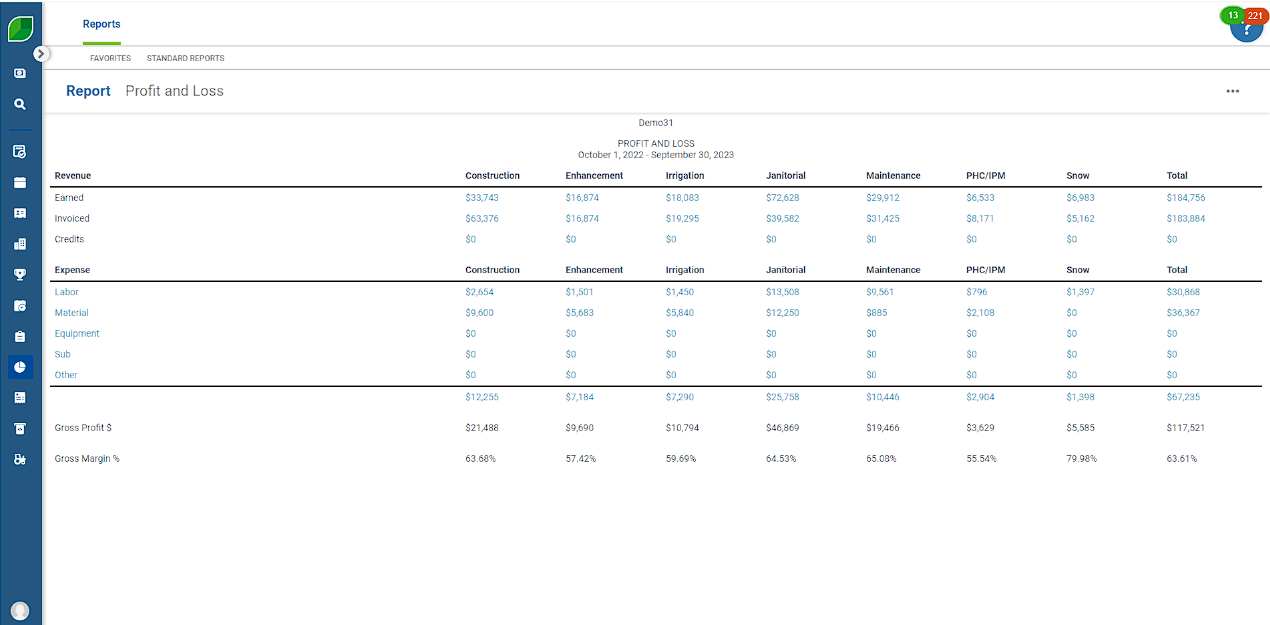
You can zero in on individual accounts to monitor revenue, expenses, and profitability. This is helpful when valuing an account for sale.
Simplifies contract visibility: All client details and contracts are centralized on Aspire’s CRM, making it easy to present account documents to buyers.
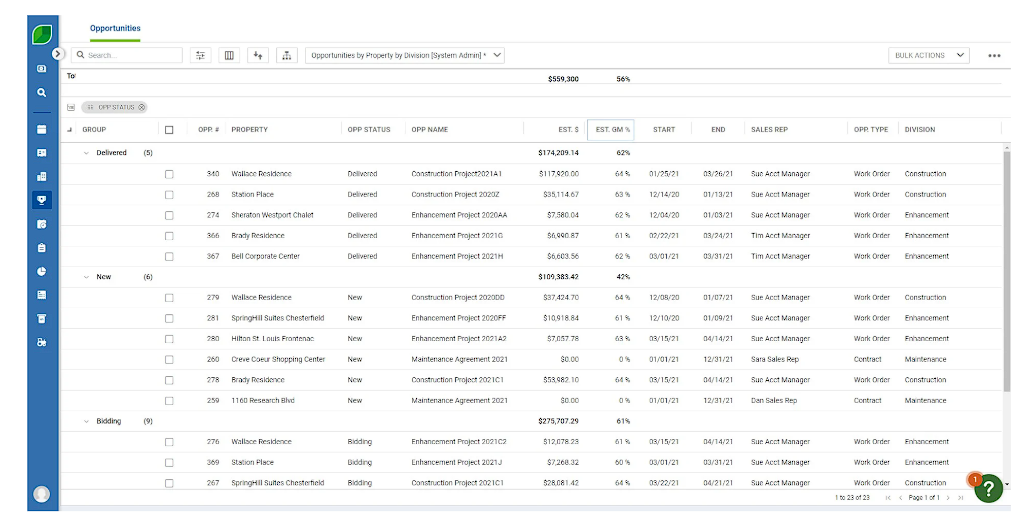
You can see the service history, contract details, payment history, client addresses, feedback, incidents, additional service requests, crew notes, and upsell opportunities.
Boosts credibility: Using Aspire builds a buyer’s confidence in the sale by demonstrating your professionalism and due diligence. It also lets you pull any account data they need in just a few clicks.
Aspire is a digital companion every landscaping business owner needs to simplify operations and grow their company.
Book a free demo to see Aspire’s value in real time.










 866-727-7473
 Schedule Demo
 390 S Woods Mill Rd #300 Chesterfield, MO 63017


