Table of Contents
Table of Contents
- Why community promotion matters for landscaping businesses
- 1. Optimize your Google Business Profile for local visibility
- 2. Join local community groups and neighborhood platforms
- 3. Launch a referral program
- 4. Turn reviews into trust magnets
- 5. Sponsor local events or community projects
- 6. Partner with complementary local businesses
- 7. Host educational workshops or community events
- 8. Launch neighborhood-focused campaigns
- 9. Use job sites as marketing opportunities
- 10. Design and print flyers
- How Aspire helps local landscaping businesses stay organized & scale
- Over to you
- Frequently Asked Questions (FAQ)
If you want to get noticed by homeowners, stand out from other local landscaping businesses, and turn community awareness into booked work, you need more than just digital marketing and paid ads.
A property manager may know your name but never reach out. Homeowners may see your crew in the neighborhood but forget to call. Referrals might be coming in, but they get lost before sales can follow up.
So how do you close those gaps?
This guide will explain how to promote a landscaping business in community spaces where local buyers already ask for recommendations.
You will learn how to leverage Google Business Profile, social media, testimonials, direct mail, flyers, and local events to attract more customers and turn local trust into revenue.
Why community promotion matters for landscaping businesses
Community promotion matters for landscaping businesses because it turns local recognition into booked work, repeat jobs, and warmer sales conversations.
Homeowners rarely choose a lawn care provider from a single ad. A familiar truck on the street, a neighbor’s referral, a clean Google Business Profile, or a crew member wearing a branded shirt at a local event gives your business a head start before the first call.
Good landscaping work is already in the public domain. Fresh mulch, sharp edging, healthy turf, and clean landscape design give nearby homeowners a reason to ask who did the job. Local visibility makes those answers easier to find.
Community marketing also reduces doubt. People trust businesses they recognize, especially in home services where crews enter private property and manage high-value outdoor spaces.
Landscapers win local work through familiarity, timing, and proof. Here’s how to achieve that.
1. Optimize your Google Business Profile for local visibility
A detailed Google Business Profile helps local homeowners find your landscaping company when they search for local help.
Local searches typically begin with the following terms: “lawn care near me”, “landscape design in my neighborhood”, or “seasonal cleanup before the first freeze”. Your profile provides search engines with the information they need to connect your business to those searches.
Follow these steps if you want to increase your local visibility:
Keep your contact information up to date and consistent across all platforms. Your Google Business Profile, website, and local directories need to display the same name, address, and phone number.
Select the primary category, such as landscaping, and add secondary categories such as lawn care service, tree service, or landscape design (if applicable).
Mention the specific areas you serve rather than setting a large and unrealistic area. Mention at least 20 precise locations within your driving range.
Upload before-and-after photos of projects you have completed in the area. Landscaping is a highly visual business, and authentic, high-quality photos are an effective way to attract more website clicks.
Build and monitor your reviews by making it a habit to ask satisfied clients to leave a review immediately after finishing a job.
Create a strong “Services” section by manually adding all your specific offerings. Use keyword-rich descriptions when describing your services.
A complete Google Business Profile makes you visible and easier to reach within your community and beyond.
2. Join local community groups and neighborhood platforms
Local community groups put your landscaping business near homeowners who are already asking neighbors who to hire.
Here are the main groups where you can make your presence known:
Facebook Groups work best when the group you are in is active. Search for town names, subdivision names, county groups, “neighbors,” “recommendations,” and “home services.” Also, advertising your landscaping business on Facebook works best when your online presence is visible, you answer questions, share quick lawn care tips, and post useful seasonal reminders.
Local Reddit posts, Yelp reviews, neighborhood forums, and community apps also give you an idea about what matters to residents.
Nextdoor helps landscapers reach specific neighborhoods. Use it to post completed projects, respond to local service requests, and keep your business name top-of-mind in areas where your crews already work.
HOA communities give you access to neighborhoods with repeat-service needs. Read posts talking about turf issues, mulch refresh, storm clean-up, irrigation, and community standards to know what services you can offer in each area.
Whichever group you choose, offer sensible solutions. Don’t hard-sell. Let helpful advice be the first point of trust.
3. Launch a referral program
A referral program turns satisfied customers into local promoters who won’t hesitate to mention your landscaping services in conversations.
A good referral program also brings repeat customers back into the sales cycle.
Here is how you can make a referral program work for you:
Build a good incentive system. Referral programs work best when they are worth the customer’s time. For instance, offer a $50 account credit, a free service, or a percentage off their first booked cleanup job.
Make the process smooth and easy. Focus on making it straightforward for customers to refer others, without processes that are difficult to understand or time-consuming.
Promote, promote, promote! Customers need to know about your program for word-of-mouth to work. Use all available channels, both online and offline, to promote your referral program.
Track and analyze metrics. A referral program without proper tracking and analytics can struggle to succeed. You should primarily track how much each new client costs, the percentage of referred leads that turn into paying clients, and how many new leads each active advocate brings in.
And lastly, always show your appreciation. Every time, even if the referral didn’t bring new customers, thank your loyal customers for taking the time to recommend your business.
4. Turn reviews into trust magnets
Reviews can be the deciding factor for a client trying to choose between landscaping companies.
A homeowner comparing landscaping companies wants proof from other customers similar to them. In their search, they are looking for comments about showing up on time, keeping the property clean, fixing specific problems, and doing the work they promised.
Good testimonials help you generate more leads by reducing doubt before the first call. A short review from a neighbor is more convincing than a polished sales line from the company itself.
Here is how to make the most of your reviews:
Always be authentic if you want your clients to consider you reliable. Display all reviews, whether bad or mediocre, and deal with them transparently.
Boost the credibility of your reviews by encouraging clients to post visual proof, such as photos or videos. Seeing the results of a real project you finished exponentially increases conversion rates.
Engage with and respond to every review you receive. Handle negativity professionally, personalize your answers, and thank the reviewers for taking the time to share their opinions.
Don’t wait for reviews to happen on their own. Engage with your clients after every completed job and ask for a review, but don’t be pushy or annoying.
Reviews can be a valuable resource if you know how to use them effectively.
5. Sponsor local events or community projects
People remember a company that helps out in the community, especially when the work connects to outdoor spaces.
Ground Works Land Design offers a compelling example. The Northeast Ohio company proudly shares its community projects on its site, including donated landscaping services for the local science center and schools, as well as offering labor and installation help for the Huntington Beach public space.
Thanks to the company’s efforts, the community receives a visible improvement, and the residents will always remember who handled the job.
As a landscaping business, you can copy the idea:
Identify the right opportunities that align your brand with events and causes that share your values. Spring home and garden shows, local schools, community sports teams, and neighborhood cleanups are a good start.
Choose your sponsorship type and ensure it meets the community's needs. You can offer to maintain the event grounds, provide seasonal flowers, or cover event costs in exchange for your logo appearing on event flyers, banners, and social media.
Maximize your ROI (return on investment) by fully leveraging the partnership and your marketing efforts. Ensure the sponsorship translates into leads and brand awareness by requiring logo placement, taking before-and-after photos of the community project, or handing out free swag.
Regularly check municipal websites, business directories, and community boards to find more local sponsorship opportunities.
6. Partner with complementary local businesses
Good local partners help grow your landscaping business and reach homeowners before they start shopping around.
Real estate agents hear from sellers who need better curb appeal. Builders know when new homes need sod, plants, cleanup, and irrigation. HOA managers hear about dead shrubs, drainage problems, messy entrances, and overgrown common areas.
The most effective local partnerships for a landscaping business include:
Plant nurseries and garden centers, where customers often come to buy plants, but need a landscaper for bed preparation or installation.
Paving and hardscaping companies that specialize in patios or driveways often need help with the finishing touches, such as turf and gardens.
Real estate agents often need help enhancing the curb appeal of their listings. They can recommend you to sellers or new buyers.
Property management companies constantly need reliable landscapers for routine maintenance on rental properties.
Pest control services can pass on clients with lawn care needs, while you can refer clients who require tick spraying.
These partnerships can be very effective as long as you keep them profitable for both parties.
7. Host educational workshops or community events
Hosting educational workshops can help your landscaping business build trust within the community, position you as a local expert, and get the attention of potential customers, which can be especially useful if you have just started your landscaping business.
Here is a step-by-step framework for hosting a successful workshop or event:
Choose a theme that focuses on seasonal topics and that can highlight your expertise, but without giving away all your secrets. A good theme can be sustainable landscaping, seasonal yard prep, or weed management.
Choose a strategic location where your knowledge will be in the spotlight. Public libraries, community centers, and neighborhood parks are all suited for larger events.
Plan the event's logistics and structure to facilitate hands-on learning. Work with 10–20 participants at a time. First educate, then demonstrate, and wrap up with a consultation session where you hand out useful written materials.
Market and promote your event on social media, hand out business cards or flyers, and partner with local businesses to cross-promote the event to their clients.
Generate leads and boost sales at the end of each event by offering attendees an exclusive discount, samples of new products, or a free consultation. Collect emails via a survey where people can write about the landscaping problems they face at home.
For a successful first event, highlight the specific services you want to promote and focus on your target audience.
8. Launch neighborhood-focused campaigns
One good local campaign beats a wide-reaching campaign that reaches the wrong homes.
Neighborhood campaigns help landscaping companies build their reputation block by block. A crew that already services three homes on the same street has a better story than a company sending the same offer to every ZIP code.
Here is how you can launch a campaign that will maximize profits and minimize drive times:
Use the “Every Door” method to leverage your existing work sites and build local trust. Place a simple, elegant yard sign on the front lawn of your business with a QR code linking to your services landing page. Also, whenever a team finishes a project, distribute door hangers to the nearby homes.
Use hyper-local digital targeting to lower your online ad spend and focus it on specific, smaller areas.
Send direct mail to new arrivals in the area, as they probably don’t have a landscaping services provider yet.
Encourage referrals from your former clients. You can turn happy clients into your best salespeople by offering an incentive for both parties.
When launching neighborhood-focused campaigns, try to saturate a smaller geographic area rather than spreading yourself thin.
9. Use job sites as marketing opportunities
Your active job sites are one of the best marketing tools your lawn care business can have. You get to showcase your expertise firsthand, and the community can admire your work as it develops.
To use your job sites as marketing tools, follow these steps:
Place yard signs on your project sites that read “Work in Progress” and include the name of your business.
Hang door-hangers or flyers in the areas where you will start a project, mentioning that you will be doing work in the immediate vicinity. Offer a time-limited local discount for any similar services.
Brand all your equipment, from trucks and trailers to the tools you use, and have your crews wear heavily branded uniforms.
Take photos and record videos of your work, then post them in community hubs to generate free, targeted leads.
Update your portfolio with each finalized project. Outline the problem and the solution you provided.
Use your Google Business Profile to upload photos of finished projects and tag them with the town or neighborhood name to boost your local SEO.
Job sites are particularly effective for promoting specific landscaping services, especially when you understand the demographics of the area you are targeting.
10. Design and print flyers
Flyers remain important marketing materials when they say the right thing to the right neighborhood.
Use direct mail, handouts, and door hangers near active job sites, target subdivisions, and routes your crews already service. A homeowner who saw your truck last week has more reason to keep the card on the counter.
Good flyers need to check the following boxes:
A clean and simple template that you can customize for landscaping and lawn care services. You can create them on platforms like Canva.
Ensure that it is readable and not too crowded with text. Mention your business name and main service at the top and in a large bold font.
Include high-quality before-and-after photos of projects you are proud of. Your clients will decide whether to trust you with their yard based on your results.
Include a clear call to action with your phone number, email address, or website so people can reach you.
Choose high-quality, durable paper to make your flyer feel premium and resist bending and tearing in mailboxes.
Use professional printing services either online or with local printing shops.
Choose your target area wisely and distribute your flyers in neighborhoods with homes that have yards and gardens.
Track metrics for calls, form fills, and booked jobs for each drop to measure campaign effectiveness.
How Aspire helps local landscaping businesses stay organized & scale
Aspire is an end-to-end business management platform that facilitates the work that comes after a community marketing strategy pays off.
Leads, estimates, schedules, job costing, invoices, and reports stay connected in one place instead of being scattered between spreadsheets, texts, and single-point apps.
Contract, estimating & proposal management
Fast follow-up matters when a homeowner or property manager asks for a quote.
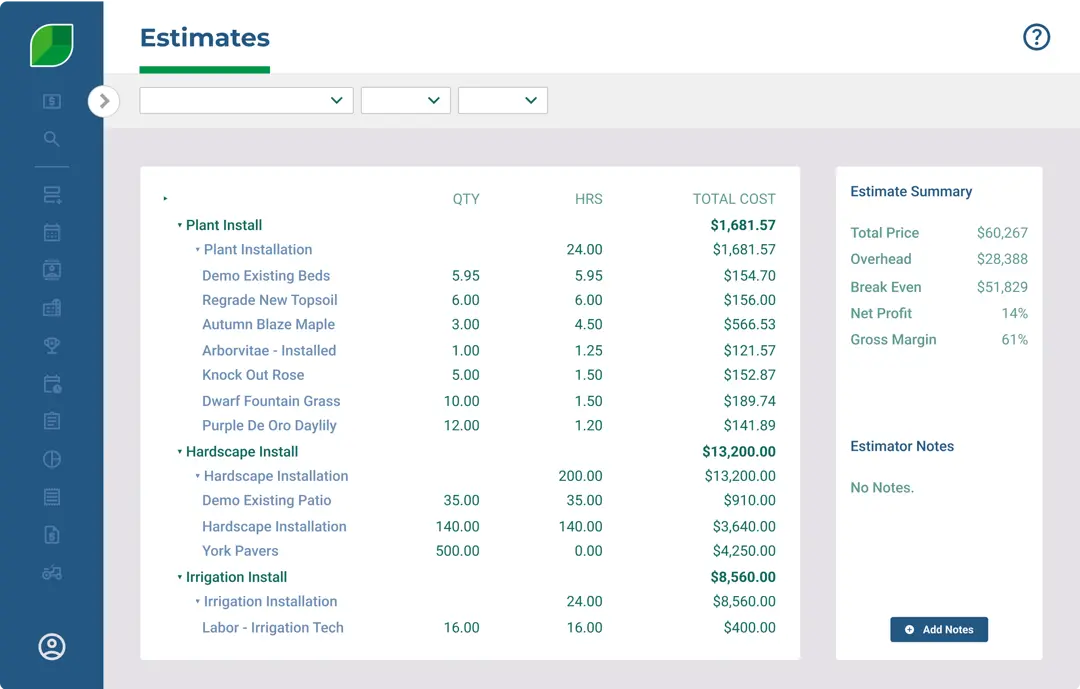
Aspire’s estimating features provide a standardized system that landscaping businesses can use to unify estimates, CRM data, and operations data.
The estimator never has to build a bid from zero. Instead, they can use the estimating features to standardize prices and services and bundle materials, equipment, and labor for a streamlined bidding process.
The software also uses integrated measuring tools that help you better understand the property measurements through aerial imagery.
Labor rates are then integrated along with the margin goals to ensure you can offer a profitable proposal.
Proposals are sent electronically, and clients can review all the information and approve estimates using digital signatures.
If a proposal is approved, Aspire will convert it into a work order or contract without requiring additional data entry.
As the project develops and the estimator and field crews use the same system, Aspire can compare initial estimates with field data.
This real-time data comparison allows landscaping businesses to adjust their pricing to improve profitability in the future.
Invoicing & payment processing
Growth slows down when billing depends on manual entry and follow-up.
Aspire helps teams invoice from the same place where they manage customer billing preferences, finished jobs, and accounts receivable.
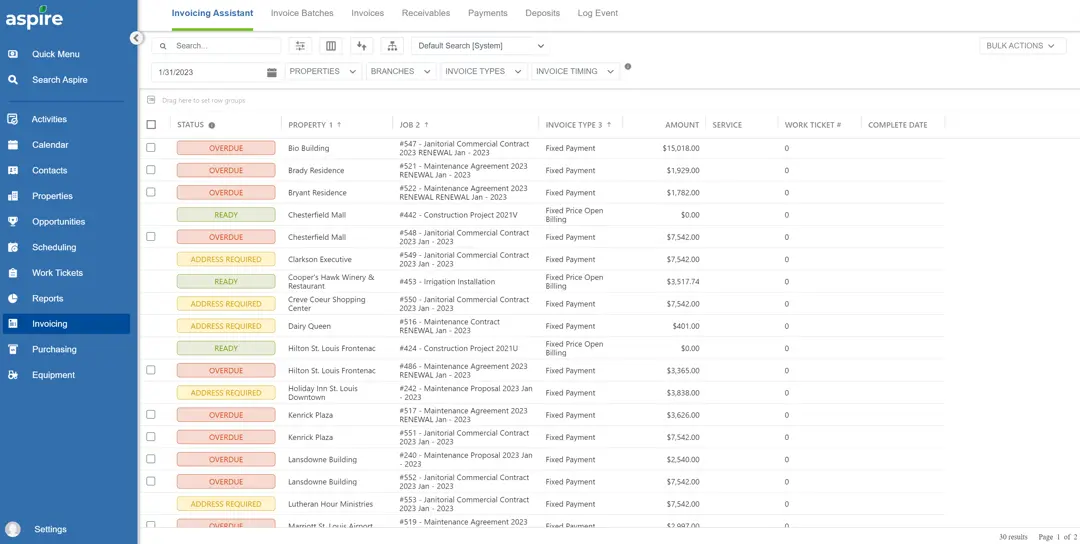
Its invoicing assistant helps you see which invoices are ready to go, overdue, missing information, or tied to unfinished work.
Once you spot the invoices you need, you can send them individually or in batches, with options for custom formats, notes, attachments, and AIA formats for construction jobs.
Once they receive them, customers can view and pay invoices through the customer portal.
One more important feature that Aspire can help with is tracking aging balances, credit memos, payments, and earned versus invoiced revenue by division, service, or property.
Business reporting & documentation
Aspire’s business management software helps landscaping businesses manage day-to-day work, finances, and field-to-office operations.
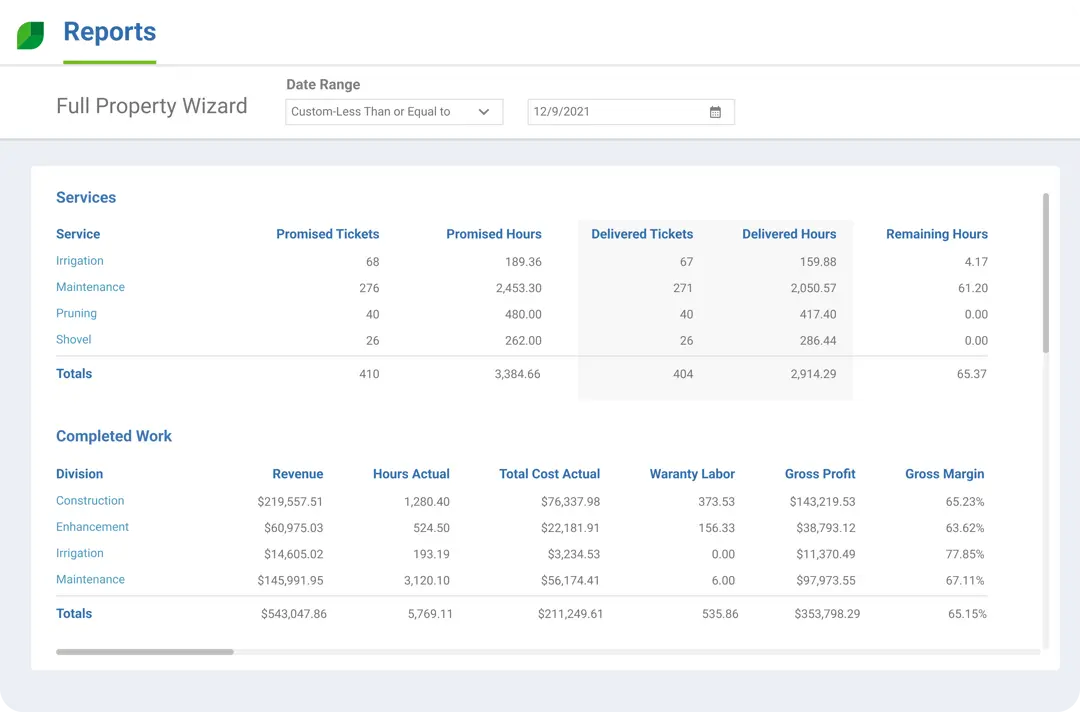
The platform has a built-in report center that tracks profit and loss, KPIs, labor efficiency, and sales planning without requiring manual data entry.
You can trace macro-level reports, transaction details, time cards, and specific orders. Also, you can create custom dashboards tailored to specific roles where everyone can see the metrics necessary for the job.
Marketing automation
Aspire helps landscaping businesses enhance their marketing efforts by offering the Marketing Pro add-on, which eliminates the need for manual spreadsheets. The add-on automates audience targeting and campaign execution across email, direct mail, and SMS.
Marketing Pro makes everything easy by directly connecting to your existing Aspire business management software, using the customer and property data you already have.
Using this data, it then builds and updates hyper-targeted audience lists.
With everything you need in one place, you can run multiple marketing campaigns simultaneously across different channels using customizable, pre-built templates.
To follow up on leads, re-engage inactive accounts, or trigger seasonal promotions, you can set up workflows that run in the background.
The add-on also provides clear metrics and insights to track campaign ROI from within the platform.
Over to you
A plan to promote your landscaping business in community spaces only works when the follow-up stays consistent.
A neighbor asks for a quote. Property managers send referrals. Homeowners fill out a form after seeing your crew on their block.
Each lead needs a fast reply, a clean estimate, a scheduled crew, and a job that stays profitable.
Aspire helps keep that work in one place, from estimates and schedules to job costs, invoices, and reports.
Book a demo to see how it fits your team.
Frequently Asked Questions (FAQ)
Local marketing brings up many practical questions for landscaping business owners.
How can I promote my landscaping business locally?
You can promote your landscaping business locally by focusing on the places where homeowners already look for recommendations.
Update your Google Business Profile, ask customers for reviews, join neighborhood groups, run direct mail campaigns, use job site signs, build referral partnerships, and track which channels turn into booked work.
What are the most affordable ways to advertise a landscaping business?
The most affordable options to advertise a landscaping business are referrals, Google Business Profile updates, local Facebook Groups, Nextdoor posts, yard signs, door hangers, and email marketing to existing customers.
These channels work well because they leverage the trust and visibility your company already has in the neighborhoods it operates in.
How can I get more neighborhood referrals?
Get more neighborhood referrals by asking for them right after a good service visit, a finished project, or a positive review. Offer a simple referral credit, track every lead by source, and thank customers for each referral, even when the new lead does not book.






 866-727-7473
 Schedule Demo
 390 S Woods Mill Rd #300 Chesterfield, MO 63017


