
Table of Contents
Table of Contents
- Do you need a license to start a landscaping business in Oregon?
- What are the types of landscaping business licenses & permits in Oregon?
- Step-by-step process to get a landscaping business license in Oregon
- How much does an Oregon landscaping business license cost?
- What are the most common mistakes to avoid when getting a license?
- How Aspire helps landscaping businesses stay organized & compliant
- Over to you
- Disclaimer
You’re ready to start a landscaping business in Oregon but don’t know where to begin.
Do you just register the business with the state to start operations, or do you need other licenses?
If there are, which department or division should you visit to get the required permits?
This guide will answer these questions and more. Here, you’ll learn about the registrations and licenses your landscaping business needs to launch and grow legally and without unnecessary delays.
The licensing process will be broken down into clear, actionable steps to ensure compliance with state laws and build trust with clients.
Do you need a license to start a landscaping business in Oregon?
You may need a license to start a landscaping business in Oregon, depending on the services you offer. The state requires new entities to register their business with the Secretary of State’s Corporation Division and obtain the applicable licenses.
For landscapers, you need permits to offer these services:
Lawn planning or installation
Addition and incorporation of soil amendments, rototilling, and/or grading
Irrigation installation, maintenance, or repair with the use of compressed air
Planning, installation, and maintenance of arbors, decks, patios, driveways, fences, retaining walls, walkways, landscape edging, or ornamental water features
Pesticide and herbicide application
Landscape design
However, if your business focuses solely on landscape maintenance, a state license isn’t required.
Keep reading to get a list of the licenses your business needs to start operations.
What are the types of landscaping business licenses & permits in Oregon?
Your business licenses in Oregon depend on the landscaping services you want to offer.
There are licenses for construction work, pesticide application, plant sales, or landscape design.
Below is a list of the licenses and permits you need:
General business license
This license is the first prerequisite for every new business in the state. It’s only when you’ve got this license that you can apply for others.
It also allows you to apply for commercial insurance and business loans, giving clients confidence to do business with you.
Landscaping contractor license
In Oregon, landscaping businesses need two licenses to perform landscaping projects that involve installation and construction:
A landscape construction professional license (LCP)
A landscape contracting business license (LCB)
The LCP is for contractors who will supervise projects and other unlicensed landscapers, while the LCB allows companies to advertise and take on landscaping projects.
Neither is necessary to run a landscaping business if you specialize only in lawn care maintenance.
Pesticide business licenses
Want to offer pesticide application services?
You need this license to do business in Oregon.
Similar to the landscape contractor license, businesses will need a licensed commercial applicator, or the owner must become licensed as one before applying for the business permit.
For the commercial applicator license, you need to pass a state examination to apply. As for the business permit, an insurance certificate along with the commercial applicator license is required to qualify.
Landscape architect license
If you intend to design outdoor spaces for clients and draw detailed plans for patios, walkways, retaining walls, and drainage systems, you’ll need a license from the Board of Landscape Architects.
The application requires you to provide documentation demonstrating that the board’s minimum standards for education, exams, and experience are met.
You also need to pass an oral exam with the board.
Permits and local regulations
Your city may require a local business license or permit for you to do business within its borders.
So, you need to research or call to find out what’s required. Permits required may include special contractor licenses, local zoning laws, irrigation licenses, or noise permits. It varies from one location to another, so it’s up to you to confirm what’s needed.
Step-by-step process to get a landscaping business license in Oregon
The steps to get licensed depend on the landscaping services you plan to offer. But you need to register with the state first, then apply for additional licenses for construction work, pesticide application, plant sales, or landscape design.
Here’s how to get started:
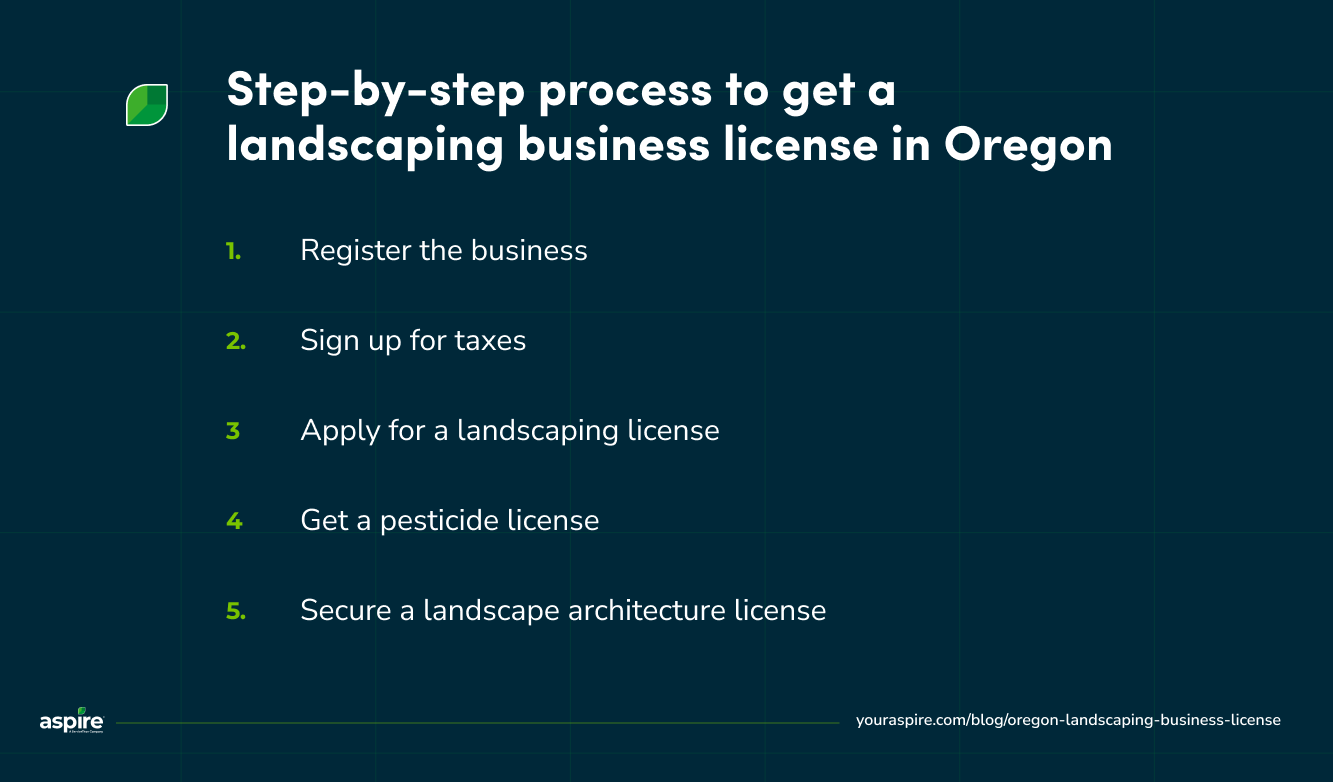
1. Register the business
To sign up your business with the state, you need to first decide on a business structure and choose a unique name.
Common structures you can choose include sole proprietorship, LLC, corporation, or general partnership.
For the business name, confirm that it’s available by searching the state’s name registry. If someone else is using the name, you can’t file it (even by adding articles, special characters, or suffixes like LLC or Inc.).
If it’s available, you can proceed to register the business. Visit the Secretary of State’s registration form dashboard, select Oregon Business Registration Form, choose your preferred entity, and proceed to register online or manually.
2. Sign up for taxes
To get your business tax-ready, you need to sign up with the IRS to get a Federal Employer Identification Number (FEIN). Then, you can register with Oregon’s Department of Revenue (DOR) to get a Business Identification Number to file for state taxes.
Here’s how to go about it:
Visit the IRS website and register for the FEIN
Sign up for a new account on the DOR platform.
Register your business for combined payroll tax reporting purposes.
Apply for a Business Identification Number.
For more information about staying tax-compliant in Oregon, visit the DOR website and consult a professional.
3. Apply for a landscaping license
Landscapers need two types of licenses to do business in Oregon:
Landscape construction professional license (LCP) for experts who are in charge of projects and will supervise unlicensed landscapers. This can be you, a business partner, or someone you hire.
Landscape contracting business license (LCB) for companies to apply for and work on landscaping projects.
To become an LCP:
Confirm you’re eligible to take the exam.
Submit your application online or by downloading and completing the form. This costs $200.
Choose your desired license phase after reviewing the available license phases and study for your exams.
Once your application is approved, schedule the exam with PSI.
Request your license after passing the exam and pay a $200 license fee.
When you get the LCP, you can proceed to apply for a business license online or by completing a printable form.
You do need to secure:
Liability insurance with a minimum of $500,000 coverage and the LCB listed as the certificate holder.
Obtain a bond using the LCB surety bond form. Follow the steps here to meet the bond requirements.
Workers’ compensation if the business has employees.
Complete and notarize an employment verification form, which must be completed by the landscape construction professional if you’re hiring one.
Once approved, you’ll get an email notifying you to activate an online account by logging in to the business online portal.
4. Get a pesticide license
To offer pesticide applicator services, you need a commercial pesticide operator license and a commercial applicator license.
Here’s how to get the operator license:
Secure a valid insurance policy that covers pesticide applications specifically.
Employ at least one licensed commercial applicator or become licensed as one.
Complete and submit the license application form, along with the license fee, to the mailing address on the form. Wait two to four weeks for processing, and a printed license will be mailed to you.
If you want to get licensed as a commercial applicator, you need to:
Pass a law and safety exam and at least one license category exam. Read the study materials and schedule your exam.
Be at least 18 years old and have been employed as a pesticide operator. Provide the operator’s license number on your application if available for easy processing.
Receive a semi-completed license application form after passing the exams.
Complete the license application form and submit it, along with the license fee ($90 for a first license category and $15 for additional license categories).
5. Secure a landscape architecture license
If you want to apply for this permit, you need to pass an exam with the Oregon State Landscape Architecture Board (OSLAB), have relevant work experience, or have a CLARB council record.
Once you do, you can apply for registration online or download and fill out application forms. The initial registration costs $300, and the license application costs $150.
How much does an Oregon landscaping business license cost?
Here’s a breakdown of all the fees you may need to operate a landscaping business in Oregon:
General business registration fees
Name reservation and business filing: $15-$100, depending on your entity type
Landscape contractor license
Landscape Construction Professional license fees
Application fee: $200
License fee: $200
Landscape Contracting Business license fees
Application fee: $285
License fee: $375
Pesticide business license
Commercial pesticide applicator license
$90 for a first-license category
$15 for additional license categories
Exam fees: $58 per attempt
Application fee: $50
Landscape architect license
Initial registration: $300
License application: $150
What are the most common mistakes to avoid when getting a license?
When securing your landscaping business license in Oregon, here are mistakes to avoid, as they can delay or invalidate your registration process or cause it to be rejected.
1. Forgetting to file annual reports
As a landscaper, you’re busy managing projects, employees, equipment, and clients. There’s little time for administrative responsibilities with all of these going on.
While such behavior is understandable, forgetting your annual reporting duties can lead to the loss of good standing with the state. This means you may not be allowed to legally operate, could face fines, lose your liability protection and licenses, or be unable to enforce contracts to collect damages.
You will be in legal limbo, and that’s bad for what you’ve built.
Here’s how to avoid all that:
File reports on time.
Pay your fees and taxes.
Provide required documentation when filing at all times.
2. Not meeting the insurance and bond coverage requirements
Oregon requires landscapers applying for the contractor and pesticide business licenses to have a surety bond, general liability insurance, and workers’ compensation (if you have employees).
Applying without meeting these requirements can delay your license and prevent you from starting operations on time.
Here’s how to avoid this: Renew the insurance policy promptly before it expires or update the insurance policy information if the provider changes to avoid license inactivation.
3. Not identifying the license type you need
The Beaver State offers multiple license types depending on your landscaping services.
You typically need:
Landscape Construction Professional (LCP) license for design and installation
Landscape Contracting Business (LCB) license to bid on and execute tasks as an entity
Pesticide applicator license if applying chemicals
Landscape architecture license to design outdoor spaces
Each license has limitations on what work you can perform. Applying for the wrong license type or missing required licenses for your scope of work can delay the launch date.
And if you take projects that exceed the license’s limitations, you can be penalized.
Here’s how to avoid this: Ensure you review each license and understand how they align with your work scope before applying.
How Aspire helps landscaping businesses stay organized & compliant
Starting a landscaping business in Oregon can be overwhelming.
In addition to securing the required licenses, tax registrations, and insurance policies, you also need to manage customers, employees, equipment, and landscaping projects.
Without the right systems in place, you will have a hard time managing operations.
While Aspire does not issue licenses or permits, it helps landscaping businesses stay organized and manage daily operations once they meet Oregon’s licensing requirements.
Here’s how:
Contract & proposal management
To take on profitable landscaping jobs, you need to create detailed proposals or contracts that outline the specific services you’ll provide and their costs.
This process ideally involves visiting a project site to get the square footage, identify slopes, and define difficult-to-access areas.
Then, you calculate the material and labor needed for the project, along with overhead and profit margins.
It’s a long process that Aspire’s landscaping estimation software compresses into a few steps.
Instead of visiting clients’ properties, Aspire integrates with PropertyIntel, industry-leading software for virtual measurements and takeoffs.
You can then import that data directly into the Aspire platform to help calculate the materials and supplies needed to complete a project, including labor and overhead costs.
When you’re done with the calculation, there are proposal templates that let you create profitable bids with service kits that automatically include labor, materials, and profit margin as line items.
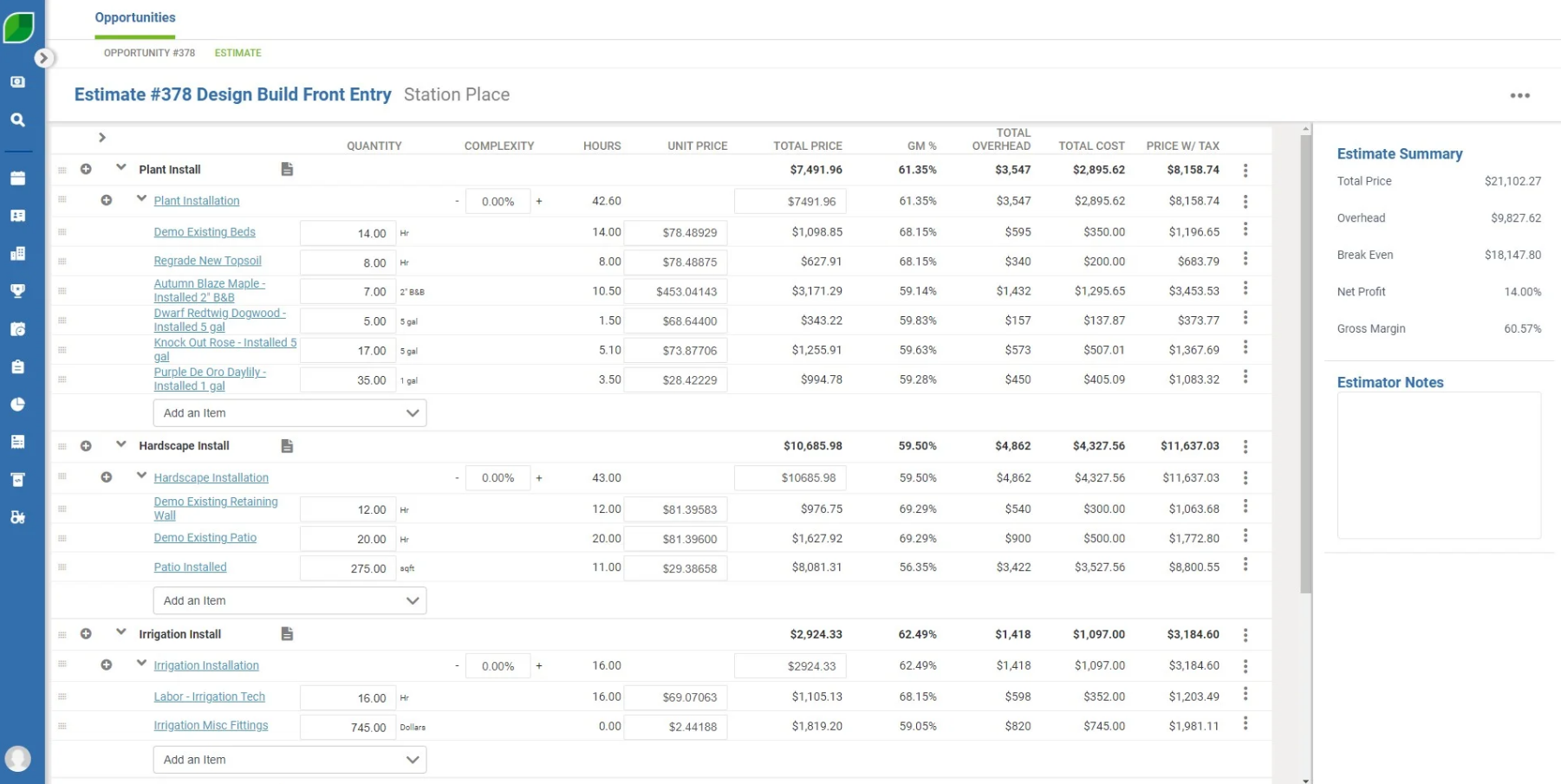
You can add your logo and branding to the contract before sending it to clients via email or the customer portal.
On this portal, clients can view and accept bids, sign contracts, and even pay their invoices.
Invoicing & payment processing
Imagine you could request payments from landscaping clients without sitting at your office desk to create a personalized invoice from scratch.
Instead of sending several “here’s a kind reminder” emails, you remind clients of upcoming invoices and get notified when they make a payment.
That’s what Aspire’s invoicing tool offers. It lets you create and send invoices to clients using project information and the estimates.
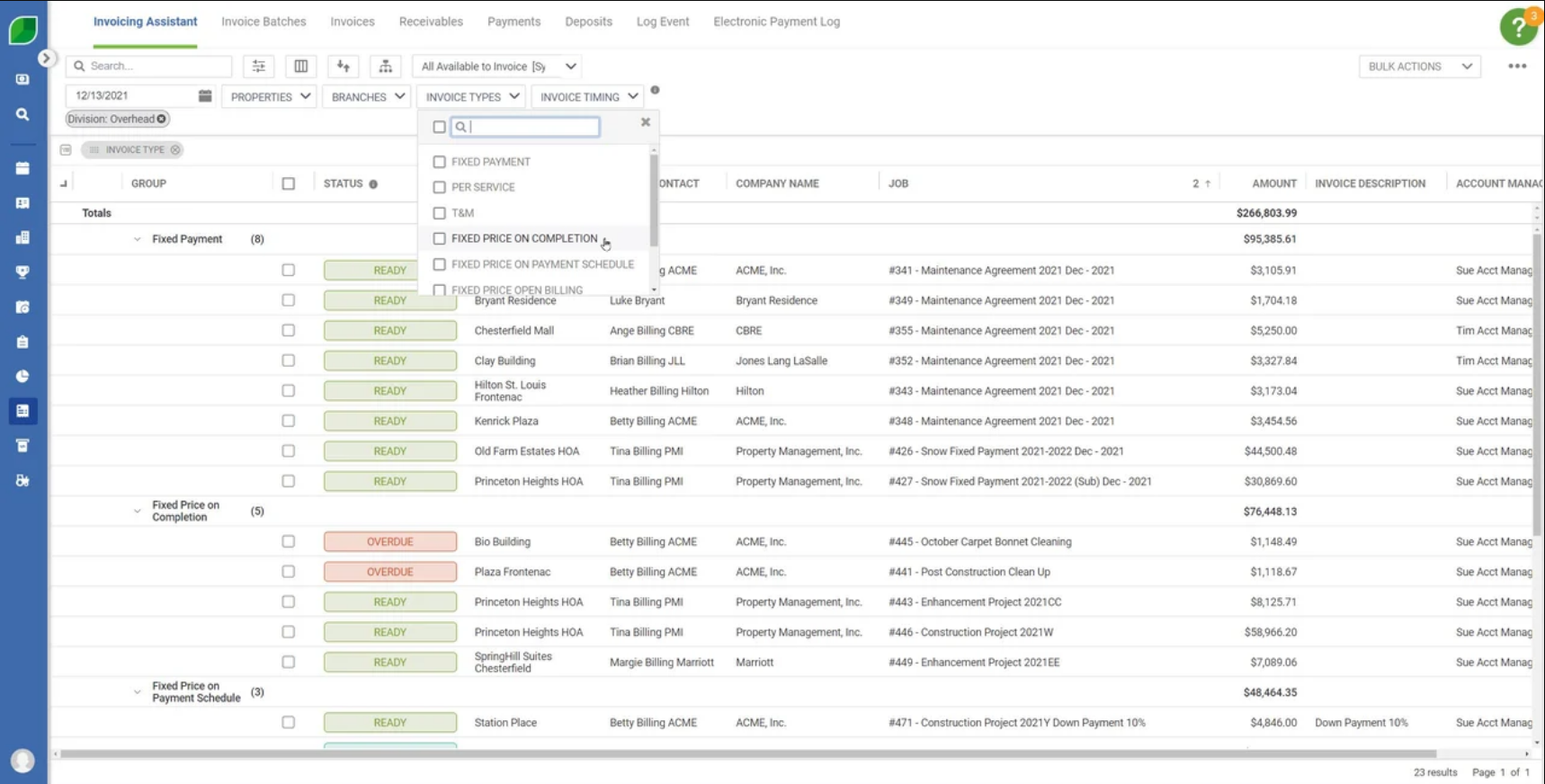
Invoices can be set to fixed, per-project, or progressive payments, with payments triggered when a milestone is reached.
Essentially, you don’t have to create each invoice from scratch.
Plus, with Aspire’s invoicing assistant, you never miss client billings, as invoices are classified based on their status — ready to send, overdue, or missing key information.
This ensures you’re always on track with billing and getting paid.
Business reporting & documentation
As a landscaping business, you need to know what goes on in the company to stay organized, build more efficient workflows, plan effectively, and scale the business.
Aspire’s reporting feature provides real-time data access, allowing you to assess business performance and make proactive decisions.
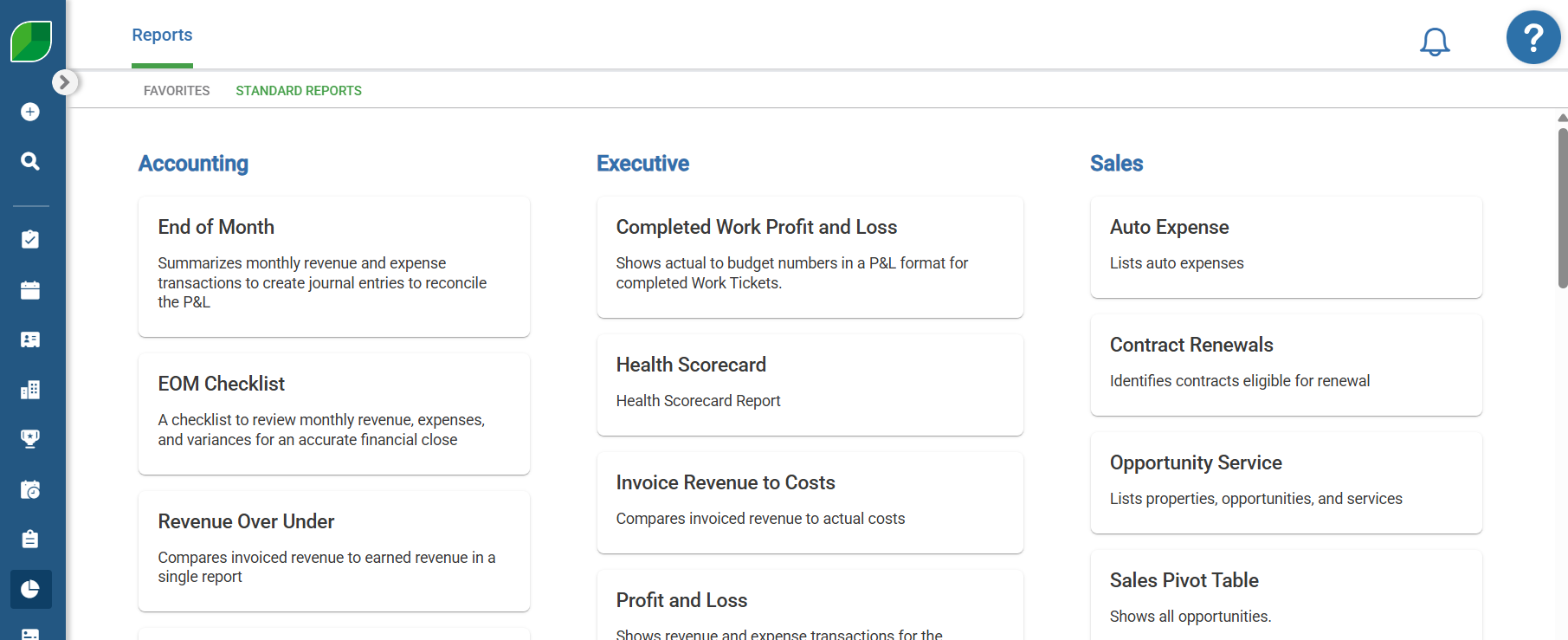
Instead of pulling data from monthly meetings or multiple sources and compiling it elsewhere, all information is immediately available organization-wide in an easy-to-understand format.
Aspire gives you comprehensive visibility into every aspect of the business — from direct costs and contracts to equipment usage, revenue, opportunities, employee productivity, and sales.
The platform provides both high-level overviews and granular insights for deeper analysis.
You can review completed job data by property, service, or division to make informed decisions about which landscaping services to offer, which contracts to renew, or what upsell opportunities to add to your service mix based on profitability.
Scheduling & job management
With Aspire, you can manage how landscaping projects are executed, who handles them, and when they are completed from a centralized location.
Its scheduling software makes it easy to schedule jobs the moment they’re won. It features a “calendar-esque” system that lets you see existing project dates, so you can pick a free day and avoid double-booking.
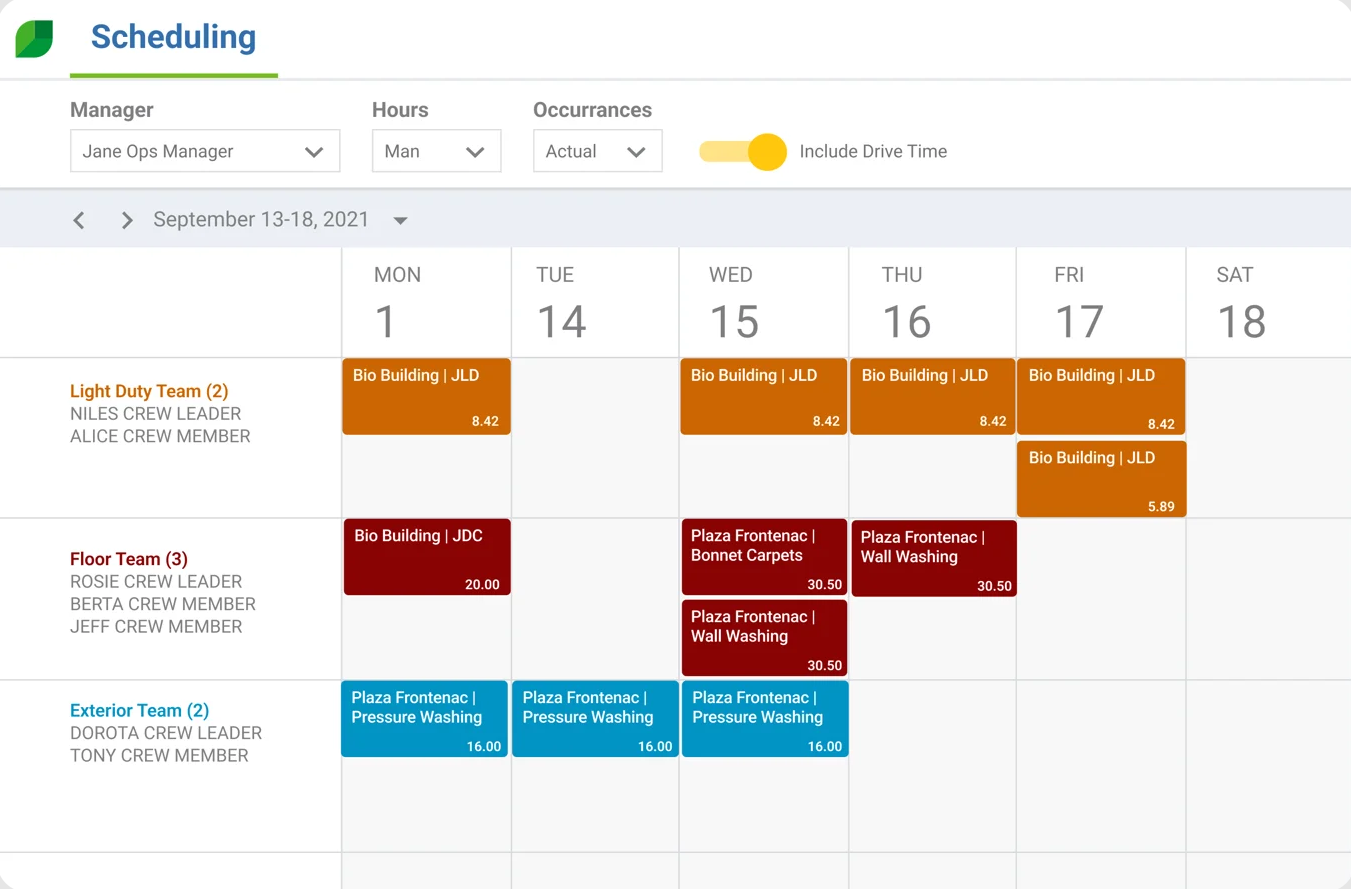
Aspire lets you adjust the schedule as needed, create checklists that field crews follow on-site, and track project progress in real time.
This ensures you have little to no scheduling conflicts, satisfied clients, better resource management, and no overworked employees.
Over to you
To start a landscaping business legally in Oregon, you need to complete the business registration process and apply for a permit that aligns with your work scope.
The right licenses allow you to advertise your landscaping services and execute projects.
However, to manage operations and scale your business, you need a system like Aspire to streamline your workflow and stay in control.
Aspire lets you automate time-consuming processes, such as site measurements, estimating, invoicing, reporting, client communications, and equipment management.
This ensures operations run smoothly and you can identify opportunities to scale.
Schedule a free demo to see how Aspire helps you take control of your landscaping business.
Disclaimer
This article is for informational purposes only and should not be considered legal or financial advice. While every care was taken to use official sources, you should always verify requirements with the Oregon government’s websites.












 866-727-7473
 Schedule Demo
 390 S Woods Mill Rd #300 Chesterfield, MO 63017


