
Table of Contents
Table of Contents
- Do you need a license to start a landscaping business in West Virginia?
- What are the types of landscaping business licenses & permits in West Virginia?
- Step-by-step process to get a landscaping business license in West Virginia
- How much does a West Virginia landscaping business license cost?
- What are the most common mistakes to avoid when getting a license?
- How Aspire helps landscaping businesses stay organized & compliant after licensing
- Over to you
- Disclaimer
You’ve got a mower, a blower, and a trimmer — essentially, all the basic equipment needed for taking on landscaping maintenance projects. But in West Virginia, advertising or executing landscaping services is prohibited without the right licenses.
Before you can start operating, you’ll need to complete certain steps and obtain the required permits based on the services you plan to offer.
This article outlines the different licenses you may require to start a landscaping business in this state.
Do you need a license to start a landscaping business in West Virginia?
You do not need a statewide landscaping license to begin operations in West Virginia.
However, a license is required for hardscaping projects, landscape irrigation installations, or any jobs that involve construction with a total project cost of materials and labor that equals or exceeds $2,500.
You also need permits for pesticide application services and for selling or distributing nursery stock.
The next section outlines the different licenses your landscaping business may need.
What are the types of landscaping business licenses & permits in West Virginia?
The licenses and permits required for a West Virginia landscaping business depend on the services you provide, such as construction work, pesticide application, plant sales, or landscape design.
Here are the types of licenses you need, depending on what you do.
General business license
You need to register your new business with the state before you can begin operations. This is how you show credibility with customers, stay compliant with state laws, and ensure the business is eligible for commercial business insurance, business financing, and even tax deductions.
In West Virginia, your business needs to be registered with the Secretary of State, the State Tax Department, and WorkForce West Virginia (unemployment compensation).
Contractor license
Landscaping businesses in West Virginia need a contractor license for construction projects. More specifically, if the total cost of materials and labor is $2,500 or more, a contractor license is required.
To get this license, you’ll need to:
Take and pass an examination.
Provide proof of workers’ compensation and unemployment compensation for all employees working in West Virginia.
Provide a wage bond to confirm your ability to pay workers.
Licensed pesticide application business license
This license is needed to commercially apply pesticides on clients’ properties. And employees who apply the chemicals must be licensed as commercial applicators by the state.
For your business to secure this permit, one person in the business must take and pass the LPAB examination. This requirement is separate from the exams taken by commercial applicators.
Your business also needs to provide certificates of insurance to show financial security in the form of a comprehensive general liability insurance policy (a minimum amount of $300,000 for bodily injury or death and $100,000 for property damage).
Nursery dealer license
If you plan to sell or distribute nursery stock you did not grow from seeds, cuttings, liners, or similar propagative material, you’ll need to register as a nursery dealer with the West Virginia Department of Agriculture.
To ensure your application goes through smoothly, you’ll have to list the names and addresses of everyone you get your nursery stock from.
Also, if you want to grow your nursery stock from seed, you need to register your nursery.
Interested in doing both? There’s one application that lets you register for both types of operations.
Landscape architect license
Want to offer services to design outdoor spaces and draw up detailed plans for stuff like patios, walkways, retaining walls, drainage systems, and where to put plants?
You’ll need a license from the West Virginia Board of Landscape Architects.
The application requires at least four references, two of which must be licensed landscape architects. This permit also requires certain educational qualifications and professional experience.
Permits and local regulations
Many cities and counties within the state require a local business license or permit for businesses to operate legally within city limits.
When opening new business locations or making renovations/improvements to existing buildings, you may be subject to local zoning laws. These laws vary from one location to another.
You need to contact your local county clerk or city government official to confirm what’s needed in your location.
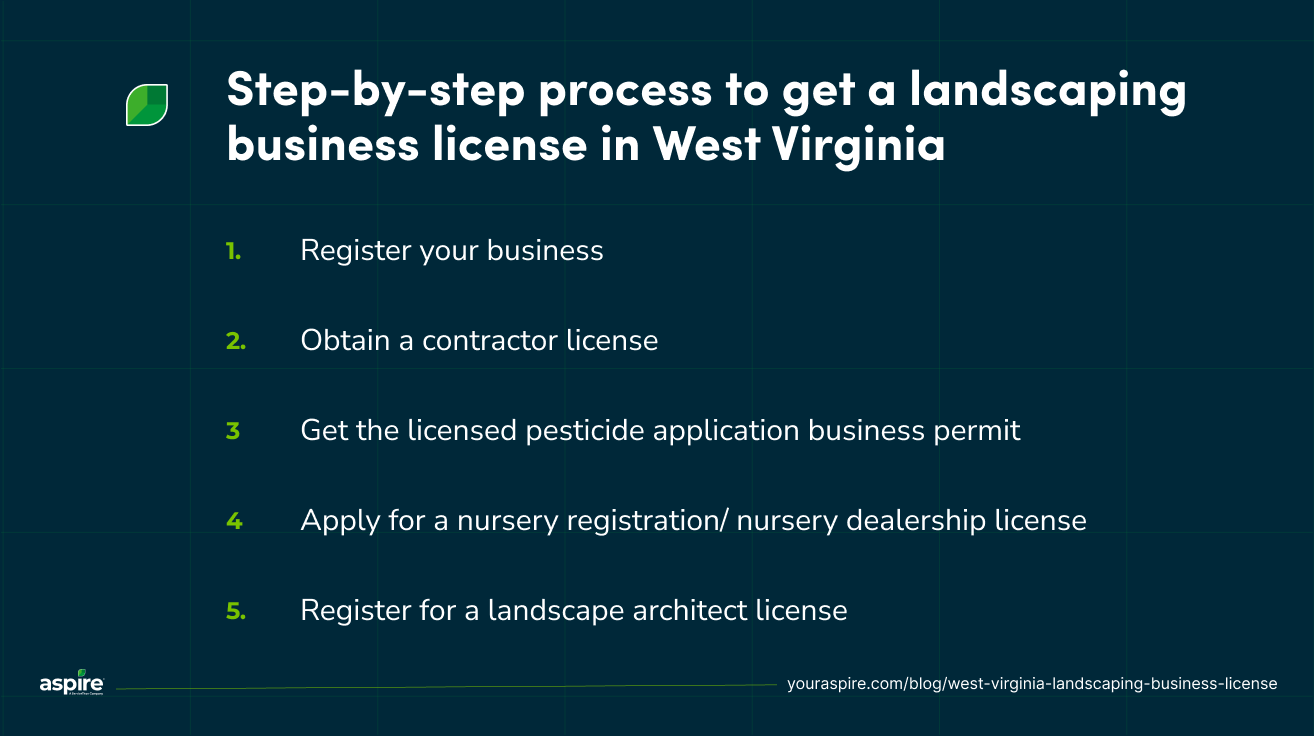
Step-by-step process to get a landscaping business license in West Virginia
Getting the right permits for your landscape business involves registering your business with the state and applying for additional licenses based on the services offered.
Listed below are the steps to obtain the licenses required for landscaping operations in West Virginia:
1. Register your business (required for all landscaping businesses)
Your first task as you begin this journey is to register the business with the state government. That’s the foundation that allows you to apply for other landscaping business licenses you may need.
Follow these steps to get your business set up in West Virginia:
Decide on a legal structure for your landscaping company. Do you want to start solo? Go for a sole proprietorship structure. Want to separate the business assets from personal ones? An LLC, a corporation, or an S-Corp will do. Thinking of adding partners or investors later? Consider a partnership structure.
Choose a business name and confirm its availability. For a sole proprietorship, general partnership, association, or joint venture, you’ll need to call the Business Registration Unit at (304) 558-3333 or 1-800-982-8297. For other business structures, you can search online using the Business Organization Search system.
Reserve the business name by filing a name reservation and paying the $15 reservation fee, which reserves the name for 120 days.
Register with the IRS to obtain a Federal Employer Identification Number (EIN), as you’ll need it to file taxes and register the business online.
Once you’re done with the IRS registration, proceed to register your business online through the One Stop Business Portal. It will cost you $100 to form an LLC (see costs for other structures).
On the portal, you can complete your registration with the Secretary of State (SOS), State Tax Department, and WorkForce West Virginia (for unemployment compensation).
You can also opt to use paper registration if online filings aren’t your thing. That would mean registering separately with the SOS, Tax Department, and WorkForce, and paying the associated filing fees.
For the Tax Division, here’s the application form to complete (a $30 fee applies).
The registration process already makes your business tax-ready. So, once you’re done, you can proceed to secure the licenses the business may need.
2. Obtain a contractor license (required only for projects $2,500+)
Before you can apply for this permit, you need to:
Email your scope of work as a landscaper to the West Virginia Contractor Licensing Board (CLBoard@wv.gov). They’ll then provide a written determination to advise you on which exam is required for your contractor license, along with the proper classification.
Schedule your exam with ProV, Inc. once the board responds about which test to take. You or a partner must complete the exam.
Provide proof of Workers’ Compensation and Unemployment Compensation for your employees.
Submit a wage bond affidavit (equal to four weeks' gross payroll at full capacity or production, plus 15% for benefits) along with the application to prove you can pay employees. Alternatively, have $100,000 in assets.
Once you meet all the prerequisites, submit your application online. The application will cost you $90.
3. Get the pesticide application business (LPAB) permit (if you apply pesticides)
To get the LPAB license, here’s the process to follow:
First, a qualifying individual (you, a business partner, or someone who won’t easily leave the business) needs to schedule a time to take the LPAB exam. Submit the exam application with a copy of your government-issued photo ID and a $20 exam fee. The exam is open-book, multiple-choice, and has 50 questions; you have 1 hour to complete it.
Secondly, secure liability insurance with minimum coverage of $300,000 for bodily injury/death and $100,000 for property damage. If you have employees, you’ll also need workers’ compensation coverage.
Thirdly, hire a commercial applicator. This is a professional working for the business, legally authorized in the state to apply pesticides/herbicides to others' lands for hire. They need to pass a separate commercial applicator exam. They must also provide their license application, a valid government-issued photo ID, and a $20 licensing fee for inclusion in the LPAB application.
After passing the LPAB exam, you’ll receive the application via email. Complete the application, gather all required documents, and mail the LPAB application along with a $60 licensing fee, a copy of your Tax ID certificate, proof of insurance, and the commercial applicator application materials to the West Virginia Department of Agriculture.
4. Apply for a nursery registration/nursery dealership license (required for selling or growing plants)
Here’s what you need to apply for this permit:
Nursery registration: Indicate the type of nursery stock you produce, show the approximate acreage of nursery stock you actually have in production, list the county where your nursery stock is being grown, and provide accurate directions or a map for locating all your nursery stock.
Nursery dealer permit: Provide the names and addresses of all your sources of nursery stock, as required by law.
If you want both, you need the information required for both permits.
Then, fill out and submit this application to the Plant Industries Division of the West Virginia Department of Agriculture. The cost is $30 for nursery registration and $60 per location for a nursery dealer permit.
5. Register for a landscape architect license (for landscape design services)
Getting a landscape architect permit requires:
A list of your educational background and degrees earned
Official transcripts from your college/university sent to the board office
A detailed description of your work history, including supervisors, employer names, dates, and duties
Four professional references; two must be licensed landscape architects, and two may be from an employer
A CLARB record (optional). If you’ve got this, you can skip the education and work experience requirements
Answering all required questions about criminal history, disciplinary actions, child support, and obligations
Confirming you’ve reviewed WV landscape architecture laws and regulations
Next, complete the application form, pay a $100 application fee, notarize the application, and send it to the WV Board of Landscape Architects.
How much does a West Virginia landscaping business license cost?
Here’s a breakdown of all the fees you may need to operate a landscaping business in West Virginia:
General business registration fees
Name reservation: $15
Business filing: $100 (LLC)
State Tax Division application fee: $30
Contractor license
Application fee: $90
Wage bond affidavit: Equal to four weeks’ gross payroll at full capacity or production, plus 15% for benefits
Pesticide business license
LPAB exam fee: $20
Commercial applicator application fee: $20
Licensing fee: $60
Liability insurance requirement: Minimum coverage of $300,000 for bodily injury/death and $100,000 for property damage
Nursery registration/nursery dealer license
Nursery registration fee: $30
Nursery dealer fee: $60 per location
Landscape architect license
Application fee: $100
License renewal fee: $100
What are the most common mistakes to avoid when getting a license?
Want to ensure the licensing process goes smoothly?
Here are mistakes to steer clear of:
1. Forgetting to register your business with the right state agency
In West Virginia, all new businesses must register with both the Secretary of State and the State Tax Department to obtain a business license identification number and maintain a State Tax Department account.
If you register only with the SOS and skip the tax department, you won’t be allowed to start operations, hire workers, or get the other landscaping licenses you may need.
And if you choose paper registration, there’s a specific path to follow:
LLCs, corporations, professional LLCs, limited partnerships, limited liability partnerships, or business trusts must register first with the Secretary of State for initial registration, then with the State Tax Department for the business license.
Sole proprietorships, general partnerships, associations, and joint ventures register with the State Tax Department for initial registration and the business license.
2. Failing to ensure your business name is unique
New businesses need to have a unique name before registering with the state.
According to West Virginia’s One Stop Business Portal, one of the most common reasons for rejection of business filings is that the proposed name is already in use in the state.
And by being unique, they don’t mean adding:
Corporate name endings (e.g., company, corporation, Inc., Ltd., or LLC)
Word separators and articles, like “The,” “A”, “And”, “&”, “-“, or “/”.
Singular versus plural words (“Food” vs. “Foods”).
Use of apostrophe(s) (“Farmer’s” vs. “Farmers”)
Separated versus combined words of the same name (“Cut Above” vs. “CutAbove”)
Do that, and you won’t be able to reserve the name or even register your business. You need to choose a name that’s different from any other registered business name to begin the application process.
3. Not having the right insurance certificates
When registering a new business in West Virginia, you need to have workers’ compensation insurance in case of workplace injury.
In fact, pesticide business and contractor license applications require proof of insurance before they can be approved.
Failure to obtain and maintain proper insurance coverage will subject you to several consequences.
So, ensure you have the right insurance before applying.
How Aspire helps landscaping businesses stay organized & compliant after licensing
Getting the right permits helps you begin operations in WV. But you need to make sure the business runs smoothly, stays organized, and grows without falling apart.
How do you respond to quotes or send proposals to several clients without disrupting daily operations? How do you handle multiple customers along one or several routes without missing deadlines or mixing up client requests?
Do you know everything that happens in the field and in the office without calling team huddles?
Aspire gives you control over your landscaping operation, streamlining workflows and ensuring nothing slips through the cracks.
Contract & proposal management
One way Aspire keeps you organized is by providing a simplified way to create estimates and respond to project proposals.
It has an estimation feature that lets you quickly create and send contracts to clients.
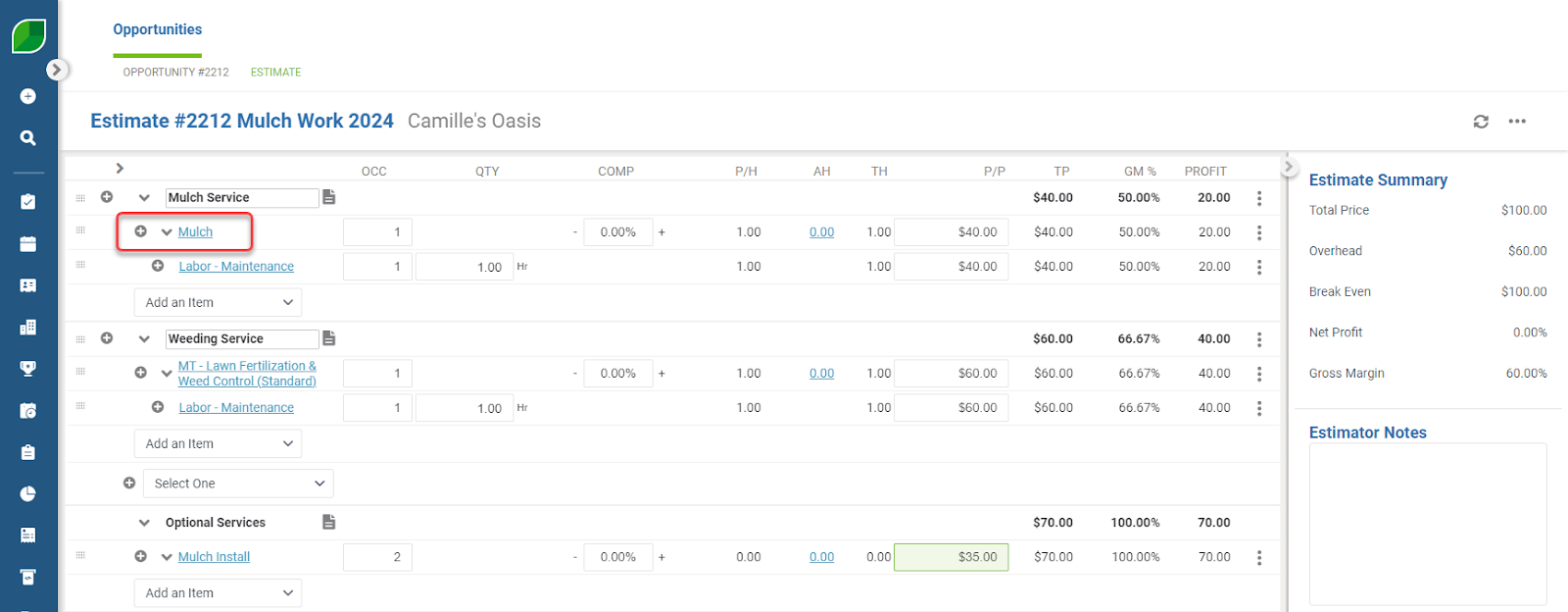
With its integration with PropertyIntel, you can measure client properties remotely and calculate the materials and supplies needed to complete a project.
From there, you can select a template from the estimation tool and add specific landscaping services, items, and pricing directly from your catalog. Your desired profit margins and markups are automatically factored in to ensure you turn a profit.
And once the estimate is ready, you can send it to clients via email or from Aspire’s customer portal, where they can respond and sign off on it.
Invoicing & payment processing
As your landscaping business grows and you have several projects in progress, manually chasing down payments and sending reminders can become overwhelming.
A tool like Aspire’s invoicing software simplifies the way you request and receive payment, regardless of your location. It lets you create professional invoices using details from an estimate and ongoing projects.
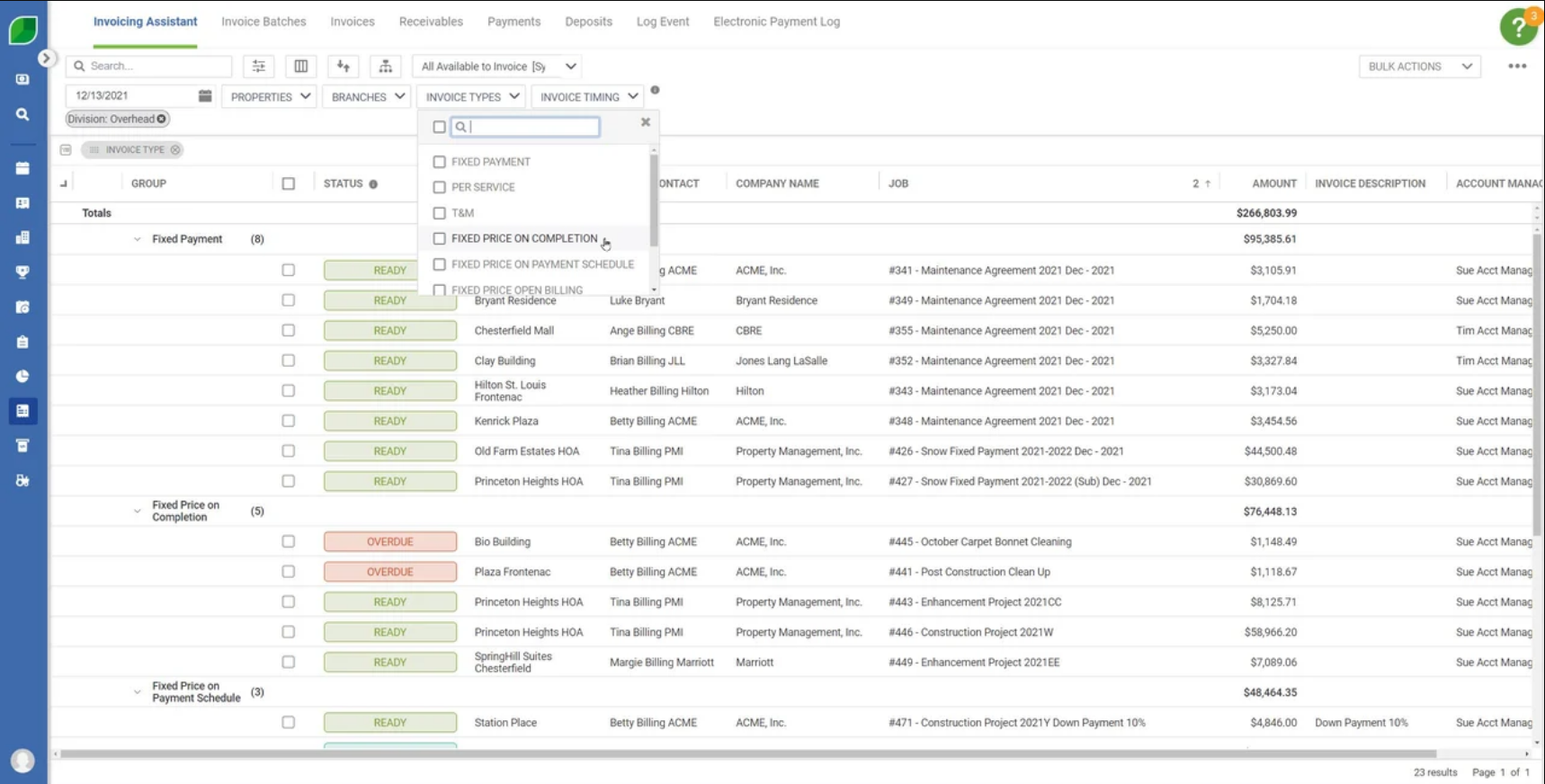
You can automate the process to bill per project, progressively, or after specific milestones. Like the estimates, invoices can be sent via email or through Aspire.
It also lets you track each invoice’s status to know whether it’s paid, pending, or overdue and receive payment through several gateways.
Business reporting & documentation
Aspire gives you complete visibility into everything happening in your landscaping business thanks to its reporting feature.
It lets you see every aspect of the operation, from fieldwork to contracts, invoiced revenue versus earned revenue, business expenses, opportunities, and more.
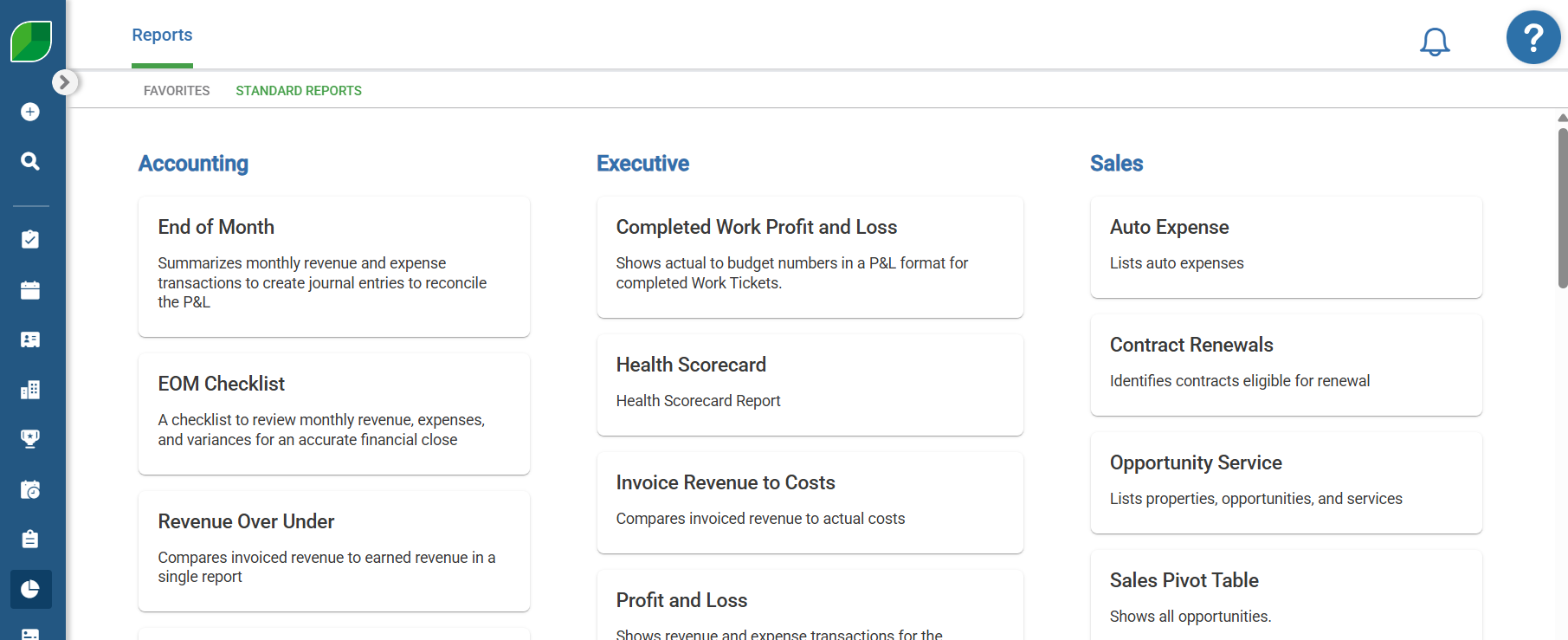
Instead of waiting for different team heads or field crews to compile and send month-end reports to know what’s going on, you have instant access to all the moving parts of your landscaping business.
As a result, you can make strategic, informed decisions based on up-to-date information.
Scheduling & job management
Another way Aspire helps your landscaping business stay organized is by making it easy for you to define when and where work happens.
Aspire offers a scheduling feature that lets you assign crews to specific jobs, define project timelines once an estimate is won, and visualize your team’s workload across days.
You can monitor job progress in real time and adjust schedules when incidents occur, ensuring no one is overbooked or left idle.
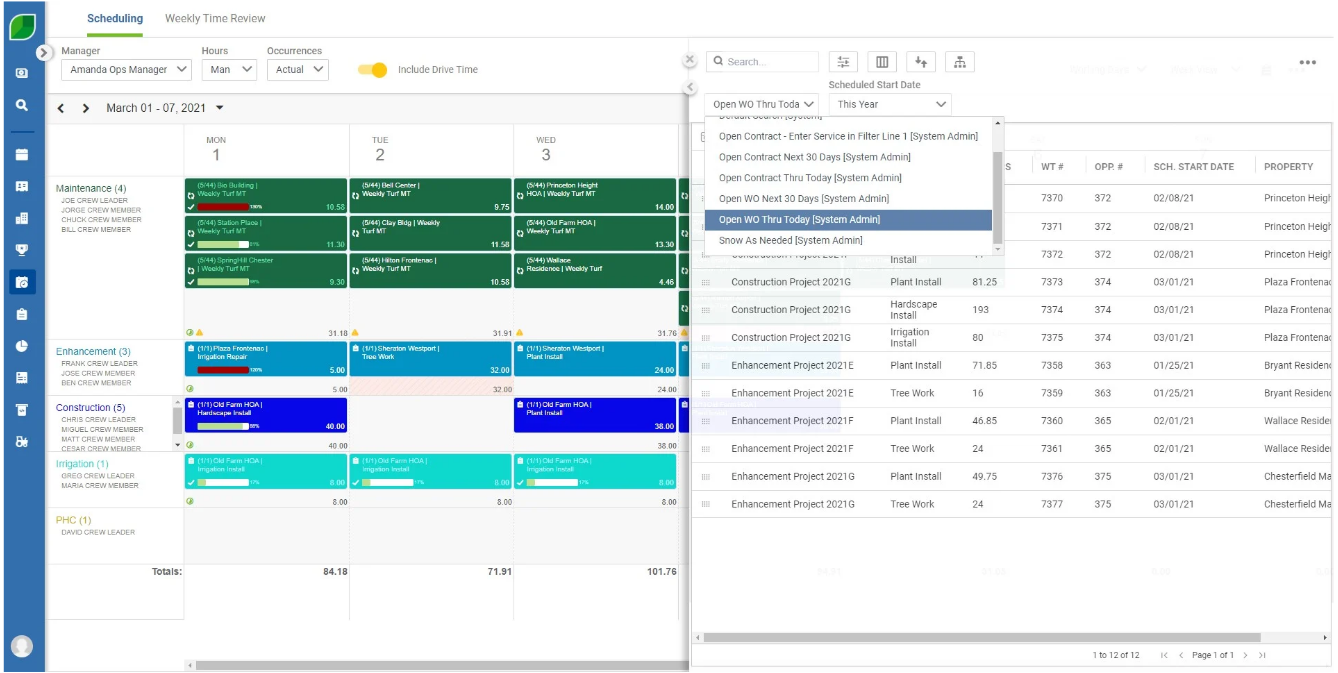
It also helps you optimize routes to reduce drive times between project sites. This results in fewer scheduling conflicts, greater client satisfaction, better resource usage, and fewer missed deadlines.
Over to you
This guide has shown you the different permits needed to start a landscaping business in West Virginia and how to secure them.
Once you’ve done that and are ready to begin operations, you need a management tool like Aspire to keep everything running smoothly. Aspire helps landscaping companies streamline everything from scheduling and invoicing to crew management and reporting.
Taylor Anderson of Sunline Landscape describes how Aspire transformed their operations:
“Aspire really helps us… to be ahead of the game. I’m able to really sit and focus on what’s effective in Aspire and where we can put it in our processes.
I’ve been able to not just help our CEO see numbers, but I can help our crew members take learning into their own hands, and they can grow from there.”
Book a free demo to see how Aspire can also transform your business.
Disclaimer
This article is for informational purposes only and should not be considered legal or financial advice. While every care was taken to use official sources, you should always verify requirements with the West Virginia government’s websites.













 866-727-7473
 Schedule Demo
 390 S Woods Mill Rd #300 Chesterfield, MO 63017


