Table of Contents
Table of Contents
- For the money, isn’t it worth it to build software customized to your business?
- Building software for a growing business is like trying to put on shoes when you’re already running
- Big errors grow from tiny mistakes in running operations
- You’re too busy to become a software expert
- You’re a great landscaper. Don’t waste time fixing software
- Aspire’s features scale with you for sustained, reliable growth

If your tech stack took up actual space in your office, would you still be able to use your desk? Sit in your chair? Open the door? If you printed out every spreadsheet your team uses, or has used, or started using and then abandoned, how many filing cabinets would they fill?
Digital clutter is easy to ignore because it’s invisible. But the space it consumes in your workday is costing you in data entry (and re-entry), out-of-date data, and lost opportunities.
In an industry where you can launch a business with little more than a lawn mower and a truck, piecemeal software solutions are common. You likely started with QuickBooks for invoicing and bookkeeping, then added a CRM, and maybe scheduling software. Now, you’re moving data between eight different tools and your monitor is surrounded by sticky notes for the things you haven’t had time to enter.
Your team has developed systems, routes, and workarounds so ingrained in your operations that implementing an end-to-end platform feels like starting from scratch.
For the money, isn’t it worth it to build software customized to your business?
Operational software is expensive and a permanent cost of running your business, like labor or equipment.
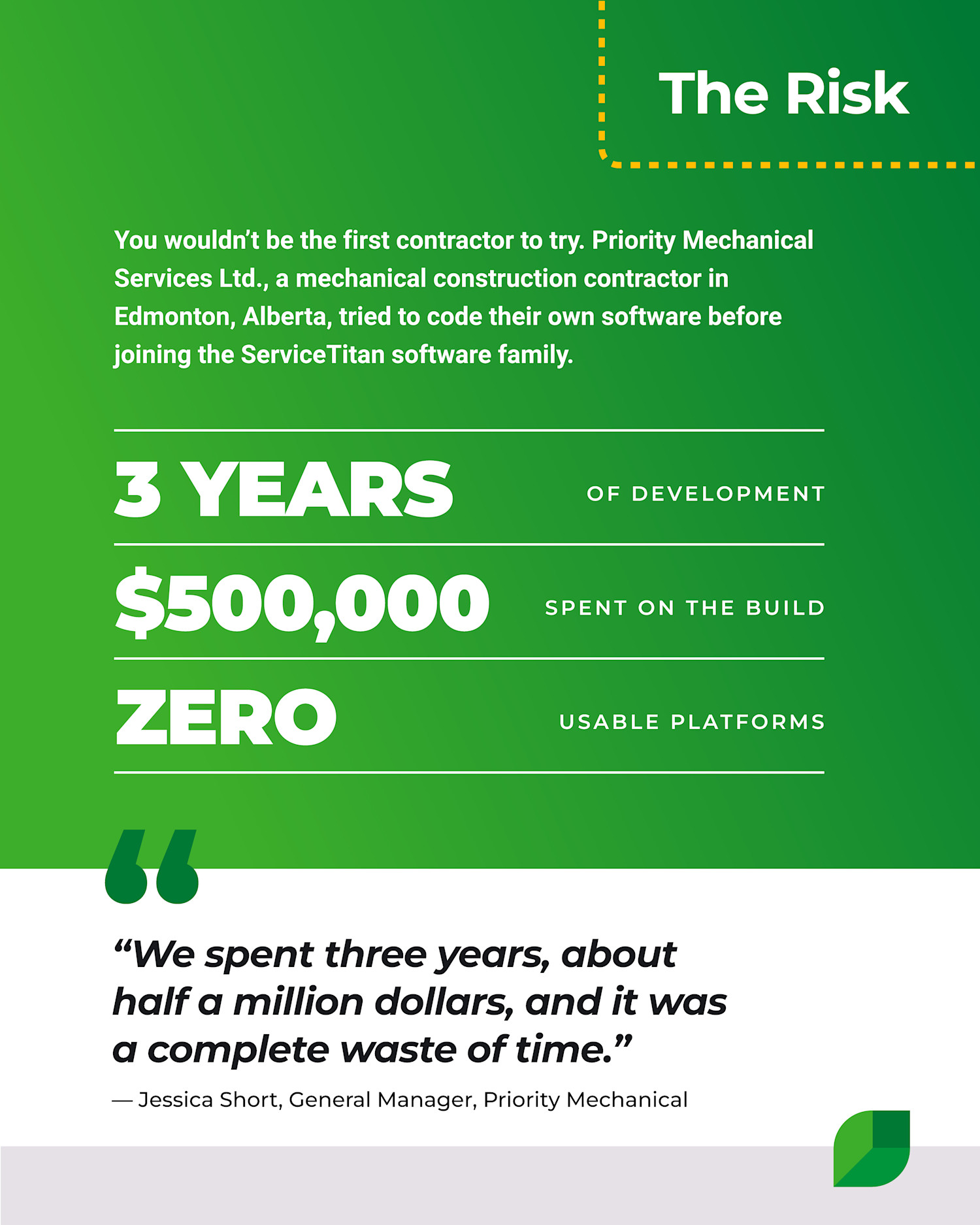
Priority Mechanical spent three years and $500K. At the end of an expensive and time-consuming process, they still didn’t have usable software.
Priority Mechanical’s General Manager Jessica Short described the endeavor as, “A complete waste of time.”
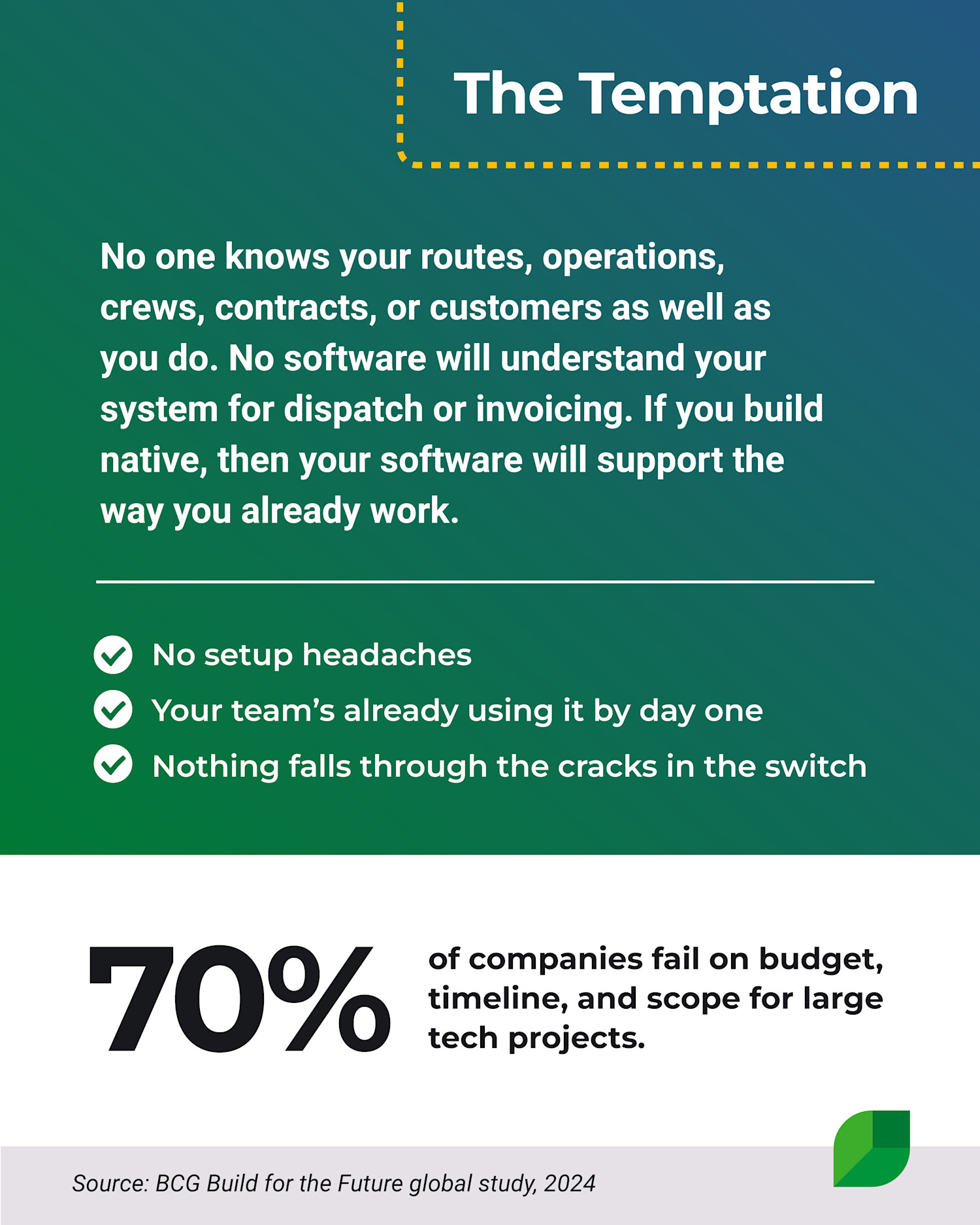
Is that really the case for every operator in the trades? Sixty-six percent of enterprise software projects overrun in budget and time. The half-million Priority Mechanical spent is more typical than not.
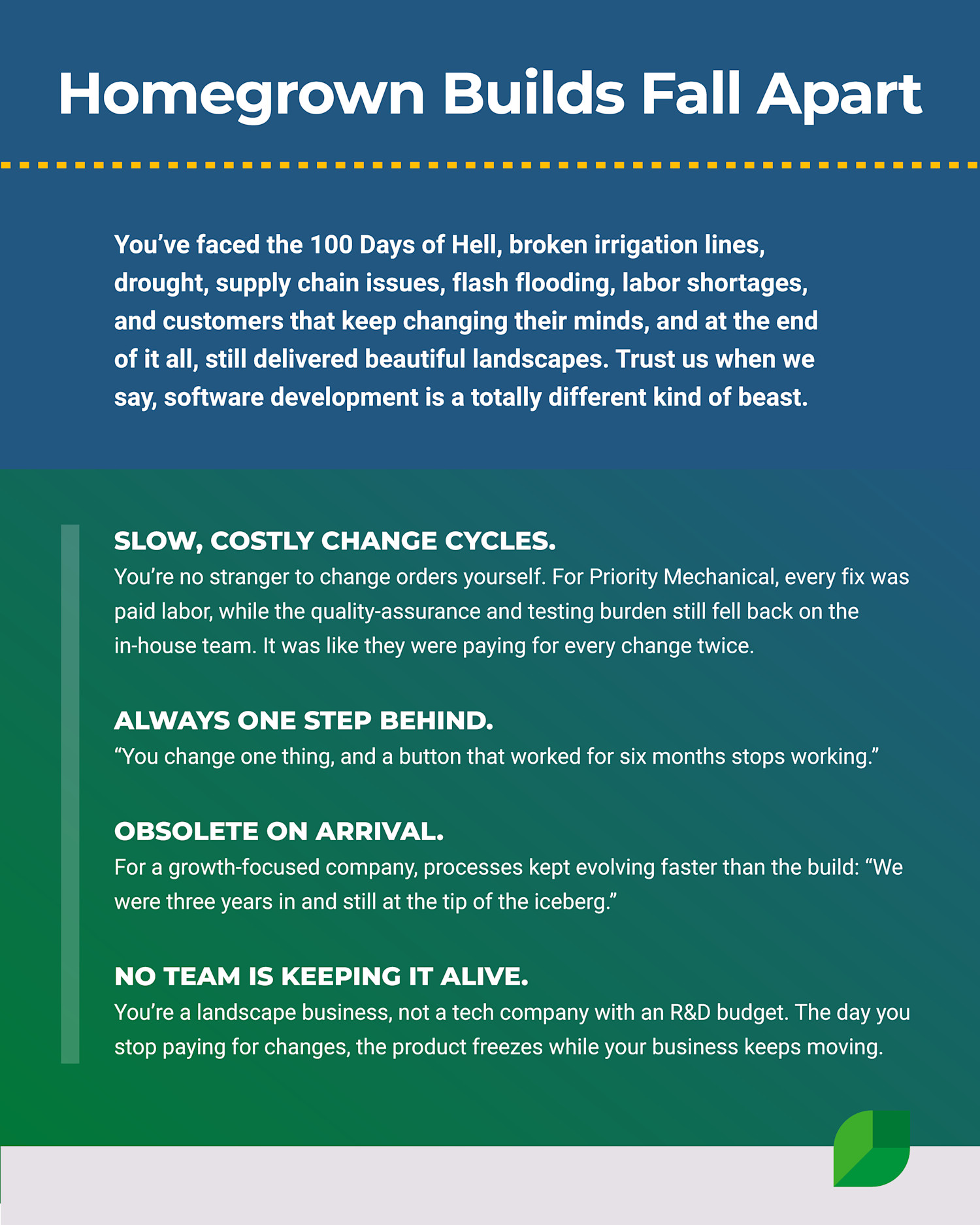
Even though it seems straightforward to build a program to your systems, there are thousands of tiny details that need to be identified, described, and then coded into the program. And Priority Mechanical found that, “You change one thing… a button that was working for the last six months stops working.”
Building software for a growing business is like trying to put on shoes when you’re already running
You’re not going to stop growing as the software is built, and as you add crews, trucks, routes, etc., your processes will likely change. Should you keep working in ways that aren’t serving you anymore to avoid another costly change to your custom software? Or accept that the changes will cost thousands more and weeks or months of extra work.
Signature Landscape was operating in three separate systems, none of which talked to each other. They implemented Aspire during a period of aggressive growth, just two years after merging with HeartLand. They were able to eliminate multiple systems and consolidate their data across all aspects of their operation. The result? Cutting down the time spent on job processing by half.
HeartLand has kept growing: 120% new-business growth from 2020 to 2024, with $500M in annual revenue.
On Aspire, HeartLand never had to call a developer, change their processes, or worry that adding acquisitions, customers, or crews would break the software.
Big errors grow from tiny mistakes in running operations
In a high-volume, mid-margin industry like landscaping, where labor costs are high, even a small error in job costing, time capture, or real-time data can dramatically impact margins. A safe 20% gross margin can easily slide to 12% if the software can’t calculate key metrics with precision.
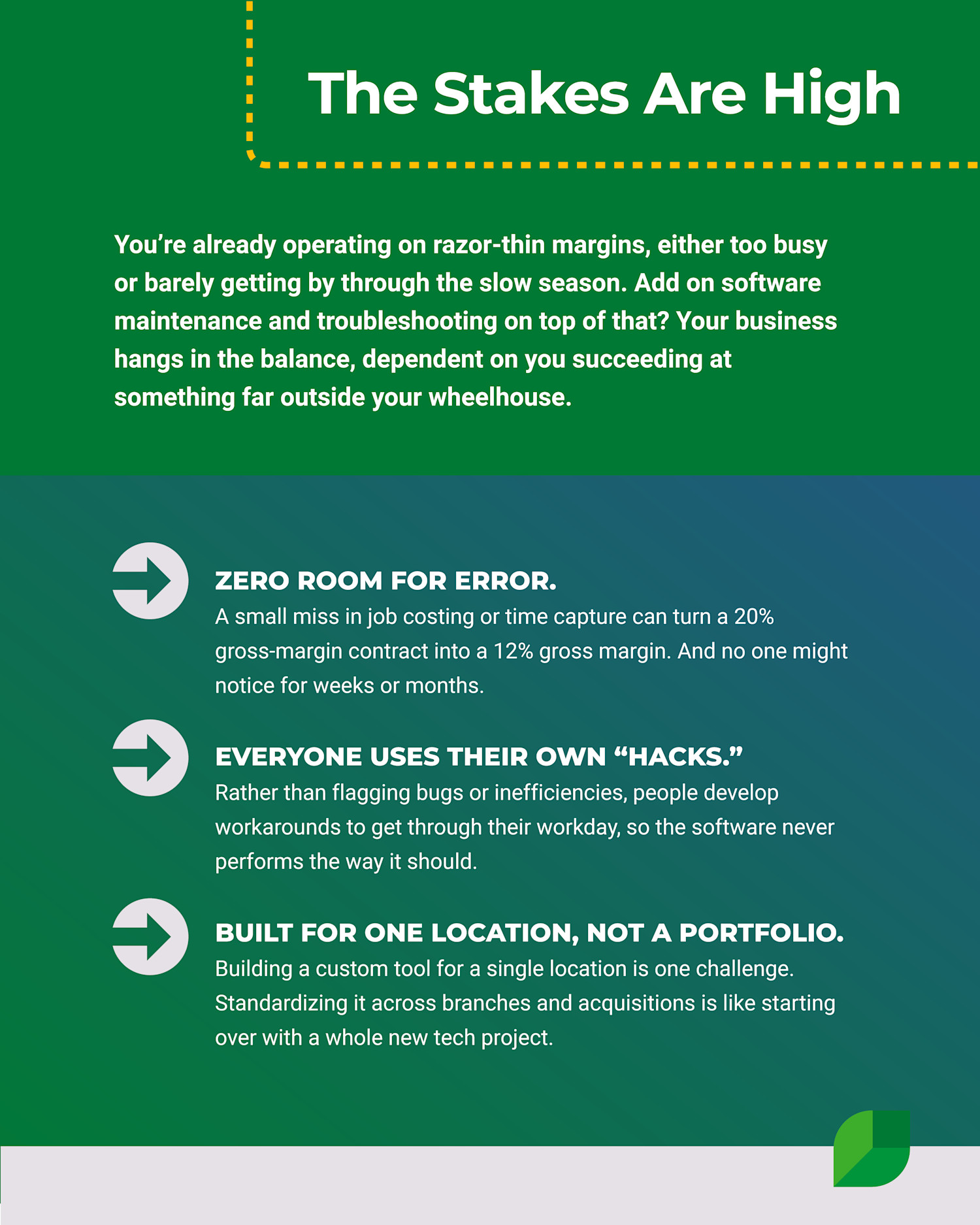
With custom software, current team members may develop Band-Aids and workarounds. They know which services need an extra hour or two of labor, or the secret six-step process for connecting to QuickBooks.
But when those people leave the company or retire, their legacy operational knowledge also leaves. Suddenly, margins disappear even though nothing has changed.
You’re too busy to become a software expert
Running a landscaping business is rewarding. But it’s also demanding, exhausting, a feast-or-famine seasonal grind. And with 110% of your attention on building success, you don’t have the time to become a software developer as well.
Software requires ongoing R&D to create and launch features that leverage the latest technology, such as AI. Custom software isn’t a one-time cost for a product that you’ll be able to run for the next 10 years. You’ll still need to anticipate new features and capabilities you might need in the future. You’ll have to iterate processes to find new efficiencies. You’ll be running a software company alongside your landscaping company, but only one will be generating profits.
You’re a great landscaper. Don’t waste time fixing software
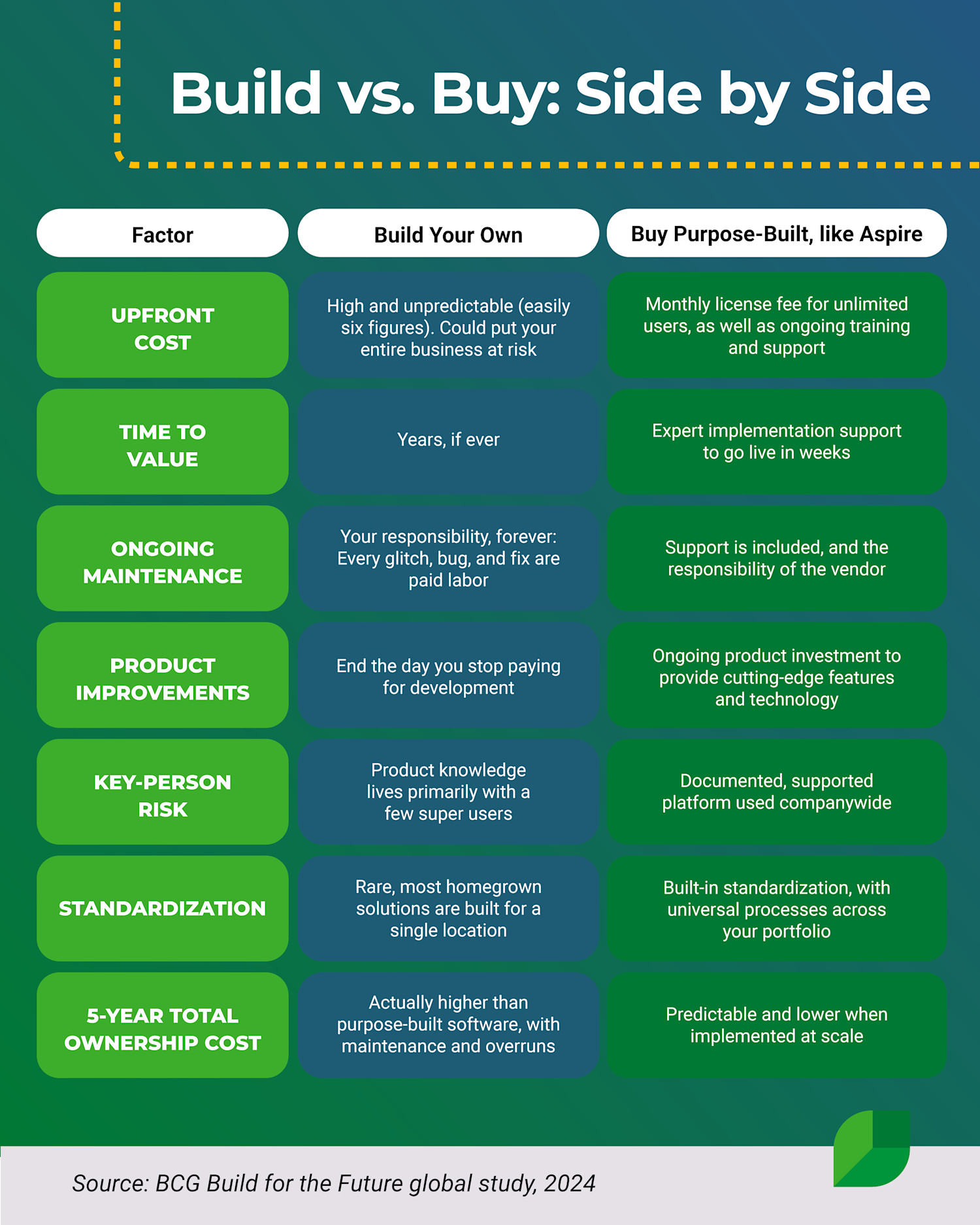
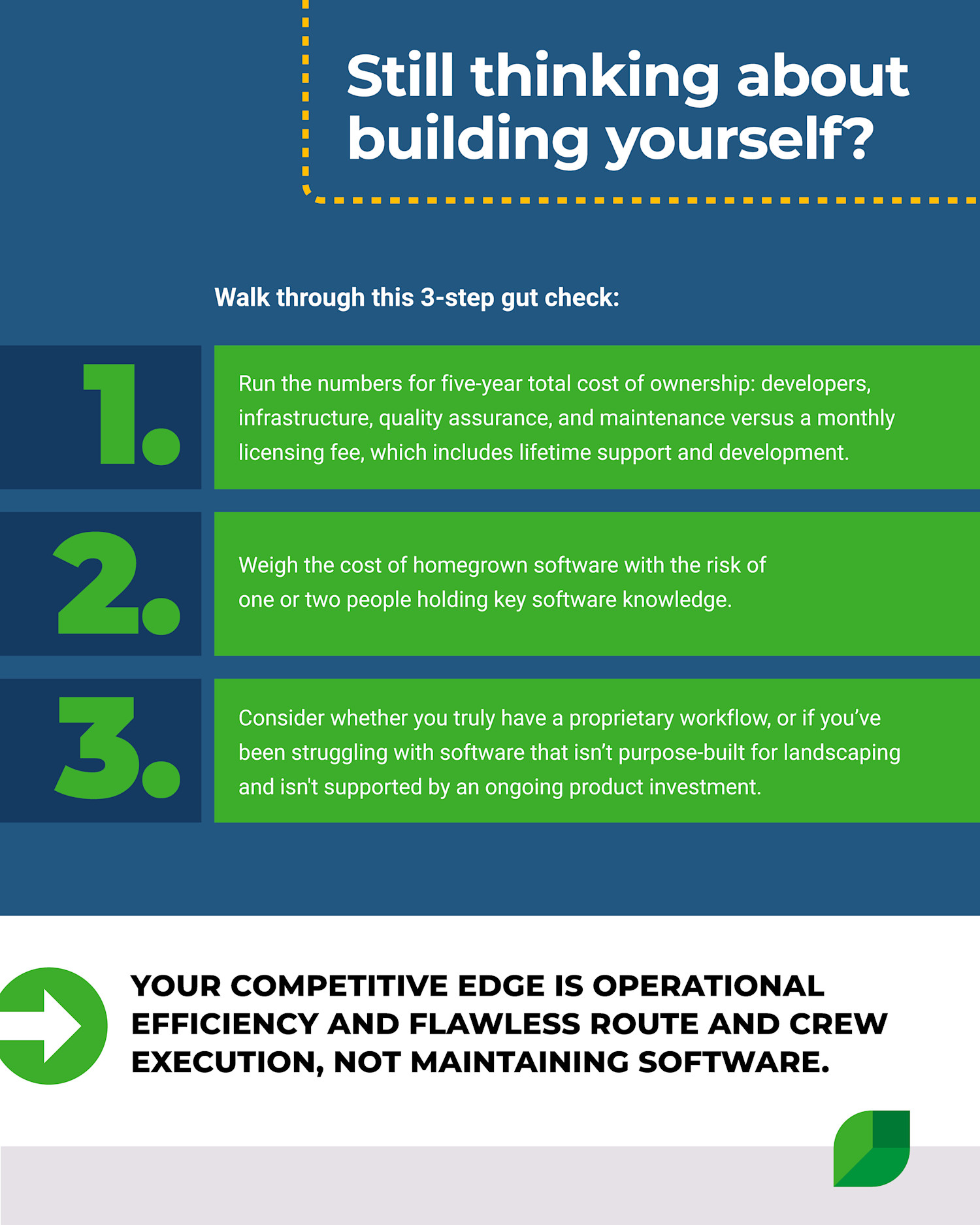
Take a quick gut check for building your own software. Add up everything it would cost to build your own software:
Developers
Project management for the build
Infrastructure
Quality Assurance
Maintenance
Ongoing R&D
Data security
Don’t forget the downtime and business interruptions when there are bugs or outages, the cost of data backups and recovery in case of data loss. There’s the opportunity cost as well, for all the time spent on the software rather than on your business. And the ongoing scaling costs as you continue to update the software as your business grows.
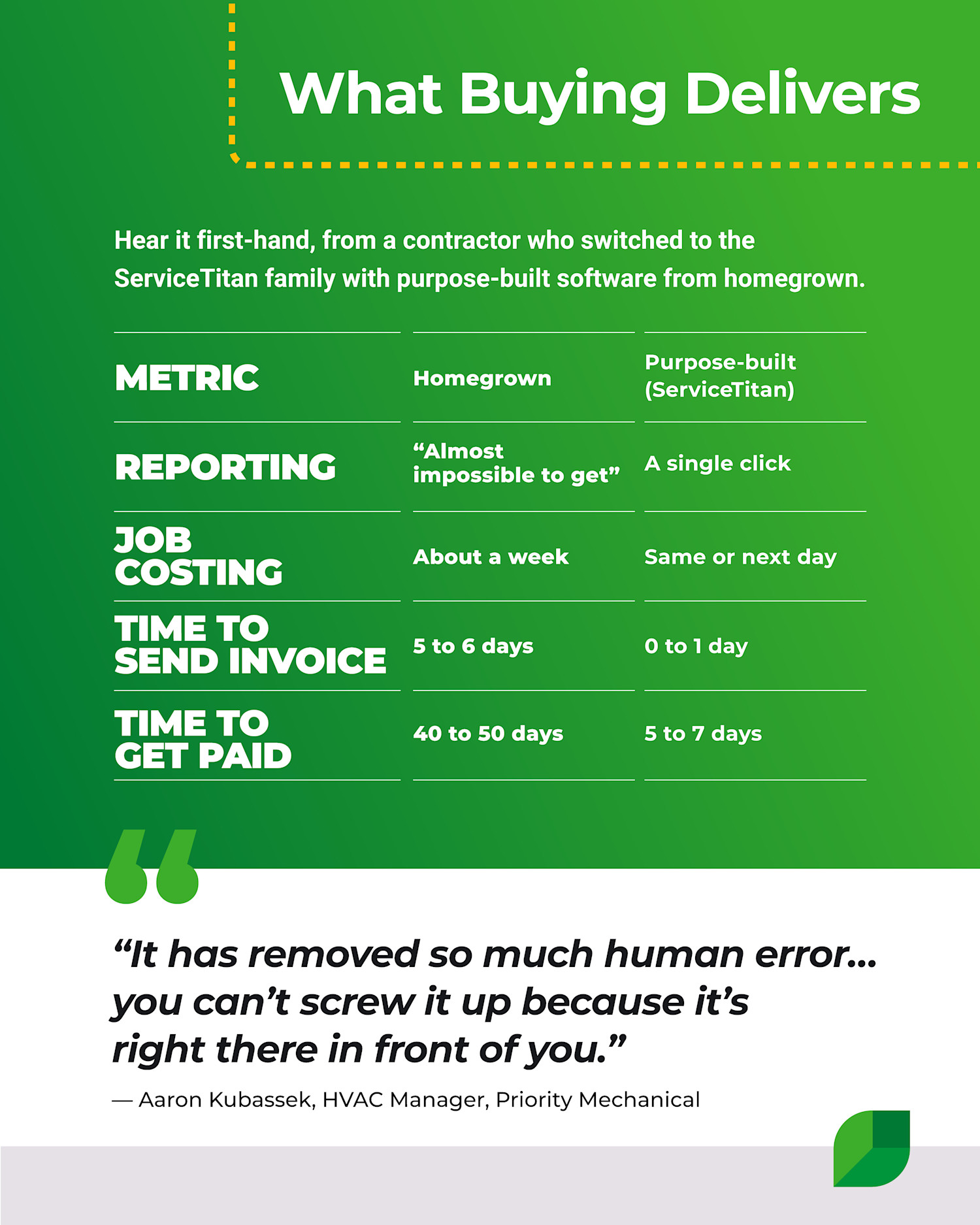
Then, compare that to the cost of an end-to-end software platform like Aspire:
A monthly subscription cost
Aspire comes with lifetime support and unlimited training, so operational knowledge will never walk out the door. With an ongoing product investment and over a decade of experience, Aspire is the technology partner trusted by 46% of the Top 100 companies on the 2025 LM150 list.*
Aspire’s features scale with you for sustained, reliable growth
“We couldn't really see how we would make 90% of our business fit into something that was centered around more than 10% of our business,” Short said about implementing an end-to-end platform. But with Aspire, landscaping operators never have to worry about software that doesn't understand their industry.
Industry insiders created Aspire, and since 2013, it has continued to refine the product specifically to help landscaping contractors run their businesses better.
Schedule a demo and discover how Aspire’s features have been developed and perfected to support best practices in the landscaping industry. With unlimited included users, a robust ecosystem of third-party integrations, and open API capabilities, you’ll never outgrow the platform.
Start operating smarter today.
* Based on analysis of the 2025 LM150 list, according to reported service mix, with revenue growth measured over the 2023-2024 calendar year.




 866-727-7473
 Schedule Demo
 390 S Woods Mill Rd #300 Chesterfield, MO 63017


