Table of Contents
Table of Contents
- Do you need a license to start a landscaping business in Connecticut?
- What are the types of landscaping business licenses & permits in Connecticut?
- Step-by-step process to get a landscaping business license in Connecticut
- How much does a Connecticut landscaping business license cost?
- What are the most common mistakes to avoid when getting a license?
- How Aspire helps landscaping businesses stay organized & compliant
- Over to you
- Disclaimer
To start a landscaping business in Connecticut, you need to secure the appropriate state and local licenses before operations can begin.
Without the right permits, you risk delays, fines, or losing potential customers.
The challenge, however, is figuring out what specific licenses you need and how to secure them. Do you rely on an agent to start the process? Or can you do it yourself?
If yes, where do you start?
That’s what you’re about to find out. In this guide, you will learn about:
The types of landscaping licenses you need in Connecticut
How to secure these permits
Costs associated with obtaining licenses
Common mistakes to avoid as you begin this process
Do you need a license to start a landscaping business in Connecticut?
Yes, you need a license to execute landscaping projects for jobs that cost over $200 and where the total cash price for all contracts over a 12-month period is expected to be more than $1,000.
Connecticut requires contractors involved in home improvement, which landscaping is a part of, to secure a home improvement contractor license for landscaping work on homes.
This covers:
Irrigation system installation
Tree and shrub planting or removal
Landscape lighting
Outdoor kitchens or hardscaping
Lawn installations
But if you intend to offer other landscaping services beyond these, such as pesticide application, you may need additional permits for your business.
Learn more about the types of licenses your landscaping business will require in Connecticut below.
What are the types of landscaping business licenses & permits in Connecticut?
Here’s a list of the different landscaping licenses you need to run a successful lawn care company in Connecticut:
General business license
All new businesses in Connecticut need to register with the Secretary of State to operate legally.
To do that, you need to:
Confirm your business name is available.
Select your preferred business structure.
Register a trade name.
Fill out forms based on your legal structure to register your business.
More information on how to register will be provided further down as you keep reading.
Home improvement contractor license
You need this license to execute landscaping projects that cost over $200, which is technically most jobs you’d get.
With this license, you can legally bid on and perform tree installations and maintenance, lawn mowing, hardscaping, flower planting, irrigation installation, and other landscaping projects.
Basically, it’s what you would typically refer to as a ‘landscaper license,’ but in Connecticut, it’s under a different name.
Income tax withholding and sales tax permit
If you plan on hiring employees (which becomes necessary as your landscaping workload increases), you’ll need to register for income tax withholding with the Department of Revenue Services (DRS).
This ensures you avoid penalties or compliance issues with the state, maintain accurate payroll records, and support your business reputation.
You also need a sales tax permit from the DRS to sell taxable goods and services legally.
Pesticide applicator licenses
You need a pesticide license if you intend to apply pesticides as a service. Keep in mind that the permit only covers your current base of operations.
If you hope to open other places of business in Connecticut, a license will be required for each physical location.
In addition to the business license, you also need a certified commercial operator and supervisor to carry out the job.
Nursery dealer permits
This license is required if purchasing and selling nursery stock is part of your landscaping services.
Not having one puts the company at risk with the state.
So, imagine a client wants you to buy and install ornamental plants or sod. Having this license enables you to execute the project legally and maintain a solid relationship with the client.
Local regulations
Depending on your location, your town may require a local business license or registration to operate.
You need to check with the municipal clerk’s office to confirm what’s required to start a landscaping business in the city.
Step-by-step process to get a landscaping business license in Connecticut
Wondering how to get the permits mentioned above?
Here’s a step-by-step process showing you how:
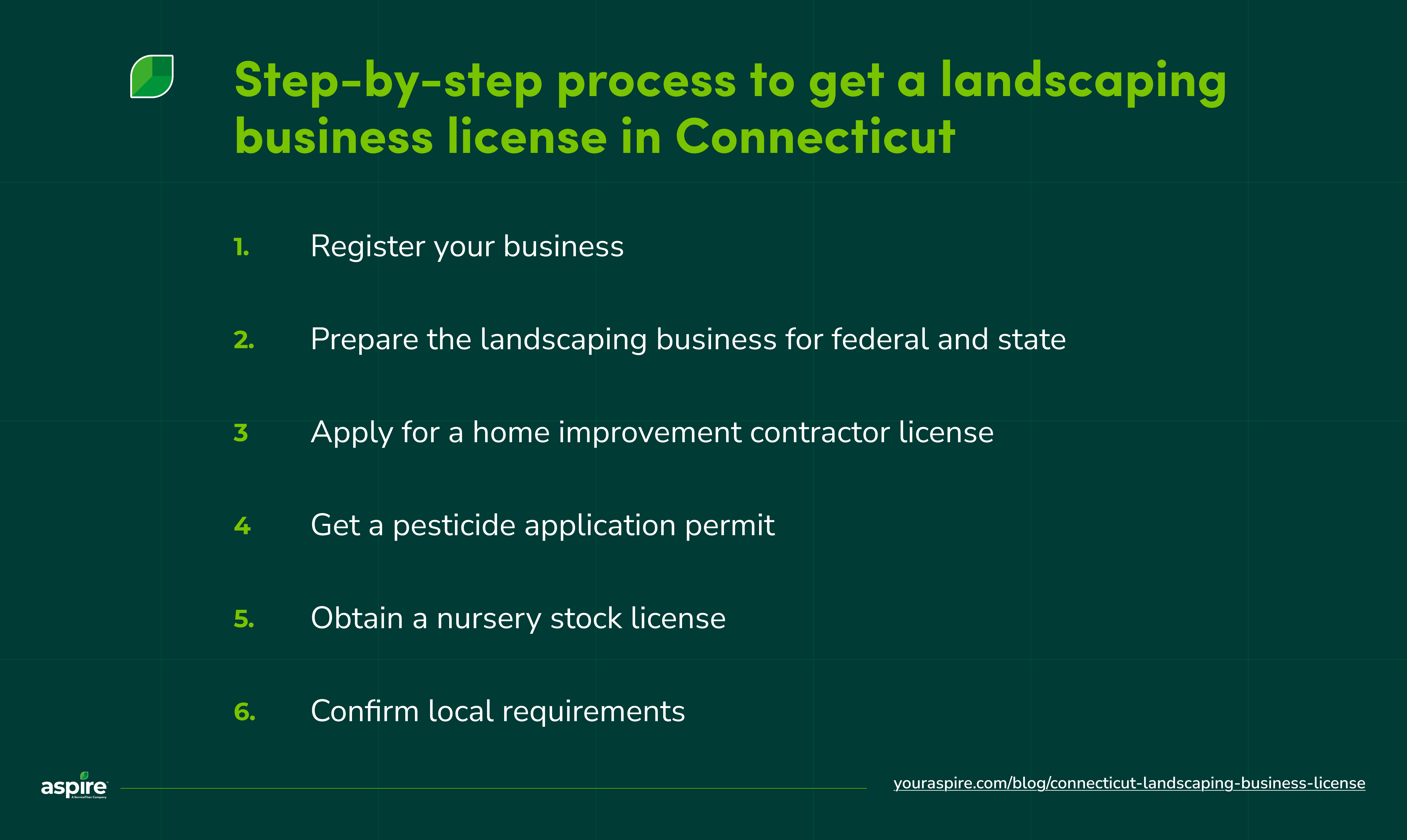
1. Register your business
Your first step is to register the business with the Secretary of State. Here’s how to do that:
Confirm that the business name you want is still available. Visit the state’s registry to do a quick name check. If it’s available, the name will need to be approved by the state before you can use it. They also require that your legal business name include certain words indicating your legal structure, e.g., Sample Landscaping LLC.
Get your NAICS code ready, as you’ll need it for registration. This is the code associated with your primary business category to be used when registering. For landscaping services, the code is 561730.
Select a legal structure that matches your business goals, such as:
Sole proprietorship for solo landscapers.
Partnership, if the business includes two or more partners.
LLC, if the ownership of your landscaping business is to be shared across individuals, corporations, LLCs, or foreign entities.
Corporations, which enable you to transfer shares across partners or owners easily.
File articles of incorporation based on your preferred business structure to register the business.
You can do this online by setting up an account with CT.gov and paying filing fees for your preferred business structure ($250 for corporations and $120 for LLCs). To file online, select your form from the LLC or corporation list, then follow the filing system to guide you through the process.
Alternatively, you can submit paper filings to register the business. You just need to download the PDF from the Paper Forms Library and submit your paper filing through the digital mail feature online.
2. Prepare the landscaping business for federal and state taxes
At the federal level, you need to register with the IRS for a federal employment identification number (EIN). It’s your business’s main tax ID, and it is crucial to have one, as this is how the IRS identifies the business.
To apply for an EIN, visit the IRS website and follow the process to complete an application.
At the state level, you need to register for income tax withholding and a sales and use tax permit.
Tax withholding is crucial if you’ll be hiring employees for your business in Connecticut, and a sales tax permit is needed since you’ll be selling taxable services or goods.
To register for either of them, visit the Connecticut Department of Revenue Services and follow the on-screen instructions.
3. Apply for a home improvement contractor license
This is the permit you need for landscaping projects over $200 in Connecticut.
Here are the requirements for registration:
General liability insurance worth $20,000 minimum, along with the insurance provider and policy number.
Applications must be done online.
Complete business registration with the Secretary of State.
Non-refundable $220 fee.
Once you’re ready to apply, follow the steps below:
Create an eLicensing account by visiting Connecticut’s licensing portal. Register as a solo landscaper, an LLC, or a corporation. If you’ve worked with the licensing agency in the past, the system will retrieve your account. You’ll then have to verify your email address before proceeding.
Begin your application. After logging in, click Online Services > Initial Application. Find the Home Improvement Contractor category, expand it, and click "Start" to open the application form.
Complete all the required fields. Go over the application requirements to ensure you respond to all questions correctly. Provide supporting documents where needed, as incomplete applications result in unnecessary delays.
Pay the application fee with a credit card or an electronic check. You’ll get an approved message that you can print and keep for your records.
Once you’ve paid, your application will be reviewed by the Department of Consumer Protection. This should take between 5 and 10 working days.
4. Get a pesticide application permit
Before you can get a pesticide business permit, you need a commercial supervisor and operator, or get someone on your team certified as one.
To apply for a supervisor permit, use the e-licensing platform and complete the exam application.
Follow these instructions:
Log on to Connecticut’s licensing portal > Online Services > Initial Application > Pesticide Management Program (DEEP) > Pesticide Commercial Supervisor Certification.
You can apply for up to 3 certification categories per application. Keep in mind that this permit belongs to whoever will work as the supervisor and not the landscaping business. If that's going to be you, then feel free to use your personal contact information and email.
Pay the exam fees and schedule your test through Everblue. Once you’ve applied, you’ll need to pay a $200 fee for the exam and a $285 licensing fee. After that, you'll receive an email from Everblue, the third-party exam coordinating company, on when you can take the exam. You then need to pay their $21 convenience fee per exam.
Complete the exam within the timeframe or reapply. You have between 60 and 90 days to complete the examination. Once you pass, your certification will be emailed to you. But if you don’t take the exam within the allotted period or fail it, you will need to reapply.
And for commercial operator certification, here’s how to get a team member licensed:
First, get them the Junior Operator Study Manual and Pertinent Pesticide General Statutes and Regulations to study for the exam.
Secondly, they need to create an account on the eLicense platform and apply for the Junior Operator Certification. Pay a $200 exam fee and a $21 Everblue proctoring fee for each exam category.
Thirdly, they must complete the exam within 60 days. If they pass, their certification will be emailed to them. And if they don’t, they have to wait 30 days before retaking the exam.
With both licenses secured, you can now apply for a pesticide business permit:
Create a business account on the eLicensing platform.
Click Online Services in the top right of the page > Initial Application > Pesticide Management Program (DEEP).
Complete the application form by filling out all the required fields.
Add supervisors and operators by typing in their names. As long as they’re certified, they should appear.
Review all responses on the final screen, click "Add to Invoice" if everything is correct, and proceed to payment. After that, your application will be reviewed, and a registration certificate will be emailed once it's approved.
5. Obtain a nursery stock license
You’ll need a nursery license if you intend to grow and sell stock for commercial purposes. But if you only want to sell stock, the dealer license is what you need.
To secure either of them, fill out this form from the State Entomologist and mail it to their office at 123 Huntington Street, New Haven, CT, 06511.
6. Confirm local requirements
Once you get the permits needed for your new landscaping business at the state level, visit your city’s office to check what permits will be needed.
Requirements typically vary across cities, but in general, they may require:
Specific landscaping license
General contractor permits
Landscaping vehicle and driver’s license
Insurance policies (e.g., workers’ compensation, general liability, or equipment insurance)
Surety bond
How much does a Connecticut landscaping business license cost?
To register your business and secure the different permits needed, here’s an overview of what you can expect to spend:
General business registration fees
Filing fees
LLC: $120
Corporations: $250
Renewal fees
LLC: $80
Corporations: $150
Home improvement contractor permit
Application fee: $220
Annual renewal: $220
Pesticide applicator license
Exam fee: $200 for up to 3 different supervisor categories
Exam retest fee: $200 for up to 3 different supervisor categories
Licensing fee: $285
Everblue convenience fee: $21 per exam taken on Everblue
Licensing renewal fee: $285 paid every 5 years at the time of renewal
Commercial operators
Application and examination fee: $200
Everblue convenience fee: $21 per exam taken on Everblue
Certificate renewal: $80 every 5 years
Business license application fee: $240
In addition to these, you would need to pay monthly premiums for insurance policies, especially for the home improvement license.
What are the most common mistakes to avoid when getting a license?
As you make plans to secure the required landscaping licenses, here are mistakes to steer clear of:
1. Not getting the proper insurance
As an employer of labor in Connecticut, you need workers’ compensation insurance to protect workers and your business in emergencies.
However, that’s not the only insurance coverage you’ll need.
When getting licenses, like the home improvement contractor license, general liability insurance of no less than $20,000 is required to be eligible for the application.
Failing to secure the insurance premium means you risk losing money (as there’s a non-refundable application fee) and not getting the permit needed for work.
2. Mixing up the pesticide license applications
To offer pesticide application services in the state, you need a Certificate of Registration from the Connecticut Department of Energy and Environmental Protection (DEEP).
You also need to pair that with an individual applicator certification from the department in the form of a commercial supervisor and operator.
Now, it’s easy to confuse the different registrations and think a business registration covers it all.
But that couldn’t be further from the truth, and you risk paying $5,000 for each day you violate the rules of registration laws.
3. Not checking renewal deadlines
You’ll need to renew your HIC, nursery dealer, and pesticide business licenses annually with the respective departments.
The same applies to your business registration, too. You’re required to file an annual report for your landscaping LLC or corporation with the Secretary of State’s office.
If you don’t do that, you won’t get a certificate of legal existence, making it difficult to do business. Plus, your company may eventually be dissolved.
How Aspire helps landscaping businesses stay organized & compliant
While securing a landscaping permit in Connecticut gives you the confidence to operate your business legally, it’s up to you to market the company and ensure customer satisfaction.
You need to set up systems for project monitoring, client communication, employee management, and cost tracking.
Doing these on your own can be stressful, with several events getting mixed up. Bookings overlap, deadlines are missed, field crews are stranded, and things are just messy.
That’s where a landscaping management app like Aspire comes in handy. It streamlines operations and ensures everything is organized.
Here’s how:
Contract & proposal management
Aspire keeps your business organized and running smoothly with its estimating feature by enabling you to create professional estimates from customizable templates.
Instead of the manual process of bidding on projects and preparing estimates, you can cut the time it takes to send proposals in half.
With Aspire, you pick a template and add the specific service from an existing catalog. Since it can pre-set labor and material costs, it’s easy to estimate new landscaping projects.
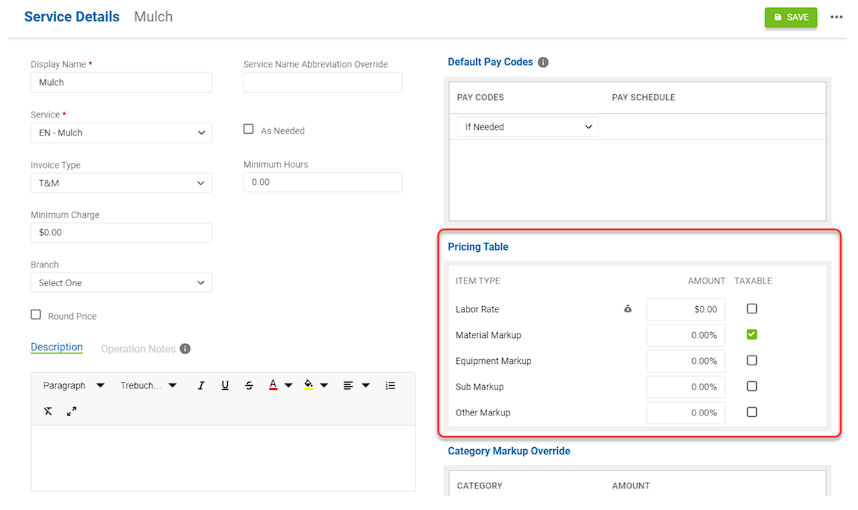
For profitability, you can also define your preferred margins and markups for labor, materials, and overhead. This way, they are automatically factored in for each project.
Invoicing & payment processing
Imagine the client accepted your proposal, and the landscaping crew has completed the job. Aspire lets you convert estimates into invoices, making it easy to request payments.
The data needed for the invoice already exists on the app, thanks to its estimating feature.
Aspire transfers that information into the invoicing tool, allowing you to generate a new invoice with ease. You just have to add the date, invoice number, client, and hit the send button.
With this field service app, you can also monitor each invoice’s status to track when it's been paid, is pending, or is overdue.
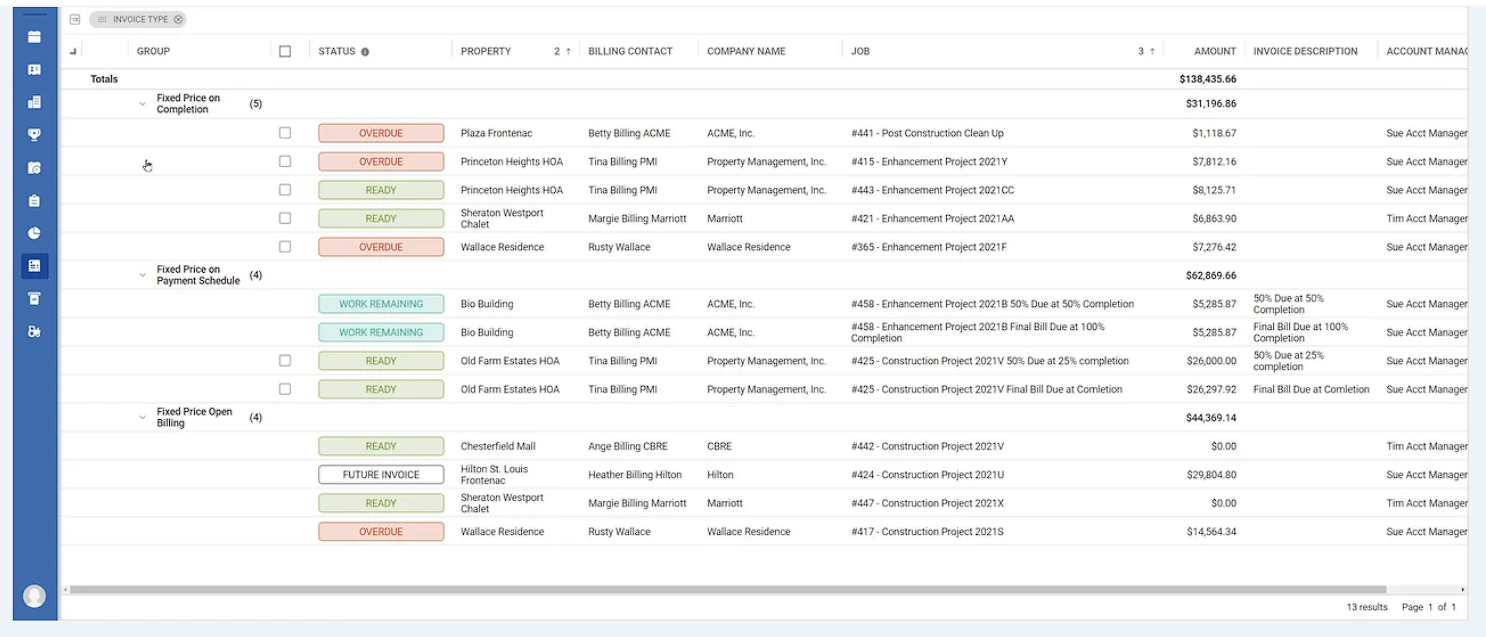
And beyond requesting payment, Aspire lets you receive payments, too.
Plus, it’s integrated with accounting software that helps you manage the business’s finances efficiently, giving you detailed reporting on how money goes in and out.
Business reporting & documentation
Next, Aspire’s reporting tool provides detailed performance insights into each landscaping project and the entire operation as a whole. You get to see the actual numbers behind what’s been the driving force of the business: revenue, cash flow, and profit and loss margins.
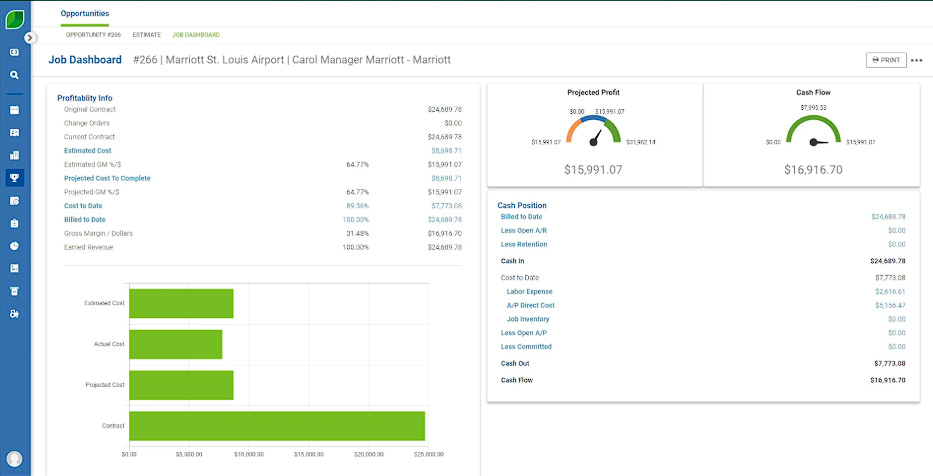
Instead of trying to piece together several Excel sheets covering employee payroll, customer lists, equipment maintenance logs, labor costs, or supplies, Aspire’s reporting provides access to all that data.
So, if you need metrics, such as client retention rate, employee productivity, projected profit, direct costs, and job inventory, you can find them on Aspire.
With access to such information, you can make better business decisions.
Scheduling & job management
Another way Aspire helps you stay organized is with its scheduling feature.
It enables you to oversee and manage projects without mixing things up or mismatching crews and clients.
You can schedule new projects as they’re won, set start and end dates, adjust projects, and assign jobs to crews.
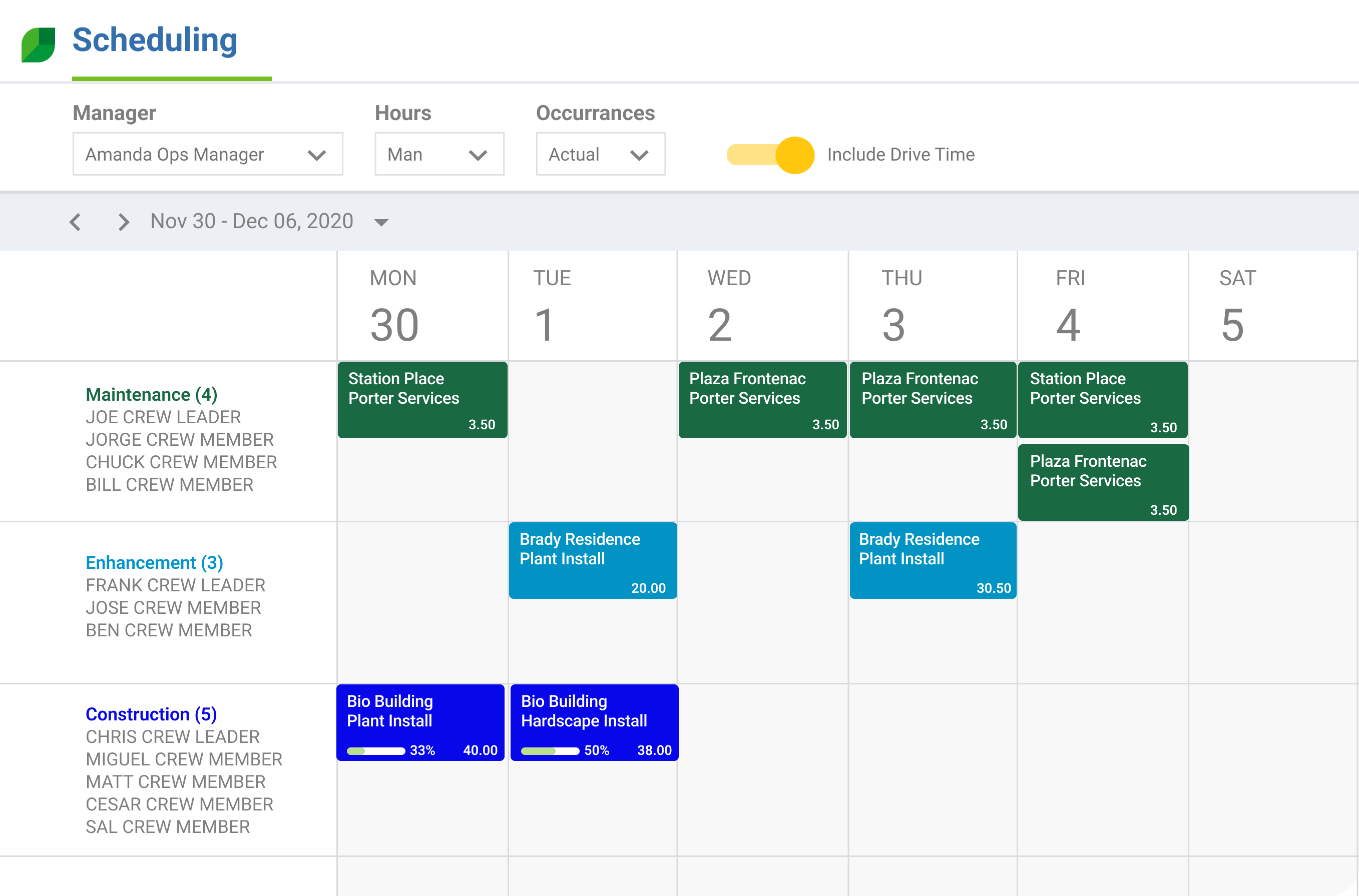
And that’s not all. Aspire allows you to add details for each project and provide checklists outlining how to execute them.
This way, everyone on the team knows what needs to be done and when.
You can also optimize routes to reduce drive time, save costs, and provide swift customer service.
Over to you
Securing the appropriate permits for your landscaping business is a big deal in Connecticut, and this guide has shown you where and how to obtain them.
To ensure you stay compliant with state laws, you need a system like Aspire to help streamline your operations. It automates processes such as estimating, bidding on projects, scheduling, and invoicing, and monitors various aspects of the business.
This way, it’s easy to know how well you’re performing and if the business is compliant.
Book a demo with Aspire today to see how it helps you stay organized and profitable, and scale your operations.
Disclaimer
This article is for informational purposes only and should not be considered legal or financial advice. While every care was taken to use official sources, you should always verify requirements on Connecticut’s government websites.










 866-727-7473
 Schedule Demo
 390 S Woods Mill Rd #300 Chesterfield, MO 63017


