Table of Contents
Table of Contents
- Understanding the payroll-to-sales ratio in landscaping businesses
- How to calculate the payroll-to-sales ratio for landscaping businesses
- Key factors affecting the payroll-to-sales ratio in landscaping
- How Aspire helps landscaping businesses optimize payroll-to-sales ratio
- Frequently Asked Questions (FAQs)
Payroll-to-sales ratio is a productivity metric that measures how effectively your landscaping business uses its labor costs to generate revenue.
Here’s why this is crucial:
If you have high labor costs and low sales, your profit margin will suffer.
Got too many employees compared to the number of active contracts? The business runs at a loss.
To stay profitable and ensure consistent growth, you must know how to balance labor expenses and revenue.
In this guide, you will learn how to determine whether your current labor costs are driving sales so you can manage them more effectively, improve profitability, and ensure efficient use of resources.
Understanding the payroll-to-sales ratio in landscaping businesses
The payroll-to-sales ratio helps landscapers evaluate the impact of labor costs on revenue and profitability. It’s the percentage of your revenue that goes toward labor costs, calculated by dividing total payroll expenses by total sales revenue.
The ratio answers questions, such as:
How efficient are you in managing labor costs? If you have a low ratio, it suggests that only a small percentage of revenue goes to payroll and that you have high profit margins.
How profitable is the landscaping business? If the payroll-to-sales ratio is high, it means a large share of revenue goes to paying workers, leading to reduced profitability.
How effective are you in leveraging labor costs to generate revenue? It shows how much you spend for each dollar earned.
Here’s an example to help you understand better:
Say you have a three-man crew paid $200 per day. If they work on eight properties per day and generate $1,600 in sales, that’s a good ratio. Why?
It shows your labor cost ($600) is being leveraged effectively to grow revenue. For every $1 in sales, you’re spending $0.375 on labor.
However, if that same crew, with the same labor cost, handles only four properties per day, generating $800 in sales, the ratio goes up. Your profit plummets as, for every $1 in sales, you’re spending $0.75 on labor.
Do you see the difference?
A low payroll-to-sales ratio means more profit for your business.
If your ratio is high, it forces you to unpack what’s driving up labor costs relative to revenue.
How to calculate the payroll-to-sales ratio for landscaping businesses
The ratio is calculated by dividing the total payroll expenses by the total sales revenue and multiplying by 100.
To calculate the ratio:
Determine the total payroll costs for a specific time period. Include expenses like:
Wages/salaries
Payroll taxes (employer portion of Social Security and unemployment)
Benefits (health insurance, retirement contributions)
Workers' compensation insurance
Overtime pay
Bonuses
Calculate the total sales revenue for the same time period as above. This is your gross revenue from all landscaping services before expenses are deducted.
Divide the labor costs by the total revenue, then multiply by 100.
Here’s the formula to use: Payroll to sales ratio =total labor coststotal revenue 100
Assuming your labor costs for the last quarter were $300,000, and total sales revenue was $700,000, the labor-to-sales ratio would be 300,000700,000 100 = 42.86%
This means that for every dollar earned, 42.86 cents is spent on labor.
Now, considering landscaping is a seasonal business, monitor the ratio regularly (daily, weekly, or monthly). This helps you know if you’re meeting your target profit margins.
You can also compare the same months over time to track annual progress and make adjustments.
Key factors affecting the payroll-to-sales ratio in landscaping
The payroll-to-sales ratio gives you insight into the cost-efficiency of your landscaping crew relative to revenue.
It’s affected by several factors that can increase or decrease it, regardless of your or the team’s efforts.
Understanding these factors is crucial to improving the ratio and increasing your profit margin.
Here are some of the key drivers you need to monitor:
Seasonal demand and payroll management
Landscaping is a highly seasonal business. During the summer, there’s typically a surge in demand, and you may need to hire extra hands to keep up with client requests. This can increase payroll expenses and, by extension, the payroll-to-sales ratio.
At the same time, in fall or winter, when demand is low, your labor costs may remain the same, meaning your ratio could still be relatively high.
Here’s what you can do during the seasonal fluctuations:
Use variable instead of fixed staffing: The trick is to hire a small core team comprising yourself, an operations manager, an admin/scheduler, or a landscaping crew leader. If needed, supplement with seasonal contract labor and part-time office staff. This ensures payroll increases only when there’s a surge in sales.
Offer off-season services to maintain consistent revenue: Consider services like snow removal, cleaning, or leaf cleanup so the business generates revenue year-round.
Incentivize productivity: Instead of immediately hiring more field staff during peak season, how about incentivizing productivity for current employees? Incentives encourage your existing workers to be more productive, thus reducing the payroll-to-sales ratio.
Some other options to consider include temporary layoffs and flexible scheduling.
Company size
The size of your landscaping company can affect the payroll-to-sales ratio. For instance, if you run a large landscaping business, there’s a good chance that your ratio will be high because of the huge workforce you manage.
Alongside the field crew, there are supervisors, schedulers, and other office staff who are on the payroll but do not directly generate revenue. This contributes to the high ratio.
At the same time, large companies benefit from economies of scale. They can balance things out thanks to established systems that improve efficiency and their ability to secure high-value commercial contracts.
The experience for smaller businesses is completely different. Even though they have more flexible staffing, it might be difficult for them to balance labor costs and sales revenue.
Owners split time between field and administrative work, and hiring their first employees often spikes the ratio before revenue catches up.
Here’s how to manage the situation for both cases to ensure a low payroll-to-sales ratio:
Small to medium businesses should use subcontractors during growth phases and hire full-time employees only when they have consistent sales.
Large companies must leverage automation to reduce the number of administrative staff. This would help reduce their ratio.
Crew productivity and efficiency
If your crew spends a lot of time commuting to job sites, takes longer to complete a project, or makes costly mistakes on the job, there’s a high chance that labor costs will increase, leading to a spike in the payroll-to-sales ratio.
Experienced workers complete jobs faster with fewer mistakes, generating more revenue per labor hour. Inexperienced crews take longer, require supervision, and make costly errors.
Here are suggestions to ensure crews remain productive and help you maintain moderate labor costs:
Train crew workers on efficient techniques and proper equipment use to help them be more productive.
Pair newbies with veterans to accelerate learning without sacrificing quality.
Monitor the crew’s productivity to identify efficient teams and duplicate their strategies.
Create a checklist to guide workers in approaching common tasks to avoid rework and reduce time spent on a project.
How Aspire helps landscaping businesses optimize payroll-to-sales ratio
Aspire gives you the tools to monitor labor accurately, control payroll expenses, and connect crew productivity to revenue, all of which can help you maintain a healthy payroll-to-sales ratio.
Here’s what Aspire offers:
Real-time labor tracking: This landscaping management platform helps you monitor crew productivity. You can see when they clock in and out of a job site, travel time, and job durations.
This helps you eliminate unproductive hours, spot labor overruns, and flag inaccurate timesheets. By accurately tracking labor, you can identify what’s inflating labor costs and improve ratios.
Job costing: Aspire breaks down labor costs for each project, allowing you to monitor the most and least profitable jobs, the most demanding clients or specific services, and overworked field crews. This allows you to adjust pricing to reflect the team’s efforts.
Scheduling: Aspire’s scheduling tool helps you assign employees to jobs based on proximity and experience.
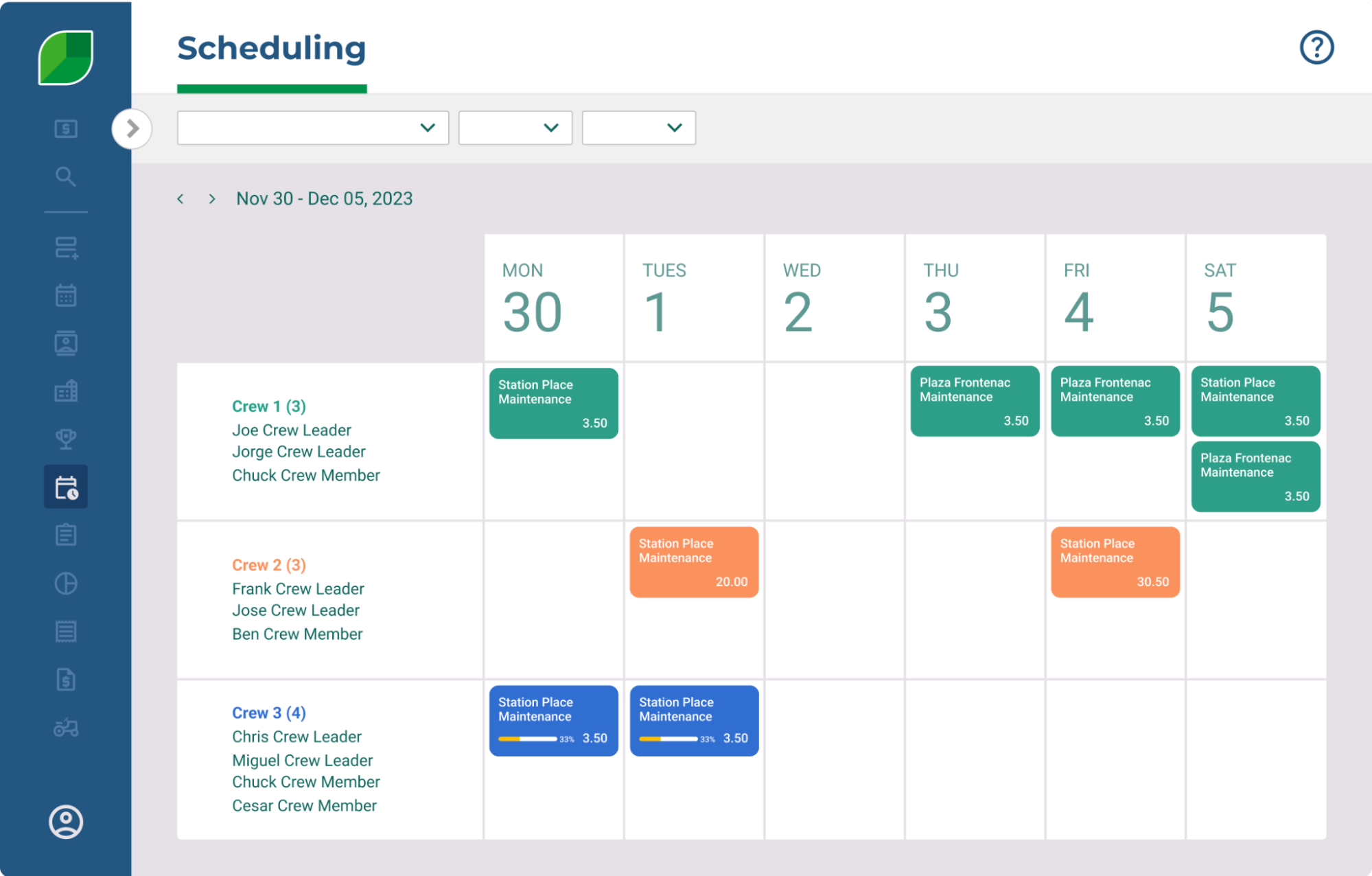
This ensures everyone understands their responsibilities, leading to fewer overtime situations and more predictable payroll costs.
Matching the field crew to the workload improves labor efficiency and the stability of the payroll-to-sales ratio.
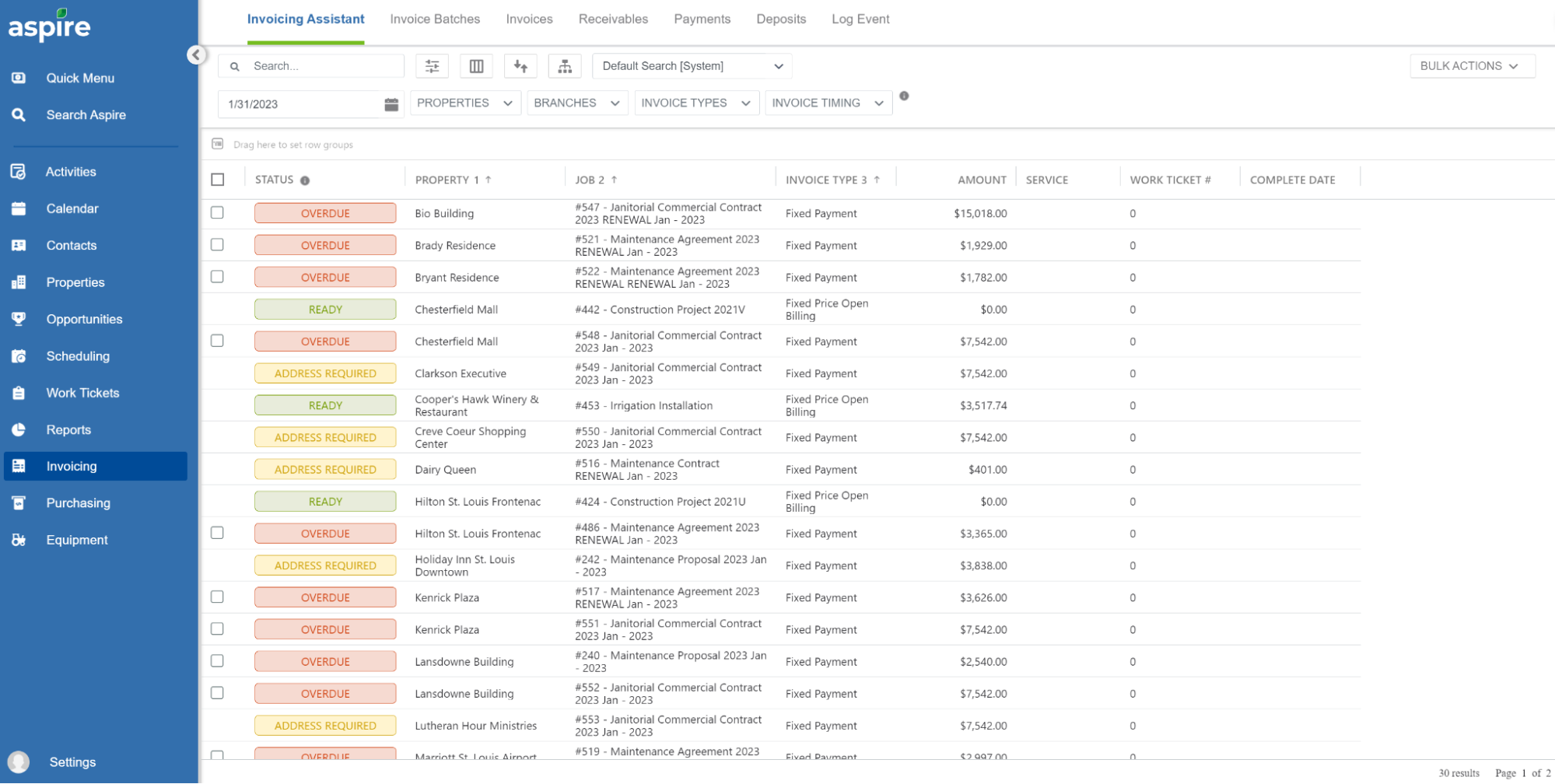
Invoicing: Automated invoicing means fewer administrative tasks for your team. Aspire automates the billing process, allowing you to invoice progressively or post-completion.
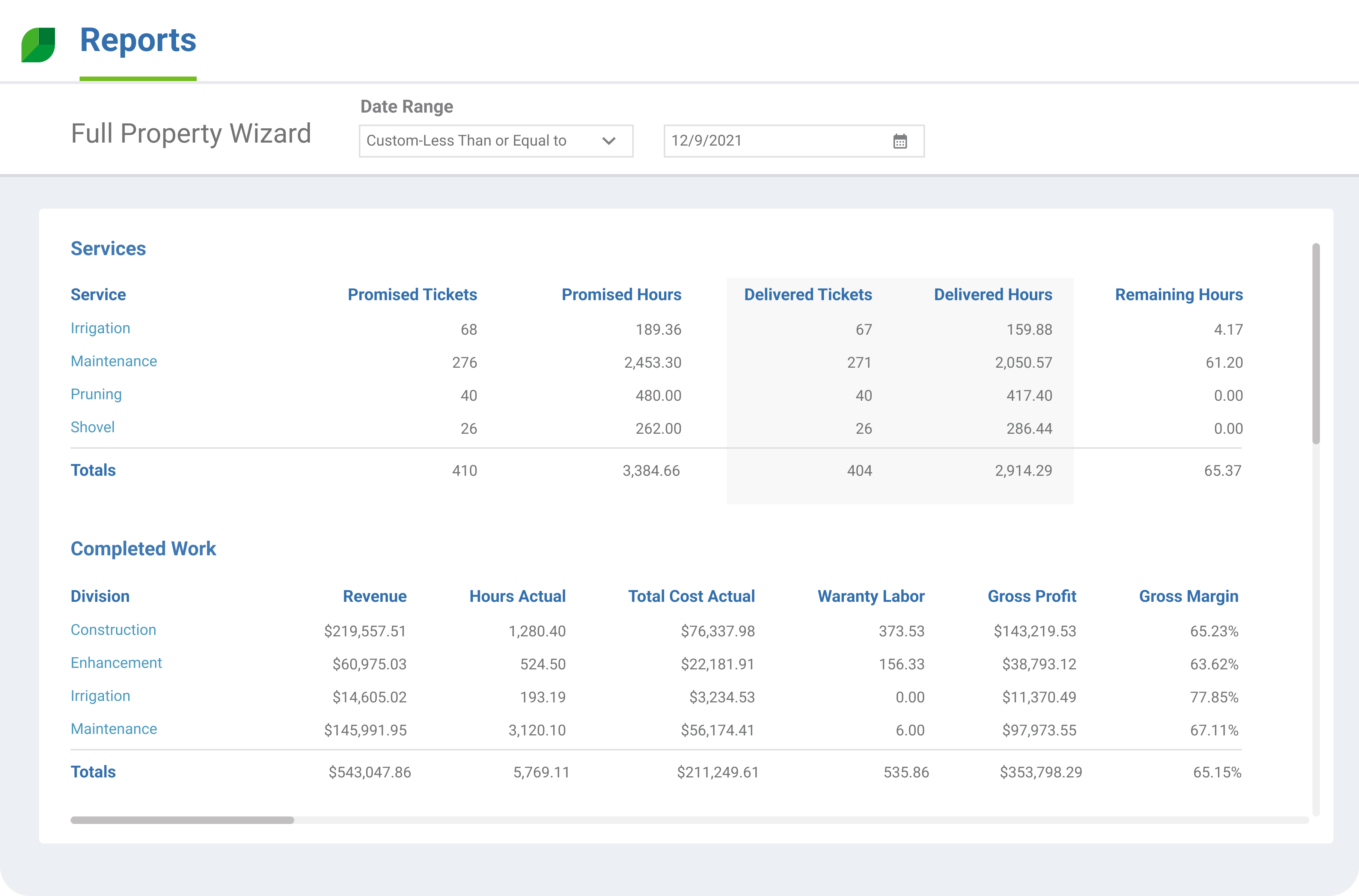
Centralized reporting: Aspire’s reporting feature gives you insight into your landscaping business.
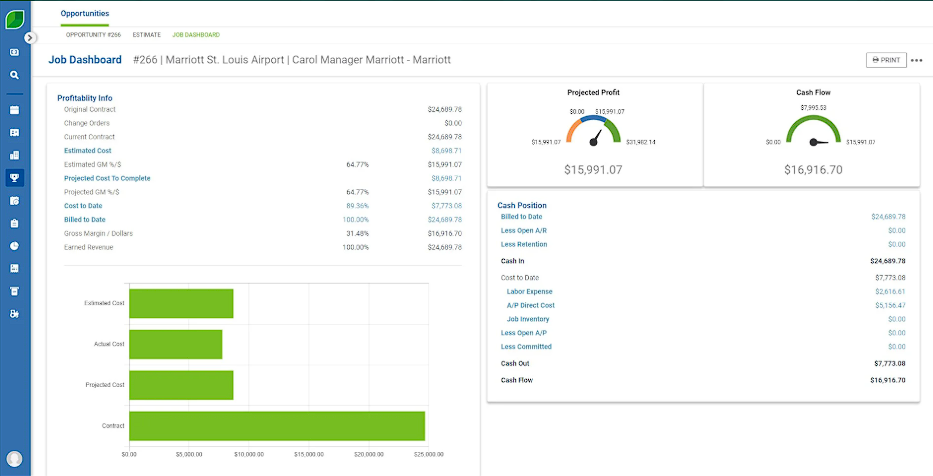
It provides dashboards that show revenue trends, payroll expenses over time, and project costs. This helps you make strategic decisions and adjust project pricing where necessary.
Here’s what Andrew Morse, head of recurring services at Belknap Landscape, had to say about Aspire:
“The first thing we noticed is how much more efficient we became.
“Because the company (Belknap) uses Aspire to manage every step of a job—contract generation, signing, pricing, tickets, invoicing—our processes became quick and consistent for every client.
“This allowed us to identify and remove redundancies while also improving accuracy in billing.
“One year in, and our billing cycle has been shortened from 2–4 weeks to a single week.”
Want a similar experience to the Belknap team?
Book a free demo with Aspire to get a detailed understanding of how it streamlines operations and ensures profitability.
Frequently Asked Questions (FAQs)
Q1. What should I do if my payroll-to-sales ratio is too high?
Find opportunities to reduce labor or overhead costs. Additionally, you can:
Switch from permanent to contract staffing.
Improve scheduling practices to avoid overbooking using a tool like Aspire.
Add high-margin offers to your service list.
Reevaluate your pricing to ensure the current structure covers labor costs.
Q2. Can I use my payroll-to-sales ratio to make pricing decisions?
Yes, you can use the payroll-to-sales ratio for pricing decisions. If labor accounts for the bulk of your expenses, it may be a sign to increase prices, offer additional services, or restructure service packages to ensure the job remains profitable.
Q3. What impact does employee turnover have on my payroll-to-sales ratio?
High turnover increases labor costs through frequent hiring, training, and onboarding. It also lowers productivity, which can push your payroll-to-sales ratio higher.













 866-727-7473
 Schedule Demo
 390 S Woods Mill Rd #300 Chesterfield, MO 63017


