
Table of Contents
Table of Contents
- What is a landscaping business exit plan?
- Why do landscaping contractors create business exit plans?
- What team will you need for a landscaping business exit plan?
- What to consider before planning your landscaping business exit plan
- Who to hand over to
- Exit timeline
- Business value
- Personal responsibilities
- Understand your ‘why’
- Staff transition plan
- Contingency plan
- What are the steps in planning a landscaping business exit?
- 1. Clarify and quantify your exit goals
- 2. Determine your business’s value
- 3. Get your records and finances in order
- 4. Assemble your exit team
- 5. Plan your post-exit life
- 6. Communicate the plan and make arrangements for transition
- 7. Execute the plan
There are many reasons why a landscaping business owner might want to sell their company. Maybe they want to spend more time with family, explore a new venture, move to a new country, or they’re simply ready to retire.
Regardless of the reason, they need an exit plan to guide the process. This exit document serves as a roadmap for selling or exiting your business.
As a landscaping contractor, creating a business exit plan ensures smooth transitions and protects your legacy.
In this guide, you’ll learn more about:
What a business exit plan is
Why it matters
Who needs to involve in the planning process
What to know before you begin
The key steps involved in creating a business exit plan
Disclaimer: Information provided in this article is for educational purposes only. It is not intended as legal or financial advice.
What is a landscaping business exit plan?
A landscaping business exit plan is a game plan for stepping away from the company on your terms. Think of it as a strategic blueprint for your organization’s future.
Whether you plan to sell the business, hand it over, or close down, an exit plan outlines the how, when, and what’s next.
A strong exit plan provides direction for you and the team. It helps you make the right moves when it’s time—financially, legally, and operationally—so nothing slips through the cracks during transition.
It should also cover how you’ll hand off responsibilities to team members and maintain client relationships, ensuring the business runs smoothly in your absence.
Why do landscaping contractors create business exit plans?
Landscaping contractors create exit plans to ensure their businesses are ready for a smooth, profitable transition when the time comes.
A solid exit strategy helps you avoid undervaluing the business and positions it as something potential buyers are queuing for.
Here are other reasons for creating exit plans:
Helps with business development: Knowing they intend to move on encourages landscaping business owners to examine the company’s strengths and weaknesses and make long-term growth plans. After all, no one will buy it from them unless its prospects are good.
Identify gaps before exit time: Having a plan helps you identify the business’s weaknesses early. For instance, you can see if a service line hasn’t been profitable, and you can decide whether to scrap or improve it.
Prepare for negotiations and offers: Selling your landscaping business likely means you’ll have multiple negotiations. Adequate planning helps you thoroughly assess the business’s value, understand market valuation, examine your goals, and determine the fair price for your business.
Safeguard your personal interest: Selling your landscaping company is a huge decision. You want to secure future finances, protect your team, address tax issues, and safeguard your legacy. As such, you need a watertight exit strategy that aligns with your objectives, not a spur-of-the-moment decision riddled with loopholes.
What team will you need for a landscaping business exit plan?
Creating an exit plan isn’t a solo ride. It’s a conversation that should begin with your spouse or business partner, to get everyone on the same page.
Following that, you’ll need these professionals in your corner for a strong exit plan:
Attorney with business or contract law experience to look after your interests. They will handle legal documentation, prepare contracts, and ensure your business meets regulatory requirements for a handoff.
Broker/M&A advisor to value your business, find and screen qualified buyers, and negotiate the best deal.
Accountant or financial advisor to guide you through tax implications and help structure the handoff for your maximum financial benefit. They can also forecast proceeds and help with a working financial plan post-exit.
HR advisor or succession planner to develop transition plans, identify and prepare a successor, and help with talent retention and effective leadership continuity.
Family business consultant to navigate succession and minimize conflicts within the family.
What to consider before planning your landscaping business exit plan
Whether you're planning to leave your landscaping business soon or years from now, it's essential to lay the groundwork early.
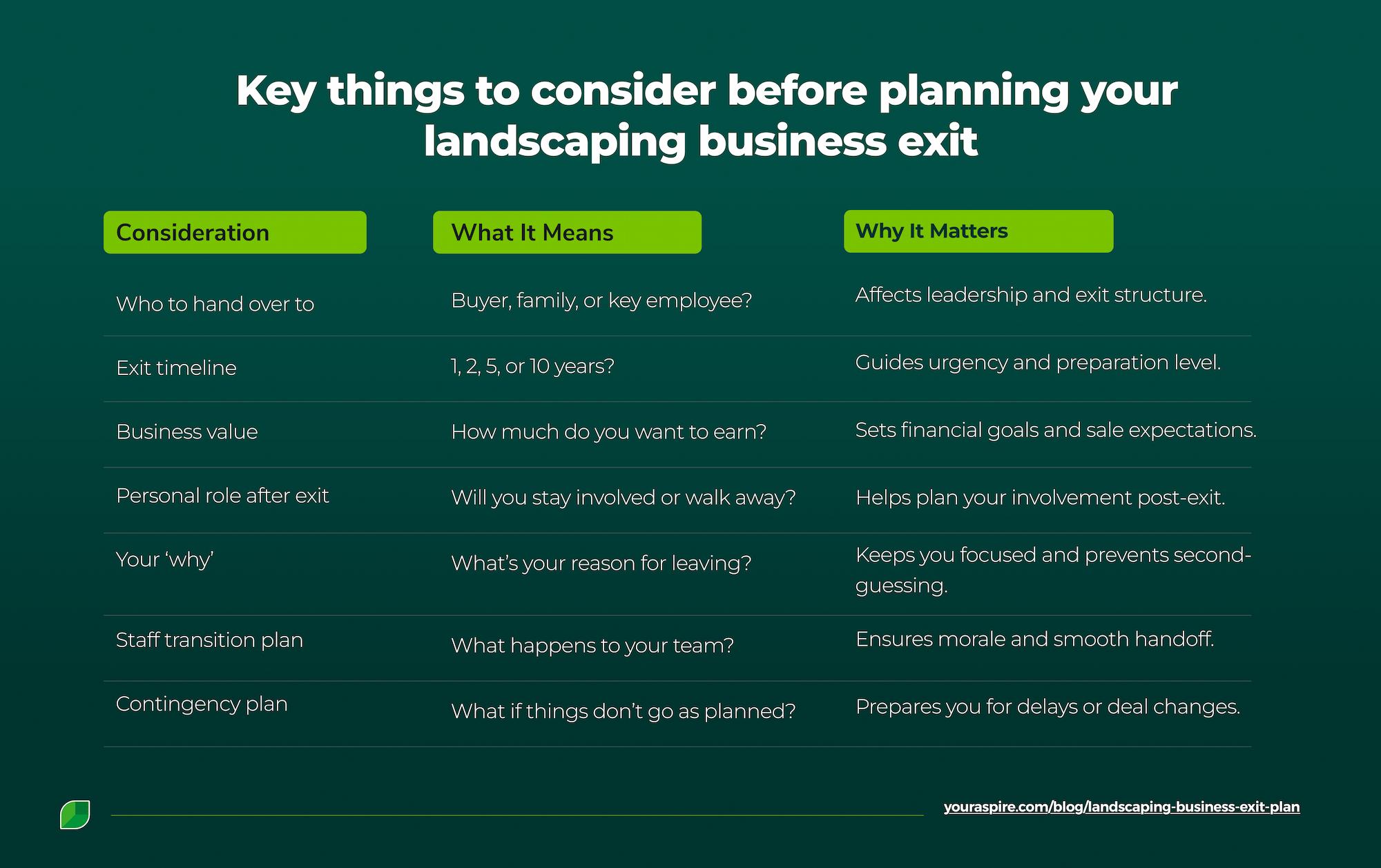
But before you begin that exit process, here’s what you need to keep in mind:
Who to hand over to
Define who you’re giving the reins of the landscaping business to. Will it be a third-party buyer, a family member, or one of your top leaders?
Exit timeline
Put a time frame on when you’d like to leave or sell the business. This helps you define what needs to be done and how urgently it needs to be done.
Want to leave in one, two, five, or 10 years?
Exiting in 10 years gives you more time to maximize the business’s value and make it more attractive to buyers or investors than if you left in two years.
Business value
Think hard about the financial value you aim to get from your landscaping business.
If it’s an outright sale, how much are you considering?
If you’re stepping away for family or someone else, how much income do you consider sufficient?
Having a number helps you evaluate the business’s current value, so you know how much effort is required to meet your financial goals.
Personal responsibilities
What will you do after the exit? If it’s a family or internal transfer, will you stay on to help, be a consultant, or remain in the background?
And if it’s a sale, will you keep working for a while? If so, for how long?
Understand your ‘why’
You need to be clear about why you want to sell. It’s important to know so you stay focused and don’t second-guess yourself. If possible, get a clear picture of what you want to do next before exiting.
Staff transition plan
Think about what happens to the team when you exit.
Will you want employees to stay under the new leadership? Will they be receiving equity or bonuses?
You need to provide staff with support to ease anxiety and preserve morale.
Contingency plan
What if your exit timeline doesn’t go as planned? What if a deal falls through? You need to consider your next moves in case any kind of nightmare scenario arises, to reduce pressure and give yourself options.
What are the steps in planning a landscaping business exit?
Ready to start planning your business exit? Here’s what you need to do in collaboration with the exit planning team described above:
Clarify and quantify your exit goals
Determine your business’s value
Get your records and finances in order
Assemble your exit team
Plan your post-exit life
Communicate the exit plan and make arrangements for transition
Execute the plan
1. Clarify and quantify your exit goals
An exit plan is a huge decision that requires time and attention.
Consider your preferred outcome: third-party sale, transfer to family, or close and liquidate?
Next, examine why you want to leave the business. Do you want to start a new venture? Is there a plan in place for that? Perhaps it’s to build another house? Travel the globe? Or is it burnout?
Clarify your goals and quantify them by:
Setting a realistic schedule for the exit.
Specifying the expected sale price or profits if it’s a business transfer.
It’s crucial to be very clear about your goals, as they shape the direction of your plan.
2. Determine your business’s value
Get a professional valuation of your business and match it against industry benchmarks. What assets—equipment, land, property—does the company own? Do you know the costs of goods sold? Assess existing client contracts and goodwill, too.
The point is to go over what you have, to set expectations for a third-party sale or internal buyout.
Plus, knowing your business’s current value gives you a benchmark to improve upon, if possible, by making it a company that strategic buyers would be willing to pay the highest price for.
3. Get your records and finances in order
If you’re going to sell your landscaping business, everything must be in order. From payroll to contracts, tax records, warranties, and total revenue generated annually. Potential buyers will need to see your books before deciding to invest.
If you’ve never taken it seriously, this is your sign to start now, and not delay the process. Everything should be on record: equipment inventory, commercial contracts, vendor relationships, and more. And if you can, ensure profitability is shown consistently.
Don’t know how to do that?
Use Aspire as your landscaping management software to streamline operations and have records in a centralized location.

Aspire handles it all, from measurement and estimation to bidding, payment, project scheduling, crew assignments and tracking, equipment management, customer relationships, job costing, purchasing, accounting, and reporting.
This allows you to see how the business is performing at any time and pull accurate, updated records to prove that the company is viable.
4. Assemble your exit team
It’s time to call on your exit strategy team: the broker, financial advisor, attorney, estate planner, wealth manager, and succession planner.
Contact them early on, preferably after defining your goals and putting together the necessary documentation, to help you avoid costly mistakes.
For instance, attorneys will want to understand why, how, and when you intend to sell the landscaping business to provide accurate legal advice that can help you.
5. Plan your post-exit life
Think about what you will do once the deal goes through. Will you stay on post-sale to help the new owners learn the ropes? Will you be available to answer questions or act as a consultant?
Ron Edmonds, principal consultant with the Principium Group, says, “A business will likely be more valuable if the owner is willing to stay in a leadership position for three to five years.”
6. Communicate the plan and make arrangements for transition
Creating an exit strategy is a team effort. You must let key staff (e.g., operations manager or longest-serving crew leader) in on your plans early on. Sure, those plans might not be executed immediately, but it’s best that staff know since the transition will likely affect them.
You also need to prepare for the transition, whether selling or transferring. Who will lead operations after you leave? Will the staff stay on and get bonuses or ownership?
This helps keep the business running smoothly during and after the transition.
7. Execute the plan
When you feel it’s time to exit based on your goals, do a pre-due diligence checklist to gauge your readiness. If you’re indeed ready, prepare the transfer agreement and closure documents in collaboration with your advisors.
But if not, you should create a profit improvement plan to increase the business value.
Partner with the legal team to ensure everything is in order at each phase, so that tax issues are addressed, the deal is secure, and your interest is protected.
If you decide to stay on to help, you’ll need a landscaping management tool like Aspire to keep track of projects and stay organized. Aspire will let you streamline your workflow and monitor every aspect of the business.
Instead of shuffling between multiple management apps or manually monitoring the team’s performance, you get to handle administrative tasks, oversee crews, handle finance, maintain client relationships, and stay updated with everything that goes on.
Book a demo to see how Aspire works and helps manage operations.







 866-727-7473
 Schedule Demo
 390 S Woods Mill Rd #300 Chesterfield, MO 63017


