
Table of Contents
Table of Contents
- What is eco-friendly landscaping?
- Why choose sustainable landscaping for your business?
- What are the main principles and practices of sustainable landscaping?
- What are the latest trends in eco-friendly landscaping?
- 1. Bioswales
- 2. Pollinator gardens
- 3. Smart irrigation
- 4. Carbon-neutral landscaping
- 5. Xeriscaping
- What are notable technological and methodological landscaping strategies?
- 1. Eco-conscious materials
- 2. Low-emission tools and practices
- 3. Water management systems
- 4. Plant selection methods
- 5. Soil enhancement methods
- What are the most profitable eco-friendly landscaping services?
- How do you market a green landscaping business?
- 1. Green certifications
- 2. Branding
- 3. Online marketing
- 4. Educational outreach
- 5. Networking
- What are common challenges in sustainable landscaping businesses?
- How landscape business software like Aspire supports sustainable growth
- Reduce paper waste
- Optimize resource use
- Improve long-term sustainability planning
- Over to you!
As competition intensifies for landscapers, eco-friendly landscaping services can help set your business apart and boost your profit margins.
Sustainable landscaping attracts environmentally conscious clients willing to pay premium rates for services aligned with their values.
From solar-powered lighting to organic fertilizers and permaculture, there are many ways to get started with eco-friendly landscaping.
This guide covers everything you need to know about building an eco-friendly landscaping practice, including:
What eco-friendly landscaping is and why it’s profitable
High-margin sustainable services and implementation strategies
How to market a green business and upsell existing clients
Some common pitfalls to avoid during the transition
But first, the fundamentals: what makes landscaping truly eco-friendly?
What is eco-friendly landscaping?
Eco-friendly landscaping involves using sustainable practices and materials to reduce your environmental impact. It often includes:
Integrated pest management to reduce pesticide use
Zero-emission tools such as electric lawnmowers
Organic fertilizers and biodegradable mulches
Stormwater management and rainwater harvesting
Some green spaces have a hidden environmental cost when they rely on heavy pesticide and fertilizer use or when they use non-native plants that require a lot of upkeep.
Eco-friendly landscaping not only reduces toxic chemicals and carbon emissions but can also create a better habitat for pollinating insects and local wildlife.
Why choose sustainable landscaping for your business?
Eco-friendly landscaping requires an upfront investment in new equipment, but it pays off in the long run.
For example, in just an hour, a gasoline lawn mower can generate as much pollution as a new car driven for 45 miles, while electric mowers never cost you (or the environment) gas.
Below are a few other reasons to choose sustainable landscaping:
Reputational advantages: Sustainability is becoming a priority for many commercial clients and municipalities, so sustainable practices let you build your brand identity around a lucrative niche.
Upsell opportunities: Solar-powered lighting installation, integrated pest management, and other solutions offer unique opportunities to upsell to existing clients.
Higher profit margins: Eco-friendly services attract premium clients willing to pay extra for environmentally friendly alternatives.
Employee retention: Employees are more motivated when their work has a purpose aligned with their values.
Opportunities to specialize: Sustainable practices open doors to services like rainwater harvesting, pollinator gardens, and LEED-certified project work.
To start seeing these benefits, you’ll need to understand some basic principles of sustainable landscaping.
What are the main principles and practices of sustainable landscaping?
Sustainable landscaping involves using core ecological principles to work with ecosystems rather than against them:
Water conservation: Strategies to reduce the amount of water a landscape needs, reuse water where possible, and protect water from becoming contaminated.
Using native plants: Plants naturally occurring in the region don’t need fertilizers or pesticides and provide food and habitats for local pollinators, birds, and insects.
Protecting soil health: Reducing harsh chemical fertilizers and planting strategically to enrich the soil.
Integrated pest management: Planting strategically to leverage natural predator-prey relationships and chemical deterrents that reduce the need for pesticides.
Waste minimization: Using waste from one area to benefit another—for example, grass clippings and leaves on site can be added back to the soil for extra nutrients.
The most successful landscapers blend these foundational principles with the latest trends in eco-friendly landscaping.
What are the latest trends in eco-friendly landscaping?
Eco-friendly landscaping is constantly evolving, so keeping up with the latest trends requires close attention to market shifts. A few of the top trends in 2025 are:
Bioswales
Pollinator gardens
Smart irrigation
Carbon-neutral landscaping
Xeriscaping
Here’s a detailed breakdown of each one:
1. Bioswales
Bioswales are channels designed to catch and filter stormwater runoff.
They’re often found in parking lots and along municipal curbs, and feature hardy plants that filter out pollutants and a drainage pipe underneath to collect and divert excess stormwater.
They’re becoming increasingly important as rainfall gets heavier and housing density increases, but their benefits go beyond water management.
They can also double as ornamental landscape features and provide habitats for wildlife and insects.
2. Pollinator gardens
Pollinator gardens are becoming increasingly popular at a time of rising concern about dwindling bee populations. Unlike traditional gardens, they’re specifically designed to attract pollinators like bees, hummingbirds, and butterflies, with native plant species.
They also include a variety of plants that bloom from spring to fall, with layers of trees, shrubs, and flowers. Instead of pesticides, they include plants that caterpillars will eat and place them out of the way of other plants.
3. Smart irrigation
Smart irrigation systems use smart controllers and sensors to adapt watering to weather conditions and soil-moisture levels. They often connect to smartphones for real-time visibility into water usage and system performance.
That way, irrigation systems don’t accidentally operate after rainfall and so waste water. The result is 8,800 gallons of annual water savings for households—and energy savings from reduced water pumping and distribution.
4. Carbon-neutral landscaping
Carbon-neutral landscaping aims to design and maintain landscapes with a net-zero carbon impact. That includes carbon from all landscape construction and maintenance aspects, from equipment emissions to material and fertilizer production.
Professional landscape architects are developing solutions like Pathfinder to calculate the carbon footprint of projects.
But since it’s such a complex calculation, most contractors are settling for carbon-conscious practices such as choosing local materials and using low-emission equipment.
5. Xeriscaping
Xeriscaping is a type of landscaping that uses drought-tolerant plants to reduce (or even eliminate) the need for irrigation and maintenance. It’s a common strategy for commercial properties, since the reduced water use can help buildings achieve LEED certification.
It’s also a possible alternative to turfgrass lawns, although it’s less popular with homeowners (many HOAs still require some grass on lawns). However, water shortages have caused some homeowners to warm up to xeriscaped yards.
If you’re new to sustainable landscaping, it might not be possible to adopt the latest trends all at once—but there are some important building blocks you can start with.
What are notable technological and methodological landscaping strategies?
The tools and methods below represent some of the first steps you can take toward upholding the principles of eco-friendly landscaping.
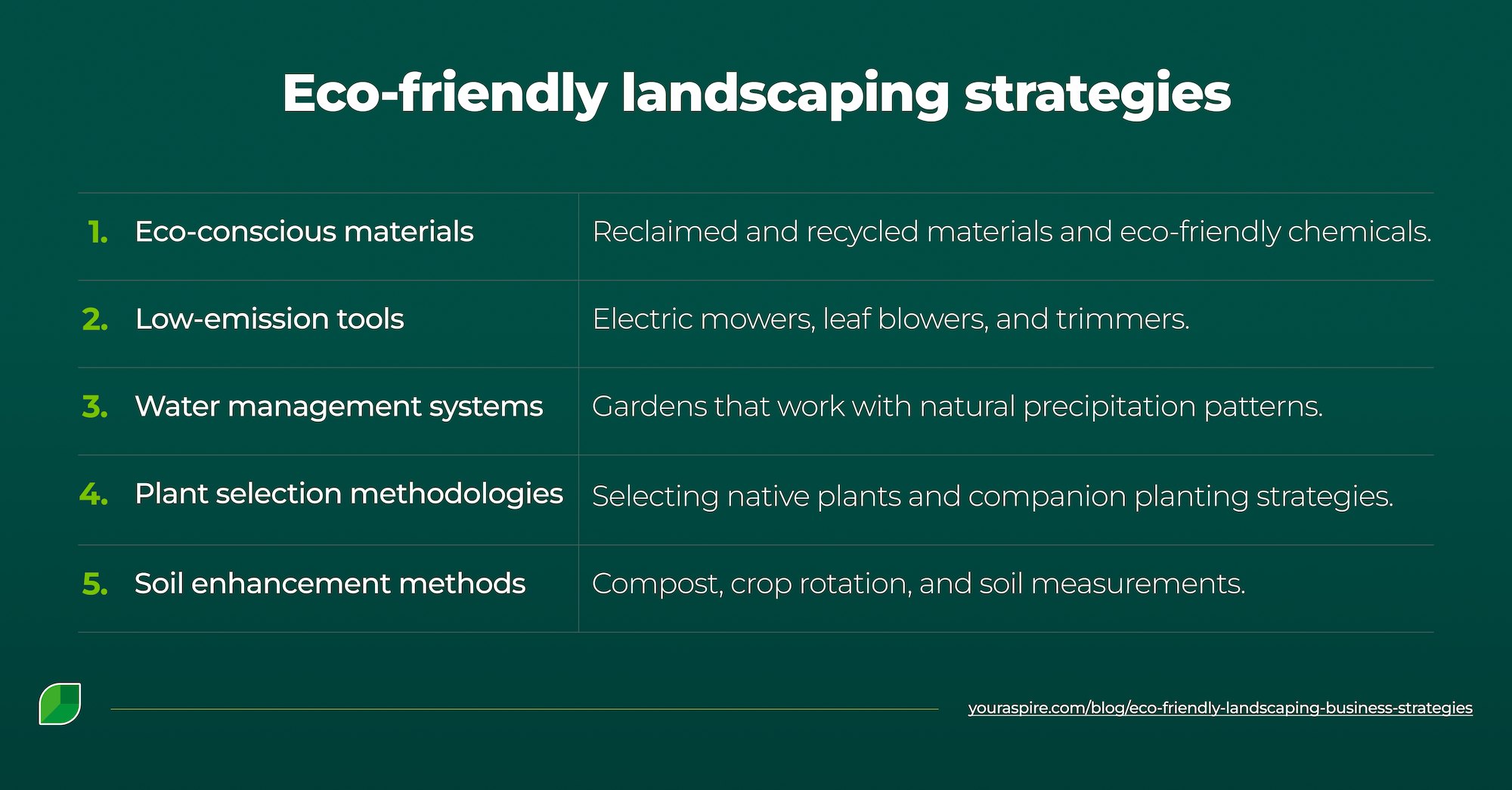
Here’s how to get started with each approach, including some specific tools and techniques you can use right away.
1. Eco-conscious materials
In some cases, eco-conscious materials can be cheaper than the materials you might normally buy. They include things like:
Recycled concrete pavers (cheaper than new)
Reclaimed wood for borders and walkways
Organic mulch from local tree services (often free)
Composite decking made from recycled plastic and wood fibers
Eco-conscious fertilizer and pest control options are also essential to sustainable landscaping.
2. Low-emission tools and practices
Battery-powered mowers, electric leaf blowers, and electric hedge trimmers can drastically reduce the emissions you produce.
Offering solar-powered lighting and drip irrigation systems can also help customers save on electricity and water over the long term.
3. Water management systems
Gardens that work with natural precipitation patterns can capture and reuse stormwater runoff, using methods such as:
Rain barrels for rainwater harvesting
Drip irrigation kits to water root systems directly
Permeable pavers for driveways and patios
French drains to redirect water
Decorative features like ponds can also double as irrigation reservoirs, reduce heat island effects, and provide a habitat for birds, frogs, and beneficial insects.
4. Plant selection methods
To find native plants in your area, you can use native plant databases and pollinator plant lists from local conservation groups.
Companion planting strategies—such as growing basil near tomatoes—can create mutually beneficial relationships between plants that reduce pests, improve soil health, and increase growth.
5. Soil enhancement methods
Soil enhancement doesn’t need to be high-tech. For example, compost and organic matter, when added to soil, feed microorganisms, while cover crops add nutrients to soil without chemical fertilizers.
However, soil test kits and moisture meters can give you better insight into what’s working. Hydrogel soil amendments are another simple and popular solution for increasing water retention in dry or sandy soil.
Most of the above can be sourced locally or online without significant equipment investments. As your familiarity with them grows, you can incorporate more of these techniques.
What are the most profitable eco-friendly landscaping services?
Starting with some of the most profitable services can help you break into eco-friendly landscaping in a financially sustainable way.
The following services are all gaining in popularity—making them more profitable and competitive:
Smart irrigation: The smart irrigation market is expected to grow at a CAGR of 14.8% until 2033 as more homeowners opt for convenience and reduced water consumption.
Rain gardens: Like bioswales, rain gardens are explicitly built to catch rainwater runoff from patios and driveways and filter it naturally—and they are surging in popularity.
Xeriscaping: Although some gravel-and-cactus experiments have faced criticism, more homeowners are embracing this alternative to maintaining a thirsty lawn.
Native plant design: The growing pollinator garden trend has increased demand for native species that support local wildlife. Many municipalities now offer rebates for native plant installation.
Organic lawn care: Organic fertilizer may cost more, but eco-conscious consumers are often willing to pay a premium for a healthier lawn over the long term.
Once you decide on a few new services and purchase tools and supplies, you need to advertise them to clients.
How do you market a green landscaping business?
Even if you’re familiar with standard marketing tactics, there are unique ways to grow your green landscaping business.
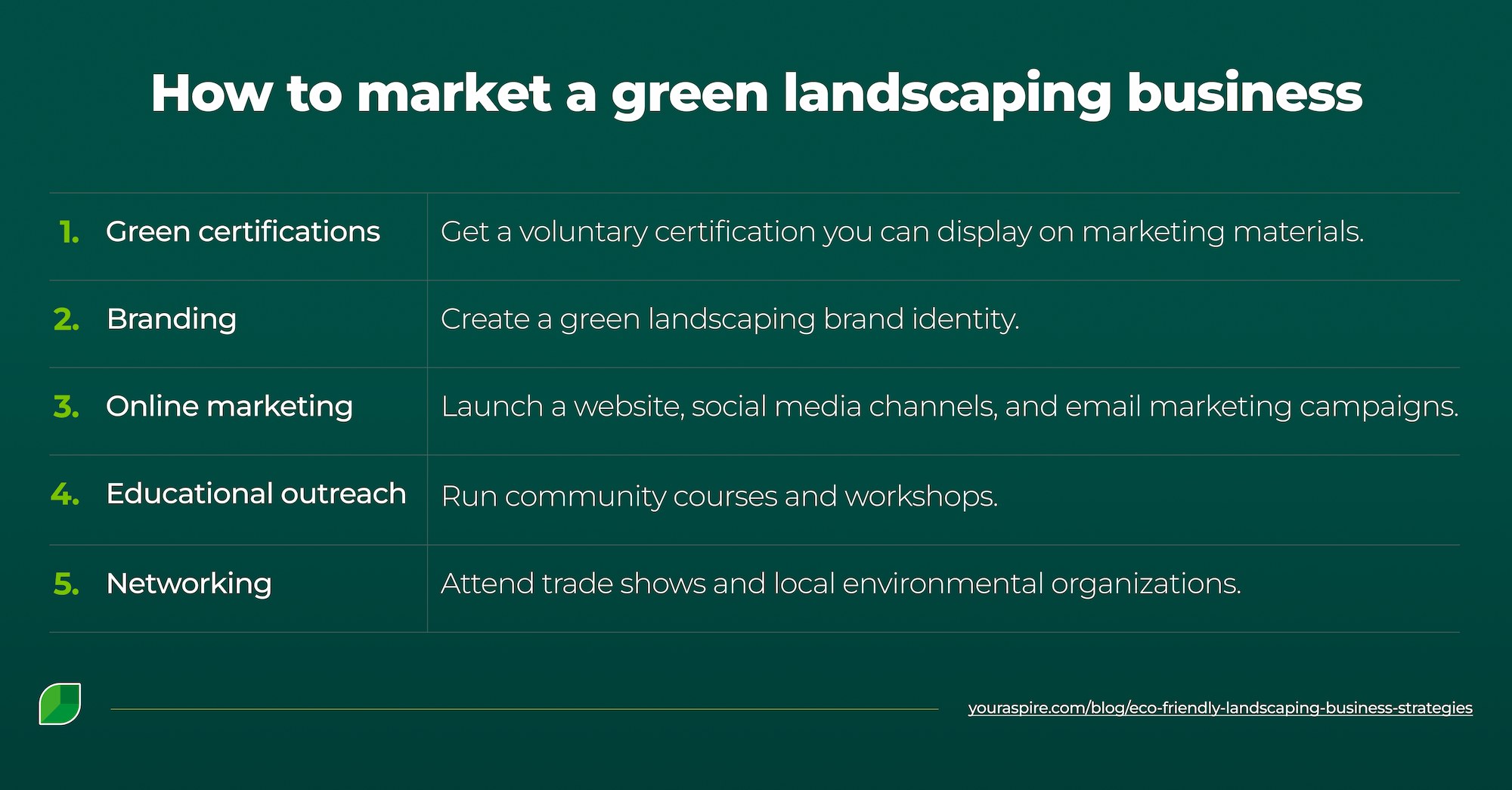
These strategies can be used whether you’re starting from scratch or repositioning your existing business as a green landscaping business.
1. Green certifications
Although there’s no federal designation for eco-friendly landscapers, you can get voluntary certifications through organizations like NALP and ecoPRO. These certifications create proof of your credibility to potential clients.
You’ll need to take a course and then receive your certification. When you do, you can display it on your website and other marketing materials.
2. Branding
Next, you’ll need to create a brand identity for your business that clearly communicates your eco-friendly positioning. This will drive consistency and build trust across all the ways you present yourself to customers:
Business name and logo
Color scheme and visual identity
Company voice
If you already have a landscaping business, consider whether you want to stick with your current brand or rebrand to reflect your new commitment to sustainability.
3. Online marketing
Any landscaping business must have an SEO-optimized website and social media business pages. Paid ads may get attention, but having an online presence to back them up is what will sustain that attention.
Online marketing can also include email newsletters with seasonal tips and special offers to keep loyal customers engaged. Green landscaping businesses have a unique opportunity to share environmentally friendly strategies that can attract more attention online.
4. Educational outreach
Consider offering a course or workshop on green landscaping techniques at your local community center. You can give people DIY tips for eco-friendly garden and lawn care, while also educating them on what’s possible with the help of a professional.
This can help grow your network of warm leads naturally by attracting homeowners already interested in eco-friendly practices.
5. Networking
You may already be growing your network through business associations and trade shows, but local environmental and sustainability organizations can give eco-friendly landscapers an extra boost.
Donate your services to community garden projects or other nonprofit initiatives to showcase what you can do. Get before-and-after pics for your marketing materials so you can use your nonprofit work to attract new clients.
What are common challenges in sustainable landscaping businesses?
Once clients start coming in, you may find that green landscaping presents unique challenges that standard landscaping doesn’t.
Here are some of the most common hurdles and ways to overcome them:
Higher upfront costs: Organic materials can be pricier, so adjust the price of your services to maintain a healthy profit margin.
Client education: Educating clients on the benefits of green landscaping can help win over skeptical leads.
Sourcing eco-friendly materials: Develop relationships with suppliers to source hard-to-find eco-friendly materials.
Unconventional results: Inform clients that organic methods may take longer and appear ‘messier’ than traditional approaches, helping to manage expectations before you begin.
Weather dependency: Sustainable practices can be more sensitive to weather, so careful scheduling is key.
Meeting these challenges is much easier when you have the right systems to manage your core business processes.
How landscape business software like Aspire supports sustainable growth
When you’re focused on delivering eco-friendly landscaping to clients, it can be easy to overlook the sustainability of your office processes. Landscape business management software like Aspire supports eco-friendly operations by streamlining workflows and reducing paper use.
But beyond just saving paper, Aspire can also enhance your profitability by making eco-conscious practices easier to implement and scale:
Reduce paper waste
Aspire’s estimating software lets you create digital proposals and estimates without a single sheet of paper. From there, you can also use Aspire to:
Create and manage schedules
Track crew performance and customer feedback
Send digital invoices
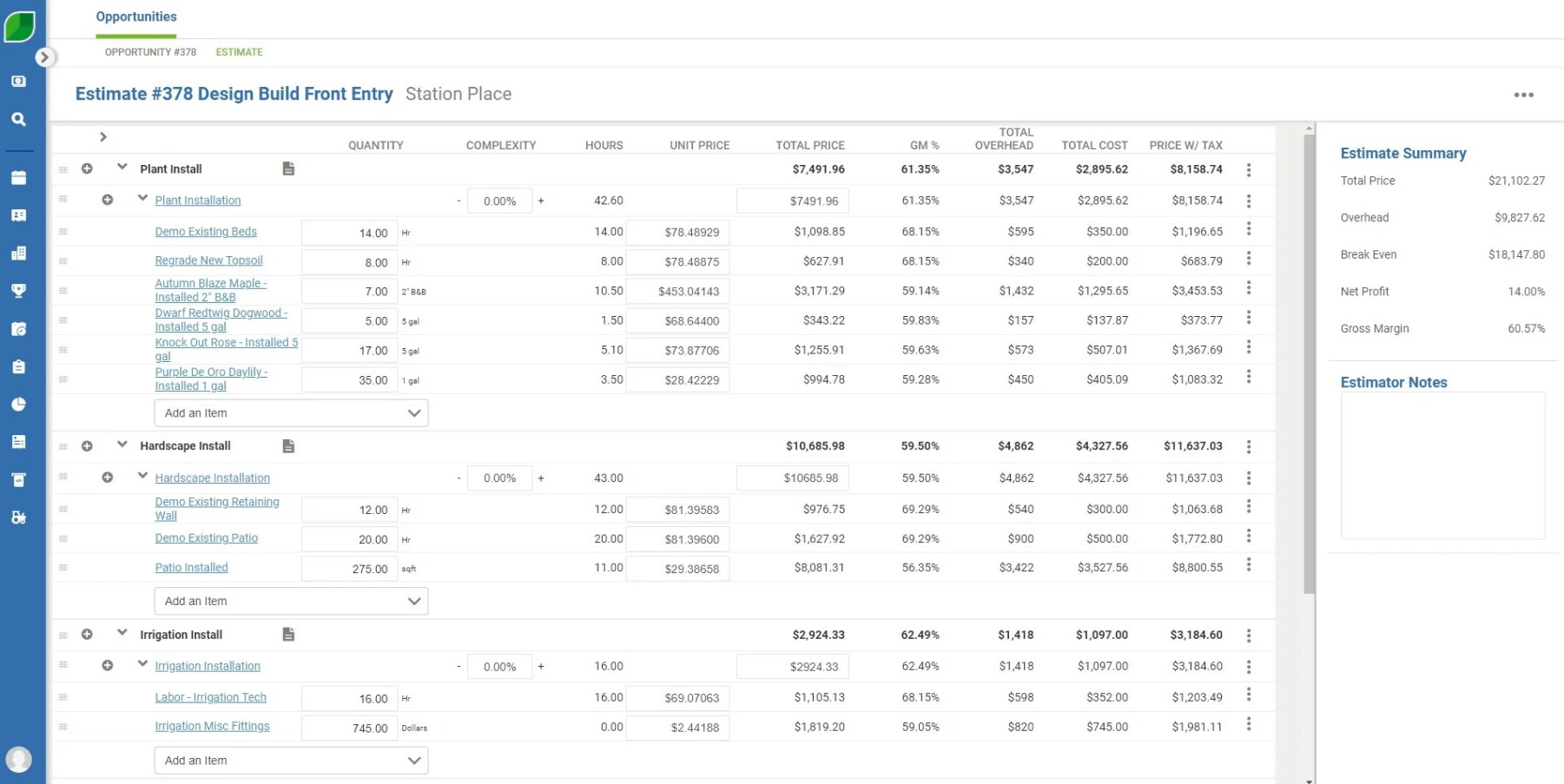
When clients see you’re committed to going paperless, they’ll know you’re genuinely dedicated to sustainability as a value rather than a business opportunity.
Optimize resource use
Aspire’s job costing features let you accurately predict the materials and supplies you need to reduce wasted materials.
You can use routing features to ensure drivers take the most efficient route to the job site and lower fuel consumption.
Finally, Aspire’s drag-and-drop scheduling lets you easily adjust when jobs are weather-sensitive, avoiding unnecessary trips.
Improve long-term sustainability planning
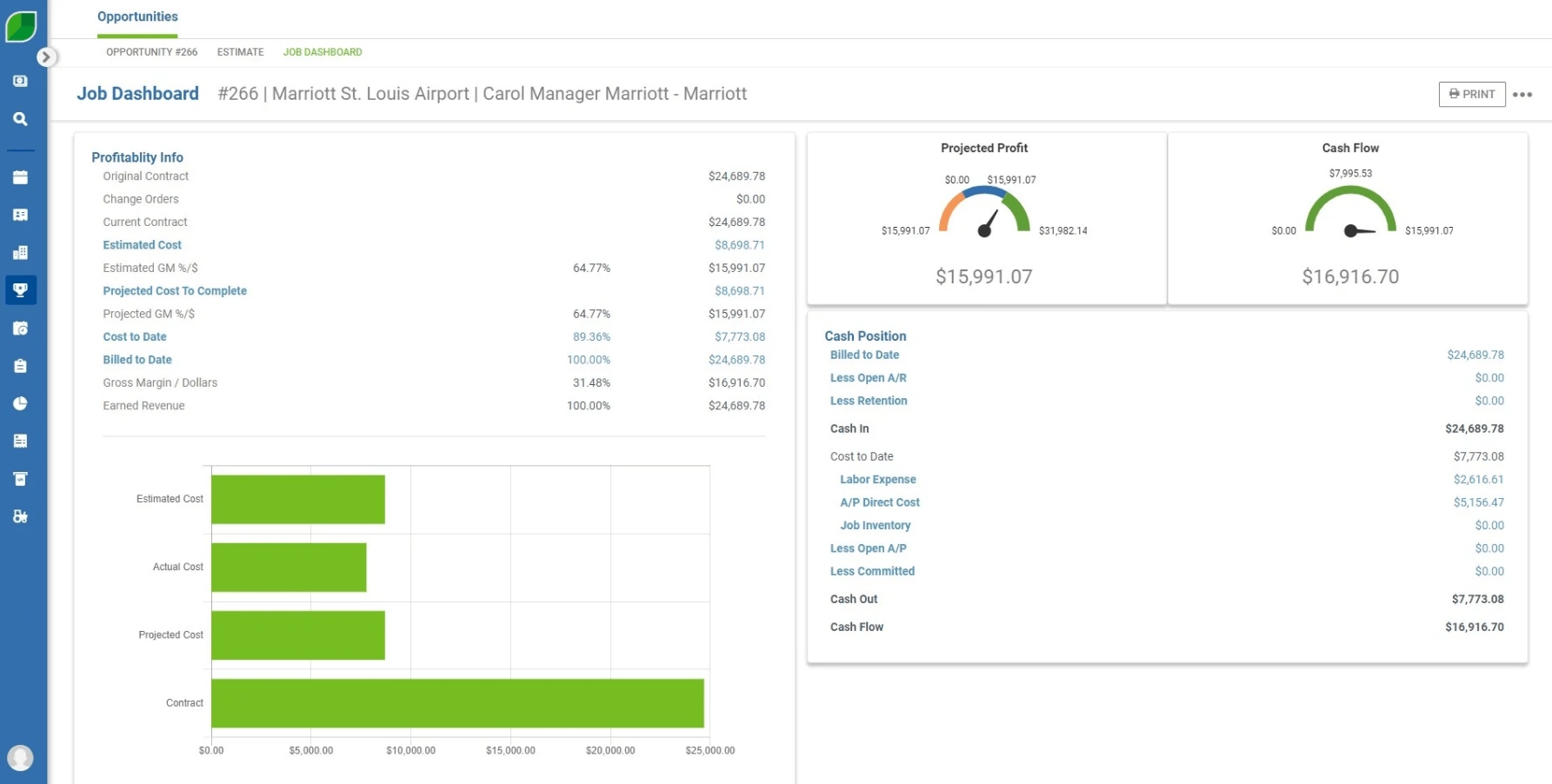
With all your business information at your fingertips, Aspire’s reporting features give you the insights you need for long-term sustainability planning.
You’ll be able to see your anticipated income and understand exactly which jobs were most profitable to support the long-term growth of your green landscaping business.
Over to you!
Eco-friendly landscaping is an exciting niche with unique opportunities to deliver services that truly benefit local ecosystems.
Pollinator gardens and smart irrigation systems aren’t just trends—they’re essential ways of considering the environmental potential of every green space.
Green landscaping can be challenging, but the right processes can make all the difference. With Aspire’s landscaping business software, you can streamline estimates, scheduling, invoicing, and much more for service that’s as efficient as it is eco-friendly.
Ready to see Aspire in action? Book a free demo today to get started.









 866-727-7473
 Schedule Demo
 390 S Woods Mill Rd #300 Chesterfield, MO 63017


